Main ceremony at WMO headquarters, Salle Obasi, 15:00 CET.
WMO invites diplomatic representatives, staff, partners, United Nations agencies, students and other guests to join the official ceremony. It will be livestreamed in six UN official languages to allow maximum engagement with WMO Members and the staff of National Meteorological and Hydrological Services.
Moderator: Nandita Surendran, Chief of WMO Global Communications Observing Today
Makoto Suwa, Astronaut, Japanese Aerospace Exploration Agency [video message]
Keynote presentation from Professor Celeste Saulo, Secretary-General, WMO
Abdulla Al Mandous, President, WMO [video message] Argentine observing station Esperanza, Antarctica, on the importance of observations in remote Polar regions [live video link up] Alexia Barrier, round-the-world ocean racer and advocate; Martin Kramp, OceanOPS Technical Coordinator, WMO [live video link up] Launch of WMO State of the Global Climate 2025 report
Video message from UN Secretary-General António Guterres Setting the scene by Claire Ransom, Associate Scientific Officer, WMO Presentation of key findings by Celeste Saulo, Secretary-General, WMO Protecting Tomorrow
Theo Wellington, Youth Coordinator, WMO Video from Regional Youth focal points, WMO Questions and statements from the floor
17:00 - Reception hosted by WMO Staff Association
EXHIBITS: Observing the Future. An interactive exhibition led by the WMO Youth team.
Station displays: Visuals highlighting the work of observation stations from different countries. Station connections: QR codes enable short, pre-recorded video exchanges. Station ambassadors: On-site ambassadors facilitate engagement and discussion.
Pakistan: Agrometeorology without borders: Dr. Adnan Arshad, from Pakistan, with his PhD student Eltayyab al Hasaan, from Sudan, researching grassland restoration and improving production by using advanced meteorology equipment to train youth to help us observe today and protect tomorrow.
Concerning car traffic and circulation: There is a lot of traffic with smoke from cars in Cantt (Lahore, Pakistan). It's a problem that affects school timings and people's health.
Our research applies a "Rain to Drain" approach, following rainfall from the moment it lands through each stage of the drainage process. This requires a network of hyperlocal weather stations to capture rainfall data at the street scale, soil moisture probes placed through the depth of the rain gardens to record infiltration and storage behaviour, and flow monitors in the sewer network to detect surcharge events. Access to this data is not limited to researchers. Along Broadway, lecterns and posters give residents and visitors a way to see results for themselves. Co-designed with Western Primary School, they make SuDS visible in the street rather than hidden infrastructure. The posters are also interactive, providing both access to live data and opportunities for residents to contribute observations through PuddleWatch, a tool that records when and where water appears. Dr. Adnan Arshad and his team, in collaboration with PODA-Pakistan and the Pakistan Meteorological Department, are building the technical capacity of rural youth engaged in agriculture. The initiative involves installing mobile automatic weather stations at multiple locations to collect site-specific data and provide real-time updates. This enables young farmers to make informed decisions for planning their field operations and management practices - especially critical in the rainfed region of Punjab, Pakistan, where rainfall is the sole source of water for agriculture.
United Kingdom: This image shows How the Water Flows, a collaborative mural created as part of the Water Data for People project and now on display at Wybers Wood School in Grimsby. Designed around the school’s SuDS planter, the mural animates this everyday feature, using it as a focal point to bring together ideas about weather, water, and the local environment. It emerged through a series of workshops and creative sessions involving pupils, researchers, teachers, and artist Emma Garness, who worked together to explore local hydrology, drainage, and environmental change. Led by the University of Hull, Water Data for People uses creative methods to help communities engage with local hydrological data and consider how it can shape future places and decisions. The project builds on the DIG Surface Water Resilience Project, a partnership between North East Lincolnshire Council, City of Doncaster Council, Anglian Water, and Yorkshire Water. Both projects are funded by Defra through the £200 million Flood and Coastal Innovation Programmes, managed by the Environment Agency. Reflecting the ideas and experiences of the pupils, the mural shows how knowledge of rainfall, flooding, water use, and environmental processes connects directly to everyday life and to the spaces around the school. Guided by Garness’s distinctive approach to environmental themes and community identity, these insights were brought together in a vibrant piece of visual storytelling.
SPAIN: Understanding the weather, the CLIMATE and ACTING on it. - Students from the Antonio Machado Primary School are making a meteorological observation at the weather station developed as part of an educational project that received an award on the European Union's Climate Education Day in October 2025.
KENYA:Analysis of Mesoscale Convective Systems (MCS) and Urban Flash Flood Vulnerability: A Case Study of the March 2026 Nairobi Precipitation Event. A multi-spectral satellite RGB composite image showing significant convective activity over the Kenyan highlands and the central Rift Valley. Convective Intensity: The bright, textured blue and white bubbles scattered across the centre of the map represent cumulonimbus clouds - the primary drivers of heavy localized rainfall. Nairobi Impact: Nairobi is situated in the central region currently obscured by dense cloud cover. The presence of these deep convective cells suggests high potential for intense, short-duration downpours. In an urban environment like Nairobi, this type of concentrated rainfall often leads to rapid flash flooding due to saturated soils and strained drainage infrastructure. Moisture Influx: The brownish-orange background indicates the warmer land surface, while the varying shades of blue/cyan highlight moisture-rich air masses moving across the region, creating the "perfect storm" for the flooding events seen in early March 2026.
On this World Meteorological Day, we are reminded that foresight saves lives.
Climate chaos is rewriting the rules of weather, with record heat, longer droughts,
rising seas and ever more frequent and extreme disasters. Accurate, trusted science
is our first line of defence.
The World Meteorological Organization and national services help keep us safe by
weaving a global web of data, from land, sea, air and space – turning
measurements into forecasts, and forecasts into early warnings. Yet the global
observing system is under strain, with critical gaps, especially in least developed
countries and small island developing States.
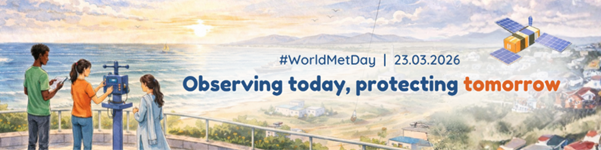
This year’s theme, Observing Today, Protecting Tomorrow, is a call to action.
Governments, development banks and the private sector must scale up support for
our global observing backbone, from surface stations to satellites, and ensure data
is shared openly and equitably. And we must accelerate Early Warnings for All so
that, by 2027, every person is protected by life-saving alerts. Investing in
observation pays many times over – strengthening peace, security, resilience and
sustainable development.
By observing today, we can protect tomorrow – for people, for planet, for
prosperity, and for generations to come.
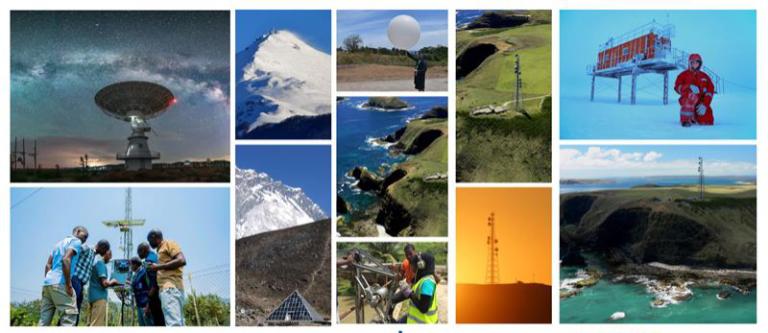
Dear members, colleagues, friends, happy World Meteorological Day. There are many UN International Days. So why does this one matter?, It's because today we celebrate the WMO community and its role in saving lives and serving society. Let's take a closer look. One of the most frequently asked questions is what's the weather going to be. People take it for granted that we can find the answer on their mobile phones and televisions.Behind each forecast are millions of observations which are processed in a unique international network coordinated by the WMO. WMO global observing system underpins decisions worth billions from aviation routing to flat protection from energy planning to health management from crop planting to infrastructure investments. It generates forecast and early warnings that save many thousands of lives. So I am delighted that the theme of the this year world meteorological day is observing today protecting tomorrow because when we observe today we don't just predict the weather we protect tomorrow's people tomorrow's planet. And that is why the young people of today are so important because they are the guardians of the future. We need your energy, your innovation, your skills. Colleagues and friends, we live in an era of great technological advances, but we must level the playing field and ensure that nobody is left behind. We must close the gaps in data and observations and we must remember that artificial intelligence depends on human intelligence. On this World Meteorological Day, I would therefore like to pay tribute to the many thousands of humans in the WMO community, the observers in remote and lonely locations, the meteorologist who release weather balloons twice a day every day, the hydrologist who monitored rivers at dawn, the forecasters who stay awake through the night. The oceanographers who brave the waves. The engineers who repair stations after a storm. The satellite technicians who maintain our eyes in the sky. The climatologists who help us understand the past and prepare for the future. The computer processors who crunch and share the data. We are more than just weather forecasters. Together we provide a global public service for the global public good. Together we are observing today and protecting tomorrow. I thank you all and once again I wish you a happy world meteorological day.
LIVESTREAM: Presentation of the Report entitled the State of the Global Climate 2025. The WMO uses datasets developed and maintained by the United States National Oceanic and Atmospheric Administration, NASA’s Goddard Institute for Space Studies, and the United Kingdom’s Met Office Hadley Centre and the University of East Anglia’s Climatic Research Unit in the United Kingdom. It also uses reanalysis datasets from the European Centre for Medium Range Weather Forecasts and its Copernicus Climate Change Service, and the Japan Meteorological Agency. This method combines millions of meteorological and marine observations, including from satellites, with models to produce a complete reanalysis of the atmosphere. The combination of observations with models makes it possible to estimate temperatures at any time and in any place across the globe, even in data-sparse areas such as the polar regions. Internationally recognized datasets are used for all other key climate indicators. Full details are available in the State of the Global Climate report .




No comments:
Post a Comment