Showing posts with label борьбы за ликвидацию расовой дискриминации. Show all posts

Friday, 18 March 2016

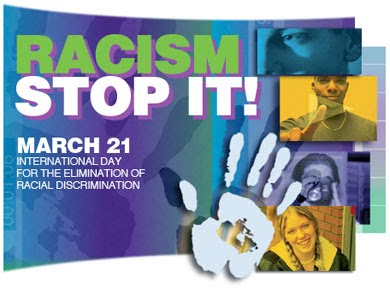
International Day for the Elimination of Racial Discrimination 2016 , 21 March.

International Day for the Elimination of Racial Discrimination, 21 March.
Международный день борьбы за ликвидацию расовой дискриминации, 21 марта.
 اليوم الدولي للقضاء على التمييز العنصري ,21 مارس.


2016 Theme: Challenges and Achievements of the Durban Declaration and Programme of Action – 15 years after.
El tema del 2016 es: «Desafíos y logros de la Declaración y Programa de Acción de Durban - 15 años después»
Thème 2016 : « 15 ans après la Déclaration et le programme d'action de Durban : progrès et défis »
2016年主题:《德班宣言和行动纲领》15年:成就与挑战
Тема Дня 2016 года «Дурбанская декларация и Программа действий: вызовы и достижения 15 лет спустя».
 موضوع عام 2016: تحديات إعلان وبرنامج عمل ديربان وإنجازاته بعد مرور 15 سنة


Racism and Racial Discrimination - UNRIC Info Point & Library


Message of the United Nations Secretary-General Message for the International Day for the Elimination of Racial Discrimination 2016.

Coming soon.


In 1979, the General Assembly adopted a Programme of activities to be undertaken during the second half of the Decade for Action to Combat Racism and Racial Discrimination (A/RES/34/24).

On this occasion, the General Assembly decided that a week of solidarity with the peoples struggling against racism and racial discrimination, beginning on 21 March, would be organized annually in all States.


FORUM : 21 March is International Day for the Elimination of Racial Discrimination

This year, the International Day is devoted to challenges and achievements of the Durban Declaration and Programme of Action – 15 years after the landmark document was adopted at the 2001 World Conference Against Racism, Racial Discrimination, Xenophobia and Related Intolerance in South Africa.

On Social Media

Ms. Gay McDougall, Member of the UN Committee on the Elimination of Racial Discrimination, will take questions from the public on Reddit, from 4:00 p.m. to 5:30 p.m. New York time on 21 March 2016


EVENTS : 
 
International Day for the Elimination of Racial Discrimination 2016.


In New York : The President of the General Assembly is convening a meeting to observe the International Day for the Elimination of Racial Discrimination on 18 March 2016 at United Nations Headquarters at 11:00 a.m. The keynote speech will be given by Mr. Ahmed Reid, Member of the UN Working Group of Experts on People of African Descent. The event will be webcast live on UN Web TV.

 Resources :

 Read the United Nations General Assembly resolution (A/RES/2142 (XXI))


   How to deal with racist people?


how to deal with racist people?

Can there ever be a ‘correct’ response for dealing with racist people?
I’ve collected answers from real people, dos and don’ts they would recommend.
Use this infographic to start a discussion:
  • Introduce the term ‘racism’ and its flavours.
  • Discuss things you can and shouldn’t do when facing racist interaction.
  • Examine statistics about Australian people’s heritage and racist attitudes.


Very little progress in tackling racism and xenophobia around the world” International Day for the Elimination of Racial Discrimination - Monday 21 March 2016
 

Friday, 20 March 2015

International Day for the Elimination of Racial Discrimination 2015, March 21


2015 Theme: "Learning from historical tragedies to combat racial discrimination today"
Тема Дня 2015 года «Извлекать уроки из прошлых трагедий, чтобы бороться с расизмом сегодня»
El tema del 2015 es: «Aprender de las tragedias históricas para combatir la discriminación racial del presente»
Thème 2015 : « Apprendre des tragédies historiques pour mieux lutter contre la discrimination raciale »
2015年主题:从历史悲剧中吸取教训,抗击今日种族歧视
موضوع عام 2015:
التعلم من المآسي التاريخية لمكافحة التمييز العنصري اليوم


United Nations Secretary-General Message for the International Day for the Elimination of Racial Discrimination 2015.


“Learning from past tragedies to combat racism today”

Every day, people of all ages endure hatred, injustice and humiliation because of their skin colour, descent, national or ethnic origin, or other supposedly racial characteristics.  Such discrimination has underpinned oppression, poverty, slavery, genocide and war. 
The International Day for the Elimination of Racial Discrimination is an opportunity to renew our commitment to building a world of justice and equality where xenophobia and bigotry do not exist.  We must learn the lessons of history and acknowledge the profound damage caused by racial discrimination.  That means carefully preserving the memory of historical wrongs so we may use our knowledge to eradicate prejudice and teach tolerance, non-discrimination and respect for diversity everywhere and for all. 
This year marks the 50th anniversary of the International Convention on the Elimination of All Forms of Racial Discrimination and the launch of the International Decade for People of African Descent.  In the past fifty years, there has been progress in the fight against racism and racial discrimination.  We have seen the end of colonialism, the dismantling of apartheid and the rise of a global movement for equality.  Yet, as history and current events attest, racial discrimination still presents a clear danger to people and communities in all regions. 
Lasting peace can only be built on the premise that all people have equal rights and dignity – regardless of ethnicity, gender, religion, social or other status.  To that end, I urge all nations to ratify the International Convention on the Elimination of All Forms of Racial Discrimination, to promote historical accuracy and put in place robust policies and laws that will end all forms of discrimination as enshrined in the Convention.

Ban Ki-moon


 FORUM : 21 March is International Day for the Elimination of Racial Discrimination

This Year 2015, and as requested by the General Assembly, Presidents of the General Assembly and of the Human Rights Council will convene meetings both in New York and Geneva during the commemoration of the International Day for the Elimination of Racial Discrimination through a debate on the state of racial discrimination worldwide.
This year's theme “Learning from historical tragedies to combat racial discrimination today” aims to explore the root causes of racism and racial discrimination and will stress the essential need to learn the lessons history has provided in order to combat racism and racial discrimination today.

Events

In Geneva, a panel event and a movie screening will take place at the Palais des Nations on 20 March 2015.
Panellists will speak at the Human Rights Council about the importance of preserving the historical memory of past human rights tragedies, including slavery, the slave trade, transatlantic slave trade, apartheid, colonialism and genocide which have led to racism, racial discrimination, xenophobia and related intolerance. They will explore the need of elaborating educational and awareness raising materials with a view to contribute to eradicating contemporary forms of racism and racial discrimination.
For the screening of the movie on racism, young people from secondary schools are invited to participate in the event and to hold an exchange of views about situations of day to day racism.
In New York, the same day, a panel event will take place at the United Nations Headquarters, with the participation of academics, including historians and experts from the civil society, active in the field of racism and racial discrimination.
  
The global fight against racism
On the International Day for the Elimination of Racial Discrimination, UN experts say the historical memory of past atrocity crimes must be preserved to strengthen the global fight against racism.

For further information, please contact registry@ohchr.org.


 Learning from historical tragedies is key to strengthen the global fight against racism International Day for the Elimination of Racial Discrimination - Saturday 21 March 2015

GENEVA (20 March 2015) – Speaking ahead of the International Day for the Elimination of Racial Discrimination, three United Nations experts on racism have called on Governments around the world to preserve the historical memory of past atrocity crimes to make more effective the global fight against racism.

The Special Rapporteur on contemporary forms of racism, Mutuma Ruteere; the  Chair-Rapporteur of the Working Group of Experts on People of African Descent, Mireille Fanon Mendes-France; and the Chairperson of the Committee on the Elimination of Racial Discrimination, José Francisco Cali Tzay, said that  breaking the silence on past human rights tragedies can only be achieved through political will and education.

“This year the International Day for the elimination of racial discrimination has a particular resonance as we celebrate the 50th anniversary of the International Convention on the Elimination of All Forms of Racial Discrimination (ICERD) and commence the International Decade for People of African descent (2015-2024).

Striving for a world free of racism and racial discrimination while remembering historical tragedies and inhumane actions, related to racial or ethnic hierarchizing and discrimination, which have affected global history and caused untold suffering are inseparable parts of the fight against racism that all actors must undertake. We continue to be confronted with evidence that we are still some way from realizing the goal of universal non-discrimination, inter-ethnic harmony and unbiased justice that so many have worked to achieve.

The complex linkages between past and contemporary forms of racism must indeed be considered to prevent racial discrimination, xenophobia, afrophobia and related intolerance and banish racism in our societies. In this respect, political will and education is key in breaking the silence on past human rights tragedies.

Often history books are silent about past atrocities committed in the name of race and ethnicity, falsify or distort historic facts, spread racial prejudice, and elude the history, cultures, traditions and positive contributions of those exposed to racism and discrimination, including people of African descent, minorities, migrants, indigenous peoples and other groups.

As we commemorate this important milestone for the ICERD, we can look back and see some great successes in the fight against racism; the most significant has been the end of Apartheid in South Africa.   But racism and discrimination is present today in our modern societies across the globe and in many forms.  Only by recognising and learning from history can we make past successes a contemporary reality.

We call upon States, and all relevant actors to adopt and implement measures to preserve historical memory of past atrocity crimes, to promote an accurate reflection of historical facts relating to past atrocities in text books and other educational material; to implement awareness-raising initiatives and ensure trainings for teachers on racial discrimination; prescribe unbiased schoolbooks that include the positive contribution of the victims of racial discrimination, while promoting more tolerance and respect for diversity.

We urge States to fully implement the ICERD as well as the Durban Declaration and Programme of Action, and the Programme of Activities for the implementation of the International Decade for People of African Descent: Recognition, Justice and Development which constitute key instruments in the global fight against racism including past atrocities.”


Documents