is an annual international campaign to promote safe, healthy and decent
work. It is held on 28 April and has been observed by the
International Labour Organization (ILO) since 2003.
28 April has also for long been associated with the world's trade
union movement's commemoration of the victims of occupational accidents
and diseases.
for the occasion. This report for the World Day for Safety and Health
at Work outlines the current situation concerning occupational diseases
and presents proposals for addressing this serious Decent Work
deficit.
Chemicals are key to healthy living and modern
convenience. They range from pesticides that improve the extent and
quality of food production, to pharmaceuticals that cure illnesses, and
cleaning products that help establish hygienic living conditions.
Chemicals are also critical in many industrial processes for developing
products important to global standards of living. However,
governments, employers and workers continue to struggle to address
controlling exposure to these chemicals in the workplace, as well as
limiting emissions to the environment.
While chemicals can be useful, necessary steps
should be taken to prevent and control potential risks for workers,
workplaces, communities and the environment, the United Nations labour
agency reported, marking the World Day for Safety and Health at Work.
“Chemicals are essential to life, and their benefits are
widespread and well-recognized… What create the dilemma are the risks
associated with exposure to these chemicals,” the UN International
Labour Organization (
ILO) said in its
report for the occasion.
Chemicals pose a broad range of potential adverse effects, from
health hazards such as cancers and physical hazards like flammability,
to environmental hazards such as widespread contamination and toxicity
to aquatic life, according to the report. Many fires, explosions, and
other disasters result from inadequate control of chemicals’ physical
hazards.
This year’s theme for the Day,
“Safety and health in the use of chemicals at work”, is meant to highlight the benefits achieved through
the production and use of chemicals while minimizing workers’ exposure
as well as the emission of chemicals into the environment through
national and international action.
Nearly 5 million deaths and 86 million Disability-Adjusted Life
Years (DALYs) were attributable to environmental exposure and management
of selected chemicals in 2004, according to the UN World Health
Organization (
WHO). These figures
include both occupational and non-occupational exposures, such as indoor
smoke from solid fuel use, outdoor air pollution and second-hand smoke.
Given these challenges, “a coherent global response is necessary
to coordinate the continuous scientific and technological progress, the
growth in chemicals production and changes in the organization of work,”
ILO reported.
Among its recommendations, it urged new tools to provide readily
available information about chemical hazards and risk, and associated
preventive and protective measures.
The agency also highlighted the need for more effective record
keeping on effects resulting from exposure to chemicals. For example,
efforts to establish a connection between an exposure to chemicals 20
years ago and a case of cancer today have been hampered by lack of
information about the effects of chemical exposures.
It also noted that governments and organizations focus on
individual chemicals instead of risks from mixtures, which are more
common.
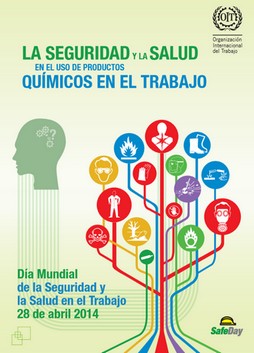
Tema 2014: «La seguridad y la salud en el uso de productos químicos en el trabajo».
Día Mundial de la Seguridad y la Salud en el Trabajo, 28 de abril 2014. Organización Internacional del Trabajo
La celebración del
Día Mundial de la Seguridad y la Salud en el Trabajo
consiste en una campaña anual internacional para promover el trabajo
seguro, saludable y digno. El 28 de abril es, asimismo, la fecha elegida
por el movimiento sindical mundial para rendir homenaje a las víctimas
de los accidentes de trabajo y las enfermedades profesionales. Este año
se centra en los riesgos para los trabajadores y para el medio ambiente
derivados de la producción y el uso de sustancias químicas.
Los productos químicos son esenciales para la vida moderna:
fármacos que curan enfermedades, productos de limpieza que mantienen la
higiene, los abonos y pesticidas que aumentan y mejoran la producción de
alimentos,…. Sin embargo, estas sustancias presentan un amplio rango de
efectos potencialmente adversos: riesgos para la salud, como la
carcinogenicidad; físicos, como la inflamabilidad; y ambientales, como
la contaminación generalizada de acuíferos.
Coordinando los esfuerzos de los gobiernos, empleadores,
trabajadores y organizaciones sindicales, se puede lograr una gestión
racional de los productos químicos para alcanzar un equilibrio adecuado
entre los beneficios de su uso y las medidas de prevención y control de
sus posibles efectos adversos para los trabajadores y el medio ambiente.
La Organización Internacional del Trabajo (OIT) ha elaborado un
informe
en el que examina la situación actual en esta área y hace un
llamamiento a todas las partes implicadas a colaborar en el desarrollo e
implementación de políticas y estrategias nacionales destinadas a la
seguridad y la salud en la producción y el uso de productos químicos en
los centros de trabajo. El informe también presenta los elementos claves
para el establecimiento de programas a nivel nacional y empresarial que
contribuyan a garantizar una gestión racional.
El Día Mundial de la Seguridad y la Salud en el Trabajo, establecido por la OIT, se celebra cada 28 de abril desde 2003.
¿Qué es un producto químico?
- De acuerdo con el Convenio de la OIT sobre la seguridad en
la utilización de los productos químicos en el trabajo de 1990
(núm.170), la expresión «productos químicos» designa a los elementos y
compuestos químicos, y a sus mezclas, ya sean naturales o sintéticos,
tales como los obtenidos a través de los procesos de producción.
- Los productos químicos peligrosos se clasifican en función
del tipo y el grado de los riesgos físicos y los peligros para la salud
que entrañan. Las propiedades peligrosas de las mezclas formadas por
dos o más productos químicos podrán determinarse evaluando los riesgos
que entrañan los productos químicos que las componen.
Тема 2014 года — «Охрана труда при использовании химических веществ на рабочих местах»
Международная организация труда (МОТ) отмечает 28 апреля
Всемирный день охраны труда в целях содействия предотвращению несчастных
случаев и заболеваний на рабочих местах во всем мире. Эта
информационно-разъяснительная кампания призвана привлечь внимание
общественности к проблемам в области охраны труда и к росту числа травм,
заболеваний и смертельных случаев, связанных с трудовой деятельностью.
Во всех регионах мира правительства, профсоюзные организации,
организации работодателей и специалисты-практики в области охраны труда
организуют мероприятия к Всемирному дню. Приглашаем вас отметить этот
день вместе с нами и поделиться информацией о проведенных мероприятиях.
Почему химические вещества на рабочих местах играют такую важную роль?
Производство и использование химических веществ на рабочих местах
во всем мире представляет
одну из наиболее серьезных проблем в программах производственной
защиты. Эти вещества стали неотъемлемой частью нашей жизни, и те
преимущества, которые они дают, широко известны
и неоспоримы. От пестицидов, позволяющих увеличивать масштабы и
повышать качество производимых пищевых продуктов, до фармацевтические
препаратов, излечивающих болезни, и чистящих средств, помогающих
поддерживать надлежащий уровень гигиены в быту, химические вещества
являются совершенно необходимым элементом здоровой жизни с современными
удобствами. Кроме того, они играют важную роль во многих
производственных процессах, в ходе которых создаются
продукты, необходимые для поддержания глобальных стандартов жизни.
Тем не менее, правительства, работодатели и работники продолжают биться
над такой задачей, как контроль за воздействием химических веществ на
работников и ограничение выбросов этих веществ в окружающую
среду.
Что такое химические вещества?
В соответствии с Конвенцией МОТ
1990 года о безопасности при использовании химических веществ
на производстве (№ 170) термин
«химические вещества» означает
химические элементы и соединения, а также смеси из них — как
природные, так и искусственные
(например, получаемые в ходе различных производственных процессов).
Опасные химические вещества
классифицируются по виду и степени представляемой ими опасности для здоровья и физической
опасности. Опасные свойства смесей из двух или более химических
веществ определяются посредством оценки опасностей, представляемых химическими веществами, входящими в смесь.
Thème 2014 : « La sécurité et la santé dans l’utilisation des produits chimiques au travail »
La Journée mondiale de la sécurité et de la santé au travail a
lieu tous les ans, le 28 avril. C’est une campagne internationale
destinée à promouvoir un travail sûr, salubre et décent. Cette Journée
constitue un outil important pour sensibiliser l’opinion à la façon de
rendre le travail sûr et salubre et à la nécessité de donner un plus
grand poids politique à la prévention des risques professionnels.
Les produits chimiques sont essentiels à une vie saine et au
confort moderne. Ainsi, les pesticides améliorent le volume et la
qualité de la production alimentaire, les produits pharmaceutiques
guérissent les maladies, et les produits d’entretien contribuent à
l’hygiène des conditions de vie. Les produits chimiques sont aussi au
cœur de nombreux procédés industriels pour la fabrication de produits
importants pour le niveau de vie mondial.
Toutefois, les gouvernements, les employeurs et les travailleurs
continuent de batailler pour régler les problèmes d’exposition aux
produits chimiques sur les lieux de travail, ou pour limiter les
émissions dans l’environnement.
Qu'est-ce qu'un produit chimique?
- Selon la convention (n° 170) de l’OIT concernant la sécurité
dans l’utilisation des produits chimiques au travail, 1990, le terme de
« produit chimique » fait référence à des éléments et des composés
chimiques, à leurs mélanges, qu’ils soient naturels ou synthétiques,
tels qu’obtenus par des procédés de production.
- Les produits chimiques dangereux sont classifiés selon le type et
le degré de dangers physiques ou sanitaires intrinsèques. Les propriétés
dangereuses des mélanges composés de deux produits chimiques ou plus
sont définies par des évaluations fondées sur les dangers intrinsèques
de leurs composants.
世界工作安全与健康日- 4月28日
2014年主题:作业场所使用化学品的安全与健康
世界工作安全与健康日的是一个旨在推广安全、健康和体面工作的国际年度活动。在每年的4月28日举行。
4月28日同时也是世界工会运动长期以来用与纪念在职业中因意外和职业病的受害者有关的日子。
在全球范围内,职业病仍然是与工作相关死亡的首要原因。据国际劳工组织估计,
每年234万件职业死亡案例,其中只有32.1万属于意外事故。其余202万人的死因
是由各类工作相关疾病造成,相当于由此平均每天死亡超过5500人。这种缺乏“体
面工作”的现状是不可接受的。
为何化学品在作业场所和其他地方如此重要?
化学品是健康生活和现代便利的关键。他们包括:提高粮食生产面积和质量的杀虫剂、治愈疾病的药物、帮助建立卫生居住环境的清洁产品。同时,化学品对许
多工业流程至关重要,而这些工业流程生产出的产品对全球生活标准又举足轻重。但是,政府、雇主和工人仍在努力控制作业场所中对化学品的接触,以及限制化学
品的排放。
什么是化学品?
- 根据国际劳工组织1990年《作业场所安全使用化学品公约》(第170号公约),“化学品”指各类化学元素、化合物和混合物,无论其为天然的或人造的,例如通过生产获得的化学品。
根据化学品固有的安全和卫生方面的危险特性分类,以确定该化学品是否为危险品。包含两种或两种以上化学品的混合物,危害性根据其组成成分的固有危险来决定。
موضوع عام 2014: السلامة والصحة في استخدام المواد الكيميائية في العمل
ا
ليوم العالمي للسلامة والصحة في مكان العمل

هو حملة دولية سنوية لتعزيز بيئة عمل لائقة وصحية وآمنة. وتدشن الحملة في 28 نيسان/أبريل من كل عام.
و 28 نيسان/أبريل هو اليوم الذي ربطتة الحركة النقابية في العالم بذكرى ضحايا الحوادث والأمراض المهنية.
وفي كل عام، يعد برنامج منظمة العمل الدولية للسلامة والصحة في
مكان العمل والبيئة تقريا يقدم معلومات أساسية لموضوع العام، بالإضافة إلى
ملصق  ومواد دعائية
للمناسبة. ويبرز هذا التقرير الحالة الراهنة في ما يتعلق بالأمراض
المهنية، كما يقدم اقتراحات لمعالجة هذا العجز الخطير في توفير العمل
اللائق.
أهمية المواد الكيميائية في مكان العمل وغيره من الأماكن
المواد الكيميائية هي المفتاح لحياة صحية ولسهولة الحياة الحديثة.
وتشتمل المواد الكيميائية على: المبيدات التي تعمل على تحسين مدى الإنتاج
الغذائي ونوعيته، والأدوية، ومنتجات التنظيف التي تساعد على تهيئة الظروف
المعيشية الصحية. والمواد الكيميائية ذات أهمية كبيرة لدخولها في كثير من
العمليات الصناعية التي تخرج بمنتجات تسهم في تحسين المعايير العالمية
للمعيشة.
ولم تزل الحكومات وأصحاب العمل والعمال يجدون صعوبات في التعامل مع مخاطر
التعرض لهذه المواد الكيميائية في أماكن العمل، و الحد من انبعاثاتها.
ما هي المادة الكيميائية؟
- وفقا اتفاقية منظمة العمل الدولية بشأن السلامة في
استخدام المواد الكيميائية في العمل، 1990 (رقم 170)، يشير مصطلح
"الكيميائية" إلى العناصر والمركبات الكيميائية والمخاليط، سواء الطبيعية
أو الاصطناعية، مثل تلك التي تم الحصول عليها من خلال عمليات الإنتاج.
- تصنف المواد الكيميائية الخطرة وفقا لنوع ودرجة المخاطر
الصحية والمادية الكامنة. وتحدد الخصائص الخطرة للمخاليط التي تتكون من
اثنين أو أكثر من المواد الكيميائية بعد تقييم المخاطر المتأصلة في المواد
الكيميائية المكونة لها.


 The World Day for Safety and Health at Work