Showing posts with label Día Mundial de la Población. Show all posts

Wednesday, 29 July 2015

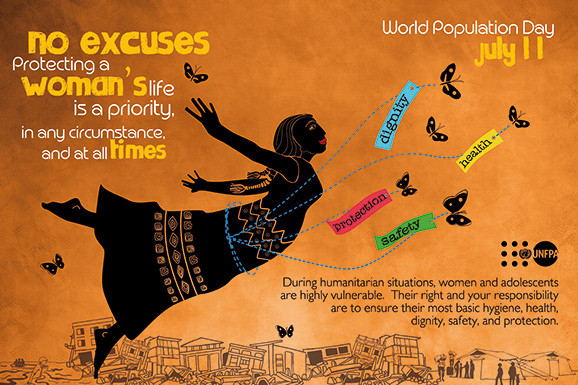
World Population Day 2015, July 11th.


2015年:紧急情况下的弱势群体
Тема 2015 года — «Уязвимое население в чрезвычайных ситуациях».
2015 Theme: Vulnerable Populations in Emergencies.
 Lema 2015: Poblaciones vulnerables en situaciones de emergencia.
Thème 2015 : Les populations vulnérables dans des situations d'urgence.
 موضوع عام 2015: الفئات الضعيفة في مواجهة حالات الطوارئ


Not since the end of the Second World War have so many people been forced from their homes across the planet. With nearly 60 million individuals having fled conflict or disaster, women and adolescent girls are particularly vulnerable. Violent extremists and armed groups are committing terrible abuses that result in trauma, unintended pregnancy and infection with HIV and other diseases. Shame and accountability rest squarely on the shoulders of the perpetrators who wage cowardly battles across the bodies of innocents.
These women are far from just victims. They have hopes, plans and the potential to make important contributions to our common future. We must staunchly protect women’s health, including their sexual and reproductive health, and address their needs as a priority in emergency relief operations. At the same time, we must continuously advance women’s human rights in times of both turmoil and calm in order to enable them to help avert conflict, stand strong should it strike, and foster the healing that is so badly needed in war-torn societies.
As the United Nations marks its 70th anniversary this year, let us take strength from our founding mission to give hope and support to the most vulnerable. On this World Population Day, I urge countries to commit to bold results that will make 2015 a time of global action, putting people first so that they help build resilience, peace and sustainable prosperity for generations to come.

Ban Ki-moon


Statement by Dr. Babatunde Osotimehin, Executive Director, UNFPA  for the World Population Day 2015.
A recent United Nations report warns that the number of forcibly displaced people has risen to a record number – almost 60 million at the end of 2014. Among these, most women and adolescent girls face particular threats as a result of the absence of health and other essential services that they need.
Even under normal conditions, reproductive health complications are a leading cause of death and illness among women of childbearing age. In humanitarian situations, an estimated one in five women and adolescent girls are likely to be pregnant. As skilled birth attendance and emergency obstetric care often become unavailable, pregnant women’s and girls’ vulnerability to death and injury is further exacerbated.
Women and adolescent girls also face much greater risk of abuse, sexual exploitation, violence and forced marriage during conflicts and natural disasters. In addition, many women who survive a crisis become heads of household, with the sole responsibility of caring for their children. They often have to overcome immense obstacles to provide health and care for children, the sick, the injured and the elderly, and bear the heaviest burden of relief and reconstruction. As a result, they may neglect their own needs as they care for others.
The complex emergencies we are responding to include protracted conflicts, made worse by poor or failed governance, the consequences of climate change, and the engagement of extremist groups claiming territory, resources and power.
That is why the theme of this World Population Day, “Vulnerable Populations in Emergencies”, is intended to highlight the special needs of women and adolescent girls during conflicts and humanitarian disasters.
One of the priorities of UNFPA, the United Nations Population Fund, is to empower and safeguard the well-being of women, adolescent girls, and young people and address their specific needs and concerns. We work closely with governments, the United Nations system, local partners and others on disaster preparedness to ensure that reproductive health is integrated into emergency responses.
UNFPA deploys hygiene kits, obstetric and contraceptive supplies, trained personnel and other support to vulnerable populations.  It also works to ensure the needs of women, adolescent girls and young people are served through both an emergency and the reconstruction phase. Our aim is to ensure that women’s and adolescent girls’ right to sexual and reproductive health is protected and their safety is ensured.
On this World Population Day, we call on the international community to redouble efforts to protect the health and rights of women and girls. We must enable women, adolescent girls and young people to play their full role in peace talks, peace building and recovery, and to ensure that governments comply with international law and bring perpetrators of sexual violence to justice.  By prioritizing health, rights and the full participation of women, adolescent girls and young people in public life, we increase our prospects for a more just, stable and peaceful world.

 Dr. Babatunde Osotimehin, Executive Director, UNFPA

 FORUM : World Population Day - 11 July

 The 2015 Revision of World Population Prospects is the twenty-fourth round of official United Nations population estimates and projections that have been prepared by the Population Division of the Department of Economic and Social Affairs of the United Nations Secretariat. The main results are presented in a series of Excel files displaying key demographic indicators for each development group, income group, major area, region and country for selected periods or dates within 1950-2100. A publication labelled Key findings and advance tables, which provide insights on the results of this latest revision, is also presented here today for your convenience.

World Population Prospects - The 2015 revision (Key findings and advance tables)


Resources

Thursday, 10 July 2014

World Population Day 2014, July 11.


As the world population edged to 7 billion people in 2011 (up from 2.5 billion in 1950), it has had profound implications for development. A world of 7 billion is both a challenge and an opportunity with implications on sustainability, urbanization, access to health services and youth empowerment.
In 1989, in its decision 89/46, the Governing Council of the United Nations Development Programme recommended that, in order to focus attention on the urgency and importance of population issues in the context of overall development plans and programmes and the need to find solutions for these issues, 11 July should be observed by the international community as World Population Day.

Today’s 1.8 billion young people are shaping social and economic realities, challenging norms and values, and building the foundation of the world’s future. Yet too many young people continue to grapple with poverty, inequality and human rights violations that prevent them from reaching their personal and collective potential.
On 2014 World Population Day, we call for investments in support of the largest-ever generation of youth.


The world today has its largest generation of youth in history – 1.8 billion young people, mostly in developing countries – with enormous potential to help tackle the major challenges facing humanity. But too many are denied their rightful opportunities to get a quality education, find decent work, and participate in the political life of their societies. World Population Day is an opportunity to renew our commitment to help young people unleash progress across society.
Action is urgently needed. Too many young people lack resources they need to lift themselves out of poverty. I am particularly concerned about adolescent girls who may face discrimination, sexual violence, early marriage and unwanted pregnancies. And even among those young people fortunate enough to receive university degrees, many find themselves without employment or stuck in low-wage, dead-end jobs.
The solution lies in investments in health, education, training and employment for young people as they undergo the critical transition to adulthood. This will improve prospects for their lives and our common future.
Young people themselves are speaking out.  Earlier this year, more than 1,000 youth organizations endorsed a Global Youth Call, welcomed by 40 countries, which recommends youth-focused goals and targets in the post-2015 development vision.
Next year marks the deadline for reaching the Millennium Development Goals, shaping the successor agenda, and adopting a meaningful legal agreement on climate change. Youth have a major role in all these processes. The year 2015 also marks the 20th anniversary of the World Programme of Action on Youth. Its practical guidelines for national action and international support remain relevant today. In particular, to fully carry out this Programme of Action, governments must respect the human rights and fundamental freedoms of all youth and respond effectively to any violations.

On this World Population Day, I call on all with influence to prioritize youth in development plans, strengthen partnerships with youth-led organizations, and involve young people in all decisions that affect them. By empowering today’s youth, we will lay the groundwork for a more sustainable future for generations to come.

Ban Ki-moon

PRB World Population

United Nations Under-Secretary-General and UNFPA Executive Director, Dr. Babatunde Osotimehin, on World Population Day 2014


 Today’s 1.8 billion young people are a powerful force, individually and collectively. They are shaping social and economic realities, challenging norms and values and building the foundation of the world’s future.

 Governments and the international community are increasingly conscious of the importance of providing resources and opportunities for all young people to reach their full potential as individuals and citizens. They recognize that investing in young people and enabling them to exercise their human rights not only benefits young people themselves, but can also help their countries reap a demographic dividend.

 We know that healthy, educated, productive and fully engaged young people can help break the cycle of intergenerational poverty and are more resilient in the face of individual and societal challenges. As skilled and informed citizens, they can contribute more fully to their communities and nations.

 For millions of young people around the world, puberty – the biological onset of adolescence – brings not only changes to their bodies, but also new vulnerabilities to human rights abuses, particularly in the areas of sexuality, marriage and childbearing. Millions of girls are coerced into unwanted sex or marriage, increasing the risks of unwanted pregnancies, unsafe abortions and sexually transmitted infections, including HIV, as well as death or disability due to childbirth.

 This is why young people, especially adolescent girls, are at the heart of our work at UNFPA, the United Nations Population Fund. Working with a multitude of partners, in particular young people themselves, UNFPA is advocating policies and programmes that invest in adolescents and youth and foster a positive environment for them; promoting their access to comprehensive sexuality education as well as quality sexual and reproductive health services, including family planning; and facilitating their leadership and participation. We are doing this with an emphasis on reaching the poorest, most marginalized and underserved adolescent girls.

 Through this multipronged effort, we and our partners are seeing how critical early investments in sexual and reproductive health can enhance the lives of young people and the welfare of their societies.

A sustainable future depends on having resilient populations, which cannot be achieved without investments in young people. They not only form a large proportion of the world’s population and deserve their fair share as a matter of equity, but are also in a critical stage of their lifecycle that will determine their future – and thus those of their families, communities, and societies. On this World Population Day, I commit UNFPA’s full support to all efforts to promote young people’s aspirations and to place young people at the very heart of national and global development efforts.


Related resources

 Investing in youth pays dividends, evidence from Sri Lanka shows
 World Population Day 2014
2013 World Population Data sheet. Population Reference Bureau.
 Press conference on the latest figures from the World Urbanization Prospects: the 2014 Revision
 World Health Organization (WHO) Non-Communicable Disease Country Profiles 2014.


Friday, 30 December 2011

Día Mundial de la Población (11 de julio)

Día Mundial de la Población (11 de julio) 
 
En 1989, el Consejo de Administración del Programa de las Naciones Unidas para el Desarrollo (PNUD) recomendó que el 11 de julio se observase el Día Mundial de la Población. Ese día, que tuvo su origen en el Día de los cinco mil millones celebrado el 11 de julio de 1987, procura centrar la atención en la urgencia y la importancia de las cuestiones de población, particularmente en el contexto de los programas y planes generales de desarrollo, y en la necesidad de encontrar soluciones a estos problemas. En el año 2000, la población del mundo era de 6.060 millones y continuaba creciendo a razón de más de 78 millones por año. Según las estimaciones de las Naciones Unidas, en 2050 habrá entre 7.300 millones y 10.700 millones de personas, siendo la proyección más probable 8.900 millones.