Showing posts with label World Press Freedom Day (WPFD). Show all posts

Wednesday, 30 April 2014

World Press Freedom 2014, May 3.


Media Freedom for a Better Future: Shaping the Post-2015 Development Agenda

This year, the international community has a once-in-a-generation opportunity to prepare a long-term agenda for sustainable development to succeed the Millennium Development Goals when they end in 2015. Successfully implementing that agenda will require that all populations enjoy the fundamental rights of freedom of opinion and expression. These rights are essential to democracy, transparency, accountability and the rule of law. They are vital for human dignity, social progress and inclusive development.

World Press Freedom Day highlights the importance of independent, free and pluralistic media to protecting and promoting these rights. Journalism provides a platform for informed discussion across a wide range of development issues – from environmental challenges and scientific progress to gender equality, youth engagement and peacebuilding. Only when journalists are at liberty to monitor, investigate and criticize policies and actions can good governance exist.

Even as we look beyond 2015, we must confront current grave threats to press freedom around the world. In many countries journalists and other media workers face systematic obstacles to reporting the truth, ranging from censorship, arrest and imprisonment to intimidation, attacks and even assassination. These outrageous abuses show that press freedom and the human rights it underpins are extremely fragile and must be actively defended.

The United Nations General Assembly has unequivocally condemned all attacks and violence against journalists and media workers. Governments and all those with influence must now act on this condemnation by protecting journalists and other media workers. The United Nations stands ready to do its part. UN bodies are already working together and with other partners under the leadership of UNESCO to create a free and safe environment for journalists and media workers around the world.

On this World Press Freedom Day, we call on all States, societies and individuals to actively defend freedom of expression and press freedom as fundamental rights and as critical contributions to achieving the Millennium Development Goals and advancing the post-2015 development agenda.

Ban Ki-moon and Irina Bokova


2014 Theme: Media Freedom for a Better Future: Shaping the post-2015 Development Agenda

World Press Freedom Day was proclaimed by the UN General Assembly in December 1993, following the recommendation of UNESCO's General Conference. Since then, 3 May, the anniversary of the Declaration of Windhoek is celebrated worldwide as World Press Freedom Day. It is an opportunity to:
  • celebrate the fundamental principles of press freedom;
  • assess the state of press freedom throughout the world;
  • defend the media from attacks on their independence; 
  • pay tribute to journalists who have lost their lives in the line of duty. 
  • 2014 theme banner 
    Media Freedom for a Better Future:
    Shaping the post-2015 Development Agenda

The focus this year is on three inter-related themes: the media’s importance in development; the safety of journalists and the rule of law; and the sustainability and integrity of journalism. An international conference will be held at UNESCO Headquarters in Paris on 5-6 May.
The annual UNESCO/Guillermo Cano World Press Freedom Prize ceremony will take place on 2 May 2014 at UNESCO Headquarters.


Тема Всемирного дня свободы печати 2014 года «Свобода СМИ во имя лучшего будущего: формируя повестку развития после 2015 года»

Всемирный день свободы печати был провозглашен Генеральной Ассамблеей ООН в декабре 1993 года. С тех пор ежегодно 3 мая, в годовщину принятия Виндхукской декларации, во всем мире проводятся мероприятия, посвященные Всемирному дню свободы печати. Это предоставляет возможность:
  • подтвердить нашу приверженность основополагающим принципам свободы печати;
  • оценить состояние свободы прессы во всем мире;
  • защитить СМИ от посягательств на их независимость;
  • 2013 theme banner

    Тема Всемирного дня свободы печати 2014 года «Свобода СМИ во имя лучшего будущего: формируя повестку развития после 2015 года»

  • отдать долг памяти журналистам, погибшим при исполнении служебных обязанностей.

В центре внимания в этом году три взаимосвязанные темы: роль СМИ в развитии; безопасность журналистов и верховенство права; и последовательность и профессионализм журналистики. Международная конференция будет проходить в штаб-квартире ЮНЕСКО в Париже 5–6 мая.
Ежегодная церемония вручения Всемирной премии ЮНЕСКО/Гильермо Кано за вклад в дело свободы печати состоится 2 мая 2014 года в штаб-квартире ЮНЕСКО.


La libertad de prensa para un futuro mejor: la importancia de su inclusión en el programa de desarrollo para después de 2015

El Día Mundial de la Libertad de Prensa es una oportunidad para:
  • Celebrar los principios fundamentales de la libertad de prensa;
  • Evaluar la situación de la libertad de prensa en el mundo;
  • Defender los medios de comunicación de los atentados contra su independencia y
  • Rendir homenaje a los periodistas que han perdido la vidas en el cumplimiento de su deber.
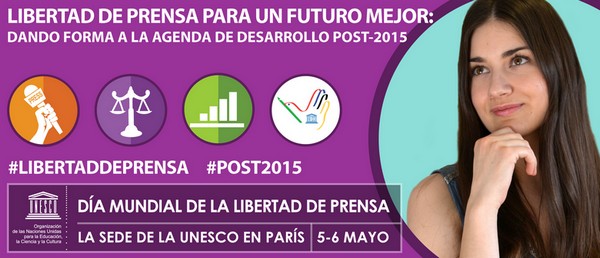
Banner 2014
La libertad de prensa para un futuro mejor: la importancia de su inclusión en el programa de desarrollo para después de 2015


En 2014, el Día Mundial de la Libertad de Prensa se centra en tres temas interrelacionados: la importancia de los medios de comunicación en el desarrollo; la seguridad de los periodistas y el estado de derecho; y la sostenibilidad e integridad del periodismo. Para debatir sobre estas cuestiones, se celebrará una conferencia internacional en la sede de la UNESCO en París los días 5 y 6 de mayo.
En esta misma sede, tendrá lugar la ceremonia anual de entrega del Premio Mundial de Libertad de Prensa UNESCO/Guillermo Cano el 2 de mayo.
El 3 de mayo fue proclamado como el Día Mundial de la Libertad de Prensa en 1993, por la Asamblea General de las Naciones Unidas, siguiendo la recomendación de la Conferencia General de la UNESCO. La fecha se eligió para que coincidiera con el aniversario de la Declaración de Windhoek, en la cual los representantes de medios de comunicación africanos que participaban en un seminario organizado por la UNESCO en la capital de Namibia, elaboraron un documento donde se recogían los principios de la libertad de prensa.

2014年主题:媒体自由促进更美好的未来:塑造2015年后发展议程

根据教科文组织大会通过的建议,联合国大会于1993年12月宣布将《温得和克宣言》通过的日子——5月3日设为世界新闻自由日。该国际日为我们提供机会来:
  • 庆祝新闻自由的基本原则;
  • 在全球范围探讨新闻的自由度;
  • 捍卫媒体的独立性;
  • 对在工作中献出了生命的记者们表示敬意。
2014主题标识

2014年主题:媒体自由促进更美好的未来:塑造2015年后发展议程


  更多信息和背景材料,请点击查询。

موضوع عام 2014: حرية وسائل الإعلام من أجل مستقبل أفضل: تشكيل جدول أعمال التنمية لما بعد 2015

اختير الثالث من أيار/ مايو لإحياء ذكرى اعتماد إعلان ويندهوك  التاريخي خلال اجتماع للصحفيين الأفريقيين نظّمته اليونسكو وعُقِد في ناميبيا في 3 أيار/ مايو 1991. وينص الإعلان على أنّه لا يمكن تحقيق حرية الصجافة إلا من خلال ضمان بيئة إعلامية حرّة ومستقلّة وقائمة على التعدّدية. وهذا شرط مسبق لضمان أمن الصحفيين أثناء تأدية مهامهم، ولكفالة التحقيق في الجرائم ضد حرية الصحافة تحقيقا سريعا ودقيقا.
ويمثل هذا اليوم فرصة لـ:
  • الاحتفاء بالمبادئ الأساسية لحرية الصحافة؛
  • تقييم حال حرية الصحافة في كل أنحاء العالم؛
  • الدفاع عن وسائط الإعلام أمام الهجمات التي تشن على حريتها؛
  • الإشادة بالصحافيين الذين فقدوا أرواحهم أثناء أداء واجبهم.
وبات يوم 3 أيار/ مايو من كل عام موعد الاحتفال بالمبادئ الأساسية لحرية الصحافة، وتقييم حرية الصحافة حول العالم، والدفاع عن وسائل الإعلام ضد ما يهدد استقلالها، والتعبير عن الإجلال للصحافيين الذين فقدوا حياتهم أثناء ممارسة عملهم.

2014 theme banner

موضوع عام 2014: حرية وسائل الإعلام من أجل مستقبل أفضل: تشكيل جدول أعمال التنمية لما بعد 2015

يركز اليوم العالمي لحرية الصحافة في عام 2014 على ثلاثة مواضيع مترابطة: أهمية وسائل الإعلام في التنمية، سلامة الصحافيين وسيادة القانون، استدامة ونزاهة الصحافة. وسيعقد مؤتمر دولي بمقر اليونسكو في باريس يومي 05-06 أيار/مايو.
تقام مراسم حفل جائزة اليونسكو/ غييرمو كانو العالمية لحرية الصحافة السنوية في 2 أيار/مايو 2014 في مقر اليونسكو.


Thème 2014 : La liberté des médias pour un avenir meilleur : contribuer à l’agenda de développement post-2015

La Journé mondiale de la liberté de la presse est l'occasion de :
  • célébrer les principes fondamentaux de la liberté de la presse;
  • évaluer la liberté de la presse;
  • défendre les médias des attaques contre leur indépendance; et
  • se souvenir des journalistes tués parce qu'ils faisaient leur devoir.
Thème 2014 : La liberté des médias pour un avenir meilleur : contribuer à l’agenda de développement post-2015

Pour la célébration 2014, l'accent est mis sur :
  • des médias libres, facteurs de bonne gouvernance, d’autonomisation et d’éradication de la pauvreté;
  • l’état de droit, indispensable pour assurer la sécurité des journalistes et combattre l’impunité; et
  • un journalisme viable et professionnel, partie intégrante du développement.
Le 20 décembre 1993, l'Assemblée générale a proclamé le 3 mai Journée mondiale de la liberté de la presse (décision 48/432). Depuis lors, le jour de l'anniversaire de la Déclaration de Windhoek est célébré dans le monde entier comme étant la Journée mondiale de la liberté de la presse.


Join the Forum : World Press Freedom Day, May 3rd.

Wednesday, 1 May 2013

2013 Themes for World Press Freedom Day - 3 May

2013 Themes for World Press Freedom Day - 3 May

" Ensuring the Safety of Journalists and Media Workers."
" Combating Impunity of Crimes against Press Freedom. "
" Online Safety."

 For 20 years, May 3 has been a day when the world celebrates freedom of expression and stands together for its protection. This is the spirit of the 1991 Declaration of Windhoek, whose anniversary the United Nations General Assembly chose for World Press Freedom Day. UNESCO was instrumental in framing the Windhoek Declaration and works today to promote freedom of expression across the world.

 Joint Message from  Mr, Ban Ki-Moon and Ms Irina Bokova - WPFD2013


PRESSING FOR FREEDOM - 20 Years of World Press Freedom Day


" Ensuring the Safety of Journalists and Media Workers."

Fundamental to the UN Plan is the insight that the experiences in one country or region can be useful for others trying to improve the safety of journalists. Compilation and sharing of up-to-date information and best practices and conducting international missions and investigations into particular cases can be highly beneficial. However, much work is still needed to achieve an optimum level of information exchange and joint learning, and in adapting good practices to different regional and national contexts.

Points for reflection:

  • What are the biggest opportunities and threats to the UN Plan of Action?
  • How do threats to press freedom differ from region to region?
  • How can various strategies to improve safety be replicated in different regions?
  • What are the preventive mechanisms to prevent journalists from being harmed in the first place?
  • How do we ensure that international standards for safety of journalists and combating impunity are respected and adopted in the country context?
  • How can public awareness be developed to ensure that press freedom is widely cherished and that public opinion at all levels will not tolerate attacks on journalists?

 Our hands write history when they are not handcuffed.

A free, independent and pluralistic media environment, online and offline, must be one in which journalists, media workers, and social media producers can work safely and independently without the fear of being threatened or even killed. It needs to be an environment where attacks, intimidations, harassments, abductions, arbitrary imprisonments, and threats are the exceptions and not the norm. Journalists (as well as citizen journalists), editors, publishers and online intermediaries alike should not be subjected to political or financial coercion and manipulation. They should especially be protected from threats to the security of themselves and their families.

 " Combating Impunity of Crimes against Press Freedom. "

Various countries and organizations have been working on reducing impunity independently or in close cooperation.  The Committee to Protect Journalists (CPJ) issues an annual index on impunity tracking some of the highest rates of impunity around the world. The International Federation of Journalists (IFJ) and Inter American Press Association (IAPA) have regular programmes and reports on impunity.  IFEX has led the process in the promotion of the International Day to End Impunity on 23 November as a global awareness raising campaign. What are some of the more effective measures taken globally to reduce impunity? And can they be replicated elsewhere? What are the lessons to be learnt?

Points for reflection:

  • What is the extent of impunity in your country and how best to address it?
  • What is the state of impunity globally?
  • How to improve research into the extent, visibility and consequences of impunity?
  • What are some of the good practices of to fight impunity that could be replicated elsewhere?
  • Is the legal justice chain adequately designed and equipped to handle crimes against freedom of expression?
  • What are the challenges of investigating crimes against press freedom when these are committed by non-state actors including extremist organizations or criminal enterprises?

 " Online Safety."

The issue of safety online also concern more than just the individual blogger or professional journalist. With the rise of institutions playing a mediating role on the Internet between authors of content and audiences, they need to understand international standards and their implications. Any limitation to freedom of expression must be imposed as a truly exceptional measure, must be provided by law, and in the pursue of legitimate purpose and be proven as necessary and the least restrictive means possible .  Accordingly, awareness and sharing of best practice is needed to ensure that intermediaries can provide principled responses if they are to protect freedom of expression in the face of mounting pressures to disclose user identities, conduct surveillance operations or take down content when there is an objection.
All this resonates with the evolution of the Internet as a platform that to date has attracted less restriction than other media platforms. The free and open character of the Internet, which is a precondition for online safety, is underpinned by a multi-stakeholder model of governance as confirmed by the resolutions of the World Summit of the Information Society.

Points for reflection:

Thursday, 3 May 2012

“Protecting journalists: Lessons learned and prospects 5 years after resolution 1738”


Round-table Discussion on “Protecting journalists: Lessons learned and prospects 5 years after resolution 1738”

Special event co-organized by the Permanent Missions of France and Greece, in cooperation with the United Nations Educational, Scientific and Cultural Organization (UNESCO) on the occasion of World Press Freedom Day.

Security Council Resolution 1738 (2006)

Programme: http://www.un.org/wcm/webdav/site/dpingorelations/shared/PROG.pdf

World Press Freedom Day website: http://www.un.org/en/events/pressfreedomday/

Tuesday, 24 April 2012

World Press Freedom Day 2012 in Palestine

World Press Freedom Day in Palestine: Strengthening Legal and Ethical Standards in a New Media Landscape

A one-day seminar to commemorate World Press Day will be held at the Birzeit University´s Law Institute in the West Bank on 2 May, and a second one will take place at the premises of Birzeit University´s Media Development Center in Gaza on 10 May. These local commemorations of World Press Freedom Day will focus on the theme “Legal and Ethical Framework for Journalism in Palestine: Challenges in a New Media Environment”. They are being organized by the Media Development Centre at Birzeit University with the support of UNESCO and Canal France International.

Palestinian journalists work in a volatile context characterized by especially difficult circumstances. On the occasion of World Press Freedom Day (WPFD), key actors in the media field will be brought together to raise awareness about the obstacles to freedom of expression in Palestine. They will discuss how to strengthen the legal and regulatory framework to ensure the respect of the rights of journalists and bloggers, guaranteeing their judiciary protection and taking into consideration emerging issues in an increasingly interconnected and fast evolving media landscape. Also at the core of the debate will be the promotion of ethical journalistic standards, and self-regulation mechanisms created and followed voluntarily by media professionals. 

Journalists and bloggers; media outlets owners, editors and managers; representatives of professional associations; academics and students; civil society practitioners; officials from local and international public institutions are expected to join the discussions in the West Bank and Gaza. 

Key media stakeholders have contributed to the development of the agenda of the celebration of World Press Freedom Day in Palestine, including WAFA news agency, Ma’an news agency, Palestine TV, I’lam Media Center in Nazareth, the Palestinian Journalists Syndicate in Ramallah and the Government Media Center.
Speakers at the event in the West Bank will include renowned international and local media experts like Toby Mendel, Executive Director of the Centre for Law and Democracy (Canada); Aref Hijjawi, former Head of Programmes at Al Jazeera (Qatar); Raed Othman, Director of Ma’an News Agency (Palestine); Waleed Shurafa, Head of the Media Department at Birzeit University (Palestine), and Ghasan Al-Khataib, Director of the Government Media Centre (Palestine). 

The concept note prepared by Birzeit University's Media Development Center for WPFD in Palestine is available here, and the agenda for the event in the West Bank can be accessed here. More information about the seminar in Gaza will be made available soon.  
UNESCO is supporting the WPFD celebrations in the West Bank and Gaza within the framework of a broader agreement with Canal France International focused on supporting media in countries in transition or affected by conflict.