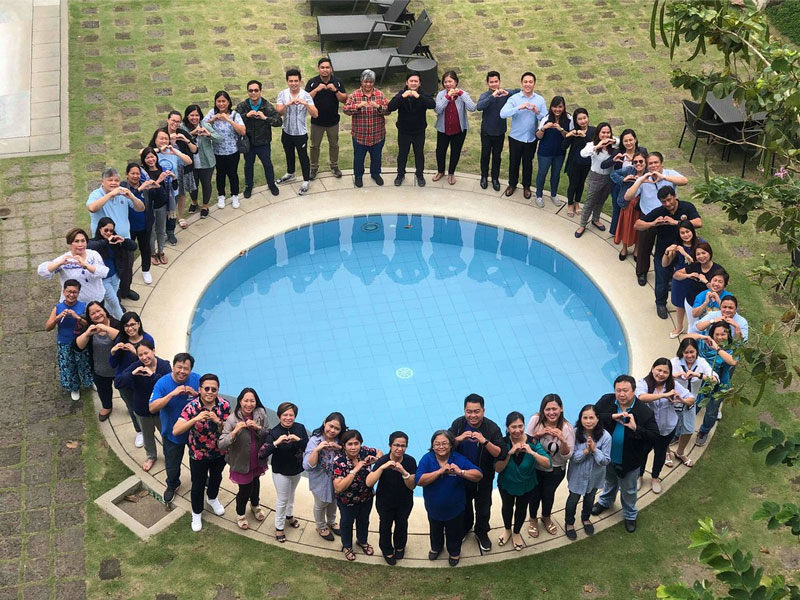
At ADB, we support the goal of toilets for all by 2030.
Friday, 19 November 2021
World Toilet Day 2021; November 19th
At ADB, we support the goal of toilets for all by 2030.
Monday, 15 November 2021
International Day of Tolerance 2021; November 16th
For the observance of the International Day for Tolerance 2021, UNESCO calls upon everybody to celebrate diversity and the inalienable right to difference, which gives depth to our societies and establishes peace in the minds of men and women.
Statement by Ms Audrey Azoulay, Director-General of UNESCO, on the occasion of International Day for Tolerance 2021; November 16th.
In his Open Letter to the Youth, Amadou Hampâté Bâ called on humanity to work towards mutual understanding by every means possible, so that "our differences, rather than separating us, become complementary and a source of mutual enrichment".For 75 years now, our Organization has been pursuing this ambition by harnessing the common goods of humanity that are education, science, culture and information to build peace in the minds of men and women. And this International Day is an opportunity to stress the topicality of our shared commitment to defending and promoting tolerance and mutual understanding. Almost two years after the start of the COVID-19 pandemic, the fault lines that divide and disfigure our societies are still pushing us apart and exacerbating distrust. It is therefore necessary to reaffirm the basic values of humankind, which we uphold in both theory and practice.This is particularly true of the work that we are doing to make education a place where students, as citizens of tomorrow's world, learn empathy, the nature of dialogue and respect for others and oppose hatred and intolerance in both form and substance.This work must reach far beyond the classroom to encompass all spheres of society. Our Organization thus works day to day to defend and promote cultural and linguistic diversity and diversity of knowledge, especially indigenous knowledge, so that all these outlooks and ways of seeing the world can open up new vistas for humankind through dialogue and exchange.As we can read in the Declaration of Principles on Tolerance signed on 16 November 1995 by the Member States of UNESCO, "Tolerance is harmony in difference."On this International Day for Tolerance, UNESCO calls upon everybody to celebrate diversity and the inalienable right to difference, which gives depth to our societies and establishes peace in the minds of men and women.
Saturday, 13 November 2021
World Diabetes Day 2021; November 14th.
Forum: "Access to Diabetes Care." World Diabetes Day 2021.
World Diabetes Day provides an opportunity to raise awareness of diabetes as a global public health issue and what needs to be done, collectively and individually, for better prevention, diagnosis and management of the condition.
This year’s World Diabetes Day is taking place at the end of a year which has been intensive in terms of global advocacy for diabetes. WHO and partners have used the opportunity of the 100th anniversary of the discovery of insulin to highlight the huge gap between the people who need access to insulin to control their diabetes, as well as essential technologies such as blood glucose meters and test strips, and those who actually have access.
The Day also comes at a time when the world continues to live through the COVID-19 pandemic, which has not only resulted in a high proportion of people with diabetes among hospitalized patients with severe manifestations of COVID-19 and among those who have succumbed to the virus, but has also led to severe disruption of diabetes services.
In the lead-up to and on 14 November, WHO will highlight not only the challenges, but more importantly the solutions, to scaling-up access to diabetes medicines and care.
How you can get involved
- Pledge your support for greater access to diabetes care by supporting our online petition. Link available soon.
- Engage a local or national policy-maker to ensure that all people with diabetes have access to the care they need.
- Organise a ‘Learn about diabetes’ event in schools.
- Organise or participate in a local diabetes awareness walk.
- Light up a local landmark, your home or workplace in blue.
- Arrange an activity with your work colleagues.
Help people learn their potential risk of type 2 diabetes with our online test.
If your region or community is observing physical distancing guidelines due to COVID-19, you can set up online activities.
Regular physical activity is an important part of diabetes management and reducing the risk of type 2 diabetes. Whether indoors or outdoors, every step counts to help stay healthy!
Join the Global Diabetes Walk, an initiative created by the World Diabetes Foundation in support of World Diabetes Day. Take to the streets – if circumstances allow – to raise awareness of the impact of diabetes and the importance of physical activity. If outdoor activities in your community are restricted, walk or exercise in your home or workplace and encourage your friends, family and colleagues to join in.Whichever way you exercise make sure to wear blue and show your support for #WorldDiabetesDay and the #IfNotNowWhen campaign.
Tuesday, 9 November 2021
World Science Day for Peace and Development 2021, November 10th.
Forum: "Building Climate-ready Communities." World Science Day for Peace and Development 2021.
To celebrate the 2021 World Science Day for Peace and Development, UNESCO will organize a webinar including panel discussions on “solutions for building climate-ready communities” and “global health in a changing environment”.An international distinction awarding outstanding contributions of individuals in communicating science to society and promoting the popularization of science.
By bridging the gap between science and society, the benefits of scientific knowledge can be used to improve daily lives, empower people and find solutions to global, regional and local challenges. In order to strengthen communication between science and society it is important that efforts made in bridging the gap do not go unnoticed. Popularizing science needs to be championed, including all activities that communicate scientific knowledge and scientific methods to the public outside the formal classroom setting and promote public understanding of the history of science.
The UNESCO Kalinga Prize for the Popularization of Science is an international award to reward exceptional contributions made by individuals in communicating science to society and promoting the popularization of science. It is awarded to persons who have had a distinguished career as writer, editor, lecturer, radio, television, or web programme director, or film producer in helping interpret science, research and technology to the public. UNESCO Kalinga Prize winners know the potential power of science, technology, and research in improving public welfare, enriching the cultural heritage of nations and providing solutions to societal problems on the local, regional and global level.
Many past Prize winners have been scientists in their own right, while others have been trained in journalism or have been educators or writers. Some have also been Nobel Prize winners. Previous laureates include Sir Julian Huxley, Margaret Mead and Sir David Attenborough.
The UNESCO Kalinga Prize for the Popularization of Science is UNESCO’s oldest prize, created in 1951 following a donation from Mr Bijoyanand Patnaik, Founder and President of the Kalinga Foundation(link is external) Trust in India. Today, the Prize is funded by the Kalinga Foundation Trust(link is external), the Government of the State of Orissa, India(link is external), and the Government of India (Department of Science and Technology(link is external)).
Who can apply?
- The Prize rewards writers, editors, lecturers, radio/television/web programme directors or film producers who have devoted their career to interpreting science, research and technology for the general public. Applicants do not need to have a science degree or to conduct research.
- Writers, editors, lecturers, radio/television programme directors or film producers who have devoted their career to interpreting science, research and technology for the general public.
- The applicant does not need to have a science degree.
- This prize does not reward research.
- This prize does not reward formal teaching (in a school/university), nor curriculum development for the formal learning sector.
Each National Commission for UNESCO shall propose a candidate on the basis of recommendations from: national associations for the advancement of science or other science associations, and/or national associations of science writers or scientific journalists.
Candidatures sent directly to UNESCO by individuals will not be accepted.
Friday, 5 November 2021
International Day for Preventing the exploitation of the environment in war and armed conflict 2021; November 6th
FORUM: Protecting the environment is essential to preserving peace. International Day for Preventing the exploitation of the environment in war and armed conflict 2021.
Statement by the U.N.Secretary-General on the International Day for Preventing the exploitation of the environment in war and armed conflict 2021; November 6th.
The climate crisis is a peace and security crisis. It intensifies conflict over natural resources, inflating food prices and increasing geopolitical tensions.
Today, around one in every five people is living in an area affected by fragility, conflict or violence. The assault on our planet is driving instability, displacement and confrontation, and making our quest for peace ever more difficult.
Protecting the environment is essential to preserving peace.
On the International Day for Preventing the Exploitation of the Environment in War and Armed Conflict, we recognize the environment as yet another victim of war. Crops are torched, water wells polluted, and soils poisoned to gain short-term military advantages, with devastating consequences that can last decades.
Protecting the environment is integral to conflict prevention, peacebuilding and sustainable development, because there can be no durable peace if the natural resources that sustain livelihoods and ecosystems are destroyed.
The time for climate action is now. Negotiators at the UN Climate Conference in Glasgow must show ambition and solidarity to save our future.
On behalf of Stakeholder Forum for a Sustainable Future, and in cooperation with the United Nations Environment Programme, Jan-Gustav Strandenaes will explore how the two UNEA meetings are connected, and in doing so consider UNEA in the context of the nearly 50 years that have passed since the founding of UNEP in 1972. In addition, the session will discuss the two commemorative events due to take place next year, UNEP@50 and Stockholm+50.
Stakeholder Forum will also announce its Autumn 2021 series of in-depth capacity-building webinars for each of the six UNEP Regions, aimed at preparing Major Groups and other Stakeholders to effectively engage with and participate in UNEA 5.2. We look forward to your participation.
Thursday, 4 November 2021
World Tsunami Awareness Day 2021; November 5th
FORUM: The theme of the World Tsunami Awareness Day 2021 is "International cooperation for developing countries tor raise tsunami awareness".
Statement by the Secretary-General on World Tsunami Awareness Day 2021; November 5th.
On World Tsunami Awareness Day, we call on countries, international bodies, and civil society to increase understanding about the threat and share innovative approaches to reduce risks. We can build on progress achieved – ranging from better outreach to tsunami-exposed communities around the world, to the inclusion of a Tsunami Programme in the United Nations Decade of Ocean Science for Sustainable Development. However, the risks remain immense. Rising sea levels caused by the climate emergency will further exacerbate the destructive power of tsunamis. We must limit warming to 1.5 degrees over pre-industrial averages and invest at scale in the resilience of coastal communities. Science and international cooperation — as well as preparedness and early action — must be at the heart of our efforts to save lives from tsunamis and other hazards. Boosting support to developing countries and improving detection and early warning is critical. In the face of increasing complex global crises, we need to be better prepared. Let us work to reduce tsunami risk, deliver on the Sendai Framework, and together build resilience against all disasters.
U.N. Secretary General
This year’s World Tsunami Awareness Day 2021 on 5 November promises to be special.
Monday, 1 November 2021
International Day to End Impunity for Crimes Against Journalists 2021; November 2nd.
FORUM:“Countering threats of violence and crimes against journalists to protectfreedom of expression for all” International Day to End Impunity for Crimes Against Journalists 2021.
Journalists around the world face targeted attacks putting their safety at risk – attacks ranging from stigmatization, hate speech, trolling, to violence, rape and even murder. Between 2006 and 2019, close to 1200 journalists have been killed for reporting the news and bringing information to the public. In nine out of ten cases, the killers go unpunished. Impunity leads to more killings and is often a symptom of worsening conflict and the breakdown of law and judicial systems.
The United Nations General Assembly proclaimed 2 November as the International Day to End Impunity for Crimes against Journalists in the General Assembly Resolution A/RES/68/163 adopted in 2013. The Resolution urged Member States to implement definite measures countering the present culture of impunity. The date was chosen in commemoration of the assassination of two French journalists in Mali on 2 November 2013.
To commemorate the 2021 International Day to End Impunity for Crimes Against Journalists, UNESCO, together with the Permanent Mission of Greece to the United Nations, and the Group of Friends for the Protection of Journalists (co-chaired by Greece, France and Lithuania), will host a virtual event discussing the impact of hate-speech on the safety of journalists, especially on women.
The event will aim to examine the impact of hate-speech on the security of journalists by bringing together experts from technical agencies, media, civil society and UN Member States, as well as understanding why the online communication have increased the attacks against women journalists and female media, and identifying legal reforms and other measures that could be taken to tackle the gender dimension of journalists’ safety. The event will also provide a platform for the presentation of a Joint Statement on the Political Leaders’ Narratives about the Press, by the OAS Special Rapporteur for Freedom of Expression.
Organizers: The Permanent Mission of Greece to the United Nations, the Group of Friends for the Protection of Journalists (co-chaired by Greece, France and Lithuania), and UNESCO