Showing posts with label 6 November. Show all posts

Wednesday, 6 November 2024

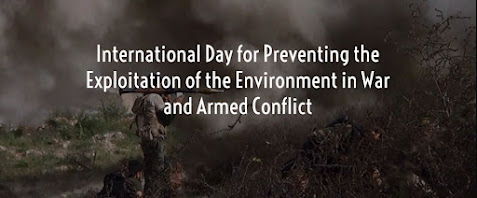
International Day for Preventing the Exploitation of the Environment in War and Armed Conflict, November 6th.


FORUM: “Protecting the natural resources that sustain livelihoods and ecosystems is essential for lasting peace.’’ International Day for preventing the protection of the environment in war and conflicts 2024. The international community need to act urgently and actively to address the isues of environmental degradation during armed conflicts, if these issues are ignored, we all have to face severe consequences not for ourselves but also for upcoming generations. For the implementation of agenda 2030 Sustainable Development we need to integrate natural resources and environmental issues into planning and conflict assessment. There is dire need to place a mechanism for collecting, monitoring and sharing information of the potential environmental impacts and protect natural resources in armed conflicts. it is needed to show commitment towards protection of our planet from devastating effects of war and in the times when the planet is warming up. Protecting the Natural environment is integral to Conflicts prevention, peacebuilding and sustainable development.. Follow the conversations with the hashtags: #EnvironmentalProtection, #EnvironmentconflictDay, #6november.

EVENTS: On November 6th at United Nations Headquarters in New york;The UNEP, the UNDP, the UN-HABITAT, the PBSO, the DPA and the UNDESA will organize a webinar to observe the International Day for preventing the protection of the environment in war and conflicts 2024.The topics of the discussions will showcase how to use all of the tools at our disposal, from dialogue and mediation to preventive diplomacy, to keep the unsustainable exploitation of natural resources from fueling and financing armed conflict and destabilizing the fragile foundations of peace.


Environmental Security in War and Armed Conflict


Yearly on November 6st, the world observes the International Day for Preventing theExploitation of the Environment in War and Armed Conflict. This day serves as a reminder of the devastating impact that war and conflict can have on our environment. The UNGA resolution 56/4 that established this Day in 2001, stresses that damage to the environment in times of armed conflict impairs ecosystems and natural resources long beyond the period of conflict, and often extends beyond the limits of national territories and the present generation. The UNEA resolution 2/15 recognized the role of healthy ecosystems and sustainably managed resources in reducing the risk of armed conflict. More recently, in March 2024, UNEA6 adopted a resolution 6/12 on Environmental assistance and recovery in areas affected by armed conflict: 

• highlighted that environmental degradation in situations of armed conflict and post-conflict can have an impact on human health, well-being and livelihoods 

• acknowledged that the important role that effective, inclusive and sustainable environmental assistance can play in conflict recovery and sustainable development in areas affected by armed conflict.

 In action 10 of the UN Pact for the Future, the states expressed deep concern about rapid environmental degradation and committed to accelerating efforts to restore, protect, conserve and sustainably use the environment. Among other international organizations, IAEA plays an important role in environmental protection, including in promoting radiation safety, environmental remediation, monitoring emissions, treating nuclear waste. War against Ukraine caused large-scale environmental damage resulted in unprecedented pollution, disruption of ecosystems and physical destruction of biological species both on the territory of Ukraine and on the scale of the entire region and the world. Destruction of the environment is prohibited in the international law. Ukraine’s "Peace Formula" attaches great importance to the issue of environmental security as one of the elements of the peace framework. In its point 8 entitled “Ecological safety”, key directions are highlighted on ensuring environmental security and countering the environmental consequences of the war. The side-event also serve as a follow-up discussion to the thematic conference on Environmental Safety, hosted by Finland, co-organized by Germany, Bulgaria and Ukraine in Helsinki on 19 October 2024. 

Objectives 

- Assess and raise awareness of the environmental damage and its immediate consequences to human health inflicted on Ukraine by the Russian war of aggression. Emphasize its regional and global impact including on climate change and biodiversity conservation. 

- Highlight the necessity of appropriate legal assessment of caused environmental damage for the sake of bringing perpetrators to accountability. 

- Provide updates on measures undertaken by the Government of Ukraine with the support of international partners to address the environmental recovery and renewal, including land remediation and demining, revival of destroyed forests and nature reserves, creation of new national parks and nature protection zones, rivers, lakes and sea waters purification. Highlight important role of green economy transition. 

- Promote global cooperation and international action with the aim of protection of environment in war and armed conflict

Co-sponsors 

Ministry of Environmental Protection and Natural Resources of Ukraine 

Permanent Mission of Ukraine to the UN Permanent Mission of Finland to the UN 

Permanent Mission of Bulgaria to the UN Permanent Mission of Germany to the UN 

World Information Transfer Ukrainian Peace Council PAX


"If we are to achieve the SDGs, we need to act boldly and urgently to reduce the risks that environmental degradation and climate change present for conflict and commit to protecting our planet from the debilitating effects of war." António Guterres Secretary-General of the United Nations message on International Day for Preventing the Exploitation of the Environment in War and Armed Conflict 2024; November 6th.

Monday, 6 November 2023

International Day for preventing the protection of the environment in war and conflicts 2023; November 6th.

FORUM: “Protecting the environment is essential to preserving peace.’’ International Day for preventing the protection of the environment in war and conflicts 2023. The international community need to act urgently and actively to address the isues of environmental degradation during armed conflicts, if these issues are ignored, we all have to face severe consequences not for ourselves but also for upcoming generations. For the implementation of agenda 2030 Sustainable Development, we need to integrate natural resources and environmental issues into planning and conflict assessment. There is dire need to place a mechanism for collecting, monitoring and sharing information of the potential environmental impacts and protect natural resources in armed conflicts. it is needed to show commitment towards protection of our planet from devastating effects of war and in the times when the planet is warming up. Protecting the Natural environment is integral to Conflicts prevention, peacebuilding and sustainable development. Follow the conversations with the hashtags: #EnvironmentalProtection, #EnvironmentconflictDay, #6november.


International Day for preventing the protection of the environment in war and conflicts 2023


EVENTS: The UNEP, the UNDP, the UN-HABITAT, the PBSO, the DPA and the UNDESA willl organize a webinar to observe International Day for preventing the protection of the environment in war and conflicts 2023 on November 6th at United Nations Heaquarters in New york. the topics of the discussions will showcase how to use all of the tools at our disposal, from dialogue and mediation to preventive diplomacy, to keep the unsustainable exploitation of natural resources from fueling and financing armed conflict and destabilizing the fragile foundations of peace.


STATEMENTS: Read the Secretary-General of the United Nations message on International Day for Preventing the Exploitation of the Environment in War and Armed Conflict 2023; November 6th.


Protecting the environment is essential to preserving peace.


Sunday, 6 November 2022

International Day for Preventing the Exploitation of the Environment in War and Armed Conflict 2022; November 6th.

FORUM: "Protecting the environment is essential to preserving peace." International Day for Preventing the Exploitation of the Environment in War and Armed Conflict 2022.


The General Assembly have declared November 6th each year as the International Day for Preventing the Exploitation of the Environment in War and Armed Conflict to emphasize the necessity of safeguarding nature for the sake of future generations and working for the protection of our common environment.

Considering that damage to the environment in times of armed conflict impairs ecosystems and natural resources long beyond the period of conflict, and often extends beyond the limits of national territories and the present generation, The United Nations General Assembly have recalled the Article 2, paragraph 4, of the Charter of the United Nations, which states that all Member States shall refrain from the threat or use of force against the territorial integrity of any State in their international relations.


At least 40% of all internal conflicts have been linked to the exploitation of natural resources over the last 60 years. To ensure durable peace, we must also commit to protecting the environment from the debilitating effects of war. Follow the conversations with the hashtags: #EnvConflictDay.


EVENT:Observance of the International Day for Preventing the Exploitation of the Environment in War and Armed Conflict.

The United Nations General Assembly invites Member States, entities of the United Nations system and other international and regional organizations to observe on November 6th, the International Day for Preventing the Exploitation of the Environment in War and Armed Conflict 2022.


Friday, 5 November 2021

International Day for Preventing the exploitation of the environment in war and armed conflict 2021; November 6th


FORUM: Protecting the environment is essential to preserving peace. International Day for Preventing the exploitation of the environment in war and armed conflict 2021.


Statement by the U.N.Secretary-General on the International Day for Preventing the exploitation of the environment in war and armed conflict 2021; November 6th.


The climate crisis is a peace and security crisis. It intensifies conflict over natural resources, inflating food prices and increasing geopolitical tensions.

Today, around one in every five people is living in an area affected by fragility, conflict or violence. The assault on our planet is driving instability, displacement and confrontation, and making our quest for peace ever more difficult.

Protecting the environment is essential to preserving peace.

On the International Day for Preventing the Exploitation of the Environment in War and Armed Conflict, we recognize the environment as yet another victim of war. Crops are torched, water wells polluted, and soils poisoned to gain short-term military advantages, with devastating consequences that can last decades.

Protecting the environment is integral to conflict prevention, peacebuilding and sustainable development, because there can be no durable peace if the natural resources that sustain livelihoods and ecosystems are destroyed.

The time for climate action is now. Negotiators at the UN Climate Conference in Glasgow must show ambition and solidarity to save our future.

António Guterres. U.N. Secretary-General.


Analysis of the 5th United Nations Environment Assembly (UNEA 5.1) – Webinar for UN Major Groups and other stakeholders.


On behalf of Stakeholder Forum for a Sustainable Future, and in cooperation with the United Nations Environment Programme, Jan-Gustav Strandenaes will explore how the two UNEA meetings are connected, and in doing so consider UNEA in the context of the nearly 50 years that have passed since the founding of UNEP in 1972. In addition, the session will discuss the two commemorative events due to take place next year, UNEP@50 and Stockholm+50.


Stakeholder Forum will also announce its Autumn 2021 series of in-depth capacity-building webinars for each of the six UNEP Regions, aimed at preparing Major Groups and other Stakeholders to effectively engage with and participate in UNEA 5.2. We look forward to your participation.


Thursday, 6 November 2014

International Day for Preventing the Exploitation of the Environment in War and Armed Conflict 2014 , 6 November


The environment has long been a silent casualty of war and armed conflict. From the contamination of land and the destruction of forests to the plunder of natural resources and the collapse of management systems, the environmental consequences of war are often widespread and devastating.
Armed conflicts are becoming ever more complex, and require solutions that address the root causes.   Issues of poverty, vulnerability to climate shocks, ethnic marginalization and the transparent, sustainable and equitable management of natural resources must be considered within and alongside peace agreements if we are to build more resilient and prosperous societies.
On this international day, let us reaffirm our commitment to protect the environment from the impacts of war, and to prevent future conflicts over natural resources. These challenges are even more urgent as the international community formulates the post-2015 sustainable development agenda.
We must use all of the tools at our disposal, from dialogue and mediation to preventive diplomacy, to keep the unsustainable exploitation of natural resources from fueling and financing armed conflict and destabilizing the fragile foundations of peace.
Let us develop solutions that meaningfully involve local communities and build on our collective knowledge to advance good stewardship of the environment as an integral part of peacebuilding and sustainable development.

Ban Ki-moon


Partnerships 

Six United Nations agencies and departments (UNEP, UNDP, UNHABITAT, PBSO, DPA and DESA), coordinated by the UN Framework Team for Preventive Action, have partnered with the European Union (EU) to help countries identify, prevent and transform tensions over natural resource as part of conflict prevention and peacebuilding programmes.

The Environmental Law Institute (ELI), United Nations Environment Programme (UNEP), and the Universities of Tokyo and McGill initiated a global research programme to collect lessons learned and good practices on managing natural resources during post-conflict peacebuilding. This four-year research project has yielded more than 150 peer-reviewed case studies by over 230 scholars, practitioners and decision-makers from 55 countries. This represents the most significant collection to date of experiences, analyses and lessons in managing natural resources to support post-conflict peacebuilding.

The United Nations Environment Programme (UNEP), the United Nations Entity for Gender Equity and the Empowerment of Women (UN Women), the United Nations Development Programme (UNDP) and the United Nations Peacebuilding Support Office (PBSO) have established a partnership to collaborate on improving the understanding of the complex relationship between women and natural resources in conflict-affected settings, and make the case for pursuing gender equality, women’s empowerment and sustainable natural resource management together in support of peacebuilding. The first outcome of the collaboration is a joint policy report released on 6 November 2013.

Forum :  International Day for Preventing the Exploitation of the Environment


 Publication : 
 Assessing and Restoring Natural Resources in Post-Conflict Peacebuilding.

 When a country emerges from violent conflict, the management of the environment and natural resources has important implications for short-term peacebuilding and long-term stability, particularly if natural resources were a factor in the conflict, play a major role in the national economy, or broadly support livelihoods. Only recently, however, have the assessment, harnessing, and restoration of the natural resource base become essential components of postconflict peacebuilding.

This book, by thirty-five authors, examines the experiences of more than twenty countries and territories in assessing post-conflict environmental damage and natural resource degradation and their implications for human health, livelihoods, and security. The book also illustrates how an understanding of both the risks and opportunities associated with natural resources can help decision makers manage natural resources in ways that create jobs, sustain livelihoods, and contribute to economic recovery and reconciliation, without creating new grievances or significant environmental degradation. Finally, the book offers lessons from the remediation of environmental hot spots, restoration of damaged ecosystems, and reconstruction of the environmental services and infrastructure necessary for a sustainable peace.

Assessing and Restoring Natural Resources in Post-Conflict Peacebuilding


Land and Post-Conflict Peacebuilding.

 Claims to land and territory are often a cause of conflict, and land issues present some of the most contentious problems for post-conflict peacebuilding. Among the land-related problems that emerge during and after conflict are the exploitation of land-based resources in the absence of authority, the disintegration of property rights and institutions, the territorial effect of battlefield gains and losses, and population displacement. In the wake of violent conflict, reconstitution of a viable land-rights system is crucial: an effective post-conflict land policy can foster economic recovery, help restore the rule of law, and strengthen political stability. But the reestablishment of land ownership, land use, and access rights for individuals and communities is often complicated and problematic, and poor land policies can lead to renewed tensions.

In twenty-one chapters by twenty-five authors, this book considers experiences with, and approaches to, post-conflict land issues in seventeen countries and in varied social and geographic settings. Highlighting key concepts that are important for understanding how to address land rights in the wake of armed conflict, the book provides a theoretical and practical framework for policy makers, researchers, practitioners, and students.


Land and Post-Conflict Peacebuilding
High-Value Natural Resources and Post-Conflict Peacebuilding.

  For most post-conflict countries, the transition to peace is daunting. In countries with high-value natural resources – including oil, gas, diamonds, other minerals, and timber –the stakes are unusually high and peacebuilding is especially challenging. Resource-rich post-conflict countries face both unique problems and opportunities. They enter peacebuilding with an advantage that distinguishes them from other war-torn societies: access to natural resources that can yield substantial revenues for alleviating poverty, compensating victims, creating jobs, and rebuilding the country and the economy. Evidence shows, however, that this opportunity is often wasted. Resource-rich countries do not have a better record in sustaining peace. In fact, resource-related conflicts are more likely to relapse.

Focusing on the relationship between high-value natural resources and peacebuilding in post-conflict settings, this book identifies opportunities and strategies for converting resource revenues to a peaceful future. Its thirty chapters draw on the experiences of forty-one researchers and practitioners – as well as the broader literature – and cover a range of key issues, including resource extraction, revenue sharing and allocation, and institution building. The book provides a concise theoretical and practical framework that policy makers, researchers, practitioners, and students can use to understand and address the complex interplay between the management of high-value resources and peace.


 Governance, Natural Resources, and Post-Conflict Peacebuilding.
Negotiating peace agreements, implementing humanitarian assistance, and developing legal frameworks are a few of the key issues involved in post-conflict natural resource management. What, indeed, is good governance? Contributing authors respond by assessing how governance should best address the cultural, social, economic, and political dimensions of post-conflict environments.


Negotiating peace agreements, implementing humanitarian assistance, and developing legal frameworks are a few of the key issues involved in post-conflict natural resource management. What, indeed, is good governance? Contributing authors respond by assessing how governance should best address the cultural, social, economic, and political dimensions of post-conflict environments. - See more at: http://www.environmentalpeacebuilding.org/publications/books/governance-natural-resources-and-post-conflict-peacebuilding/#sthash.pqVIvhob.dpuf

Governance, Natural Resources, and Post-Conflict Peacebuilding
 Livelihoods, Natural Resources, and Post-Conflict Peacebuilding.

 In developing countries around the world, local natural resources – such as charcoal, wildlife, and fisheries – have strong microeconomic and cultural importance. So vital to traditional livelihoods, these resources are unfortunately not exempt from the brutal effects of conflict. Contributing authors discuss strategies in managing these resources and supporting livelihoods in post-conflict environments.

Livelihoods, Natural Resources, and Post-Conflict Peacebuilding
 Water and Post-Conflict Peacebuilding.

 Water is a basic human need, and the provision of safe water is thus among the highest priorities during post-conflict recovery and peacebuilding. Water, sanitation, and the associated delivery infrastructure are also critical to economic development and the recovery of livelihoods in the aftermath of war. And despite predictions of “water wars,” shared waters have proved to be the natural resource with the greatest potential for interstate cooperation and local confidence building. Indeed, water management plays a singularly important role in rebuilding trust after conflict and in preventing a return to conflict.

Featuring nineteen case studies and analyses of experiences from twenty- eight countries and territories in Africa, Asia, Europe, the Americas, and the Middle East, and drawing on the experiences of thirty-five researchers and practitioners from around the world, this book creates a framework for understanding how decisions governing water resources in post-conflict settings can facilitate or undermine peacebuilding.The lessons will be of value to practitioners in international development and humanitarian initiatives, policy makers, students, and others interested in post-conflict peacebuilding and the nexus between water management and conflict.


Water and Post-Conflict Peacebuilding