Showing posts with label 25 November. Show all posts

Tuesday, 25 November 2025

International Day for the Eliminartion of Violence Against Women 2025; November 25th.

 FORUM: "UNiTE to End Digital Violence Against All Women and Girls." International Day for the Eliminartion of Violence Against Women 2025. Online and digital spaces should empower women and girls. Yet every day, for millions of women and girls the digital world has become a minefield of harassment, abuse, and control. Violence against women and girls affects one in three women. It is a global human rights emergency that must stop. As the world marks the 30th anniversary of the Beijing Declaration and Platform for Action – one of the most progressive international agreements on women’s rights to date – the UN Secretary-General’s UNiTE 2025 campaign will focus on one of the fastest-growing forms of abuse: digital violence against women and girls. This year’s campaign is also a reminder that digital safety is central to gender equality. Follow the conversation with the hashtags: #Noexcuse, #25November, #orangetheworld, #16daysofactivism, #DomesticViolence and #GenerationEquality.

November 25th.


Statement of the United Nations Secretary-General on International Day for the Eliminartion of Violence Against Women 2025; November 25th.

Violence against women and girls is a global scourge. And in our digital age, it is being amplified by the reach and speed of technology.

That is why online protection is the focus of this year’s International Day for the Elimination of Violence Against Women. Online harassment, deepfakes and hate speech are proliferating.

Misogynistic content is moving from the margins to the mainstream. And violence that begins in the digital world can spill over into the physical –– in the form of stalking, abuse, even femicide. Ending this crisis demands action from us all:

Governments must criminalize digital violence and strengthen support for survivors. Technology companies must ensure their platforms are safe and accountable.

And communities must come together in zero tolerance for online hate. We cannot allow digital spaces to be yet another place where women and girls are unsafe.

On the 30th anniversary of the Beijing Declaration, I call on the world to unite to end violence against women everywhere.

Together, we can build a world free of fear where every woman and every girl can thrive.

António Guterres.

EVENTS: This year's commemoration of the International Day for the Eliminartion of Violence Against Women will mark the global launch of the 2025 UNiTE Campaign: "UNiTE to End Digital Violence Against All Women and Girls." It will bring together Member States, UN entities, civil society, youth leaders, celebrity guests, and partners from the technology and creative sectors to call for stronger action and accountability to prevent and respond to digital violence against women and girls. The UN Women Goodwill Ambassador Marion Reimers will moderate the event and will include remarks by the President of the 80th Session of the General Assembly, the Secretary-General and the Deputy Secretary-General of the United Nations, and the participation of the Executive Directors of UN Women and UNFPA, the High Representative of the Union for Foreign Affairs and Security Policy/Vice-President of the European Commission and the Permanent Representative to the UN of the Dominican Republic.


Interactive discussions and creative performances will feature voices from youth, activists, frontline responders and champions from various backgrounds across the world.


High-level event
Live General Assembly


CAMPAIGN: 16 Days of Activism: #NoExcuse for online abuse.

From 25 November to 10 December 2025, mark the 16 Days of Activism to End Gender-based Violence under the theme: “UNiTE to End Digital Violence against All Women and Girls”.


Monday, 25 November 2024

International Day for the Elimination of Violence Against Women 2024; November 25th.


FORUM: "Towards Beijing+30: UNiTE to end violence against women and girls." International Day for the Elimination of Violence against Women 2024. This year’s theme calls on all duty bearers, especially Member States and the private sector, to act upon the priorities of the review of the thirty years of implementation of the Beijing Platform for Action and Political Declaration—recommitting to preventing and ending VAWG, demonstrating accountability, and providing resourcing. This action includes implementing comprehensive, whole-of-government and whole-of society strategies, in partnership with women’s rights organizations. It involves allocating adequate budgets, implementing laws and policies to prevent VAWG, including eliminating discriminatory legislation, and urgently addressing femicide and ending impunity. It focuses on prioritizing survivor-centred holistic support for survivors, including developing gender-responsive legal and institutional frameworks, strengthening the health sector, and providing psycho-social support for survivors’ recovery. It also comprises strengthening law enforcement and justice sector responses, including increasing women’s access to justice and ensuring that perpetrators are held accountable. The good news is that we have more knowledge than ever before about what works to prevent VAWG. We need to focus on evidence-based interventions, including those that promote positive gender norms, attitudes, and beliefs that are captured in the RESPECT Framework on preventing VAWG. The presence of a strong and autonomous feminist movement is a critical factor in driving policy change to end VAWG. We must adequately resource women’s organizations, especially at the local level, through flexible funding, including for survivor-led organizations and for those in decision-making spaces, so they can demand accountability for ending VAWG. The 30th anniversary of the Beijing Declaration and Platform for Action in 2025 is a unique opportunity for the international community to reflect upon its promise that every woman and girl should enjoy a life free from discrimination, exclusion, and violence. The clock is ticking towards 2030 and the achievement of the Sustainable Development Goals, including eliminating VAWG. We urgently need action at all levels to prevent VAWG, hold perpetrators accountable, and invest in solutions to protect women and girls everywhere. UN Women will be calling to revitalize commitments, call for accountability and action from decision-makers. This year we mark the 25th anniversary of International Day for the Elimination of Violence against Women will highlight best practices of investment to prevent violence against women, gaps and challenges, and the way forward. This year’s campaign theme is also aligned to the 2024 priority theme of the Commission on the Status of Women, focused on Accelerating the achievement of gender equality and the empowerment of all women and girls by addressing poverty and strengthening institutions and financing with a gender perspective. The campaign and the Commemoration event will also be an activation moment for the Generation Equality Action Coalition on Gender-Based Violence (GBV) and the Action Coalition on Economic Justice and Rights (EJR) to build on the momentum of the Generation Equality midpoint moment, and the SDG midpoint summit, held in September 2023 to amplify commitments and investments to prevent gender based violence against women and girls. Please refer to the UNITE Campaign Concept Note which provides further information. Follow the conversation with the hashtags: #Noexcuse, #25November, #orangetheworld, #16daysofactivism, #DomesticViolence and #GenerationEquality.

EVENTS: On Monday, November 25th from 10:00 - 18:30 pm at General Assembly Hall UNHQ a High-level meeting to mark the 25th edition of the Day and the commemoration of the International Day for the Elimination of Violence against Women 2024 was held. The 30th anniversary of the Beijing Platform for Action in 2025, coupled with the fast-approaching five-year deadline to achieve the Sustainable Development Goals, presents a critical opportunity to rally all stakeholders to take decisive and urgent action for women’s rights and gender equality. This includes ending impunity and preventing all forms of violence against women and girls.
 

10:00 to 10:45: Opening segment:Keynote statements.
10:45 to 13:00: Plenary segment.


Statement of the United Nations Secretary-General on the International Day for the Elimination of Violence Against Women 2024; November 25th.

The epidemic of violence against women and girls shames humanity.

Every day, on average, 140 women and girls are killed by someone in their own family. . Around one in three women still experience physical or sexual violence. No country or community is unaffected. And the situation is getting worse.

Crises of conflict, climate, and hunger have inflamed inequalities. Horrendous sexual violence is being used as a weapon of war. And women and girls face a torrent of online misogyny. The situation is compounded by a growing backlash against women and girls’ rights. Too often, legal protections are being rolled back, human rights are being trampled, and women’s human rights defenders are being threatened, harassed and killed for speaking out.

The United Nations Spotlight Initiative and the UNiTE by 2030 to End Violence against Women initiative call on all of us to join forces to end the scourge of violence against women and girls everywhere. The world must heed this call. We need urgent action for justice and accountability, and support for advocacy.

Almost thirty years since the Beijing Declaration and Platform for Action promised to prevent and eliminate violence against women and girls – it’s beyond time to deliver.


United Nations Secretary-General.

Other Statements:


Joint statement and call to action on the occasion of the official commemoration of the International Day for the Elimination of Violence against Women 2024 at UN headquarters.

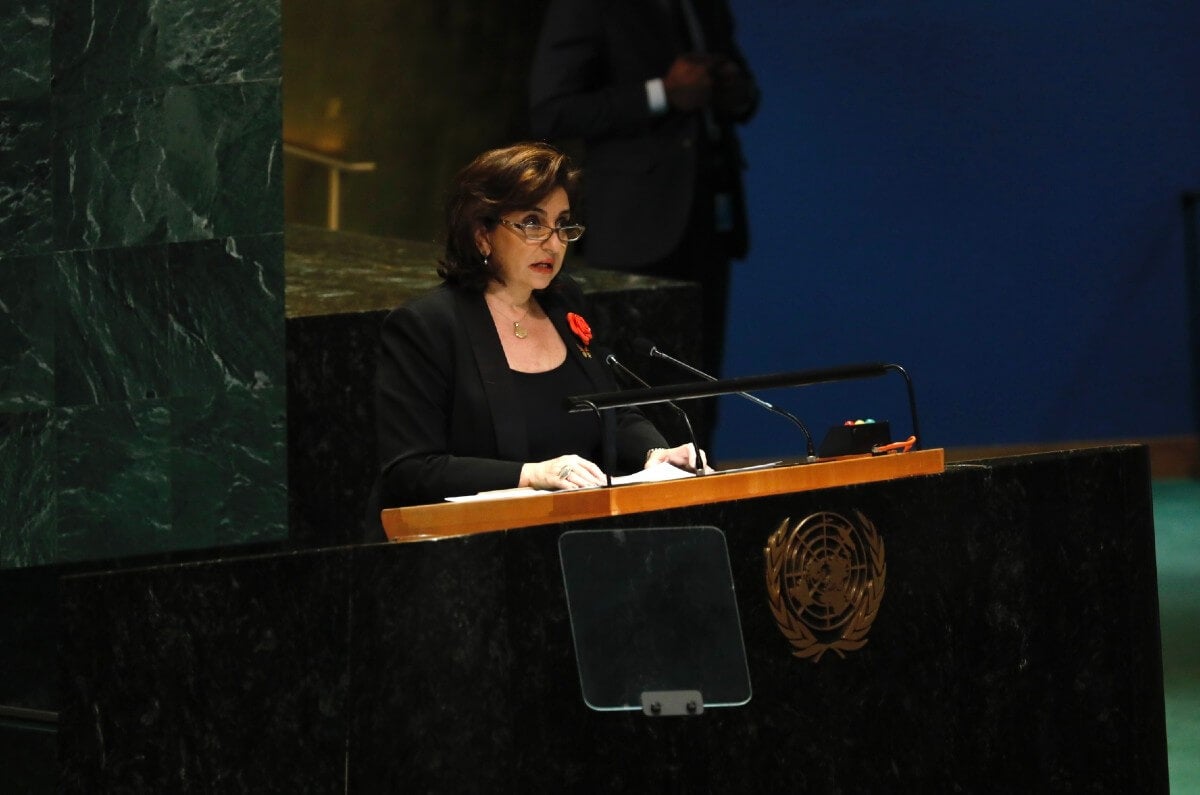
Speech delivered by the UN Women Executive Director Sima Bahous at the high-level meeting to mark the 25th anniversary of the International Day for the Elimination of Violence against Women 2024 at UN Headquarters on November 25th.


Today, as we mark the 25th anniversary of the International Day for the Elimination of Violence against Women, I thank the President of the General Assembly for convening this high-level meeting and I also thank the Dominican Republic for its organization.

Twenty-five years ago, in this very hall, Member States adopted a landmark resolution designating November 25th as the International Day for the Elimination of Violence against Women [A/RES/54/134]. The date was chosen to honour the Mirabal sisters—Patria, Minerva, and María Teresa—whose bravery in resisting oppression stands as a symbol of the fight for women’s rights and justice.


UN Women Executive Director Sima Bahous delivers remarks at the high-level meeting to mark the 25th anniversary of the International Day for the Elimination of Violence against Women, UN Headquarters, 25 November 2024. Photo: UN Women/Ryan Brown.


Next year, we commemorate the 30th anniversary of the Beijing Platform for Action. The basic concept of a life lived in safety, free from violence, and for every woman and girl, is the foundation upon which that Declaration stands.

Today, let me sound an alarm, one you will have heard before, but which we must sound ever louder.

Based on new data released today by UN Women and UNODC, we know that one woman or girl is killed every 10 minutes by an intimate partner or a family member. Six will be killed as we are meeting here today.

Precisely where they should be most safe, they are least safe, with some 60 per cent of intentional killings of women and girls taking place in the home.

Across their lifetime, 1 in 3 women, around three-quarters of a billion, are subjected to physical or sexual violence by an intimate partner or by a non-partner during their lives. It is unacceptable that this figure is largely unchanged over the past decade.

Globally, child, early, and forced marriage has decreased from 25 per cent in 1997 to 19 per cent in 2022, but still, at current trajectory, will continue to exist almost until the end of this century.

Violence is often most unrestrained where conflict rages. In 2023, as the number of civilians killed in conflict rose by 72 per cent in just one year, the proportion of women killed doubled.

I recently met with women in the Asia-Pacific region who spoke of the silencing of women in Afghanistan, of violence exacerbated by crisis and climate disasters, and of the violence faced by women human rights defenders in Myanmar.

This reality is not unique to Asia and the Pacific. It is the reality for women and girls caught in conflicts and violence across the world. In Haiti, where women face gang violence, including pervasive sexual violence. In Sudan, where reports of mass rape have become the norm. In Ukraine, where women are increasingly first responders, yet receive minimal funding. And the list continues.

It is also the reality for women and girls in the Middle East, in Lebanon, in the occupied Palestinian territories—in Gaza where women and girls are being bombarded, killed, and living on the brink of famine, where women are still being held hostage in Gaza. For them, the war and the killing must end, the hostages must be released, and aid must reach those who need it. Peace must prevail now.

And for all of those caught in conflict, there is no alternative but the end of war, the end of violence. And for peace, for justice, and for hope to prevail.

We see new pervasive forms of violence emerging though technology and new media. Our data points to the scale of the problem, with studies showing that the prevalence of violence against women in digital contexts ranges from 16 to 58 per cent, with younger women especially affected—most report their first such experience between 14 and 16 years of age. Women in politics also experience disproportionately high levels of online violence and abuse, particularly around election cycles.

Violence is the essential thread running through the pushback against gender equality that we increasingly see from the international to the community levels. It is the great enabler of the growing, organized, financed, and virulent efforts against women’s rights. The consequences of which are exacted on women’s safety and on their bodies.

While I am here to sound an alarm today, I do not intend only to bemoan our collective circumstances. Much has been done, and, most importantly, much more can be done.

Based on initial reporting under the Beijing+30 process, we know that in the last five years, 79 per cent of reporting Member States have introduced, updated, or expanded national action plans on ending violence against women and girls. Ninety percent have introduced or strengthened legislation. Eighty-eight per cent have introduced or strengthened services for survivors of violence.

I appreciate and applaud every action this represents. This is making a difference.

It tells us that violence against women and girls is preventable. Yet, the reality is that it still remains pervasive and devastating. No country has yet eliminated the scourge of violence against women and girls. Ending it requires bold and transformative action.

We need greater investment, greater innovation, and greater political will to close the very real gaps that remain in women’s empowerment and leadership, in legislation, in services, and in systems that ensure justice, and accountability, and an end to impunity.

We need to include men and boys in all our efforts.

As the UN we relentlessly seek to do our part.

The Spotlight Initiative is on course to prevent violence for more than 21 million women and girls by 2025, to save the lives of at least 1,800 women across 26 countries every year. That is saving two women a day.

The UN Trust Fund to End Violence against Women currently supports the work of civil society organizations in 74 countries and territories across five regions, with grants totalling USD 87.5 million.

These are just part of what the United Nations does across its entities, to eliminate violence against women and to build their agency and resilience. While we seek to do ever more, we take pride in what we have done and do together with you, our partners.

Despite the efforts of all of us here, we still fail to live up to the ambitions of Beijing, of CEDAW, and of the human rights standards that should guarantee safety for every woman and girl.

We must in no way denigrate very real progress, but we must also be honest with ourselves that it is too slow, and it is threatened by emerging challenges from the political to the technological. Today is when we again make this case, as we must do tirelessly.

Change is coming. Because our will for change is strong. Because we are united. Because we are determined. And because solutions are there to be taken. And because women are determined and resilient.

The reality of violence against women and girls diminishes us all. But the movement to end it inspires us all. We should not doubt for a moment that we will see a world free of violence for women and girls, for our children and theirs. And we will not stop until we have delivered the change women and girls demand, expect, and deserve.

I thank you.


TAKE ACTION: Every 10 minutes, a woman is killed. #NoExcuse. UNiTE to End Violence against Women; Join the 16 Days of Activism to demand accountability, invest in prevention, and build a future free from violence against women and girls.Take action!


Thursday, 24 November 2022

International Day for the Elimination of Violence Against Women 2022; November 25th.


FORUM: “Mapping the Nexus between Media Reporting of Violence against Girls.” International Day for the Elimination of Violence Against Women 2022. 

The media industry has an unprecedented influence on how entire societies perpetuate gender inequality, from discriminatory norms and stereotypes to the normalization of violence against girls. On the other hand, media reporting also has the immense potential to combat the root causes of violence against women and girls, promote positive social and gender norms, and support risk mitigation through the provision of essential information to survivors, victims and those who wish to support them. To complement the full report, there is an Executive Summary and the 10 Essentials, which were developed as a call to action for key stakeholders, including media practitioners, media organizations, the United Nations, and other human rights agencies.

 Follow the conversation with the hastags: #25November, #orangetheworld, #16daysofactivism, #DomesticViolence and #GenerationEquality.


EVENTS: On November 25st, the Working Group on discrimination against women and girls, the Special rapporteur on Violence against Women, the UNICEF, the World Bank, the United Nations Entity for Gender Equality and Women's Empowerment (UN Women), and the UN information offices around the world will held a conference and several webinars to mark the International Day for the Elimination of Violenceagainst women 2022 from the UN Headquarters.


Ending violence against women.

One in three women worldwide experience physical or sexual violence, mostly by an intimate partner. Violence against women and girls is a human rights violation, and the immediate and long-term physical, sexual, and mental consequences for women and girls can be devastating, including death.

Violence negatively affects women’s general well-being and prevents women from fully participating in society. It impacts their families, their community, and the country at large. It has tremendous costs, from greater strains on health care to legal expenses and losses in productivity.

At least 155 countries have passed laws on domestic violence, and 140 have legislation on sexual harassment in the workplace (World Bank 2020). But challenges remain in enforcing these laws, limiting women and girls’ access to safety and justice. Not enough is done to prevent violence, and when it does occur, it often goes unpunished.
Our solutions

A woman’s right to live free from violence is upheld by international agreements such as the Convention on the Elimination of All Forms of Discrimination against Women and the 1993 UN Declaration on the Elimination of Violence against Women.

Only 40 per cent of women seek help of any sort after experiencing violence, and so we advocate for, and support, women and girls’ access to quality, multi-sectoral services essential for their safety, protection and recovery, especially for those who already suffer multiple forms of discrimination.

Let's enhance partnerhips with governments, UN agencies, civil society organizations and other institutions to find ways to prevent violence against women and girls, focusing on early education, respectful relationships, and working with men and boys. Prevention is still the most cost-effective, long-term way to stop violence.

As part of UN Women’s comprehensive approach, they also work with partners to enhance data collection and analysis to provide a better understanding of the nature, magnitude, and consequences of violence against women and girls. Data collection and analysis also helps UN Women and our partners understand what works and doesn’t work to address this violence.

For more than 10 years, UN Women’s global initiative, Safe Cities and Safe Public Spaces, has worked to prevent and respond to sexual harassment against women and girls in public spaces, and since 2017 the UN-Women have also been a key member of the EUR 500 million Spotlight Initiative that deploys targeted, large-scale investments in ending violence in Africa, Asia, the Caribbean, Latin America, and the Pacific.

Tuesday, 25 November 2014

International Day for the Elimination of Violence against Women 2014, November 25th.


Orange symbolizes International Day for the Elimination of Violence against Women.


Campaign “Orange YOUR Neighbourhood.”
 联合国秘书长发起“联合起来制止暴力侵害妇女行为”
 أعلنت حملة الأمين العام"اتحدوا لإنهاء العنف ضد المرأة"


Sexual and gender-based violence is the most extreme form of the global and systemic inequality experienced by women and girls. It knows no geographic, socio-economic or cultural boundaries. Worldwide, one in three women will suffer physical or sexual violence at some point in her life, from rape and domestic violence to harassment at work and bullying on the internet.
This year alone, more than 200 girls have been kidnapped in Nigeria; we have seen graphic testimony from Iraqi women of rape and sexual slavery during conflict; two Indian schoolgirls were raped, killed and hung from a tree; and in the United States, there have been high-profile cases of sexual violence on sports teams and university campuses.
Women and girls experience violence in all countries and neighbourhoods but these crimes often remain unreported and hidden. We must end the silence. That is why this year’s International Day for the Elimination of Violence Against Women is centred on a grassroots effort to raise awareness called Orange Your Neighbourhood. Around the United Nations in New York, the Secretariat building and the Empire State Building will be lit orange, and many other events are planned across the world and on social media.
Everyone has a responsibility to prevent and end violence against women and girls, starting by challenging the culture of discrimination that allows it to continue. We must shatter negative gender stereotypes and attitudes, introduce and implement laws to prevent and end discrimination and exploitation, and stand up to abusive behavior whenever we see it. We have to condemn all acts of violence, establish equality in our work and home lives, and change the everyday experience of women and girls.
Women’s rights were once thought of as women’s business only, but more and more men and boys are becoming true partners in the battle for women’s empowerment. Two months ago, I launched the HeForShe campaign; a global solidarity movement for gender equality that brings together one half of humanity in support of the other, for the benefit of all.
We all have a role to play, and I urge you to play yours. If we stand together in homes, communities, countries and internationally, we can challenge discrimination and impunity and put a stop to the mindsets and customs that encourage, ignore or tolerate the global disgrace of violence against women and girls.

Ban Ki-moon


International Day to End Violence against Women 2014 - Message of UN Women Executive Director.
 
 In her message for the International Day for the Elimination of Violence against Women on 25 November 2014, UN Women Executive Director Phumzile Mlambo-Ngcuka stresses that violence against women can and must end by addressing its root cause – gender inequality.


Every year, on the International Day for the Elimination of Violence against Women, we are reminded how every day, women and girls experience violence in their lives.

Women are beaten in their homes, harassed on the streets, bullied on the internet. Globally, one in three women will experience physical or sexual violence at some point in her life.

More often than not, violence against women is committed by an intimate partner. Of all women killed in 2012, almost half died at the hands of a partner or family member. It is no exaggeration that the overall greatest threat to women’s lives is men, and often the men they love.

Yet we know how violence against women can be eliminated. In 1995, close to 20 years ago, 189 governments came together in Beijing. They adopted a Platform for Action that spelled out key strategies to end violence against women, empower women, and achieve gender equality.

This includes effective prevention strategies that address the root causes of gender inequality.

This includes better services for women surviving violence, such as hotlines, shelters, legal advice, access to justice, counselling, police protection, and health services.

This includes more accurate reporting rates, better data collection, and strengthened analyses of risk and prevalence factors.

This includes greater support for women’s organizations, which are often on the frontline of the response.

This includes having more men and boys standing up against violence, denouncing it, and stopping it. Male leaders, including traditional and religious leaders, must show the way.

UN Women has launched HeForShe, a global campaign to engage men and boys as advocates and agents of change for the achievement of gender equality and women’s rights. We need men who believe in gender equality to take action now.

A global review of progress and gaps in implementing the Beijing Platform for Action is underway. Preliminary data show that many countries have introduced laws to prohibit, criminalize, and prevent violence against women. Yet implementation and enforcement of these laws are inadequate. Reporting of violence remains low and impunity for perpetrators remains high. Not enough resources are targeted at provision of quality services and effective prevention strategies.

Next year, after the endpoint of the Millennium Development Goals, a new roadmap for development will be adopted by the international community. Ending violence against women and girls must have a central place in this new framework.

The promises from 20 years ago are still valid today. Together we must make 2015 the year that marks the beginning of the end of gender inequality. Now is the time for action.
    
UN Women Executive Director


Forum : Int'l Day for the Elimination of Violence against Women - November 25

    “Orange your Neighbourhood”

 “Orange Events” in your own neighbourhoods between 25 November and 10 December 2014.


Join us!
Share your photos, messages and videos showing how you orange your neighbourhood at facebook.com/SayNO.UNiTE and twitter.com/SayNO_UNiTE. For more information about “Orange YOUR Neighbourhood,” see flyer and download toolkit.
 
Get inspired!
Watch this video and see how we ‘oranged’ the world last year!
You can also find more information in our UN Women's Focus Package for this Day here:


 Resources
UN WOMEN


Office of the High Commissioner for Human Rights
UNESCO
World Health Organization
UN High Commissioner for Refugees
UN Food and Agriculture Organization
Rutgers University

Sunday, 17 November 2013

Int'l Day for the Elimination of Violence against Women 2013, November 25th.


WHO report into violence against women: key data.


A new report from the World Health Organisation has drawn together data from dozens of studies and found that worldwide, 35% of women have experienced violence - and that the consequences for their health can be devastating.


 Health consequences ;


The report catalogues the disastrous consequences that violence has on women's physical, mental and sexual and reproductive health. Many of these are complex and not immediately evident, but their impact is often enormous. Non-fatal injuries are one of the most direct effects of violence.

The report uses the USA as an example where half of women in abusive relationships are physically injured by their partners and that most of them sustain multiple types of injuries - the head, neck and face being the most common, followed by muscular, skeletal and genital injuries.

Several studies identified that women with a history of intimate partner violence are 16% more likely to have a low-birth-weight baby and twice as likely to report having had an induced abortion - nearly half of which globally take place in unsafe conditions.

What's more, when compared with women who have not experienced partner violence, those that have are 1.5 times more likely to acquire HIV. Every study that looked at the relationship between intimate partner violence and harmful alcohol use found a positive correlation between the two - although substance abuse may also be linked mental health disorders which also increase a woman's vulnerability to violence. Depression and suicide was also consistently cited as a severe health consequence of violence against women. Traumatic stress is the mechanism most likely to explain the fact that depression rates are double for women who have experienced violence.