Showing posts with label 8 september. Show all posts

Monday, 8 September 2025

International Literacy Day 2025; September 8th.


FORUM: ‘’Promoting literacy in the digital era.” International Literacy Day 2025. The ILD2025 will be an opportunity for critical reflection on what literacy is and how literacy teaching and learning, programmes and policies are designed, managed and monitored in this digital era. In addition, ILD2025 will spotlight effective policies and interventions to promote literacy as a common good and a right, and as a lever for empowerment and transformation to build more inclusive, just and sustainable societies. It will also provide a space for collective discussion on the futures of literacy. The ILD 2025 Objectives aim at: • Celebrating literacy achievements and raising awareness of the need to address remaining and emerging challenges in the rapidly evolving digital landscapes. • Reflecting on the transformative power of literacy as a key factor for improving education and lifelong learning in the digital era. • Exploring both potential and risks of digitalization for literacy teaching and learning, programmes, policies and lifelong learning ecosystems. • Identifying effective strategies and programmes for developing literacy and digital skills • Identifying digital programmes and initiatives that effectively support the development of literacy skills of diverse learners and target groups • Fostering multistakeholder dialogue and partnerships in support of enhanced literacy efforts. The increasing integration of AI into education presents both transformative opportunities and complex challenges, reshaping pedagogies, curricula and education governance while raising critical questions about equity, ethics and human agency. As debates swirl over AI's disruptive potential — ranging from hyperbolic promises to more cautionary approaches — education systems must navigate dilemmas, including the implications of digital surveillance, systemic biases and the potential erosion of human accountability in education decision-making to recalibrate positive new directions for education futures. Under the theme "AI and the future of education: Disruptions, dilemmas and directions", The UNESCO's 2025 Digital Learning Week will assist in charting pathways for equitable, ethical and human-driven AI integration in education, ensuring technology serves as a force for inclusive progress.. Follow the conversation with the hashtags #LiteracyDay#LiteracyLearningSpaces#8september.


EVENTS: On and around September 8th, 2025; The ILD will be celebrated across the world at global, regional, country, community levels in person and online. At the global level, a global conference will be organized by UNESCO at its Headquarters in Paris, France, on 8 September 2025. Several national governments are planning national celebrations, while many events are being organized by other partners. To participate in the Global celebration of the International Literacy Day 2025. Read the agenda programme and Register to participate. For further information please visit the webpages of International Literacy Day 2025 and the UNESCO International Literacy Prizes. For specific inquiries, please contact: • International Literacy Day and the global celebration: ILD2025 Secretariat (Section of Youth, Literacy and Skills Development, Division of Policies and Lifelong Learning Systems) at literacy@unesco.org • International Literacy Prizes 2025: ILP Secretariat (Section of Youth, Literacy and Skills Development, Division of Policies and Lifelong Learning Systems) at literacyprizes@unesco.org.

On September 9th, 2025; In the context of the global International Literacy Day celebration at UNESCO Headquarters in Paris, the UNESCO Institute for Lifelong Learning (UIL) will host the Annual General Meeting of the Global Alliance for Literacy (GAL) and the Action Research on Measuring Literacy Learning and Educational Alternatives (RAMAED) online. Aligned with the objectives of the Marrakech Framework for Action and the Sustainable Development Goals, particularly SDG 4, the meeting will promote literacy as a foundation for lifelong learning and emphasize its importance as a policy priority. Participants will share updates and identify national priorities in GAL and RAMAED countries. The meeting will also reflect on key findings from the evaluation of the GAL Strategy and engage members in discussions to identify lessons learned, gaps, and areas for improvement. A strategic dialogue will be facilitated to address the governance and future direction of the Global Alliance for Literacy, laying the groundwork for the development of the GAL Strategy 2030. Representatives of GAL and RAMAED countries, GAL Associate Members, GEC members, invited speakers, and other interested partners will participate in this invitation-only event. The meeting will be conducted in English, French, and Arabic with simultaneous interpretation. Learn more about this event.

From September 2nd to 5th, 2025; The Third edition of Digital Learning Week will take place at UNESCO Headquarters in Paris in the Room IX and Room II. The UNESCO's Digital Learning Week presents a unique opportunity to participate in dynamic and thought-provoking discussions, dialogue and the sharing of groundbreaking ideas, and to foster meaningful co-creation and collaborative efforts to advance the digital transformation of education and to “reimagine our futures together.”The event aims to foster critical reflection, peer learning and policy dialogue, addressing today’s pressing challenges while shaping the future of education in an era of rapid technological change. It is expected to gather up to 1,000 participants, including 30 Ministers of Education, alongside digital education leaders, policy-makers, researchers and practitioners from various organizations, including UN agencies, governments, academia, NGOs and the private sector. Discussions will explore whether and how AI is disrupting education, navigate the complex dilemmas it presents, and identify strategic directions to harness its potential responsibly. The Digital Learning Week 2025 event spans four engaging days, including:

  • Ministerial panels, multistakeholder dialogues and public lectures from global opinion leaders
  • Parallel sessions, foresight workshops and open ideas labs for knowledge exchange and co-creation
  • Launch of UNESCO-led knowledge products and tools, including think pieces on AI and learning futures
  • Exhibition of digital learning solutions and innovations
  • Networking opportunities with policy-makers, educators and innovators driving change


The Digital Learning Week 2025 will take place in person at UNESCO Headquarters in Paris, France. All plenary sessions will be livestreamed in English and French to a global audience. Register to participate, explore the Day 1 - Day 2 - Day 3 Photos of the event and get Access the webcast for plenary sessions!

WEBINARS: These one-hour online professional learning events organized by the International Literacy Association (ILA) deliver insight and practical resources from experts in the field of literacy. You'll gain dependable, research-supported ideas you can apply in your classroom, school, and district. Explore the ILA digital events!

PUBLICATIONSAI and the future of education. Disruptions, dilemmas and directions; This new UNESCO publication explores the philosophical, ethical and pedagogical dilemmas posed by disruptive influence of AI in education. Read the full publication.

REPORTSAI and education: protecting the rights of learners; This report argues for a human-centred, rights-based approach that ensures innovations strengthen learning opportunities for all. Read the full report.

STATEMENTS
: Statement from the UNESCO Director-General on International Literacy Day 2025; September 8th.

Promoting literacy in the digital era


The global celebration of International Literacy Day (ILD) 2025, organized by UNESCO under the theme ‘Promoting Literacy in the Digital Era’, will take place on 8 September 2025 at its Headquarters in Paris, France. The in-person event will also be livestreamed to a global audience. The celebration will include the award ceremony of the UNESCO International Literacy Prizes. Interpretation will be available in English, French and Spanish. 

The main objectives of the global conference are:

• To reflect on both the potential and risks of digitalization for literacy.
• To explore how lifelong learning ecosystems can be enhanced to promote literacy in the digital era.
• To identify effective digitally empowered literacy programmes and practices.
• To reflect on the futures of literacy in a world where digitalization is increasingly transforming our life, work and learning.
• To celebrate the achievements of the six laureates of the 2025 UNESCO International Literacy Prizes.

Participants In-person participation in the global event is by invitation. Participants will include representatives of governments and partners in charge of education and digitalization, staff and experts from ministries, multilateral organizations, civil society organizations, NGOs, the private sector and foundations, learners and educators, research institutions and universities. 


AGENDA PROGRAMME

Registration & informal discussions and Opening session 

Master of Ceremony: 

  • Mr Marco Horanieh, Presenter and actor, France
  • Ms Farida Shaheed, UN Special rapporteur on the right to education 

Keynote speech Introduction:

  • Mr Borhene Chakroun, Director, Division of Policies and Lifelong Learning Systems, Education Sector, UNESCO 
  • Ms Kate Arthur, British-Canadian entrepreneur

High-level panel – Literacy in the digital era.

This session intends to explore the potential of digital technologies to improve the way in which literacy is promoted at the system, programme and practice levels. It also aims to reflect on the challenges and potential risks posed by rapidly evolving digital landscapes, which must be addressed to ensure that everyone can achieve relevant and functional literacy skills as a right and a foundation for inclusive, just and sustainable societies. 

Session 1: Enhancing lifelong learning ecosystems.

A lifelong learning ecosystem encompasses systems, institutions, structures, policies, frameworks, and governance. Creating an enabling ecosystem is essential for promoting literacy as a lifelong pursuit across both physical and virtual spaces, and within formal, non-formal and informal learning settings, such as schools, training institutions, online courses, workplaces, community learning centres and home. This session will explore ways to strengthen lifelong learning ecosystems, with attention to human rights principles, democratic values, digital inclusion, privacy, and diversity in cultures, languages and knowledge systems

Session 2: Promoting effective literacy programmes and practices in the digital era.

Digitalization is transforming literacy programmes and practices broadly in two aspects: responding to evolving skill demands – particularly the need for higher levels of literacy skills as a basis for lifelong learning, alongside digital skills, which are increasingly integral to literacy itself; and leveraging digital technologies to improve design, content, management and monitoring of literacy programmes. This session will explore the key factors that can make literacy programmes in the digital era more inclusive, effective and sustainable

Session 3: Envisioning the futures of literacy in the digital era and ways forward.

This session aims to reflect on the futures of literacy in a world where digital technologies are increasingly permeating many spheres of life, transforming how we learn, live, work, interact and socialize, while also impacting the well-being of our planet. What kind of global literacy landscapes do we aspire to shape by 2050? What should be continued, discontinued or transformed in the way we design and manage literacy policies, programmes and practices? 


CAMPAIGN MATERIALS: ‘’Promoting literacy in the digital era.” These challenges highlight the importance of developing more solid and higher levels of literacy skills, while ensuring linguistic, cultural, and epistemic diversity, through enhancing holistic lifelong learning ecosystems, and embracing policies, programmes, practices, monitoring, governance, financing and partnerships.The Ideas generated through ILD2025 discussions to address issues in these areas are expected to chart future actions at the global, system, programme and practice levels. join the campaign, Get the ILD2025 Poster and other communication materials!


POSTER


Thursday, 7 September 2023

International Literacy Day 2023; September 8th.

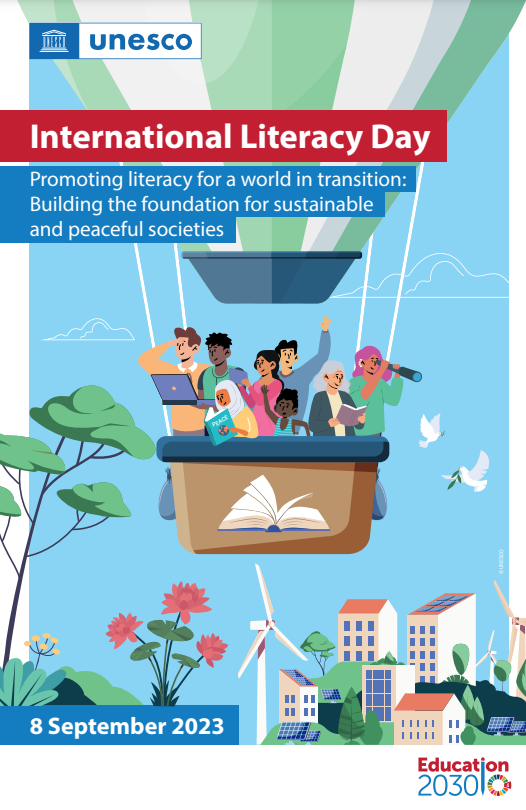
FORUM: ''Promoting literacy for a world in transition: Building the foundation for sustainable and peaceful societies.'' International Literacy Day 2023.


EVENTS: UNESCO will celebrate International Literacy Day (ILD) on 8 September 2023 under the theme ‘Promoting literacy for a world in transition: Building the foundation for sustainable and peaceful societies’.

Main expected outcomes of ILD2023 • Raise awareness of the literacy promotion as the ‘two-way process’, through which the ‘literacy and numeracy learning’ and ‘advancement in different areas of development and peace’ are mutually reinforced as integral part of lifelong learning. • Relevant knowledge, experiences, and solutions identified and shared for unleashing the transformative power of literacy at the system, programme, content and practice levels, towards more sustainable and peaceful societies. • Cooperation and partnerships fostered for promoting literacy. Format The global conference will take place in a hybrid format. The in-person participation is by invitation only. The global conference, however, can be attended via a virtual platform (Link to be provided later). Working languages The working languages of the global conference are English, French, and Spanish.


This year marks the mid-point towards the 2030 Global Agenda for Sustainable Development and the 17 Sustainable Development Goals (SDGs) to which the international community committed eight years ago. By resolving to achieve this agenda, countries and partners envisioned a future world that is peaceful, just, inclusive, and free from poverty, hunger, and inequalities. As highlighted in the recent report by the UN Secretary-General, however, ‘the SDGs are in deep trouble’. Despite the progress in many areas, ‘a preliminary assessment of the roughly 140 targets with data show only about 12 per cent are on track; close to half, though showing progress, are moderately or severely off track and some 30 per cent have either seen no movement or regressed below the 2015 baseline’. The repercussions of the COVID-19 pandemic along with other challenges such as climate change, digitalization, widening inequalities, polarization of societies and conflicts, are increasingly felt in different spheres of human life and the planet.


The SDG4 on education and lifelong learning is not an exception. It confronts persistent and interrelated challenges related to equity, inclusion, and equality, as well as the quality and relevance . In 2020, at least one out of seven youth and adults aged 15 years and over worldwide (763 million) lacked basic literacy and numeracy skills . In addition, a significant number of children, including those who are enrolled in school, are not acquiring basic literacy and numeracy skills, while 244 million children and young people between the ages of 6 and 18 are not enrolled in school. The COVID-19 crisis, along with other global challenges, has exacerbated the educational and literacy challenges faced by millions of children, young people and adults, predominantly those who were already marginalized before the pandemic. In low- and middle-income countries, the estimated proportion of ten-year old children who cannot read a simple text has risen from about 57 per cent in 2019 to 70 per cent in 2022. Global learning losses from the COVID-19 crisis could cost this generation of students close to US$21 trillion in lifetime earnings. 

Fulfilling the commitment to the SDG4, including the SDG target 4.6 on youth and adult literacy and numeracy, and shaping a greener, better, and safer future requires not only intensified efforts but also radical changes in our thinking, approaches, and action. In its 2021 report entitled ‘Reimagining ourfutures: A new social contract for education‘, the UNESCO’s International Commission on the Futures of Education addressed the necessity to transform education to shape a peaceful, just, and sustainable futures. While the Seventh International Conference on Adult Education (Marrakech, 15-17 June 2022) shed light on the importance of a lifelong learning perspective, the Transforming Education Summit(TES) convened by the United Nations Secretary-General (New York, 16-19 September 2022) generated a global movement with more than 130 countries and partners committing to transforming education towards the Summit of the Future (New York, 22-23 September 2024) and beyond.

Thematic focus of International Literacy Day 2023 

Literacy is central to equipping individuals with the relevant knowledge, skills, and competencies, transforming education, and shaping more sustainable and peaceful societies. At this critical juncture of the SDG journey, therefore, International Literacy Day 2023 (ILD2023) will focus on ‘Promoting literacy for a world in transition: Building the foundation for sustainable and peaceful societies’. Locating literacy in the entire SDG spectrum centered around the five pillars of sustainable development, namely ‘People (social development)’, ‘Planet (environmental protection)’, ‘Prosperity (economic prosperity)’, as well as ‘Peace’, and ‘Partnership’, it will provide an opportunity for reinforcing and adjusting our paths, embracing the reciprocal relations between development in ‘literacy and numeracy’ and ‘different areas of sustainable development and peace’. Literacy, on the one hand, empowers people and improves their self-esteem, creativity, and critical thinking. It enables them to acquire knowledge, skills, attitude, and values required to thrive in our rapidly changing society and economy. As such, literacy contributes not only to generating personal benefits, such as better well-being and economic conditions, but also social, economic, political, cultural, and environmental ones

Evidence shows, for instance, that literacy programmes help enhance democratic values, peaceful coexistence, and community solidarity. By empowering people, especially through a critical and emancipatory approach, literacy can help them ‘to engage and assume active role both locally and globally to face and resolve global challenges’ and to become an agent for transformation for more sustainable and peaceful societies. On the other hand, progress in other areas of development, such as health, agriculture, water, energy, transport, and peace, can improve the conditions and environments in which people live, work, and learn. More reading materials, libraries, and learning opportunities in multiple forms that become available due to socio-economic development can help literacy learning. At the same time, new environments generated by such development, including increased employment opportunities, could generate people’s demands for acquiring, applying, and advancing literacy and numeracy skills’. In looking at these reciprocal relations, ILD2023 will also note that not all new developments create necessarily the favorable conditions for fulfilling everyone’s right to education, of which literacy is a part. For instance, the advancement of digital technology can be a double-edged sword. While its potential for expanding teaching and learning has been demonstrated most recently during the COVID19 crisis, multiple issues have been pointed out, including the digital divide that has disproportionately affected marginalized people in terms of access to the quality learning and their misrepresentation within AI-driven learning. New services devised for convenience, such as voice recognition, automatic dictation and interpretation services may disincentivize people to make efforts to be literate.


Exploring human-centered solutions at system, programme, content and practice levels. Promoting the mutually-benefitting ‘two-way process’ of development in ‘literacy and numeracy’ and ‘different areas of development and peace’, calls for lifelong learning and intersectoral approaches, underpinned by the notion of literacy as a continuum of proficiency that alters throughout life. Also required is attention to evolving contexts. In addition to basic literacy and numeracy skills, higher-level skills as well as skills for communication, using digital text, are increasing. ILD2023 will explore how the ‘lifelong literacy and numeracy’ approaches can be translated into concrete solutions and actions at the system, programme, and practice levels. In doing so, it will pay attention to the learning content that connects literacy with acquisition of other knowledge, skills, attitudes, values and competencies. It will also reflect on the appropriate governance and partnerships based on whole-of-government and whole-of-society approaches through democratic conversations and interactions, across and within education authorities at different levels, different ministries, development partners, disciplines, and people from diverse background and age groups. More broadly, there is a need for fostering a culture of lifelong learning, which facilitates intensified interactions between individuals, communities and social institutions. 

In doing so, ILD2023 will remind the centrality of people - their needs, aspirations, and capabilities, as well as the conditions and environments in which they live - to making all action meaningful. It is demand-driven, human-centered policies, programmes, and practices that can harness the transformative power of literacy

Celebrations of International Literacy Day 2023.

Objectives and formats International Literacy Day 2023 will be celebrated on September 8 worldwide to acknowledge advancements in literacy and foster a more literate society. The day will bring together policymakers, practitioners, development partners, youth, and individuals. At the global level, a Conference on ‘Promoting literacy for a world in transition: Building the foundation for sustainable and peaceful societies’ will be held at UNESCO Headquarters in Paris, France on 8 September, immediately after the Digital Learning Week (Paris, 4-7 September 2023) and prior to International Day to Protect Education from Attack (9 September 2023). The Global Conference will also feature the Award Ceremony of the UNESCO International Literacy Prizes. Additionally, the ILD2023 webpage will showcase a number of events planned at the country level, while virtual celebrations will take place in other formats, including social media. 

To Participate Register to attend the event.


CAMPAIGN: On International Literacy Day 2023, join the #ImALifelongLearner campaign and share your literacy learning story. Literacy is an integral part of the right to education and the foundation of lifelong learning as well as a driver for sustainable development. The campaign serves as a reminder that the right to education is a right to lifelong learning that knows no age limits. Join the #ImALifelongLearner campaign!

Wednesday, 7 September 2022

International Literacy Day 2022; September 8th.

 FORUM: Transforming Literacy leraning Spaces. Internayional Literacy Day 2022.

The Day will be celebrated worldwide under the theme, "Transforming literacy learning spaces” and will be an opportunity to rethink the fundamental importance of literacy learning spaces to build resilience and ensure quality, equitable, and inclusive education for all.


Rapidly changing global context took a new meaning over the past years, hampering the progress of global literary efforts. In the aftermath of the pandemic, nearly 24 million learners might never return to formal education, out of which, 11 million are projected to be girls and young women. To ensure no one is left behind, we need to enrich and transform the existing learning spaces through an integrated approach and enable literacy learning in the perspective of lifelong learning.


EVENTS
Celebrations in 2022

At the global level, a two-day hybrid international event will be organized on 8 and 9 September 2022, in Côte d’Ivoire. The International Literacy Day global celebration lies at the heart of regional, country and local levels. As such, this year's outstanding programmes and literacy practices will be announced through the 2022 UNESCO International Literacy Prizes award ceremony.Concept note and agenda - Speakers' biographies

Background paper: full document - summary

REGISTRATION
Register to the ILD 2022 Event.


Since 1967, International Literacy Day (ILD) celebrations have taken place annually around the world to remind the public of the importance of literacy as a matter of dignity and human rights, and to advance the literacy agenda towards a more literate and sustainable society. Despite progress made, literacy challenges persist with 771 million illiterate people around the world, most of whom women, who still lack basic reading and writing skills and are faced with increased vulnerability.


Saturday, 7 September 2013

International Literacy Day 2013, September 8

" Literacies for the 21st century"  is the Theme for International Literacy Day 2013.

Literacy is at the heart of basic education for all, and essential for eradicating poverty, reducing child mortality, curbing population growth, achieving gender equality and ensuring sustainable development, peace and democracy.

Resources :

- Literacy rates are rising, but women and girls continue to lag behind. 
-Message from Irina Bokova, Director-General of UNESCO on the occasion of the International Literacy Day 2013
-Working paper on the Definition of Fundamental Education

Infografics :


That's why Sunday is International Literacy Day.

Milestones :

Starting from 2003, when UNESCO took the lead of the the United Nations Literacy Decade (2003-2012), and going back to 1946, when UNESCO first established a committee to promote ‘Fundamental Education’, review the major milestones on the road to Literacy for All. More


More information from Unesco here: http://bit.ly/QaiBGA