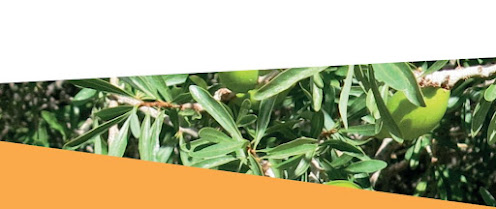
FORUM: "Roots of Tradition; Seeds of Tomorrow'' International Day of Argania 2026. Its protection is fundamental, given the importance of its environmental and socioeconomic role. In recent decades there has been a growing awareness of its value and an increase in initiatives to protect it. The Argania (Argania spinosa) is a woody species endemic to Morocco, where it is concentrated in the Souss, in the South, and Algeria, where it is present in the Tindouf region. It belongs to the sapotaceae family, and has leathery leaves, small yellow flowers and a yellow-greenish fruit that looks like olives. It is also a unique tree due to its high capacity of adaption to the natural environment and its ability to develop its own ecosystem. The argan tree is the ideal species to fight against erosion and desertification, as argan tree masses constitute a green belt against the advance of the desert. These features arose curiosity on the Argania many centuries ago. One of the first writings that mention this trees is the Traité des simples (13th century), written by the Andalusian physician and botanist Ibn al-Baitar. It had previously been mentioned by the Andalusian botanist and historian El Bakri in the 11th century and was later mentioned by the famous Andalusian explorer Leon the African (15th-16th century), who detailed the uses of argan oil for food and illumination. The Argania has played an important role in the traditional culture of the local population, especially among the Imazighen tribes. One of its first uses lies in the hardness of its wood, which was traditionally used as a construction material, due to its good insulating properties, and as fuel. However, it is best known for its oil, produced from its fruits, which are particularly slow to ripen and contain between one and three small kernels rich in oil. In some places, argan oil replaces olive oil, making it an essential ingredient in regional cuisine, as well as being used as a condiment for many dishes. In the Souss region, argan oil, honey and a glass of tea is served as a symbol of hospitality towards guests. This oil is also used for the preparation of the popular and delicious amlou, a paste made with argan oil, roasted and crushed almonds and honey. Amlou is a culinary specialty of the Souss region, which has become popular throughout Morocco and even beyond its borders. Argan oil is also known for its many benefits and its high content of vitamin A and E, as well as its essential fatty acids. For this reason, it is regularly used to treat skin diseases, as well as being a highly appreciated ingredient in cosmetics by both artisanal and major international brands. For centuries, the argan tree has been the main means of subsistence for many families in rural areas, through the sale of its fruits or its oil, whose production is based on traditional knowledge passed down from generation to generation. Today, most of the quality oil is still produced in women-organized cooperatives, such as the Amal Cooperative in the Moroccan village of Tamanar or the Tifaout Women’s Agricultural Cooperative in the Souss-Massa-Draa region. It is estimated that more than 2,000 people work in Moroccan argan oil cooperatives. The importance of this tree is such that its disappearance would affect the entire ecosystem: soil, water reserves, fauna, and flora. This know-how and the practices linked to argan oil were included in UNESCO’s list of Intangible Cultural Heritage of Humanity in 2014, following a request from the Moroccan government. Since April 2009, the production of oil is also a Protected Geographical Indication (PGI). Argan oil was the first African product to benefit from this protection. These recognitions underline this tree’s importance and the practices that surround it. The benefits of the argan tree transcend these uses, and we all profit from its impact directly or indirectly. In fact, it is the ideal species to fight against erosion and desertification, as argan tree masses constitute a green belt against the advance of the desert. For instance, the UNESCO’s decision to declare “la Arganeraie” a Biosphere Reserve in 1988. This reserve in the southwest of Morocco, formed by the Souss Massa National Park, has since protected an Argan forest of 25,687 km2. Likewise, this tree, a symbol of life in Morocco, was declared an Intangible Cultural Heritage of Humanity by Unesco in 2014, as a living example of the symbiosis between humans and nature. It is crucial to provide protection of this invaluable species for effective and durable results .