FORUM: “Your widow to the world.” World Day for Audiovisual Heritage Day 2024. As a window to the world, audiovisual heritage enables us to witness events we do not attend, listen to voices of the past, and create narratives that inform and entertain. Through the exploration of recorded sounds and visual imagery captured on film and video, we not only gain an appreciation for the cultural wealth but also extract valuable lessons from it. Audiovisual materials can tell your story, your truth, and your presence. They provide a window to the world, allowing us to observe events we cannot attend, hear voices from the past who can no longer speak, and craft stories that inform and entertain. By listening to recorded sounds and looking at images captured on film and video we can not only appreciate the richness of this culture but also learn from it. Audiovisual archives tell us stories about people’s lives and cultures from all over the world. They represent a priceless heritage which is an affirmation of our collective memory and a valuable source of knowledge since they reflect the cultural, social and linguistic diversity of our communities. They help us grow and comprehend the world we all share. Conserving this heritage and ensuring it remains accessible to the public and future generations is a vital goal for all memory institutions as well as the public at large. Follow the conversations with the hashtags: #WorldDayforAudiovisualHeritage, #WDAH, #audiovisual ,#27october, #AudiovisualHeritageDay #AudiovisualHeritage.
.jpg)
EVENTS: WDAH 2024 - Celebrations around the world.
On and around the Octobe 27th; Celebrations around the world of the World Day for Audiovisual Heritage Day 2024 will be held in many countries and organized by national and regional sound and film archives, broadcasters, museums and libraries, and major audiovisual associations to honor audiovisual preservation professionals and institutions that safeguard our heritage for future generations. The nine associations forming the CCAAA (AMIA, ARSC, FIAF, FIAT-IFTA, FOCAL International, IASA, ICA, SEAPAVAA, IFLA) strongly encourage all their members (and any other institutions) to Participate to the global celebrations of the World Day. You can now visualize all events on a dedicated world map that is updated in real time. Explore the world map of WDAH 2024 events.
On July 2nd, 2024 - Panel Discussion on how Library Translates Essential Resources in the Field of Audiovisual Heritage Preservation - The Qatar National Library partnered with IASA to complete Arabic translations of four pivotal publications from IASA’s Technical Committee.
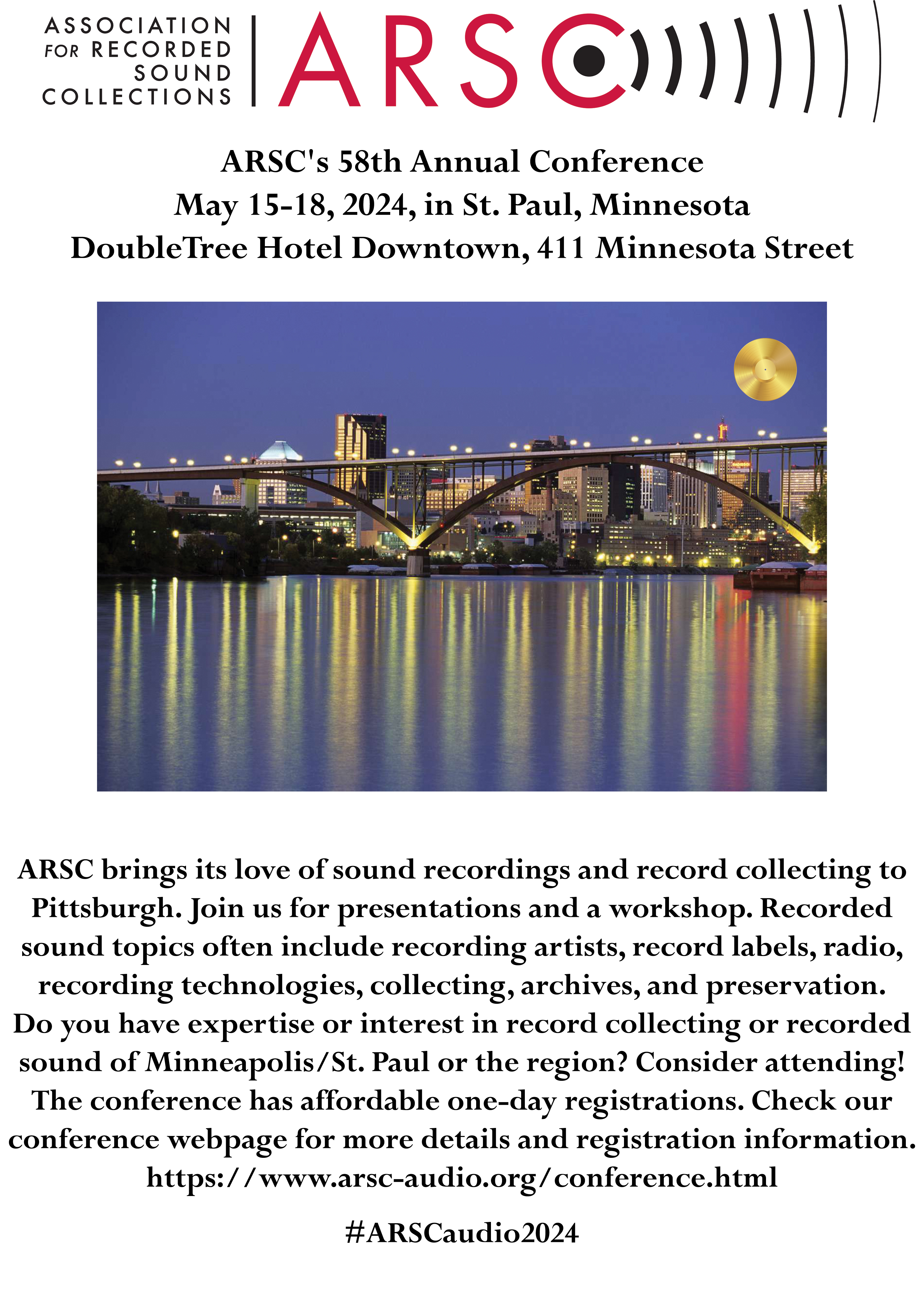
From 15 to 18 May 2024; ARSC's 58th Annual Conference - The Call for presentations for ARSC's 58th Annual Conference to be held in St. Paul, Minnesota is open until 12 January. The Association for Recorded Sound Collections welcomes all who are interested in any aspect of sound recording to attend or present at the conference. The program will include individual presentations, posters, and panel discussions with sound recording scholars, collectors, preservationists, and creators engaged in a broad range of topics that cross geographic, cultural, and collection boundaries. There will also be a silent auction and social events (screenings, Ask the Technical Committee, a Collector's Roundtable) offered each evening. Get the Conference Flyer and the Call for Presentations.
From 22 to 23 April 2024, 2024 FIAF Congress: The call for papers for the symposium of the 2024 International Federation of Film Archives (FIAF) Congress in Bangkok on the theme "Film Archives in the Global South" is now open. In 2023, out of the 173 FIAF members and associates, 41 affiliates were located in what is being referred to as the "Global South", spreading predominantly across Latin America, Asia, and Africa. Despite struggling with developmental and economic challenges, alongside political and social instability, these collections are significant for their cultural diversity, local history, and poignant reflections of societal and political issues experienced by the vast majority of the world's population. As they continue their work on the preservation of the world's audiovisual memory, film archives of the Global South have become important centers for developing specific strategies, approaches and concepts of preservation beyond hegemonic models. More than that, these developments may expand preservation practices to areas and contexts that were previously ignored or considered unreachable through traditional methods and ideas, highlighting the resourcefulness and ingenuity of archival practices in the often under-resourced contexts of the Global South. Participants must fill out the online form before 8 January 2024.
On March 8th - Participate to the 2024 FIAT-IFTA Conference. The Call for Papers of the 2024 FIAT-IFTA World Conference, set to take place in Bucharest in October 2024, is open until 31 March.
PUBLICATIONS: Read the Guidelines on the Production and Preservation of Digital Audio Objects Published by the International Association of Sound and Audio Visual Archives (web edition).


+-+Source+-+Digital+TV+research.png)
+-+Source+-+Digital+TV+research.png)
+-+Source+-+Digital+TV+research.png)