LIVESTREAM: Why 2026 is shaping up to be a pivotal year for multilateralism?
Friday, 24 April 2026
International Day of Multilateralism and Diplomacy for Peace 2026; April 24th.
LIVESTREAM: Why 2026 is shaping up to be a pivotal year for multilateralism?
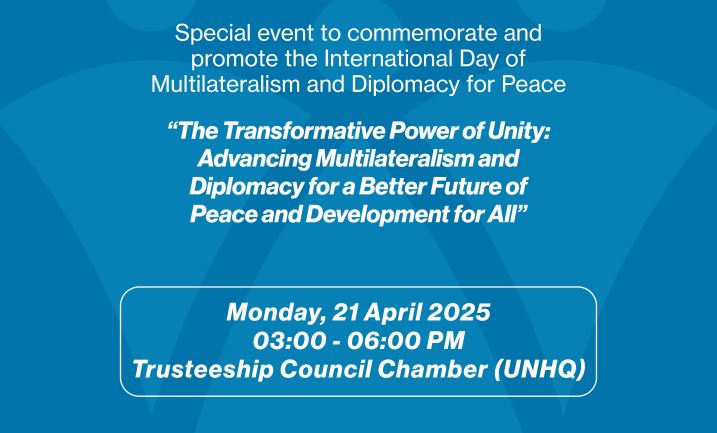
Thursday, 24 April 2025
International Day of Multilateralism and Diplomacy for Peace 2025; April 24th.
- Lack of willingness to engage, compromise and/or accommodate divergent views, positions and priorities;
- Assumption of a zero-sum mentalities and departure from consensus-building approaches;
- Resort to supremacist, punitive, divisive or confrontational approaches
- and/or measures;
- Non-fulfillment of international obligations and commitments, coupled with selective approaches and/or accommodative interpretations of the provisions of the UN Charter, as part of efforts to impose a so-called “rules-based order” that, insofar as unknown and vague, may only serve agendas of a dubious nature; or
- Resort to group unilateralism, when real and genuine multilateralism – inclusive and consultative – is perceived as not necessarily serving the purpose and/or interests of certain States.
Against this backdrop, and taking into account the persistent polarization and continued geopolitical tensions in international relations, a transformation of current diplomacy seems increasingly imminent. But not just any transformation. The diplomacy of the future – which shall necessarily still be rooted in the UN Charter and the norms of international law collectively developed over the past 79 years – must also be able to support global efforts for overcoming both growing and common challenges and threats that humanity is currently facing in multiple areas, and in which the central role of States is critical.
The United Nations, an intergovernmental Organization established in 1945 from the shatters of World War II, is at the service of its Member States for reaching agreements and taking collective decisions. Its founding Charter clearly establishes that the United Nations is a “centre for harmonizing the actions of nations in the attainment of these common ends”, in order to “take effective collective measures for the prevention and removal of threats to the peace”, to “develop friendly relations among nations based on respect for the principle of equal rights and self-determination of peoples”, and to “achieve international cooperation”. To this end, the United Nations must, in particular, work to solve “international problems of an economic, social, cultural, or humanitarian character” and develop “respect for human rights and for fundamental freedoms for all”. Nevertheless, there is a growing tendency to resort to policies and methods that seek to suppress developing States and their needs. For instance, there is an increasing recourse to unilateralism, whether in the form of group unilateralism or unilateral, protectionist and/or isolationist measures; to attempts aimed at imposing a so-called “rules-based order” that not only remains vague, but which has never been agreed upon and has the potential to undermine both the rule of law at the international level and the very tenets of the UN Charter; and to efforts aimed at replacing, minimizing or equating the central and leading role of States, in the context of intergovernmental processes and debates, particularly at the United Nations, with that of non-State actors, especially nongovernmental organizations (NGOs), which are largely based in and financed by the developed world. With respect to the latter phenomenon, while acknowledging the contribution that relevant stake-holders may indeed have to specific processes and conversations at the United Nations, we ought to note how striking it is to see that multilateralism is being slowly – yet effectively – replaced by multi-stakeholderism; an approach that ultimately dilutes the role of States, especially those in the Global South, diminishing their voice and their chances of really making meaningful contributions and ultimately having a significant impact on critical debates and decision-making processes on issues that, no doubt, will have an incidence on the lives of their peoples and the future of their nations. Hence, as things stand, multilateralism, far from being revitalized, strengthened or reinvigorated to better respond to the challenges of the 21st century, it is being threatened by growing trends and challenges that detract from the participation of developing States and make it nearly impossible to achieve the goals we have set ourselves, particularly the realization of that other possible world of peace and prosperity a reality for all. With world leaders set to convene at the UN Summit of the Future this September to reaffirm their dedication to peace, sustainable development, and protection of human rights, the importance of multilateralism and diplomacy is more paramount than ever. Follow the conversation with the hashtags: #InternationalDayforMultilateralismandDiplomacyforPeace; #24April; #MultilateralismDay; #DiplomacyDay.
PUBLICATION: The United Nations have launched a report entitled “Effective Multilateralism.” that outlines an ambitious plan to strengthen the multilateral system, ensuring it is better positioned to address current and future challenges – from the climate crisis to rising inequality, lack of finance for sustainable development, and increasing threats to democracy and stability.
STATEMENT: Group of Friends in Defense of the Charter statement.
Tuesday, 23 April 2024
International Day of Multilateralism and Diplomacy for Peace 2024; April 24th.
Statement of the United Nations Secretary-General for International Day of Multilateralism and Diplomacy for Peace 2024; April 24th.
The International Day of Multilateralism and Diplomacy for Peace highlights a fundamental truth: no country can solve today’s challenges alone.
Dialogue, diplomacy and multilateral solutions provide the surest path to a peaceful and just world.
These eternal ideals form the foundation of the United Nations Charter, and drive global efforts to safeguard human rights and forge hope, prosperity and peace for all people.
But around the world, conflicts, climate catastrophe, poverty and inequalities create enormous obstacles to diplomacy and multilateral solutions. Collaboration is consumed by competition; dialogue is overtaken by relentless division.
Diplomacy and the multilateral system itself were created precisely for moments like this. We need to resurrect a new spirit of global cooperation to rebuild trust, heal divisions, and place humanity on the path to peace.
The Summit of the Future this September will be a critical opportunity for countries to share solutions. A New Agenda for Peace that takes a holistic approach to the drivers of conflict can help to restore faith in the multilateral system and what we can accomplish by working as one.
On this important day, I call on all governments and leaders to spare no effort to bridge divides, renew dialogue and trust, and deliver a peaceful future.
Sunday, 23 April 2023
International Day of Multilateralism and Diplomacy for Peace 2023; April 24th.
FORUM: "Effective multilateralism through the defence of the principles of the Charter of the United Nations." International Day of Multilateralism and Diplomacy for Peace 2023. Follow the conversation with the hashtags: #InternationalDayforMultilateralismandDiplomacyforPeace; #24April; #MultilateralismDay; #DiplomacyDay.
EVENTS & CONFERENCES: Join the International Day of Multilateralism and Diplomacy for Peace 2023 Webinar Effective Multilateralism. this April 24th under the agenda: "Maintenance of international peace and security".
A new report outlines an ambitious plan to strengthen the multilateral system, ensuring it is better positioned to address current and future challenges – from the climate crisis to rising inequality, lack of finance for sustainable development, and increasing threats to democracy and stability.
Saturday, 23 April 2022
International Day of Multilateralism and Diplomacy for Peace 2022; April 24rd.
FORUM: "Recognizing the values of multilateralism and diplomacy for peace.'' International Day of Multilateralism and Diplomacy for Peace 2022; April 24rd.
Statement by the U.N. Secretary-General on the International Day of Multilateralism and Diplomacy for Peace 2022; April 24rd.
United Nations Member States, by ratifying or accepting the UN Charter, have committed themselves to the values of multilateralism and diplomacy for peace.
But as we mark this year’s International Day of Multilateralism and Diplomacy for Peace, this commitment is being broken. The principles at the heart of multilateral cooperation are under the greatest strain since the founding of the United Nations.
From the climate crisis to the multiplication of conflicts – including the ongoing war in Ukraine; the governance of weapons of mass destruction; health emergencies; and the global refugee protection regime – the multilateral system and the value of diplomacy are under threat from all directions.
We need to transform this moment of crisis into a moment for multilateralism.
The recommendations in my report on Our Common Agenda aim to protect and strengthen the foundations of global cooperation and create a networked, inclusive multilateralism that is fit for the future.
On the International Day of Multilateralism and Diplomacy for Peace, I call on all governments and leaders to renew their commitment to dialogue and global solutions that are the only sustainable path for peace.
Saturday, 24 April 2021
International Day of Multilateralism and Diplomacy for Peace 2021; April 24
FORUM: ''Towards an inclusive Multilateralism''; International Day of Multilateralism and Diplomacy for Peace 2021.
The General Assembly invites all Member States, observers and organizations of the United Nations to observe the International Day in an appropriate manner and to disseminate the advantages of multilateralism and diplomacy for peace, including through educational and public awareness-raising activities.
The COVID-19 pandemic is a tragic reminder of how deeply connected we are.
There is a clear and urgent need for concrete multilateral solutions, based on common action across borders for the good of all humanity, starting with the equitable distribution of vaccines as a global public good.
This need goes far beyond the pandemic. It applies to all the transnational threats we face: the climate crisis; air and water pollution; the proliferation of weapons of mass destruction; the development of new technologies in the absence of agreed principles and norms.
We need a more networked multilateralism, with stronger coordination between regional and international organizations, international financial institutions and public/private alliances.
We need an inclusive multilateralism, that draws on civil society, business, local and regional authorities and others, and shares power more broadly and fairly.
And we need strong multilateral action now, to emerge from the pandemic safely, to address the climate crisis, and to build stronger, safer communities and societies.
Today, as we mark the International Day of Multilateralism and Diplomacy for Peace, let’s renew our commitment to global multilateral solutions that deliver for people and planet.
António Guterres
Thank you, Mr. President, for inviting the International Committee of the Red Cross to participate in today's event on this International Day of Multilateralism and Diplomacy.
Today, I will provide examples of effective multilateralism and the important role it plays in alleviating suffering and creating conditions for peace. I will close with a word on the future of consensus-building and multilateralism.
First, let us look at some multilateral diplomacy success stories.
The quintessential example and proof that multilateralism and diplomacy can work is in the universally ratified Geneva Conventions. Adopted in 1949, the Conventions form the core of international humanitarian law. These rules created important multilateral consensus on the limits of violence to reduce human suffering and protect essential infrastructure.
The Geneva Conventions also gave a clear mandate to the ICRC and to the National Societies of the Red Cross and Red Crescent to prevent and alleviate suffering. With the inclusion of this mandate, States recognized the importance of impartial humanitarian action.
Indeed, humanitarian actors are not peace builders: neutral, impartial, independent humanitarian action is distinct from political agendas and must remain so.
Yet, while States and others make peace, humanitarian action can help make peace possible.
Frontline humanitarian action can be a stabilizing factor in fragmented environments and a building block towards stability. Principled humanitarian action serves to protect against development reversals or societal division caused by the effects of armed conflict.
Humanitarian actors can also help facilitate confidence-building measures such as in keeping families connected by addressing the issue of missing persons. We also act as neutral intermediaries to facilitate the release and return of people detained in relation to fighting, as we saw in October 2020 when the ICRC helped facilitate the release of more than 1,000 people detained in relation to the conflict in Yemen. The operation was a result of talks that built upon the Stockholm Agreement of 2018.
Mr. President,
Multilateralism works when states pursue a common goal. It happened recently in March 2021 when states adopted by consensus the report of the Open-ended Working Group on ICTs (cyber). States shared the view that there are potentially devastating humanitarian consequences of malicious ICT activities on critical infrastructure supporting essential services to the public. States concluded that the COVID-19 pandemic has accentuated the importance of protecting healthcare infrastructure including medical services and facilities through the implementation of relevant norms.
The Treaty on the Prohibition of Nuclear Weapons is another example of multilateralism in action. It is the promise that one day we will be freed of the dark shadow of these indiscriminate and inhumane weapons. Our collective work is far from complete. We must intensify our efforts to promote adherence to the Treaty, ensure that its provisions are faithfully implemented and take the Treaty all the way to its goal: a world without nuclear weapons.
I raise these examples to illustrate that multilateral diplomacy agreements developed by States create norms and develop international humanitarian law to ensure that legal limits are in place. I also raise these examples because in them we see that IHL is integral to multilateralism and that multilateralism is integral to IHL.
Next, I want to say a word on the global challenges we face and the future of consensus-building. Climate change, the pandemic, protracted conflicts, rising inequality are incredibly complex, interconnected and often transnational issues. To address these challenges, States must work together through the international system to preserve hard-won gains and to break through deadlocks. But States cannot do this alone.
The future for consensus-building cannot just be multilateral: it also must be multistakeholder. It must bring together different actors to unlock solutions. One group's response will not be enough on its own. We must involve local institutions and nongovernment actors, the UN, development actors, civil society, the private sector and others.
In this way the international community can address key challenges of today, whether they be flash points arising from protracted or new conflicts, or promoting and ensuring respect for human rights and IHL.
As we've seen in the past, multilateralism can work. And the people caught in armed conflict or suffering from the impacts of COVID, climate change, food insecurity or other challenges – they depend on multilateral, multi-stakeholder diplomacy that works.
Thank you.