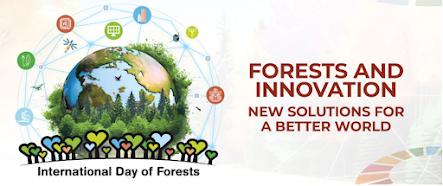
In November 1971, at the request of the European Confederation of
Agriculture, FAO'S member governments supported the annual observance of
21 March as World Forestry Day. Since then many nations have adopted
this practice. In schools and public buildings in Nigeria, World
Forestry Day posters appeared calling attention to "Our Forest
Heritage." In the United States, a presidential proclamation marked
World Forestry Day as part of a week of activities and ceremonies about
the role of the forest and forestry in every man's life. In Australia, a
national committee representing states, territories, universities and
timber producers launched a campaign which included distribution of free
booklets (
Forests are forever; Forestry, the environmentally compatible industry)
and a 15-minute television film. In multilingual Switzerland, the
press, radio and television, encouraged and assisted by the information
services of the state forest service, described in French, German and
Italian the important role played by forests and forestry in the
economy, in the protection and conservation of the environment, and in
the mountain heritage and culture of the Swiss people.
Case Study : Forests in Finland , Forests in Vietnam
The need to explain
Forestry, more than other branches of agriculture, is an activity
which needs to be brought before the public, as is well noted in the
article entitled "Explaining forestry to forest users". But to make the
practices and benefits of forestry comprehensible to the public is not
as simple as it may at first seem. This is partly because of the long
time scale involved in forest management compared to the increasingly
rapid pace which modern man has come to accept as normal in so many
other activities. In some countries there is also a residue of public
suspicion of foresters as the "policemen of the woods" and this has to
be overcome.
Every forester appreciates and understands the value of the
forest as a source of raw material, as a provider of local employment
and national income, as the great sponge which gathers and releases
water, as the habitat for flora and fauna that otherwise would become
extinct, and as the environment and atmosphere in which man feels
uniquely at home with nature. If foresters and forest services talk in
plain language about that which they know best, people will listen,
understand and be with them.
Sir Frank Fraser Darling rightly says: "Man is weaned of the
forest, and yet the forest is still very much a part of us." This is at
the root of the concern of so many people today for the preservation of
forests and other natural environments.
We would like to know about the various kinds of
World Forestry Day activities in different countries so as to better communicate ideas
among them. Those in charge of such activities should send samples of
their efforts - posters, booklets, press cuttings, photographs and films
- to
unasylva.
FAO congratulates and supports the European Confederation of Agriculture in its efforts to promote World Forestry Day.
Shifting cultivation, the oldest system of farming still widely
practiced, is destroying forests, degrading land and causing erosion in
many parts of the world on a vast scale. There are an estimated 3.6
thousand million hectares currently under shifting cultivation
throughout the world and it is believed that some 250 million persons
live by it.
The situation is particularly serious in countries where there is
population pressure on the land, such as in the tropics of Asia. This
is a problem of historic importance in which food production and forest
management are the interlocked elements and, it is widely felt, the
foresters have the key.
As is shown in the article by Krit Samapuddhi of Thailand (page
20) and the report from the Philippines by Rifat Alwi (page 22),
agri-silvicultural methods -
taungya and its variations-are
providing viable working alternatives to uncontrolled slash-and-burn
agriculture. In various ways agri-silviculture seeks to create harmony
between crop farming and tree farming. Both reports point out that
agri-silviculture is not easy and does not always work. Patient,
flexible, intelligent administrators with an understanding and sympathy
for the farmers of the forest, their traditions and their human needs,
are among the most important elements for the success of any system of
agri-silviculture.
Preventing forest destruction
At a time where there is an awareness throughout the world of the
serious imbalance between food production and distribution and
population increases, there should be much more research and practical
work on agri-silviculture for tropical countries. As foresters we should
also spread an awareness of the imbalance between the vast areas of the
tropics which are being devastated by unchecked slash-and-burn
cultivation and the relatively small areas where agri-silviculture is
being practiced, and in good part successfully practiced. The latter can
and should be greatly increased. Forest services in tropical countries
and university faculties specializing in tropical forestry should
concentrate more resources and efforts in these directions.
Are you looking for FAO documents on forestry?
You can locate them with the new two-volume
ANNOTATED BIBLIOGRAPHY (Vol. 1)
and
AUTHOR AND SUBJECT INDEX (Vol. 2)
Publications and documents for the period 1967-73 covering
forestry, forest industries, forestry education, administration,
environment, wildlife and related forestry subjects.
A total of 917 pages with 33350 index references
Price: US$10.00 £4.00 FF50.00
From these basic reference books you can order the actual publications and documents.
If out of print, FAO publications and documents are availabe on MICROFICHE
Size: 105 x 150 mm (Cosati Format A-6) up to 60 document pages on a card Price per microfiche: US$1.00 £0.40 FF5.00
Orders to be sent to FAO - Distribution and Sales Section, Via delle Terme di Caracalla, 00100 Rome, Italy