FORUM: "Bee together for people and the planet: A partnership that sustains us all." World Bee Day 2026. For millennia, bees and people have shared a close and evolving connection, shaped by the ways communities across the world have relied on bees for food and livelihoods, with bees often becoming part of their cultural identity. From honey hunting to a large variety of beekeeping systems, this relationship has continually adapted to different environments, technologies, and socio-cultural needs. The observance of the World Bee Day 2026 focuses on how humans and bees have been working together to nourish and sustain people and the environment. It will highlight the evolution of beekeeping across diverse cultures and landscapes over thousands of years, while promoting innovative approaches that improve bee production and health, and support the livelihoods of beekeepers, including women and youth. It will also emphasize how both traditional knowledge and modern technologies can contribute to sustainable beekeeping, and how partnerships and inclusive approaches can help secure a sustainable future for both pollinators and people, while advancing the transformation of agrifood systems. This theme aligns closely with the International Year of Rangeland and Pastoralists 2026 and the International Year of the Woman Farmer 2026, offering valuable opportunities to reflect on the role of beekeeping in rural and pastoral livelihoods and its contribution to women’s empowerment. Follow the conversations with the hashtags; #SustainableBeekeeping, #Pollination, #savethebees, #worldbeeday, #beekeepers, #20May.
By observing World Bee Day each year, we can raise awareness on the essential role bees and other pollinators play in keeping people and the planet healthy, and on the many challenges they face today. The date for this observance was chosen as it was the day Anton Janša, a pioneer of modern apiculture, was born. Janša came from a family of beekeepers in Slovenia, where beekeeping is an important agricultural activity with a long-standing tradition. Today bees, pollinators, and many other insects are declining in abundance. This day provides an opportunity for all of us – whether we work for governments, organizations or civil society or are concerned citizens – to promote actions that will protect and enhance pollinators and their habitats, improve their abundance and diversity, and support the sustainable development of beekeeping. Register to participate!
Visual identity: Bees are essential for pollination, biodiversity, and a sustainable future. Let’s come together to: Preserve Biodiversity, Protect Bees and Promote Sustainability.
LIVESTREAM: Celebration held by the Khadi and Village Industries Commission (KVIC) at the SMVEC. In honoring the tiny pollinators that make a huge impact on our planet, this special celebration organized by the Khadi and Village Industries Commission (KVIC), the Ministry of MSME, and the Government of India, in collaboration with leading academic and innovation institutions. The Expert talks on beekeeping & biodiversity; Awareness on sustainable ecosystems following by Live sessions with researchers, innovators & entrepreneurs on the Importance of honey bees in agriculture and food security.
FORUM: “Bee inspired by nature to nourish us all.”. World Bee Day 2025. This year’s theme will underscore the critical roles of bees and other pollinators in agrifood systems and the health of our planet’s ecosystems. Bees and other pollinators are essential for our existence, sustaining agriculture and biodiversity worldwide. With over 20,000 species of bees and various other wild pollinators, they face challenges from human activities, such as habitat loss, pesticide use, and climate variability. Our world would be a very different place without bees and other pollinators! These amazing creatures are vital to our existence, and we owe them so much. Without pollinators, our diets would be very different, and so would our agriculture and biodiversity. Since 2018, World Bee Day has been an occasion to celebrate these tiny miracle workers globally. In 2025, under the theme "Bee inspired by nature to nourish us all", the World Bee Day celebration will shine light on the vital roles of bees and other pollinators in ecosystem restoration, biodiversity conservation and food security and nutrition. It is thanks to the over 20 000 bee species and various other wild pollinators that we can produce most of the crops we eat. These range from butterflies through birds and bats to other unsung heroes of pollination such as several species of monkeys, rodents, lemurs, tree squirrels, olingo and kinkajou. In fact, they pollinate 87 out of 115 world's leading food crops. In addition to their contribution to agricultural production, pollinators play an important role as indicators of ecosystem’s health. Their cyclical presence or absence signal changes that affect the entire ecosystem, for instance. This World Bee Day celebration is a unique opportunity to appeal to beekeepers, pollination experts, researchers, policy makers, Indigenous Peoples, industry representatives, civil society organizations and individuals from around the world to:
Raise awareness – Disseminate information on the importance of bees and other pollinators to food security and nutrition and environmental sustainability.
Foster collaboration – Establish a "Friends of Bees and Pollinators" network to drive global and local action.
Promote nature-positive and agroecological approaches – Advocate for pollinator-friendly practices and policies at national and international levels.
Showcase creativity, traditional knowledge and innovations – Highlight outputs of groundbreaking research, Indigenous Peoples’ knowledge and practices for the conservation and sustainable use of pollinators, and sustainable beekeeping initiatives that support communities and livelihoods.
Together, let’s amplify and reinforce the contributions of bees and other pollinators to resilient agrifood systems and highlight the vital roles of all actors in conserving and sustainably managing them. Follow the conversations with the hashtags: #worldbeeday, #20May, #SavetheBees.
From (09:00 – 10:00; Ethiopia time, UTC+3) - Opening of the World Bee Day 2025.
Moderator: Yurdi Yasmi, Director of Plant Production and Protection Division, FAO.
Keynote addresses may include:
His Excellency Moses Vilakati, Commissioner for Agriculture, Rural Development, Blue Economy, and Sustainable Environment, African Union Commission (AUC) (TBC).
Astrid Schomaker, Executive Secretary of the Convention on Biological Diversity (CBD) - video message.
Rita Bissoonauth, Director of the United Nations Educational, Scientific and Cultural Organization (UNESCO) Liaison Office in Addis Ababa, Ethiopia.
Her Excellency Mateja Čalušić, Minister of Agriculture, Forestry and Food of Slovenia - video message.
Abebe Haile-Gabriel, Assistant Director-General and Regional Representative for Africa, FAO.
QU Dongyu, Director-General, FAO - video message.
His Excellency Girma Amente, Minister of Agriculture Ethiopia.
Guest of Honour – Government of the Federal Democratic Republic of Ethiopia (TBA).
From (11:00 - 12:00; Ethiopia time, UTC+3). Raising awareness and screening of animated film for the youth.
Short remarks by Farayi Zimudzi, FAO representative in Ethiopia and Subregional Coordinator for Eastern Africa and Representative to the AU and UNECA, ad interim, addressing the youth prior the film screening
Short remarks by Yurdi Yasmi, Director, Plant Production and Protection Division (NSP), FAO
Presentation of animated film entitled “Asali: Power of The Pollinators” by Maya Penn, Film Director and Chief Executive Officer (CEO), “Maya's Ideas 4 The Planet” (online)
Screening of animated film “Asali: Power of The Pollinators”
STATEMENTS: Read the message of the Executive Secretary of the Convention on Biological Diversity on World Bee Day 2025; May 20th.
"This call is extended to all Member Nations, international and regional organizations, civil society, leaders of Indigenous Peoples, researchers, the private sector, everyone working in the sector and anyone with an interest in bees and other pollinators to get involved, share their experiences and show how important these pollinators are," says Yurdi Yasmi, Director of the FAO Plant Production and Protection Division.
FORUM: “Bee engaged with Youth”. World Bee Day 2024. Bees and other pollinators are essential for our existence, sustaining agriculture and biodiversity worldwide. With over 20,000 species of bees and various other wild pollinators, they face challenges from human activities, such as habitat loss, pesticide use, and climate change. In recognition of the pivotal role that youth can play in addressing challenges bees and other pollinators are facing, the theme of World Bee Day 2024 will highlight the importance of involving young people in beekeeping and pollinator conservation efforts, recognizing them as the future stewards of our environment. This year's the World Bee Day 2024 campaign aims to raise awareness among youth and other stakeholders about the essential role of bees and other pollinators in agriculture, ecological balance, and biodiversity preservation. By engaging young people in beekeeping activities, educational initiatives, and advocacy efforts, we can inspire a new generation of environmental leaders and empower them to make a positive impact on the world. Fostering more diverse agricultural systems and reducing reliance on toxic chemicals can facilitate increased pollination. This approach can improve food quality and quantity, benefiting both human populations and the ecosystem. Follow the conversations with the hashtags: #worldbeeday, #20May, #SavetheBees.
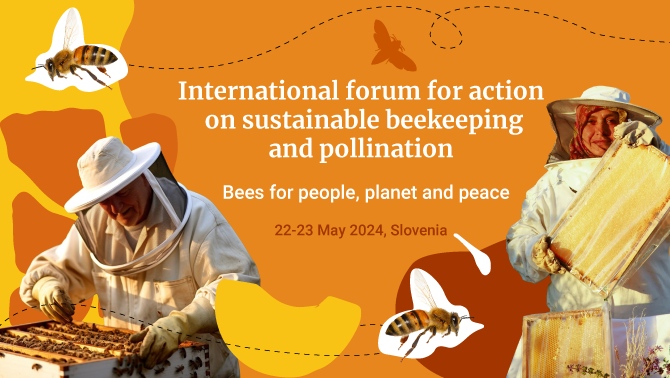
EVENTS: On May 22nd, The Government of Slovenia and FAO organize the International forum for action on sustainable beekeeping and pollination; This hybrid event entitled “Bees for people, planet and peace” will be held from the FAO headquarters starting at 09.00 GMT. The event brings together governments, experts, business and civil society to give a regular fresh impetus to the international cooperation on beekeeping and pollination and to align it with the quickly changing needs. It also provides a platform to share experience from beekeeping and pollination development projects and initiatives around the globe – to learn and get inspired by them. The forum will provide an opportunity for in-depth dialogue and reflection. Tune up to watch the livestream!
Worldwide events
In Geneva May 21st, 2024; The celebration of World Bee Day will take place at the Palace of Nations. Find out more
In Slovenia; From 22 to 23 May 2024; will be held the International Forum for Sustainable Beekeeping. Find out more
In Madrid, Spain; From June 15 to 16th will be held the Bee Health Symposium 2024. Find out more and register
Why did some bees stay in the hive when it swarmed? Can I cut swarm cells out of my hive?
I see a lot of pollen in my honey supers. Should I worry?
How can I use a double deep to manage swarms?
When using a double screen, can I put the queen in the top box?
How do I know when to add another brood box? Should I treat with oxalic acid right now?
Should I cyclically treat using oxalic acid? What are the requirements for selling honey in Connecticut?
Welcome and announcements Watch transparent hive creation & follow along (more discussion)
Early season package installation cautions & reminders Do bees like to feed on forsythia?
How do you grind pollen - what are the sizes etc.?
iNaturalist - how to use it and what CBA is doing to collaborate
View graph showing weight and temperature inside a colony (additional graph of another hive
What should I spray new bee packages with?
Walkthrough of oxylic acid label and instructions.
Is a dribble as effective as a vaporization?
Should I be feeding in March?
How will I know if my bees need food right now?
My bees haven’t eaten their sugar cakes - can I reuse them?
Will the solar eclipse affect on my bees’ behavior?
What is checkerboard mite check?
What do the blocks mean on a sticky board?
Can feeders be left on during vaporization treatment?
Which electric fencing do you recommend for bee yards?
Will it hurt my dogs?
Broodminder gave sensors to beekeepers in the eclipse trail to monitor activity Is there a certain time of day that is better for vaporization treatment?
Is anyone using Slovenian hives in CT?
Can I convert from Langstroth?
Will bees get shocked by an electric fence?
Do we need to worry about bees creating toxic honey if there is mountain laurel in our area?
Should I put bacon on my bear fence?
No. No you should not. How’s the transparent hive doing?
View additional graph showing temperature and sensor data in a different hive Excitement about transparent hive experiment
Example of a bee carrying pollen
When do I install Supers?
How do I prevent mass hive death?
What’s the difference in modern mite reading methods?
FORUM: “Bee engaged in pollinator-friendly agricultural production.”. World Bee Day 2023. Bees and other pollinators are fundamental for the health of ecosystems and food security. They help maintain biodiversity and ensure the production of nutritious food. However, intensive monoculture production and improper use of pesticides pose serious threats to pollinators by reducing their access to food and nesting sites, exposing them to harmful chemicals, and weakening their immune systems. Under this year theme, we call for global action to support pollinator-friendly agricultural production and to highlight the importance of protecting bees and other pollinators, particularly through evidence-based agricultural production practices. Follow the conversations with the hashtags: #worldbeeday, #20May, #SavetheBees.
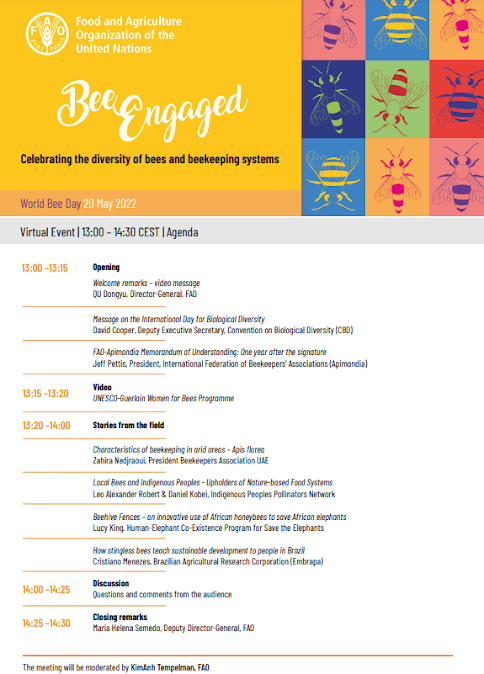
Bee engaged – Celebrating the diversity of bees and beekeeping systems.
Beekeeping is a widespread and global activity, with millions of beekeepers depending on bees for their livelihoods and well-being. Together with wild pollinators, bees play a major role in
maintaining biodiversity
ensuring the survival and reproduction of many plants
supporting forest regeneration
promoting sustainability and adaptation to climate change
improving the quantity and quality of agricultural systems
The event featuring bee and pollinator experts and practitioners from across the world will open with a video message by FAO Director-General QU Dongyu. The event will raise awareness on the importance of the wide variety of bees and sustainable beekeeping systems, the threats and challenges they face and their contribution to livelihoods and food systems.
Our ecosystem and 1/3 of the world’s food production depend on #bees & other pollinators, which are today under threat from human activities. Although farmers & policymakers play a pivotal role in safeguarding pollinators, we can all help
Aware of the problems facing beekeepers worldwide. Bee population decline at an alarming rate, with many commercial and hobby beekeepers reporting higher Bee colony losses than ever before. Beekeeping can be an expensive hobby, and costs of hive losses increase business overheads making it harder for commercial beekeepers to stay in business.


 .
.