 |
| 30 August |
The classic image of a victim of enforced disappearance is that of
a person being deprived of liberty, taken to a secret place of detention, and
being kept there without any further contact with the outside world. Yet victims
of enforced disappearances are also the parents, children, partners or friends
of those who have disappeared; anguished women and men desperately seeking any
information, even if only a clue, that will lead them to their loved ones.
According to the International Convention for the Protection of
All Persons from Enforced Disappearance, a victim is also “any individual who
has suffered harm as the direct result of an enforced disappearance”. With the
support of their communities, human rights defenders, and non-governmental
organizations, these victims seek and demand adequate responses from the
authorities. They have a right to know the truth regarding the circumstances of
these disappearances, the progress and results of any investigations, and
ultimately, the fate and whereabouts of their loved ones.
All States have an obligation to investigate, prosecute and punish
enforced disappearances, as well as to provide redress to its victims. However,
victims often face a lack of responsiveness or outright hostility from the
authorities to which they reach out. The Committee on Enforced Disappearances
and the Working Group on Enforced or Involuntary Disappearances, the two main
United Nations expert mechanisms in this realm, have received accounts of
reprisals such as arbitrary arrests, threats, and intimidation against
relatives, or against the human rights defenders, lawyers, and non-governmental
organizations that support them.
On this International Day, I call on States to acknowledge that
family members and friends of the disappeared are also victims, and to guarantee
their right to full protection from any form of reprisals. I also urge all
Member States to sign, ratify or accede to the International Convention for the
Protection of All Persons from Enforced Disappearance, which includes specific
provisions against the ill-treatment or intimidation of witnesses, relatives,
and persons participating in the investigation of enforced disappearances.
Ban Ki-moon
FORUM: International Day of the Disappeared on August 30
Hundreds of thousands of people have vanished during conflicts or periods of
repression in at least 85 countries around the world.
News :
“Every minute counts” – UN experts
raise alarm over short-term enforced disappearances International Day of the
Victims of Enforced Disappearances - Tuesday 30 August 2016
GENEVA (26 August 2016) – Two United Nations expert groups on enforced
disappearances called on States worldwide to prevent and eradicate enforced
disappearances, including short-term enforced disappearances, and to ensure that
relatives of persons deprived of their liberty are informed accurately and
promptly of their detention.
Speaking ahead of the International Day of the Victims of Enforced Disappearances, the Committee on Enforced Disappearances and the Working Group on Enforced or Involuntary Disappearances also expressed their concern at allegations of intimidation and reprisals against victims of enforced disappearances and those who report their cases.
“There is no time limit, no matter how short, for an enforced disappearance to occur. Every minute counts when a person is put outside the protection of the law. And when a person is disappeared, every anguished minute spent by his or her relatives without news of that person is a minute too long.
Reports and complaints have been received of people being briefly detained by State authorities, who then refuse to acknowledge their detention, nor allow them to make contact with their family members or their counsel, depriving them temporarily of any kind of legal protection.
Under these circumstances, and whatever their duration, these detentions amount to enforced disappearances, for which the States concerned bear international responsibility.
States have the obligation to disclose the whereabouts of persons who are deprived of their liberty; to hold them in officially recognized places of detention; and to promptly provide accurate information on their detention to their family, their counsel, or other persons with a legitimate interest.
The relatives of persons who have disappeared have the right to know the truth regarding the fate and whereabouts of their loved ones. Unfortunately, their claim for truth and justice often gives rise to intimidation and reprisals. We have received worrying reports of acts of retaliation against relatives, witnesses and human rights defenders who report cases of enforced disappearances to the authorities, or who bring them to the attention of the Working Group or the Committee.
As we commemorate the International Day of the Victims of Enforced Disappearances, we encourage all victims and their relatives to continue engaging with the UN human rights mechanisms* and to make use of the avenues available against any form of intimidation and reprisal. These include the San José Guidelines against intimidation and reprisals adopted by the treaty bodies, and the framework for action on alleged acts of intimidation and reprisal, adopted by the Special Procedures mandate holders to strengthen their ability to provide a systematic and coordinated response to this phenomenon.
We also reiterate our call to all States to ratify or accede to the International Convention for the Protection of All Persons from Enforced Disappearance, as a fundamental first step towards the prevention, and the ultimate termination, of the inadmissible practice of enforced disappearances.”
(*) How to submit urgent actions:
To the Committee on Enforced Disappearances:
To the Working Group on Enforced or Involuntary Disappearances:
Guidelines against Intimidation or Reprisals (“San José Guidelines”)
Special Procedures framework on addressing reprisals on enforced disappearances :
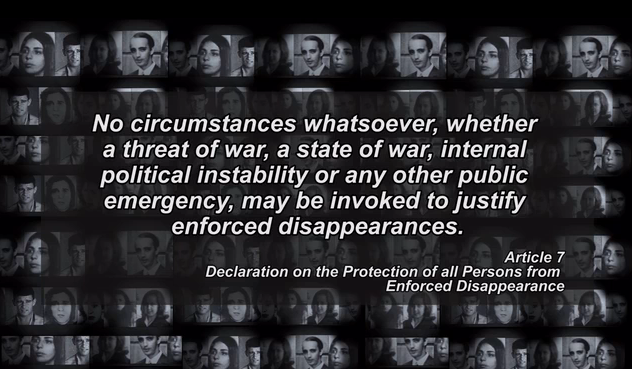 |
| #ARTICLE7 on Enforced Disappearances |
Conférences AUDIO/VIDEO : Forced disappearances leave communities in "spiral of anguish" | United Nations Radio

