Showing posts with label UNOCHA. Show all posts

Wednesday, 19 August 2026

World Humanitarian Day 2026, August 19th.

ACT FOR  HUMANITY


FORUM: "#ActforHumanity" World Humanitarian Day 2026. 2025 set another grim record for violence against aid workers, with 907 colleagues killed, injured or kidnapped, the Office for the Coordination of Humanitarian Affairs (OCHA) said today on World Humanitarian Day.

While the death toll decreased slightly to 350 last year, the overall level of violence did not ease: 322 aid workers survived attacks that left them injured while 235 were kidnapped, according to Humanitarian Outcomes’ Aid Worker Security Database.

With 186 humanitarians killed, Gaza remained the deadliest context for the third year running, followed by Sudan with 71 killed.

So far in 2026, 82 aid workers have been killed, 97 injured and 39 kidnapped across the world.

“More than 1,000 aid workers have been killed in just three years and that is utterly unacceptable,” said Tom Fletcher, Under-Secretary-General for Humanitarian Affairs and Emergency Relief Coordinator. “But just calling it out will not protect the next aid worker. States must uphold international humanitarian law and use every tool to protect civilians and our colleagues. And for those who break the rules, there must be real consequences.”

Of particular concern is the proliferation of cheap and adaptable armed drones that are putting lethal power into ever more hands and sending more explosive weapons into towns and cities.

In Sudan, armed drones caused 80 per cent of civilian deaths in the first four months of 2026, hitting markets and health facilities.

In Ukraine, drones killed 80 civilians in April this year alone, while in the Russian Federation, civilians have been killed and civilian infrastructure damaged because of drone attacks.

In Colombia, attacks using weaponized drones quadrupled between 2024 and 2025.

Humanitarians are increasingly in the crosshairs of armed drones. In March this year, an aid worker was killed in a drone strike on a residential building in the Democratic Republic of the Congo. In just one week in May, four humanitarian convoys were hit in Ukraine.

"Weaponized drones have become the new face of an old danger: the deliberate or reckless destruction of civilian life,” Mr. Fletcher said. “The technology may change, but the laws of war do not.”

This year’s global campaign, Act for Humanity, spotlights aid workers who have been killed, through interviews with their families. Behind every statistic is a family whose world has been torn apart. This year's observance is calling for greater protection of humanitarian workers and civilians, safe and unimpeded humanitarian access, and accountability for attacks and violations of international humanitarian law. This year, the demand is clear: act early before warning signs become casualty lists. Stop the violence. Stop the obstruction. Investigate every attack. Prosecute those responsible. Support survivors and families. WHD is a campaign by the United Nations Office for the Coordination of Humanitarian Affairs (OCHA). 

Follow the conversations with the hashtags:  #ActForHumanity, #19August, #WorldHumanitarianDay, #humanitarian


Statement of the United Nations Secretary-General on World Humanitarian Day 2026, August 19th.

On World Humanitarian Day, we honour the dedicated workers who provide life-saving aid to millions in need. We also confront an appalling truth: Serving others has become more dangerous than ever. More than a thousand humanitarians have been killed in the last three years. Most were local staff supporting their own communities. Countless others narrowly survived being shot at, shelled, bombed, kidnapped, or raped. Schools and hospitals are coming under fire. And new tools of war – including armed drones – are posing fresh risks. At the same time, disinformation is eroding trust. Humanitarian funding is being cut. And humanitarian access is being restricted. We see aid convoys blocked. Aid workers threatened, arrested, and detained. And people in desperate need left without support. Attacks on humanitarian workers are illegal. And the consequences are devastating. For families struggling to survive. Children waiting for food. Patients seeking urgent care. And so many more. The world has made commitments. Now it must act: To respect the rules of war; Ensure safe access; Hold perpetrators accountable; And provide sufficient resources. Humanitarian workers stand up for people in need. We must stand up for them. We must act for humanity – now.


António Guterres.

EVENTS: On August 19th, starting at 4 p.m., the UN Geneva held a commemorative event in the memory of those who paid the utmost sacrifice in line of duty and to honour the invaluable contribution of humanitarian workers. The event will bring together partners from across the humanitarian system to advocate for the survival, well-being and dignity of people affected by crises, and for the safety and security of aid workers. Register to participate and Watch the livestream!


Agenda Programme


World Humanitarian Day 2026 – Commemoration Ceremony.
Tuesday, 19 August 2026, 4 p.m.
Salle des Pas Perdus, 3rd Floor, Building A, Palais des Nations


4 P.M. OPENING OF THE EVENT

Master of ceremony: Ms. Alessandra Vellucci, Director, United Nations Information Service at Geneva

Wreath laying and candle lightning ceremony by the United Nations

Laying of flowers by the survivors and families of the victims of the attack against the United Nations Mission in Baghdad of 19 August 2003, and other UN offices

Laying of flowers by the Permanent Representative of the Republic of Iraq to the United Nations and other international organizations in Geneva

Remarks by Ms. Tatiana Valovaya, Director-General, United Nations Office
at Geneva

Minute of silence

Remarks by Mr. Barham Salih, United Nations High Commissioner for Refugees

Remarks by Ms. Awa Dabo, Deputy High Commissioner, Office of the High Commissioner for Human Rights

Remarks by H.E. Mr. Saywan Barzani, Permanent Representative of the Republic of Iraq to the United Nations Office and other international organizations in Geneva

Remarks by Ms. Shawbo Taher-Al-Talabani, survivor of the 19 August 2003 terrorist attack against the United Nations Mission in Baghdad

Remarks by Ms. Laura Johnson, Executive Secretary, UNOG Staff Union

Remarks by Ms. Gemma Connell, Officer-in-Charge, Humanitarian Sector Division, Office for the Coordination of Humanitarian Affairs

5 P.M. CONCLUSION OF THE EVENT.


Annual observance of World Humanitarian Day at the Palais des Nations, Geneva, Switzerland.

On 19 August 2003, a bomb attack on the Canal Hotel in Baghdad, Iraq, killed 22 humanitarian aid workers, including the UN Special Representative of the Secretary-General for Iraq, Sergio Vieira de Mello. Five years later, the General Assembly adopted a resolution designating 19 August as World Humanitarian Day (WHD). Since then, WHD has become OCHA's annual flagship campaign. Each year, WHD focuses on a theme, bringing together partners from across the humanitarian system to advocate for the survival, well-being and dignity of people affected by crises, and for the safety and security of aid workers. This year, we call for an end to the attacks on humanitarians and civilians and impunity under International Humanitarian Law. We urge those in power to #ActForHumanity.
Lowering of the UN Flag to half mast in observance of World Humanitarian Day 2026, and in honour of humanitarian personnel who have lost their lives.


 Lowering of the UN Flag to half mast in observance of World Humanitarian Day 2026, and in honour of humanitarian personnel who have lost their lives.

Led by the United Nations Office for the Coordination of Humanitarian Affairs (OCHA), the 2026 campaign theme under #ActForHumanity spotlights the grave dangers aid workers face—particularly from weaponized drones—and shares the personal stories of fallen humanitarians through their families.

Watch the Lowering of the UN Flag to half mast in observance of World Humanitarian Day 2026, and in honour of humanitarian personnel who have lost their lives


UN FLAG


Meetings & Events

Lowering of the UN Flag to half mast in observance of World Humanitarian Day 2026, and in honour of humanitarian personnel who have lost their lives. Wreath-laying by the Secretary-General, H.E. Mr. António Guterres in front of the plaque honouring those who lost their lives in Baghdad, followed by a moment of silence.

The commemoration of the bombing of the United Nations headquarters in Baghdad (Iraq) will be observed with a brief ceremony organized by the UN Staff Union's Standing Committee on the Security and Independence of the International Civil Service.

The ceremony also marks the observance of World Humanitarian Day designated by the General Assembly in 2008 to coincide with the date of the bombing in Baghdad.

The Day also honours humanitarian aid workers who have been killed or injured in the course of their work.

Confirmed attending survivors (in-person):Mr. Salim Lone, the spokesperson in Baghdad for Mr. Sérgio Vieira de Mello, the head of the UN mission in Iraq. Mr. Lone currently writes columns for a newspapers, including The New York Times, The Guardian, The Washington Post, The Sunday Nation (Kenya), and publishes on the Iraq war. More about Mr. Lone: Salim Lone - Wikipedia
Mr. Francis Mead, UN and BBC Filmmaker/Writer: He was working on the day of the bomb blast in the Canal Hotel - reporting on the situation in Iraq for the IRIN news service - which was then part of the UN. He is from the UK and worked for the UN for 25 years, mostly making documentaries, before retiring in 2023.
Mr. Darko Mocibob, Director, Political Affairs - Middle East Division, DPPA-DPO.
Mr. Romano Lasker, Manager, Humanitarian Development Peace, Crisis Bureau, UNDP.

Other survivors and family members of the victims will also join us live on UN Web TV.View less
Related Sites and Documents: Press release.


CAMPAIGN: Despite repeated promises from the international community, humanitarians continue to come under attack, with over 1,000 aid workers killed in the past three years alone. On World Humanitarian Day, 19 August, join our call to end these violations and the impunity that allows them. #ActForHumanity.


World Humanitarian Day 2026


Thursday, 4 June 2026

International Day of Innocent Children Victims of Aggression 2026; June 4th.


June 4th.


FORUM
: "Shattering the Cycle of Impunity: Reaffirming the Rights of the Child in Times of Armed Conflict.'' International Day of Innocent Children Victims of Aggression 2026.


Focus on the Erosion of the Protected Status of the Child: Contemporary armed conflicts have increasingly transcended traditional combat zones, infiltrating the spaces where children should be afforded sanctuary-their homes, schools, and healthcare facilities. The gravity of these violations is cataloged in the annual reports of the United Nations Secretary-General on Children and Armed Conflict, revealing a landscape where the rights of the child are routinely disregarded. The use of explosive weapons in densely populated areas, including indiscriminate shelling and the use of remnants of war, has inflicted physical and psychological trauma upon a generation. Beyond these casualties, we are witnessing the recruitment of children into armed forces, the use of sexual violence as an instrument of terror, and the abduction of minors. Furthermore, the denial of humanitarian access- the obstruction of food, life-saving medicine, and essential education-constitutes a violation of the right to life, survival, and development as guaranteed under international human rights law. These are not merely collateral consequences; they are violations that dismantle the future of these children.

Focus on the Legacy of the 1996 Graça Machel Report: A turning point in this advocacy arrived in 1996 with the report, Impact of Armed Conflict on Children, authored by Graça Machel. This study shifted the international paradigm by documenting how armed conflict destroys the infrastructure essential for a child’s survival, including schools, clean water systems, and healthcare networks. Machel’s work exposed the reality of the "weaponization of childhood," wherein children were forcibly recruited into hostilities through abduction and coercion. The report did not merely observe this suffering; it demanded systemic change. Machel insisted that the protection of children be integrated as a pillar of all peace and security agendas, arguing that any peace process failing to prioritize the rehabilitation and safety of children is unsustainable. Her report led to the creation of the mandate of the Special Representative of the Secretary-General for Children and Armed Conflict, establishing a mechanism to monitor violations and advocate for the accountability of perpetrators who treat children as collateral damage. The international community has forged a legal architecture to safeguard children, anchored by the 1989 Convention on the Rights of the Child (CRC). As the primary instrument for the protection of minors, the CRC obligates States to ensure the survival and development of every child. These mandates are strengthened by the Optional Protocol on the Involvement of Children in Armed Conflict, which establishes a prohibition against the recruitment and participation of children in hostilities. Complementing these are the Geneva Conventions and their Additional Protocols, which dictate the distinction between combatants and non-combatants, mandating protection for children against the effects of warfare. Despite the universality of these instruments, a chasm exists between legal obligations and ground-level realities. We are witnessing an erosion of international norms, characterized by a climate of impunity where the perpetrators of these violations continue to act without fear of legal consequence. Monitoring and reporting mechanisms are essential, but they are ineffective in the absence of an enforcement apparatus capable of ensuring accountability. Follow the conversations with the hashtags: #ChildViolence, #4june, #ChildVictimsDay, #childabuse, #ChildProtection.


EVENTS: On Thursday, June 4th, the international community will observe the International Day of Innocent Children Victims of Aggression 2026. A webinar will be held to mark the day. The observance was established by the United Nations General Assembly in 1982, this day emerged as a response to the suffering of Palestinian and Lebanese children during the 1982 Lebanon War. This historical genesis serves as an indictment of the international community’s failure to prevent the targeting of the most vulnerable. The United Nations highlight that children, whose status as protected civilians is enshrined in international law, continue to be subjected to acts of aggression, it's time to re-evaluate our collective commitment to their safety and dignity. Register to participate!


This Guidance Note was authored by Sophie Solomon Federspiel, under the supervision of Dragica Mikavica as the project manager, and with the substantial support of Claire Bertouille. OSRSG CAAC would like to express profound gratitude to a myriad of contributors who have provided invaluable insight and feedback during the creation of this Guidance Note. The Note is the result of thorough consultations with numerous field staff members, NGO partners and others who engage with MRM on grave violations against children. Special thanks are extended to members of the Technical Reference Group, including UNICEF, DPO and DPPA, and to OCHA for its subject matter expertise. We are particularly grateful to our colleagues in the United Nations Support Mission in Libya and the United Nations Mission in South Sudan who facilitated field missions associated with the project and provided support during the research phase. Finally, our deepest appreciation goes to the mothers, children, community leaders and the people we met along this journey. Those individuals shared their personal stories and experiences with us, offering a keener understanding of the harsh realities surrounding DHA and its impact on children in situations of armed conflict and other situations of violence. Their voices have been instrumental in the formation of this Guidance Note.


Read the latest report of the Secretary-General entitled ''Children and armed conflict''. 


Saturday, 20 December 2025

International Human Solidarity Day 2025; December 20th.


International Human Solidarity Day 2025


FORUM: “A call for unity and action.” International Human Solidarity Day 2025. Solidarity is the principle that recognizes our common humanity and the interconnectedness of our destinies. It highlights the need for collective effort, cooperation, and mutual understanding to solve complex challenges such as poverty, hunger, climate change, and conflict. This day serves as an opportunity to celebrate achievements made through solidarity and to recommit to building a more just and equitable world. To promote human solidarity, it is important to actively engage in your community, and get involved in different activities and events. This means helping out and supporting causes that help people who are in need. By doing this, we can bring people from different backgrounds together and help them understand each other better. It’s also important to support local projects that help address homelessness, education, and health. In this way, we show compassion for our community members, making sure every individual is cared for. Follow the conversations with the hashtags: #SolidarityDay, #20December, #HumanSolidarityDay, #TheWorldWeWant, #PromotingSolidarity, #LeaveNoOneBehind.


EVENTS
: On December 20th, the United Nations system organizations will hold a virtual event to discuss the values of unity, kindness, and diversity to mark the International Human Solidarity Day 2025 at the UNHQ. The Observance of the International Human Solidarity Day is a special day that reminds us that we are all part of the same human family. It teaches us the importance of working together and helping each other. When we work together in solidarity, we can overcome any problem or difficulty. The celebration of this day will encourage us to think about how we can make the world a better place for everyone. Register to participate!


Our planet is under strain like never before: Temperatures are rising, biodiversity is collapsing, and nearly every person on Earth breathes unsafe air.

Yet there is hope.

Now is the time to invest in resilience, commit to justice, and remember what we are fighting for.

Sustainability is the bedrock on which all our other ambitions rest. Peace, prosperity, equality — none of these exist without a planet to exist on.

Now is the time for courage and creativity.

We must rapidly scale solutions on a range of challenges — from water management and climate resilience, to mining metals and the environmental footprint of Artificial Intelligence.

With the tide turning in favor of renewables, and the help of the next generation, transformation is within reach. We must transform broken systems, unite policy with science, and share solutions with all.

Now is the time set humanity on a path to protect our only home, for generations to come.

Tuesday, 19 August 2025

World Humanitarian Day 2025; August 19th.

FORUM:" #ActForHumanity.'' World Humanitarian Day 2025. A bomb attack on the Canal Hotel in Baghdad, Iraq, killed 22 humanitarian aid workers, including the UN Special Representative of the Secretary-General for Iraq, Sergio Vieira de Mello on 19 August 2003. Five years later, the General Assembly adopted a resolution designating August 19th as World Humanitarian Day (WHD). Since then, WHD has become OCHA's annual flagship campaign. Each year, WHD focuses on a theme, bringing together partners from across the humanitarian system to advocate for the survival, well-being and dignity of people affected by crises, and for the safety and security of aid workers.This year, we call for an end to the attacks on humanitarians and civilians and impunity under International Humanitarian Law. We urge those in power to Act For Humanity. Follow the conversation with the hashtags: #ActForHumanity, #WorldHumanitarianDay, #august19, #safetyandsecurity, #reliefworkers, #aidworkers, #humanitarians.


World Humanitarian Day


EVENTS:  On August 19th, the Annual observance of World Humanitarian Day 2025 at the Palais des Nations, Geneva, Switzerland. Last year on WHD, we demanded protection for humanitarians in conflict zones. Resolutions were passed, promises were made. But nothing changed on the ground. The rules and the tools exist. Security Council resolution 2730 sets a path. A major political declaration is on the way. What we need now is the will – and the courage – from all with power or influence to #ActForHumanity.


Wreath-laying by Mr. Atul Khare, Under-Secretary-General, Department of Operational Support (accompanied by survivors of that bombing).

Watch the Wreath-laying ceremony to honour colleagues who lost their lives at the Canal Hotel, Baghdad!


Wreath-laying ceremony


Message of the United Nations Secretary-General for World Humanitarian Day 2025.


Humanitarian workers are the last lifeline for over 300 million people caught in conflict or disaster.

Yet, funding for that lifeline is drying up.

And those who provide humanitarian aid are increasingly under attack.

Last year, at least 390 aid workers - a record high - were killed across the world.

From Gaza to Sudan to Myanmar and beyond.

International law is clear: humanitarians must be respected and protected. They can never be targeted.

This rule is non-negotiable and is binding on all parties to conflict, always and everywhere.

Yet red lines are crossed with impunity.

Governments have pledged action – and the Security Council has laid out a path to protect humanitarians and their lifesaving work.

The rules and tools exist. What is missing is political will – and moral courage.

On this World Humanitarian Day, let’s honour the fallen with action:

To protect every aid worker – and invest in their safety.

To stop the lies that cost lives.

To strengthen accountability and bring perpetrators to justice.

To end arms flows to parties that violate international law.

Together, let us say in one voice: An attack on humanitarians is an attack on humanity.

And let’s #ActForHumanity

Secretary-General António Guterres.

Remarks by Mr. Tom Fletcher, Under-Secretary-General for Humanitarian Affairs and Emergency Relief Coordinator at the World Humanitarian Day 2025 Commemoration Ceremony.

Dear survivors, families – especially the families – Excellencies and colleagues:

We are here to grieve and honour those we have lost. They are the best of us.

Humanitarians carry hope where there is despair.

They are selfless in a selfish world. They seek to mend what others seek to break. They bring humanity where there is inhumanity.

Yet from that day in Baghdad till now, the best of us are under attack.

Last year, more than 380 humanitarians were killed – not dead, killed – the highest ever recorded. Hundreds more wounded, kidnapped, detained.

In Gaza, 520 aid workers – mostly UNRWA staff – killed since October 2023, the deadliest place for humanitarians for the second year running. This number doesn’t even touch the hundreds of staff who have lost family members, like my colleague Saed Al Ghamri, whose wife Ola was killed in our guesthouse.

In Sudan, 60 colleagues lost their lives – over double the year before. These include my colleague Sadig [Andosa], killed in El Fasher in November.

Already this year, hundreds more names. Each a family, each with a story.

This is more than a statistical spike. It is a stain – the normalization of violence against this community. Each attack on a colleague is an attack on all of us and we do not accept it. Enough.

Zero accountability, an indictment of international inaction and apathy. The Member States must not accept it. Enough.

As a humanitarian movement, we demand the protection of civilians and aid workers and we demand that perpetrators are held to account.

Humanitarians will not retreat, despite these dangers.

Last year, despite the risks, we reached more than 116 million people. Families fed, children in school, sick people cured, communities protected. We will not let down those we serve. It is our way of honouring those who died in 2003 and who have been killed since. But you, the international community, must also not let us down.

So, we grieve again those we’ve lost, and those we’ll continue to lose. We honour those who defy the dangers. We demand their protection and an end to impunity. And we commit afresh to this mission, whatever the risks.

Thank you.

Mr. Tom Fletcher, Under-Secretary-General for Humanitarian Affairs and Emergency Relief Coordinator.
UN Office for the Coordination of Humanitarian Affairs


Remarks by Mr. Ramesh Rajasingham, Head and Representative of OCHA Geneva and Director of the Coordination Division  at the commemoration service for fallen humanitarian workers on World Humanitarian Day 2025.


Survivors, families, Excellencies, colleagues:

I would like to express here my appreciation to Australia and Ambassador Walsh for this initiative and for the important leadership and support you have brought to the protection of aid workers.

19 August is always a hard day. I remember exactly where I was in 2003 when I heard about the bombing of the Canal Hotel in Baghdad. That day, 22 humanitarians were killed, including my former boss, Sergio Vieira de Mello. It was a wound to the humanitarian community that has never healed.

Every year since, on World Humanitarian Day, we gather to honour those we have lost – and to stand with those who continue bringing hope to the world’s hardest and most dangerous places.

But remembrance is not enough. Because today is not only about looking back. It is about confronting a present reality that is unacceptable.

Last year alone, 383 humanitarians were killed – another record. Hundreds more were wounded, kidnapped, or detained. Already this year, the toll is rising again.

We lost 181 colleagues in Gaza – many from UNRWA – who kept classrooms open and food lines running even as the very schools and shelters where they worked were bombed.

We lost 60 colleagues in Sudan, more than double the year before – killed as they tried to deliver medicine, food, and water to those in desperate need.

These are not just statistics. These are fathers, mothers, sons, daughters. Friends, mentors, teammates. They had names. They had families waiting for them at home. And, for the vast majority of them – home was in the same country where they were killed. They are among the thousands of local staff of UN agencies and NGOs who carry the biggest risk, pay the highest prize, yet whose names often go unheard.

These events are not recent. I remember a close colleague and friend who was pulled out of his Landcruiser and executed by armed men. But, what was a rare event in that period, has now become a weekly occurrence and humanitarian innocence is all but lost.

Let us be clear: these attacks are often not accidents of war. Many are deliberate acts. And they continue because the world allows them to continue. Impunity is pervasive. Our calls for justice are too often met with silence, or, even worse, accusations of culpability.

Last year the Security Council passed Resolution 2730, reaffirming the duty to protect humanitarian personnel and hold perpetrators to account. But resolutions mean little if no one enforces them. Words do not save lives. Silence does not protect aid workers. Action does.

That is why remembrance is only a part of our duty today. The other major part is demand. Demand for protection. Demand for accountability. Demand for change. Because the killing of aid workers is not an unfortunate side-effect of war. It is an outrage. It is an attack on humanity itself.

And it isn’t only the bullets and bombs. Humanitarians are being strangled by bureaucratic blockades, by relentless underfunding, by smear campaigns that spread lies and hatred online. Their families scroll through social media and see them vilified for the very work that keeps others alive.

Yet despite it all, humanitarians continue to step forward. Last year, more than 116 million people received aid because colleagues refused to give up. Children had classrooms. Families had food on the table. Displaced communities had shelter and clean water.

This is what humanitarianism means. Not a slogan, not an abstract principle – but lives saved, hope restored, dignity defended.

So today, as we remember those we have lost, let us also honour those still carrying hope. And let us not leave this place without a pledge.

The campaign we relaunch today – #ActForHumanity – is not a hashtag. It is a demand. A demand for protection. For accountability. For action.

To our colleagues in Gaza, in Sudan, in every crisis where humanitarians are risking their lives: we see you. We grieve with you. We stand with you. And we will fight for your protection.

To the families of those who never came home: we cannot fill the space they leave behind. But we can promise this – their names will not be forgotten, and their sacrifice was never in vain.

Because violence against humanitarians is not inevitable. It is a choice – a choice made by people. And together, we must make a different choice. A choice to defend humanity. A choice to end impunity. A choice to act.

Thank you.

Mr. Ramesh Rajasingham.


Remarks by the Executive-Director of the International Organization for Migration (IOM) on World Humanitarian Day 2025.

On World Humanitarian Day, the International Organization for Migration (IOM) joins United Nations agencies and humanitarian organizations in calling for the urgent protection of aid workers and an end to the rising violence against them worldwide. IOM is urging stronger, coordinated, and decisive political action from Member States to halt this alarming trend.

“International humanitarian law explicitly protects humanitarian workers, yet attacks continue with impunity. We see this play out everywhere: convoys attacked, facilities damaged, and aid corridors cut off or rendered unsafe,” said IOM Director General Amy Pope. “When humanitarians are silenced, it’s the people in greatest need who are left without life-saving support. We need to see urgent political will and real accountability to stop these indefensible attacks.”

This year’s World Humanitarian Day comes as the cost for those delivering aid reaches devastating levels. In 2024, attacks killed 383 humanitarian workers, according to the United Nations Office for the Coordination of Humanitarian Affairs (OCHA). In 2025, as of August 15, 265 humanitarian workers have been killed, with at least 202 more wounded, kidnapped, detained or arrested. At the current rate, 2025 is on track to becoming one of the deadliest years on record.

The rise in attacks is unfolding against a backdrop of growing displacement and escalating needs that have left millions dependent on humanitarian assistance. By the end of 2024, conflict and violence had forced 73.5 million people from their homes, according to the 2025 Global Report on Internal Displacement.

IOM and other humanitarian actors are often the first to respond in high-risk environments, and international humanitarian law requires the protection of both civilians and those who deliver life-saving assistance. IOM joins the United Nations and humanitarian partners in calling on all states to use their influence to prevent and end these violations.

"Humanitarians risk their lives every day to help people in need. On World Humanitarian Day, let's honor their service and sacrifice by doing more to protect them now and in the future,” DG Pope said.

Miss Pope, Director at IOM.


Statement by UN Women on World Humanitarian Day 2025.

On this World Humanitarian Day, we honour every humanitarian who risks and -- all too often -- loses their life to help others. We honour the women leaders and local responders who stand on the frontlines, often facing double peril: targeted for the work they do, and for who they are. We pay tribute to those killed, and salute those who keep showing up in the face of danger.

This year’s call to #ActForHumanity is more urgent than ever. The humanitarian landscape is collapsing under escalating violence, dwindling resources, and broken promises of protection.

The past year marked a devastating chapter for humanitarian workers, with more lives lost than ever before and attacks surging significantly. These deaths are not accidents. They stem from systemic failures: impunity for those who break the rules of war, eroded respect for humanitarian principles, and a growing disregard for international humanitarian law.

The violence is compounded by unprecedented funding shortfalls. As at 12 August, only about 18 per cent of the Global Humanitarian Overview’s requirements have been met. Cuts to women responders are severe: a 2025 UN Women survey found that in 44 crisis settings, 72 per cent have laid off staff and over half have suspended programmes. This loss of capacity strips away essential services, increases violence against women, burdens them with heavier unpaid care work, and removes social protections that could prevent harm.

We cannot allow this to be normalized. We call on leaders to act, decisively, now to: Protect humanitarian workers – including women on the frontlines who face targeted violence – and the civilians they serve.
Fund the lifeline that sustains lives – ensuring resources reach women-led and local organizations that are often first to respond and last to leave.
Guarantee the full participation and leadership of women in humanitarian decision-making, recognizing their essential role in effective, inclusive response.

Act now. The world is watching. #ActForHumanity.

UN Women Americas and Caribbean.


Statement by Jorge Moreira da Silva, UN Under-Secretary-General and UNOPS Executive Director, on World Humanitarian Day 2025.

On World Humanitarian Day, we pay tribute to the humanitarian workers who risk their lives everyday to deliver for people caught in crises around the world.


Their courage, compassion and unwavering commitment in the face of adversity embodies the very best of humanity.

Their work could not be more important, now more than ever.

When crises happen, UNOPS helps partners identify and address urgent needs, and helps communities recover and build resilience.


We live at a time of growing humanitarian needs: Our world is more violent now than at any time since the second world war. The climate crisis is wreaking havoc and natural disasters are becoming more intense, longer and more frequent.

And yet 2024 has been the deadliest year on record for humanitarians around the world.

In Gaza, Sudan, and many other places, humanitarian workers are increasingly caught in the crossfire, suffering injuries, abductions, and deaths, just as the people they are there to help.

The deliberate targeting of humanitarian personnel is a violation of international law.

Over the past two years, two of our UNOPS colleagues have been killed in Gaza. Our premises in Gaza have come under attack, at least twice.

We honor the memories of our colleagues and other fallen humanitarians.

We demand an end to attacks on humanitarians and on all civilians. Perpetrators must be held to account.

And we call on everyone to do more to protect and safeguard our common humanity.

To all humanitarian workers — thank you for your strength, dedication, and hope.

We salute you.

And we vow to continue your efforts, to help deliver life-saving assistance and bring dignity and hope to vulnerable communities.


Jorge Moreira da Silva, UN Under-Secretary-General and UNOPS Executive Director.


PUBLICATIONS: 

United Nations Secretary General’s Report on the Protection of Civilians in Armed Conflict
provided by the UN Publication. Learn more


2025 Aid Worker Security Report provided by the Humanitarian Outcomes. Learn more


Rapid support for aid workers at risk provided by the Protect Aid Workers. Learn more

CALL TO ACTION:

When protection is denied and accountability is absent, our voices and actions must fill the void. Aid workers keep going into danger, through checkpoints, under fire. They show up. So must we.

  • Use your voice: Every post, tag and conversation build pressure for protection. Share, speak out and demand action using #ActForHumanity.
  • Fund the lifeline: Humanitarians can’t deliver without safety or support. Help keep aid flowing and protect aid workers – especially local responders.
  • Mobilize: Across cities, campuses and communities; people are taking a stand. Show leaders the world is watching.
  • Create with purpose: Artists, storytellers, influencers – use your art, platforms and brands to stir emotion and inspire action. Make this message impossible to ignore.

Friday, 4 April 2025

International Day for Mine awareness and Assistance in Mine Action 2025; April 4th.


FORUM: ”Safe Futures Start Here” International Day for Mine Awareness and Assistance in Mine Action 2025. Mines, explosive remnants of war, and improvised explosive devices continue to cause death and injury, especially in situations of armed conflict. On average, one person is killed or injured by such explosive device every hour. Many children are among the victims. The use of improvised explosive devices has expanded, terrorizing civilians and threatening humanitarian actors and United Nations missions and personnel. The United Nations mine action community will commemorate the annual International Day for Mine Awareness and Assistance in Mine Action under the theme “Safe Futures Start Here”. The UN mine action community will bring attention to the progress made over the last year and the challenges that remain in countries around the world. Building on the Pact of the Future, considering the condemnation of the devastating impact of armed conflict on all persons including persons with disabilities (Action 14) and seizing “on opportunities provided by new and emerging technologies to empower and advance equity for persons with disabilities, including through promoting the availability of assistive technologies” (Action 29), events and campaigns will focus on raising awareness about the needs of people around the world. The United Nations is calling for a greater responsiveness to the needs and rights of all people with disabilities in conflict and peacebuilding settings. The 2025 campaign will also bring attention to the anniversary of Security Council resolution 2475, which calls upon Member States, and specifically Security Council members, to consider and protect persons with disabilities; to ensure they have access to assistance, and to include them in conflict prevention and peacebuilding. Follow the conversation with the hashtags: #IMAD2025, #safefuturesstarthere, #MineAwareness; #landmines; #4april; #Mineaction.

4 april


EVENTS: On April 3rd, 2025; The Assistant Secretary-General for Rule of Law and Security Institutions, Mr. Alexandre Zouev, and two other UN officials will be guests at the Noon Briefing of the Spokesperson of the Secretary-General. Watch the press briefing!

On April 4th; To commemorate the International Day for Mine Awareness and Assistance in Mine Action 2025; The Permanent Mission of the Republic of Azerbaijan to the United Nations will hold a roundtable discussion entitled “Saving Lives through Humanitarian Mine Action in Azerbaijan”. The briefing will be held in cooperation with the Center of Analysis of International Relations (AIR Center). Details to follow.


Events Around the World:

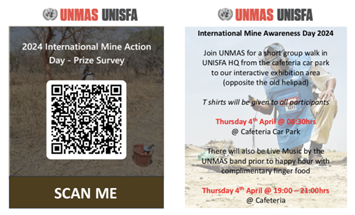
Abyei - On 4 April in Abyei, UNISFA set up an interactive exhibition area about the “Prize Survey” and invited the staff to the “Show and Tell” event. They will be presenting a skit on explosive ordnance risk education to raise awareness about the dangers of explosive ordnance. Additionally, there will be live music and an award ceremony to recognize the most meaningful answers to the “Prize Survey”.

Afghanistan - The IMAD commemorations in Afghanistan will be led by the Directorate for Mine Action Coordination (DMAC) and the mine action implementing partners on 4 April in Kabul. UNMAS Afghanistan and other key stakeholders will participate in the event. On the day around 100 deminers along with their technical equipment including (metal detectors, visors, and armor jackets) will be displayed/ paraded. There will also be an exhibition area for demining equipment, risk education and victim assistance. See how Sharafuddin, Team Leader at Halo Trust is working to demine Afghanistan for a safer tomorrow.

Colombia - On 3 April, UNMAS Colombia a panel discussion will be held from, 10am - 12pm at the Auditorio Marino Troncoso, Pontificia Universidad Javeriana, Bogotá; Join us for a conversation on 'Humanitarian Demining and Territorial Transformation: Contributing to the Construction of Peace from the Territories' organised by the High Commissioner for Peace. Get the flyer (in Spanish) and Register for the event.

Somalia; On April 6th, 2025, from 10am to 12pm at theTukul, UN Compound, Mogadishu. We invite you to join us in this important commemoration with remarks from key UN and Somali officials and presentations on the ongoing efforts to strengthen Somali-led mine action capabilities. You will have an opportunity to meet our wonderful explosive detection dogs and watch them go through their paces, as well as to familiarize yourself with the equipment and engage with technical experts to discuss all aspects of mine action in Somalia. Personnel from SNA and SPF will be present to participate in the interactive session for the EDD response Demo.
Ethiopia - On 4 April, the United Nations in Ethiopia would like to stress the need for enhancing support to victims affected by Explosive Ordnance with a commemorative event in Addis Ababa, bringing together the United Nations, donors and members of the Mine Action community. Keynote speaker will be the director of the Ethiopian Mine Action Office, with further contributions by the UN Resident and Humanitarian Coordinator, the UNICEF Ethiopia Head and a representative of a local NGO involved in Mine Action in the country.

Democratic Republic of the Congo - On 4 April, UNMAS RDC partner with the Korean International Cooperation Agency (KOICA) and the Congolese Mine Action Coordination Center (CCLAM) to organize an event in Kinshasa, in recognition of mine action day. The event brought together important people and organizations, including donors, embassies, national authorities, and others to raise awareness about the dangers of landmines and explosive remnants of war.

South Sudan - On 4 April, from 09:00 to 11:30 CAT, UNMAS South Sudan will lead a commemoration with a focus on youth. Highlights will also include speeches by Honourable Angelina Teny, Minister of Interior Affairs; UNMISS, National Mine Action Authorities (NMMA), and mine action partners; as well as the launch of the National Mine Action Authority Law.

Syria - The ​​UNMAS team in Syria invited heads of agencies in Syria for a field visit to Yarmouk on Thursday 14th March (Yarmouk is a Palestinian refugee camp and was heavily affected by the crisis). The joint visit by UNMAS ,UNRWA and Norwegian People’s Aid (NPA) survey and clearance teams took place then.The event has been arranged to mark Mine Action Day. In cooperation with agencies including UNHCR, UNFPA, UNICEF, UNRWA, WHO, OSE, and OCHA, a series of joint media posts will be published to mark the day and raise awareness of affected populations. Furthermore, a joint initiative with UNICEF was organized to promote mine awareness through painting activity in two schools located in Rural Damascus. There was also an SMS awareness campaign to all mobile phone subscribers in the country, and a Facebook campaign to ensure the messages and visual contents reach beneficiaries. Additionally, official ceremony will be held on 16 April, an open-door afternoon at the UNMAS office in Damascus allowing visitors to learn about the organization’s demining operations in the country.

EXHIBITS: In the Washington D.C., United States, on April 7th 2025, from 6pm - 8pm at the Rayburn House Office Building; an Exhibition and Reception will be held to mark the day. You are cordially invited to join the bipartisan Congressional Unexploded Ordnance/Demining Caucus for an exhibition and reception to celebrate International Mine Awareness Day, and to acknowledge the United States' historical commitment to Conventional Weapons Destruction. Join us for an evening with refreshments, interactive exhibits from leading demining organizations, cutting edge technology from the Department of Defense (including Spot the robot dog), and demonstrations from live demining dogs and rats. Hear from Members of Congress (including Caucus Co-Chairs Reps. Chrissy Houlahan and David Valadao, and HFAC Chairman Brian Mast), Administration representatives, and Ambassadors about the modern field of humanitarian demining and how the United States is saving lives and strengthening security around the world. Get the flyer and Register to participate!

ACTIVITIES: Over the next week we will bring you more stories from the occupied Palestinian territories, Rwanda, Syria, Ukraine and elsewhere. “Leave no one behind”, the goal of the 2030 Agenda, and as disability rights activists have stated for decades, “Nothing about us, without us”.

STATEMENTS: Read the statement from the United Nations Secretary-General António Guterres’ on the International Day for Mine Awareness and Assistance in Mine Action 2025; April 4th.


Sunday, 18 August 2024

World Humanitarian Day 2024; August 19th.


FORUM: “It’s time for those in power to act for humanity. “ World Humanitarian Day 2024. For This year’s observance, we demand an end to these violations and the impunity with which they are committed. It is time for those in power to end impunity and Act For Humanity. 2023 was the deadliest year on record for humanitarian workers. 2024 could be even worse. These facts lay bare a glaring truth: the world is failing humanitarian workers and, by extension, the people they serve. Despite universally accepted international laws to regulate the conduct of armed conflict and limit its impact, violations of these laws continue unabated, unchallenged and unchecked. And while civilians, including aid workers, pay the ultimate price, the perpetrators continue to evade justice. This failure of those in power cannot be allowed to continue. Attacks on humanitarian workers and humanitarian assets must stop. Attacks on civilians and civilian infrastructure must stop. Follow the conversation with the hashtags: #ActForHumanity, #19 August; #WorldHumanitarianDay.


EVENTS: Commemorations of the World Humanitarian day 2024.

At UNHQ in New York, On August 19th, the United Nations Emergency Relief Coordinator Under-Secretary-General for Humanitarian Affairs and the United Nations Office for the Coordination of Humanitarian Affairs launches a one-week campaign to honor humanitarian workers. Our 2024 WHD efforts will confront the normalization of attacks on civilians, including humanitarians, and impunity under International Humanitarian Law (IHL). The aim is to build public support to help pressure parties to conflict and world leaders to take action to ensure the protection of civilians, including humanitarians, in conflict zones. We will also release the latest aid worker security data and trends and hold events around the world to demand that those in power Act For Humanity.


CONCERT: UN Chamber Music Society | Virtual Performance in Observance of World Humanitarian Day - In celebration of World Humanitarian Day on Monday, 19 August 2024, the UN Chamber Music Society of the United Nations Staff Recreation Council (UNCMS), will pay special tribute to the real-life heroes from the United Nations and other humanitarian organizations, who have committed their lives to helping others in the most extreme circumstances throughout the world. Daily, the humanitarian community provides life-saving support and protection to those most vulnerable, from refugee camps and displacement settlements to bustling cities and remote areas. As part of the ongoing efforts to support peace and humanitarian aid through music, the music programme will feature “Hold Your Fire”, composed by the renowned musical artist Kadim Al Sahir, and produced in collaboration with the UN Chamber Music Society (Brenda Vongova, Artistic Director). The song is a timeless and evocative track designed to raise awareness about all global crises in the world. Its poignant lyrics resonate with the universal human experiences of pain and loss, transcending specific events to touch the hearts of all. It symbolizes our deep commitment to promoting enduring values of love, solidarity, and unity. Learn more about the virtual performance and listen the concert!


At UN Geneva; On August 19th at 4:00 pm CET a commemorative event will be held at the Palais des Nations, Building E, 3rd Floor; Outside the Human Rights and Alliance of Civilizations Room (Room XX). The Humanitarian partners are coming together to reaffirm that civilians and aid workers caught in conflicts are not a target and to honor humanitarians who strive to meet ever-growing global needs. Register to participate to the event!


PUBLICATIONS: Reports on the humanitarian situation in the Middle east, in Africa and asia.

The Humanitarian Access SCORE Report: Gaza - the first six months (March 2024) estimated that more than 30,000 civilian deaths have included over 150 aid workers, an unprecedented number for a single context in such a short period.

The 2024 Global Humanitarian Overview requires $48.65 billion to assist 186.5 million people in need. As of end of July 2024, reported GHO funding amounts to $12.26 billion or 11 per cent less than last year at the same time.

From OPT to Sudan to Myanmar and beyond, the first half of 2024 was characterized by attacks against health, education and water and sanitation facilities that left millions of people without access to the services they need to survive. (Global Humanitarian Overview 2024)


Thursday, 16 May 2024

International Day of Living Together in Peace 2024; May 16th.


FORUM: “Moving towards a peaceful coexistence.” International Day of Living Together in Peace 2024. Heritage, education, culture, social reconstruction and scientific cooperation are truly invaluable cornerstones of peace; a step forward in any one of these areas helps to bring people a step closer together. Collective commitment and solidarity are indispensable in this effort to bring together humanity. Dialogue paves the way for reconciliation, to moving from a divided past towards a shared future. We need a globalization of solidarity and compassion instead the normalization of division and hatred. We need a new narrative to address the current global context. One that is people-centered focusing on the vulnerable. We need to rebuild trust and restore solidarity. On May 16th, participate in discussions to find the ways to promote reconciliation to ensure peace and sustainable development; To recognize, respect and appreciate each others’ cultures and diversities and to transform relations among communities affected by conflict. Follow the conversation with the hashtags #LivingTogetherinPeaceDay; #16May.


Why living in peace in worth the fight?


As salaam alaikum.

I was born in Lisbon — a city that for centuries was part of Al-Andalus. This was at a time when Cordoba was the centre of culture and civilization of the Iberian Peninsula, just as Baghdad was the centre of culture and civilization of the world — reaching out from the Chinese border to the Atlantic coast. History moved on. And a number of transformations — cultural, economic, technological and military — changed the world to the detriment of the Arab people.

The majority of Arab countries were colonized. It took decades of struggle for liberation — sometimes bloody wars — often with long periods of exploitation — and a legacy of lines arbitrarily drawn in the sand.

But, today, once again, the world is changing and I see enormous potential in the Arab region. You have the resources. You have the culture. You have the people. But there is one core condition for success in today’s world: unity.

Time and again, history has shown that divisions allow outsiders to intervene — promoting conflicts, stoking sectarian tensions and inadvertently fueling terrorism. These are obstacles to peaceful development and the well-being of your peoples.

Overcoming those obstacles requires breaking the vicious circle of division and foreign manipulation — and moving forward together to build a more peaceful and prosperous future for the people of the Arab world and beyond.

We gather as hearts are breaking for Palestinians in Gaza. The war in Gaza is an open wound that threatens to infect the entire region. In its speed and scale, it is the deadliest conflict in my time as Secretary-General — for civilians, aid workers, journalists and our own UN colleagues.

Of course, nothing can justify the abhorrent 7 October terror attacks by Hamas. I reiterate my call for the immediate and unconditional release of all hostages. And nothing can justify the collective punishment of the Palestinian people. Yet the toll on civilians continues to escalate.

Entire families wiped out. Children traumatized and injured for life. People denied access to the very basics for human survival. A looming famine.

Any assault on Rafah is unacceptable. It would inflict another surge of pain and misery when we need a surge in life-saving aid. It is time for an immediate humanitarian ceasefire and unimpeded access for humanitarian assistance throughout Gaza.

The United Nations Relief and Works Agency for Palestine Refugees in the Near East (UNRWA) remains the backbone of our operations in Gaza and a lifeline for Palestine refugees across the region. It needs full support and funding.

I am also deeply troubled by tensions in the occupied West Bank including East Jerusalem, with a spike in illegal Israeli settlements, settler violence, excessive use of force by Israeli Defense Forces, demolitions and evictions.

The only permanent way to end the cycle of violence and instability is through a two-State solution, Israel and Palestine living side-by-side in peace and security, with Jerusalem as the capital of both States. The demographic and historical character of Jerusalem must be preserved, and the status quo at the holy sites must be upheld, in line with the special role of the Hashemite Kingdom of Jordan.

Turning to Sudan, a devastating war has thrown half the country’s population into a humanitarian freefall. One year on, thousands have been killed, and 18 million people are staring down the terrifying threat of famine.

I urge the international community to intensify its push for peace and call on the warring parties to agree on a lasting ceasefire. This should be followed by a political process that includes women’s and youth groups. I pledge the full support of the United Nations.

We must also protect the fragile political processes in Libya and Yemen.

As High Commissioner for Refugees, I witnessed the enormous generosity of the Syrian people. I am pained to see Syria now, with so much suffering and with parts of its territory occupied with several external actors involved. I call on all Syrians to come together in a spirit of reconciliation, honouring the diversity of the Syrian people and respecting the human rights of all.

We face other serious global crises. The climate emergency; rising inequalities, poverty and hunger; crushing debt; and new technology — including artificial intelligence — that is running ahead of governance and guardrails. We need deep reforms to the global multilateral system — from the Security Council to the international financial architecture — so they are truly universal and representative of today’s realities.

The upcoming Summit of the Future is a pivotal opportunity to create momentum for a more networked and inclusive multilateralism. I look forward to welcoming you to the Summit in New York in September.

There is no better moment for the Arab region to come together. Unity and solidarity throughout the Arab world would amplify the vital voice of the region and further boost your influence on the global stage. It can help this region find peace, make the most of its enormous potential and further contribute to the global good. In all this work, you can count on the United Nations, and on me personally, for our support and partnership.

UN Secretary‑General António Guterres.


EVENTS: On May 16th to mark the United Nations International Day of Living Together in Peace 2024; the United Nations General Assembly president invites all Member States, organizations of the United Nations system and other international and regional organizations, as well as civil society, including non-governmental organizations and individuals to reflect on the ways to Live Together in Peace. For the 6th World Forum on Intercultural Dialogue entitled “Dialogue for Peace and Global Security: Cooperation and Interconnectivity”. The UNAOC have led 3 sessions: 1) An inter-generational Dialogue with 20 of UNAOC youth alumni. 2) a plenary on the interfaith dialogue as a confidence building measure 3) the launch of the Young Peacebuilders in Central Asia and the Caucuses, which is supported by the Government of Azerbaijan to advance the Peace4Culture initiative.


2024 Path To Peace Gala


STATEMENTS: Read the UNAOC High Representative’s Remarks at the 6th World Forum on Intercultural Dialogue.

CAMPAIGN: Working Together towards More Peaceful Future.