Showing posts with label climate change. Show all posts

Friday, 12 May 2023

World Migratory Bird Day 2023, May 13th.

FORUM:Water: Sustaining Bird Life.”. World Migratory Bird Day 2023.

Water and its importance to migratory birds – and the increasing threats to both water quality and quantity - is the focus of this year’s observance, the global campaign aims to raise awareness of migratory birds and the need for international cooperation to conserve them. Activities to mark the campaign will be held globally on two peak days in May and October. Follow the conversation with the hashtags: #WaterSustainingbirdLife, #13May, #Migratorybirds, #worldmigratorybirdDay.


EVENTS: The World Migratory Bird Day 2023 will be officially held on 13 May and 14 October. The two days of World Migratory Bird Day reflect the cyclical nature of bird migration as well as the fact that there are varying peak migration periods in the northern and southern hemispheres. The Events to raise awareness of migratory birds and the importance of water will take place all over the world including in local parks, nature centers, museums, libraries, schools, and other locations on these peak days and throughout the year. The annual events are organized by the Convention on the Conservation of Migratory Species of Wild Animals (CMS), the African-Eurasian Migratory Waterbird Agreement (AEWA), Environment for the Americas (EFTA), and the East Asian-Australasian Flyway Partnership (EAAFP)


CAMPAIGN: World Migratory Bird Day serves as an international call to action for the protection of migratory birds, whose ranges often span multiple countries, and are facing many different threats worldwide.

Water is fundamental to sustaining life on our planet. Migratory birds rely on water and its associated habitats—lakes, rivers, streams, ponds, swamps, marshes, and coastal wetlands—for breeding, resting, refueling during migration, and wintering. Yet increasing human demand for water, along with climate change, pollution, and other factors, are threatening these precious aquatic ecosystems.

Headlines around the world are sounding alarm: 35 percent of the world’s wetlands, critical to migratory birds, have been lost in the last 50 years. Utah’s Great Salt Lake, the largest saltwater lake in the Western Hemisphere and used by more than a million shorebirds, is in danger of disappearing within five years. Across the Amur-Heilong Basin in Asia, climate change is amplifying the impact of habitat destruction by depleting natural water systems and depriving migratory birds of vital breeding and stopover site. These sobering examples go hand-in-hand with recent reports that reveal that 48 percent of bird species worldwide are undergoing population declines.

Another poignant example is that of the Aral Sea shared by Kazakhstan and Uzbekistan. Once the fourth-largest lake in the world, it is widely regarded as one of the planet’s worst water-related environmental disasters. Soviet-era irrigation projects almost completely dried up the lake, which led to the loss of livelihoods for fishermen and farmers and the deterioration of public health due to toxic dust and reduced access to clean water. The impact has been severe for the communities around the lake, but also for migratory birds, which lost important food sources and a critically important stopover point on their journey.

Another example is the Sahel, a vast semi-arid region in Africa: Prolonged periods of drought, deforestation, and overgrazing in the Sahel have led to the degradation of the soil and loss of vegetation, threatening the survival of both the local human population and wildlife, including migratory birds. Lake Chad, one of the largest water bodies in Africa in 1960, lost 90 % of its area, depleting water resources for local communities and also for many migratory birds.


Wednesday, 7 September 2022

International Day of Clean Air for Blue Skies 2022; September 7th.

 FORUM: "The Air We share.''.International Day of Clean Air for Blue Skies 2022.

Greenhouse gases, aerosols, pollutants, they all impact the climate. The links between air pollution and climate change are legion and increasing. When people are exposed to air pollution and extreme heat, their risk of death is some 20 per cent higher.


In July this year, nations recognized the universal right to a clean, healthy and sustainable environment.

Clean air is now a human right.

A stable climate is a human right.

Healthy nature is a human right.

Today, air pollution is denying billions of people of their rights.

Dirty air affects 99 per cent of people on the planet.

The poor suffer worst.

Especially women and girls, whose health suffers by cooking and heating with dirty fuels.

The poor also live in areas choked with fumes from traffic and industry.

Air pollutants also cause global warming.

Wildfires are further polluting the air.

When people are exposed to air pollution and extreme heat, their risk of death is some 20 per cent higher.

Climate change and air pollution are a deadly duo.

On this third International Day of Clean Air for Blue Skies, I call on all countries to work together to combat air pollution.

We know what to do.

Invest in renewable energy and swiftly transition away from fossil fuels.

Rapidly move to zero-emission vehicles and alternative modes of transport.

Increase access to clean cooking, heating and cooling.

Recycle waste instead of burning it.

These actions would save millions of lives each year, slow climate change and speed up sustainable development.

Air pollution knows no borders.

So, nations must work together.

Let’s monitor air pollution.

Make laws to meet World Health Organization Air Quality Guidelines.

And deliver credible plans to reduce emissions from vehicles, power plants, construction and industries.

Together, we can reduce air pollution and keep people and the planet healthy and safe.

U.N. Secretary-General.


OTHER STATEMENTS

The Chief Scientists of the World Health Organization (WHO), the International Union for Conservation of Nature (IUCN), the World Meteorological Organization (WMO) and the UN Environment Programme (UNEP) have come together to highlight the theme of the 2022 International Day of Clean Air for blue skies, "The Air We Share," stressing collaboration and connection.


Air pollution is at the heart of global public health, economy, agriculture, biodiversity, environment and climate crisis that both affects and needs the urgent attention of all sectors of society. The evidence is overwhelming: exposure to air pollution adversely affects the health of all, but particularly the most vulnerable, the young and old, those with underlying health issues and above all children from prenatal, to neonates and infants during important developmental stages.

Today, less than one percent of humanity breathes air which meets the WHO’s strictest air quality guidelines. According to WHO’s estimates, there are 7 million premature deaths a year, including roughly 600,000 children under the age of 15 years as a consequence of air pollution – without accounting for the many additional millions who suffer from air pollution-related chronic illnesses.

The Chief Scientists of the World Health Organization (WHO), the International Union for Conservation of Nature (IUCN), the World Meteorological Organization (WMO) and the UN Environment Programme (UNEP) have come together to highlight this critical issue that affects all. This is why the theme of the 2022 International Day of Clean Air for blue skies is the Air We Share, stressing collaboration and connection.

Air pollution also affects other systems such as ecosystems. Sulphur and nitrogen deposition can, result in both acidification and eutrophication (over-enriched with nutrients) of water systems. Tropospheric ozone can have negative impacts on ecosystems leading to loss of biodiversity and negatively impacting plant growth, vitality, photosynthesis, water balance, flowering processes as well as the ability of vegetation to sequester carbon. The IUCN Red List of Threatened Species incorporates classification of threats to biodiversity including a sub-class for air-borne pollutants. For terrestrial vertebrates alone, there are 7,427 threatened species, of which 1,181 are classified as threatened by pollution and 64 specifically classified as threatened by air-borne pollutants.

Exposure to ozone can also lead to reduced yields of major crops between 1-15 percent and affect their nutritional value. Recent studies showed that the increase of carbon in the atmosphere is impacting negatively the nutritional quality of our food. Studies have estimated that annual economic losses owing to the impact of ozone on 23 crops amounted to US$26 billion in 2006. Air pollution can even impact water systems when harmful concentrations of pollutants accumulate or by reducing the ability of vegetation to filter water systems.

Air pollution has high economic costs - for example, through lost work or school days due to chronic diseases such as asthma, increased health care costs, reduced crop yields, and reduced competitiveness of globally connected cities. In 2021, a World Bank study found that the economic cost of the health impacts of air pollution alone amounted to US$8.1 trillion, equivalent to 6.1 percent of global Gross Domestic Product (GDP) in 2019.

The greatest impacts of air pollution are often in areas near the source of emissions, but many air pollutants can travel or form in the atmosphere hundreds to thousands of kilometres from a source of emission, causing regional and continental impacts. For example, soil mineral dust and sand, which makes up approximately 40% of total aerosols in the lower atmosphere, can remain in the atmosphere for as much as a week allowing it to be transported over continents and has a global impact on health, agriculture, transport, economy, and climate.

Finally, air pollution is strongly linked to climate change, with many greenhouse gases and air pollutants being emitted by the same sources. This means that the adoption of coherent policies and measures aimed at reducing emission of climate pollutants could also have beneficial impacts on air quality. Conversely, they can also aggravate each other in multiple ways. Rising temperatures can result in an increase in the frequency of wildfires, which in turn result in increased levels of airborne particulate matter containing several other air pollutants, notably ozone and black carbon (a component of PM2.5) which can shift weather patterns and contribute to warming, particularly over areas covered in ice and snow.

The good news is that, while complex and requiring a coordinated government response, air pollution is a preventable and manageable threat. While air pollution has not been solved in any region - with the problem exacerbated in urban and industrial areas of low- and middle-income countries - many cities and countries around the globe have shown remarkable decreases in emissions and pollutant concentrations where strong policies, regulations and monitoring systems have been put into place. But air pollution knows no municipal or national borders. The air we breathe truly connects us all - addressing this threat in a sustainable manner requires urgent action and cooperation at all scales across the globe.

We, chief scientists at UNEP, WHO, IUCN, and WMO will contribute to a more integrated and systems-based approach to address air pollution by working more closely together at the international level to understand the scale of the problem; share information; identify gaps in the knowledge needed by countries to act and to encourage the agencies they represent to coordinate their efforts at national scale to reduce the air pollution threat more rapidly.

In that spirit, we call on researchers, industry leaders, decisionmakers and political leaders to work together to:

Continue to strengthen and expand cooperation at all scales on transboundary air pollution, particularly around integrated monitoring, reporting, and knowledge sharing of experiences and good practices. This includes strengthening and integrating policies, the capacity of institutions in all countries to develop the knowledge, tools, ground-based observations and data to implement effective policies to reduce air pollution.


Support development of a comprehensive global network of ground-based observations of atmospheric pollutants. Together with chemistry-transport models, a network involving scientific community, in coordination with UN agencies, to develop a clear picture of the global distribution of atmospheric pollutants, as well as the necessary set of guidelines to advise countries on how to deal with air pollution.


Identify co-benefits of action and prioritize policies that maximize synergies across multiple goals, national priorities and imperatives. The interlinkages between tackling air pollution, climate change mitigation, biodiversity conservation, food security, and development provide many opportunities to amplify the benefits of our actions and catalyse even greater mitigation ambition. Harnessing these will put the world on a trajectory that maximizes benefits, reduces the risk of policy failure, and delivers national development priorities.


Undertake specific science-based actions to manage air pollution, including for example:

National implementation of the WHO's air quality guidelines which would contribute to an 80% reduction of mortality caused by air pollution, a significant decrease in the burden of diseases and health costs to governments;


Solar and electric powering of health systems of all countries given the significant emissions of CO2 from this sector globally;


Implementation of the COP26 Health commitment which aims to achieve a Climate resilient and sustainable health system, creating the Alliance for Transformative Action on Climate and Health (ATACH) with more than 57 countries as part of the alliance and chaired by WHO;


Ploughing residual agricultural waste from a crop into the ground rather than burning it (responsible for a significant proportion of pollution in many parts of the world every year).

These are just a small few of the science-based actions that can be taken to manage air pollution while delivering simultaneous benefits for climate, public and ecosystem health, food security and sustainable development. For more resources for action, please refer to the following:

The International Day of Clean Air for blue skies webpage contains information and resources to educate and support local, regional and global action on air pollution.


The Compendium of WHO and other UN guidance on health and environment for ambient and indoor air pollution, includes policies and actions which can help governments and communities can take to comprehensively address air pollution.


The 2021 WHO Global Air Quality Guidelines provide recommendations on air quality guideline levels as well as interim targets for six key air pollutants as well as examples of good practice to manage certain types of particulate matter air pollution.


The UN Convention to Combat Desertification’s Sand and Dust Storms (SDS) compendium provides information and guidance on how to assess and address the risks posed and actions to combat SDSs.


Friday, 27 March 2020

Earth Hour 2020

2020 has already been a big year for Australia. In only two months, we’ve seen droughts, catastrophic bushfires and floods. But 2020 is also a year of great hope and change.

That’s why Earth Hour 2020 is the most important Earth Hour ever.

2020 is the year everything changes, which is why this Earth Hour is the most important hour for our planet. 

Will you sign up to #SwitchOff and raise your voice for nature on Saturday 28 March 8.30pm your local time?

Sign up to #SWITCHOFF


This year we’ll be switching off on Saturday 28 March 8:30pm local time.

Become a voice of Nature

Monday, 30 November 2015

2015 United Nations Climate Change Conference

 Конференция по изменению климата 2015.
气候变化大会2015.
Conférence sur les changements climatiques 2015.
United Nations Climate Change Conference 2015.
Conferencia sobre el Cambio Climático 2015.
 مؤتمر تغير المناخ 2015.


PARIS2015 - UN Climate Change Conference

2015 United Nations Climate Change Conference : The 21st session of the Conference of the Parties to the UNFCCC is expected to take place in December 2015, in Paris, France. COP21


The twenty-first session of the Conference of the Parties (COP) and the eleventh session of the Conference of the Parties serving as the meeting of the Parties to the Kyoto Protocol (CMP) will take place from 30 November to 11 December 2015, in Paris, France. UNFCCC


 United Nations Secretary- General Ban Ki-moon on ‪‎Climate Change‬ and COP21/CMP11 - UN Radio Interview (Paris, 29 November 2015) UN Web TV


The Secretary-General answers the following questions:

1. Do you think we are on track to reach a climate change agreement in Paris?
2. How are climate change and the Paris Agreement linked with the sustainable development goals?
3. Why is it so urgent that we do something now?
4. In the context of a world threatened by disease, war and famine, what makes you optimistic that world leaders can work together instead of in their own interests?


FORUM : The COP21/CMP11
  
 The conference objective is to achieve a legally binding and universal agreement on climate, from all the nations of the world. Leadership of the negotiations is yet to be determined.


EVENTS :  2015 United Nations Climate Change Conference.

COP21-CMP11


Where and when do I collect my COP 21 conference badge?

Registration and the collection of the badges will take place at the conference venue at the Paris-Le Bourget site (Parc des expositions du Bourget). Badges are compulsoryfor participants to gain access to the premises. They are issued only on the basis of being nominated from Parties, observer States or observer organizations. You must first register at the registration desk, which will be open from: Sunday, 22 November to Friday, 11 December 2015


Related News : 

- Everything you need to know about the Paris climate summit and UN talks.
The Sustainable Innovation Forum (SIF15).
- E.L.L. Practice | The 2015 United Nations Climate Change Conference
-  With climate at 'breaking point', leaders urge breakthrough in Paris.
-UNFCCC COP 21
- Get News on the latest Climate Action - UNFCCC 
- COP21-CMP11 -Paris Conference information HUB 
Obama: Business needs seat in climate efforts
- Climate Change, Teaching Resources.


Key Steps :


Saturday, 14 March 2015

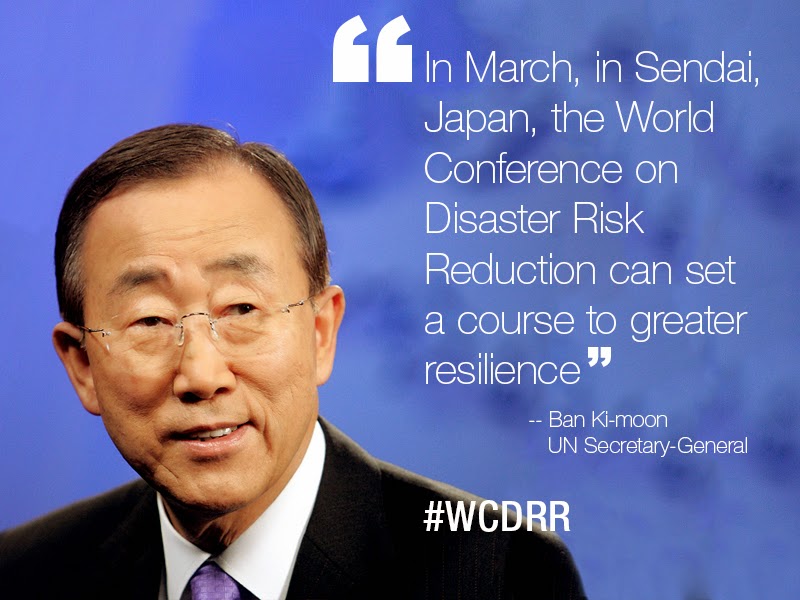
Focus on The Third UN World Conference on Disaster Risk Reduction (3rdWCDRR)


Third UN World Conference on Disaster risk reduction ; ‪#‎WCDRR


The Third UN World Conference on Disaster Risk Reduction and its preparatory process welcome the participation and contributions of all relevant stakeholders, including parliaments, civil society, the International Red Cross and Red Crescent Movement, non-governmental organizations, national platforms for disaster risk reduction, focal points for the Hyogo Framework for Action, local government representatives, scientific institutions and the private sector, as well as organizations of the United Nations system and intergovernmental organizations.
  

UN Secretary-General calls for massive investment in disaster risk reduction


March 14, 2015 : The UN Secretary-General, Ban Ki-moon, today opened the Third UN World Conference on Disaster Risk Reduction, stating that annual economic losses now exceed US$ 300 billion annually.
“We can watch that number grow as more people suffer. Or we can dramatically lower that figure and invest the savings in development. Six billion dollars allocated each year can result in savings of up to US$360 billion by 2030, the Secretary-General said.

He said he had met earlier in the day with Vanuatu President, Baldwin Lonsdale, and extended his condolences to the people of Vanuatu amidst fears that Cyclone Pam may have caused widespread damage and destruction over the weekend.

The Secretary-General told the 4,000 participants – including representatives of 186 governments - attending the opening day of the five day event: “You have made this the highest-level meeting on disaster risk reduction in history. This is the first stop on our journey to a new future. Disaster risk reduction advances progress on sustainable development and climate change.”
He praised the existing global agreement on disaster risk reduction, the Hyogo Framework for Action (HFA), which was adopted ten years ago in Kobe, Japan. He said it “has saved thousands of lives. Now we must respond to the world’s growing needs by empowering individuals, supporting communities and backing promises with resources.”

Work is continuing at the Conference to agree on a new framework for disaster risk reduction which will update the HFA.

Mr. Ban Ki-Moon said: “Our thoughts are with all disaster victims. Our best possible tribute will be to make this Conference a success.”


Lists of Natural Hazards
  • Avalanche snow avalanche, snow slide
  • Cold Wave extreme weather, extreme temperature, cold temperatures
  • Cyclone hurricane, tropical storm, tropical depression, typhoon
  • Drought deficiency of precipitation, desertification, pronounced absence of rainfall
  • Earthquake seismic, tectonic
  • Epidemic & Pandemic epidemic: bubonic plague, cholera, dengue, non-pandemic diseases, typhoid; pandemic: H1N1, HIV, smallpox, tuberculosis
  • Flood inundation; includes: flash floods
  • Heat Wave extreme weather, extreme temperature, high temperatures
  • Insect Infestation locust, plague, African bees
  • Land Slide debris flow, mud flow, mud slide, rock fall, slide, lahar, rock slide and topple
  • NBC - Nuclear, Biological, Chemical biohazard risk, chemical contamination, nuclear radiation risk
  • Storm Surge coastal flood, wave surge, wind setup
  • Technical Disaster chemical spill/leak, explosions, collapses, gas leaks, urban fire, oil spill, technical failure
  • Tornado waterspout, twister, vortex
  • Tsunami
  • Volcano crater, lava, magma, molten materials, pyroclastic flows, volcanic rock, volcanic ash
  • Wild Fire bush fire, forest fire, uncontrolled fire, wildland fire
Loss Events Worldwide 2014

The United Nations General Assembly Resolution adopted in 2013 (68/211) on International Strategy for Disaster Reduction states that the World Conference will result in a concise, focused, forward-looking, and action-oriented outcome document and will have the following
objectives:

To complete assessment and review of the implementation of the Hyogo Framework for Action;
• To consider the experience gained through the regional and national strategies/institutions and plans for disaster risk reduction and their recommendations as well as relevant regional agreements within the
implementation of the Hyogo Framework of Action;
• To adopt a post-2015 framework for disaster risk reduction;
• To identify modalities of cooperation based on commitments to implement a post-2015 framework for disaster risk reduction;
• To determine modalities to periodically review the implementation of a post-2015 framework for disaster risk reduction.


The Third UN World Conference on Disaster Risk Reduction


The global community needs a plan on how it will build resilience against natural hazards, according to the director of Kenya's National Disaster Operation Centre.Nathan Kigotho, who is in Sendai, Japan for the Third UN World Conference on Disaster Risk Reduction, says Kenya is mostly affected by drought.In 2005, a 10-year plan called the Hyogo Framework for Action was adopted to help protect the world from natural disasters. A new plan is now needed to replace it. Nan Zheng began by asking Mr Kigotho what he hopes the outcome of the conference will be.

The Global Assessment Report on Disaster Risk Reduction (GAR) 2015

 The Global Risk Data Platform is a multiple agencies effort to share spatial data information on global risk from natural hazards. Users can visualise, download or extract data on past hazardous events, human & economical hazard exposure and risk from natural hazards. It covers tropical cyclones and related storm surges, drought, earthquakes, biomass fires, floods, landslides, tsunamis and volcanic eruptions. The collection of data is made via a wide range of partners (see About for data sources). This was developed as a support to the Global Assessment Report on Disaster Risk Reduction (GAR) and replace the previous PREVIEW platform already available since 2000. Many improvements were made on the data and on the application.


Support the Global Risk Data Platform
  

The GAR is a comprehensive review and analysis of disaster risk and risk management. It is published every two years.GAR15 was launched in March 2015, it looks at how to make development sustainable. Visit the GAR15 website


Draft post-2015 framework for disaster risk reduction (revised on 13 March 2015)
Education for Disaster Risk Reduction (DRR) takes into account the relationships between society, environment, economy, and culture and their impacts. It also promotes critical thinking and problem-solving as well as social and emotional life skills that are essential to the empowerment of groups threatened or affected by disasters.
Natural Disaster Preparedness and Education for Sustainable Development - UNESCO

Media 

United Nations - Interview of Margareta Wahlström, Special Representative of the Secretary-General for Disaster Risk Reduction ahead of the opening of the Third UN World Conference on Disaster Risk Reduction (Sendai, Japan, 14-18 March 2015)

UNISDR : Resilient Cities Connect is a platform where cities, development partners and businesses can exchange their knowledge, services and capacities to increase the local resilience of people, public services and businesses


Queries on the preparations 


Ms. Elena Dokhlik
Tel: +41 22 91 78861
Fax: +41 22 73 39531, +41 2 27 339855
Email: wcdrr2015@un.org


Saturday, 22 March 2014

United Nations Partners on Climate Change

Climate change affects us all. Here are tips on how you can personally make a difference.

At Home – reduce, reuse, recycle!
  • Buy minimally packaged goods
  • Recycle paper, plastic, glass, and metal. Reuse, mend, and repurpose things to save money and divert waste from your local landfill
  • Plug air leaks in windows and doors to increase energy efficiency
  • Adjust your thermostat, lower in winter, higher in summer
  • Replace old appliances with energy efficient models and light bulbs
  • Save electricity by plugging appliances into a power strip and turning them off completely when not in use
  • Wash clothes in cold or warm water
  • Run dishwashers only when full and don’t use heat to dry dishes
  • Eat less meat, poultry, and fish
  • Plant Trees – Enter tree planting pledges online, then plant indigenous or locally appropriate trees where you live. View results of tree planting efforts globally.


United Nations Partners on Climate Change