The 2026 Asteroid Day Festival in Luxembourg.
Join us to celebrate the International Asteroid Day with astronauts and leading experts in the space industry as they discuss key topics in space science — from space for Earth, asteroids, comets and planetary defence to unconventional careers in the space sector and beyond!

Adventures: Visiting Impact Craters Around the World.
In 2029, the world will turn its eyes to the sky. The passage of asteroid Apophis at around 30,000 kilometres from Earth, together with the United Nations’ proclamation of the International Year of Asteroid Awareness and Planetary Defence, will mark a rare moment in human history, not only an astronomical spectacle, but also an invitation to reflect on our vulnerability in the cosmos, and on how far we have come in learning to protect our planet.
Asteroid Day is an opportunity to celebrate and reflect on the role of asteroids in Earth’s history – and few experiences make this more tangible than visiting impact craters, true open-air classrooms and laboratories. These geological formations, created by cosmic collisions, are scattered across the planet and, in many cases, are protected areas or tourist destinations with educational infrastructure.
Among the most emblematic examples is Meteor Crater in the Arizona desert, USA, also known as Barringer Crater. This well-preserved site offers guided walks along the crater rim, a visitor centre with an interactive museum, and interpretive tours explaining how the formation was created and the role of asteroids in Earth’s geology. The site often organises special Asteroid Day activities, combining lectures, astronomical observing sessions, and other educational programmes.
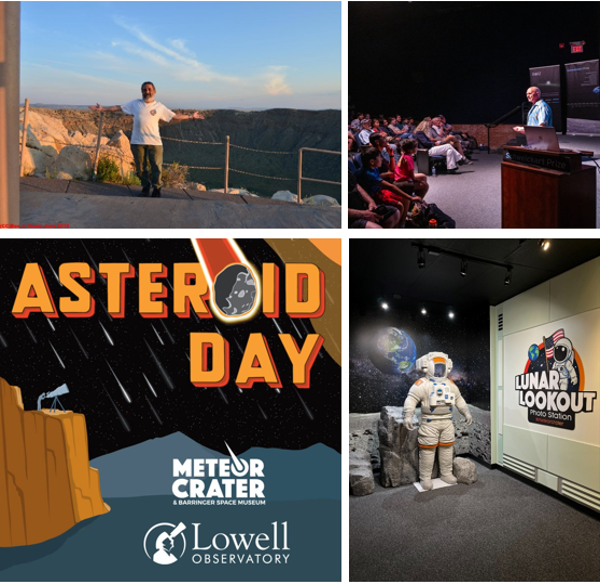
Asteroid Day is celebrated each year around the world, and in 2025, a trip to Barringer Crater in the USA was one of its most iconic experiences (Meteor Crater Space Museum – AD2025).
In South Africa, the Vredefort Dome, a UNESCO World Heritage Site, represents the largest and oldest known astrobleme on Earth, dating back more than two billion years. Although the structure is vast and heavily eroded, the region hosts both tourism and scientific activities, including interpretive excursions and guided walks that explore the evidence of the impact and its importance for planetary geology. The inauguration of a visitor centre is planned to further enhance the educational experience.
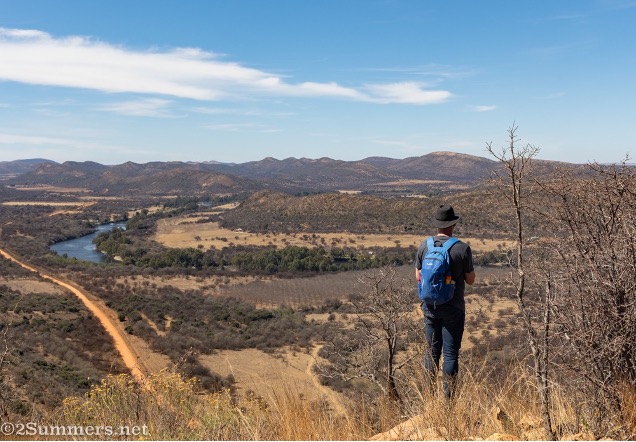
The Vredefort Dome: a magnificent view and an unforgettable open-air lesson about one of Earth’s oldest impact events (2Summers).
In Europe, places such as the RiesKraterMuseum in Germany and Meteorittparken Gardnos in Norway offer educational experiences centered on the impact craters of their regions. At the first, visitors can explore scientific exhibits, meteorites, impact rocks, and even a lunar sample brought back by one of the Apollo missions. At the Norwegian park, visitors can walk along interpretive trails inside the crater, observe outcrops of rocks formed by the impact, and follow educational panels explaining the geology of the event.
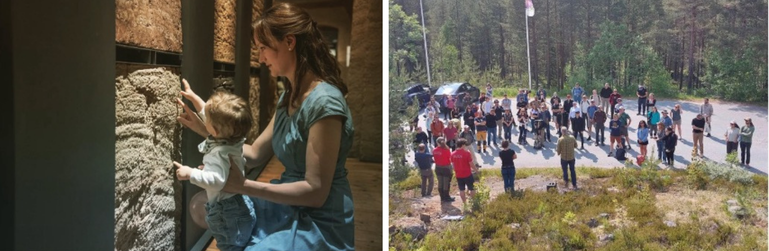
The RiesKrater Museum in Nördlingen, Germany (left), and Meteorittparken Gardnos in Nesbyen, Norway (right), are two excellent places in Europe to learn about Earth’s dramatic geological history.
In India, one of the most well-known impact structures is the Lonar Crater, which contains Lonar Lake, considered the only impact lake formed in basaltic rock in the world. The area allows for interpretive trails around the crater and down into the interior of the structure, giving visitors the opportunity to observe its unique geology and the landscape shaped by the impact.
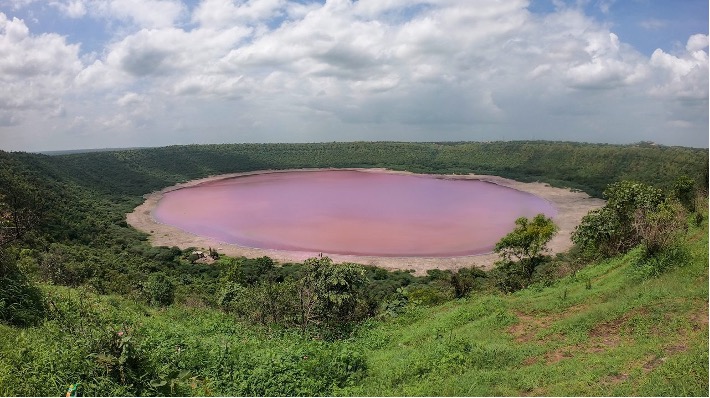
The stunning Lonar Lake Crater in Maharashtra, India, attracts visitors and researchers alike (Incredible India).
Other craters scattered across different continents, even without formal infrastructure, can inspire educational expeditions and field research. Examples include the Roter Kamm crater in Namibia, the Shoemaker crater in Australia, and other formations visible in aerial or satellite imagery.
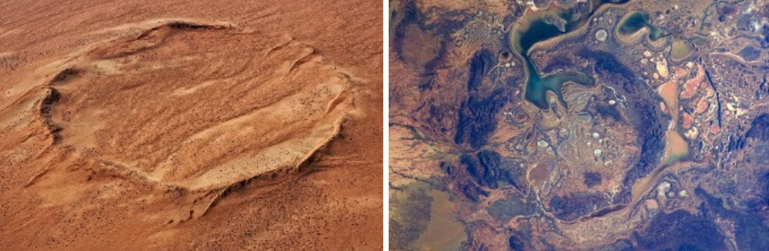
Roter Kamm in the Namib Desert (left) and the Shoemaker Impact Structure in Australia (right): two remarkable places where unforgettable experiences await (Bernhard Edmaier Photography / Gateway to Astronaut Photography of Earth).
Beyond tourism, these craters can also serve as bases for scientific expeditions and outreach projects. Groups of researchers, universities, and science enthusiasts often organise field campaigns to study the geology of these sites, document their features, and produce educational materials. These natural environments also inspire digital content—such as documentaries, educational series, podcasts and scientific exploration videos— helping to bring knowledge about cosmic impacts to a broader audience.
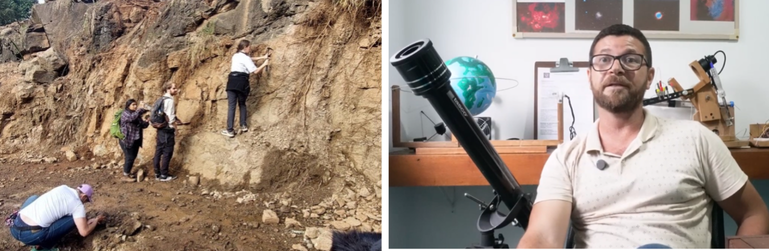
Expedition and workshop at the Vista Alegre crater (left), and a scene from the documentary about the Colônia crater (right), both in Brazil (GEAstro – Federal Technological University of Paraná / Echomundi – Embu-Guaçu City Hall – https://www.youtube.com/watch?v=PJVAOFRA-ZA).
Here is a list of proposed activities to celebrate Asteroid Day at these special locations:
- Thematic guided tours with geologists and astronomers, highlighting shock structures and evidence of impact.
- Field workshops focused on identifying impact minerals and conducting scientific documentation such as photography and mapping.
- Night-time astronomical observing near the craters, connecting terrestrial craters with lunar craters.
- Outdoor lectures about asteroid monitoring and the prevention of cosmic hazards.
For those who do not have access to a site that can be visited in person, there are equally enriching alternatives, such as exploring craters using Google Earth or interactive mapping applications to locate and study impact craters around the planet. This lesson lists some of the most notable craters and their locations.
If that is not feasible, a night of lunar watching can be organised, highlighting its dozens of well-preserved craters—true natural laboratories of impact processes, visible with binoculars or telescopes.
Be sure to share your experience of visiting an impact crater up close.
WEBINAR: Asteroid Day Festival


No comments:
Post a Comment