Showing posts with label 17 May. Show all posts

Sunday, 17 May 2026

World Telecommunication and Information Society Day 2026; May 17th.

World Telecommunication and Information Society Day 2026


FORUM: "Digital lifelines – Strengthening resilience in a connected world.World Telecommunication and Information Society Day 2026. This year's initiative, driven by ITU, WTSID highlights the need for robust, secure, and sustainable digital infrastructure, encouraging global action to protect essential communication networks and bridge the digital divide.This year long campaign explores the often invisible digital systems that keep everyday life running, especially when communities face disruption or crisis. In a world that increasingly depends on uninterrupted connectivity, the resilience of our digital networks is essential. Digital lifelines – terrestrial networks, submarine cables, satellites, and data systems – form the backbone of our communities and economies. A single cable break, data center outage, or satellite failure can disrupt vital services, from health and education to finance and disaster response. In a time of escalating natural hazards and rising dependence on technology, building resilient digital infrastructure is critical to the stability of systems and growth for all. This is especially true for Small Island Developing States (SIDS) and Least Developed Countries (LDCs), where reliable connectivity underpins recovery from climate impacts and supports growth for all. Share your accomplishments, national visions and strategies, commitments and initiatives on your social media accounts using the hashtags #DigitalLifelines#DigitalInclusion, #EveryoneIncluded, #wtisd, #17May, #InformationSocietyDay, #TelecommunicationDay.

EXHIBITS


EVENTS: On May 17th, 2026; a virtual event will be held to World Telecommunication and Information Society Day 2026. This event calls on governments, industry, and communities to strengthen the digital lifelines that keep the world running. Join us in designing the networks and systems that can withstand shocks and recover quickly, ensuring that no one is cut off and left offline when it matters most. Register to participate!

Digital lifelines – Strengthening resilience in a connected world

On 19 May 2026, from 15:00 – 16:30 CEST, Join the ITU Space Connect webinar Beyond the Horizon: Framing the Future of Space Communications” for further insights on ITU spectrum
coordination. Registration and Join live webcast

WEBINAR


Statement of the United Nations Secretary-General on World Telecommunication and Information Society Day 2026; May 17th.

On World Telecommunication and Information Society Day, the International Telecommunication Union and the world recognize digital technologies as lifelines – connecting people to safety, services and one another.

When disaster strikes, networks carry early warnings, enable first responders, and keep clinics, classrooms and public services up and running.

But lifelines must be trusted, secure and accessible to all. Too many communities remain offline. Critical systems are vulnerable. Disinformation and cyberthreats are growing. And as climate emergencies intensify and the AI divide widens, the cost of inaction falls hardest on those already left behind.

We must invest in connectivity – from seabed cables to satellites, from local access to open standards and digital skills. We must implement the Global Digital Compact, advance rights-based AI governance and strengthen cooperation across governments, industry and civil society.

Digital infrastructure is an essential public good, so let us build it to withstand the crises ahead. When digital lifelines are universal and safe, every community can prepare, respond and recover.


United Nations Secretary-General.


Statement of the ITU Director-General on World Telecommunication and Information Society Day 2026; May 17th.

Today, more people are connected than at any point in human history. Billions of us rely on digital technologies to do the things that matter most. From accessing health care to running a business to learning, communicating with our loved ones and calling for help in a crisis, connectivity has become as crucial to modern life as roads and electricity. And in many parts of the world, digital infrastructure has transformed economies and communities within a generation. But what happens when those networks and services fail? Think of the submarine cables that extend more than 1.7 million kilometers around the globe and they carry 99% of international data traffic. A single earthquake can sever multiple cables at once, cutting entire regions off from the world for weeks. Likewise, a major solar storm can disrupt power grids, satellite navigation networks, and even the global financial system that we rely on. Very often, these critical digital risks transcend borders. And when connectivity fails, the consequences fall hardest on those who can least afford them. And that's why resilience must be built into digital infrastructure from the very beginning and it must be built collectively with the people at the core through international standards, capacity building and global cooperation. This world telecommunication and information society day. Join the ITU in strengthening the digital lifelines that keep our world meaningfully and reliably connected. Together, we can build a more resilient digital future for everyone, everywhere.

Doreen Bogdan-Martin, ITU Secretary-General.


ACTIVITIES: Several events on digital lifelines will be held , such as local community roundtables and exhibitions bringing the vital importance of resilient digital lifelines to professional and public diplomacy audiences whose lives run on them. 

WTISD-2026


CAMPAIGN: Join the advocacy for resilient digital infrastructure!


What if the digital systems you count on were resilient by design?

Explore how the world’s essential connections stay strong—from clear navigation signals and lifesaving alerts to resilient undersea data routes—and the role ITU plays behind the scenes to make it happen.

This WTISD What if…? series reveals the often‑hidden systems that keep people safe, informed, and connected, and highlights the global cooperation that makes these digital lifelines possible.


What if a simple message on your phone could save your life?

ITU helps countries strengthen mobile-based early warning systems to reach at-risk communities fast, reliably and at scale when disasters strike.Explore the Early Warnings for All initiative


What if navigation signals remained strong and reliable for generations?Every day, satellite and terrestrial navigation systems guide travel on land, at sea, and in the air. ITU coordinates radio frequencies, ensuring these essential signals remain safe and interference-free. Discover how satellite spectrum and orbits are coordinated


What if distress signals at sea were always received?Maritime safety relies on dependable communications. ITU coordinates the spectrum use, identification resources and standards for the systems behind global distress signals.Explore how maritime distress systems work


What if no one lost connection when forced to flee?Through the Connectivity for Refugees initiative, ITU and partners are advancing meaningful, affordable connectivity, aiming to reach 20 million displaced people and host communities by 2030.Learn how connectivity supports displaced communities.


What if digital use didn’t increase our environmental footprint?

ITU sets global standards for energy efficient, low-carbon digital technologies, and tracks ICT sector emissions and e-waste through the Greening Digital Companies Report and the Global E-waste Monitor. Join the partnership for Green Digital Action


What if everyone had the skills to keep digital systems running?

Every year, the ITU Academy trains 5,000+ learners worldwide in topics such as digital inclusion, connectivity, cybersecurity, artificial intelligence, policy leadership and more. Take a course with ITU Academy!


What if global data traffic across oceans was never interrupted?

ITU co-convened the International Advisory Body for Submarine Cable Resilience to safeguard undersea cables carrying over 99% of intercontinental data. Explore global efforts to strengthen submarine cable resilience!


What if AI helped improve disaster preparedness?

ITU and partners advance the use of AI for disaster preparedness through the Early Warning Connectivity Map, identifying where and how many people can be reached via digital networks. Learn how to Attend the AI for Good Global Summit!


What if everyone had access to resilient digital infrastructure?

ITU supports infrastructure mapping, planning, and analysis to help countries identify connectivity gaps and build inclusive, resilient networks. Explore global connectivity infrastructure maps!


What if every digital network was trusted and secure?

ITU’s Global Cybersecurity Index benchmarks cybersecurity commitments across all ITU Member States, and ITU Global CyberDrills engage incident response teams in live cyber-incident simulations. Discover how countries strengthen cybersecurity with ITU


What if connectivity reached everyone, everywhere?

Today, 2.2 billion people remain unconnected. Partner2Connect mobilizes new resources, partnerships, and commitments to advance universal connectivity. Make a pledge with Partner2Connect!

Every day, invisible digital systems help keep the world running. They warn communities when disasters approach. Guide navigation across land, sea and air. Carry the data that connects continents. These systems form the digital lifelines that underpin modern life. Explore how they work, why they matter, and how global cooperation helps keep them strong.  Digital resilience depends on many systems working together. But which one matters most from your perspective? Vote here and tell us why.

POLL: Share your perspective – take part in this poll!

  1. Early warning systems
  2. Navigation signals
  3. Maritime distress and safety
  4. Connectivity for displaced people
  5. Green digital technologies
  6. Digital skills
  7. Submarine cable resilience
  8. AI for disaster preparedness
  9. Resilient national infrastructure
  10. Trusted and secure networks
  11. Universal connectivity


PUBLICATION: A new report by ITU and UNDRR mapping the hidden fragility of our interconnected digital world and the priorities needed to build resilience. Read the full report!

International Telecommunication Union


EDITORIAL

COMMUNICATION MATERIALS: Get Access to materials such as posters, backgrounds, and social media cards. To Become a partner by providing financial or in-kind support. Check out opportunities!

WTISD-2026


Saturday, 17 May 2025

World Telecommunication and Information Society Day 2025; May 17th.

FORUM: ‘‘Gender Equality in Digital transformation.’’ World Telecommunication and Information Society Day 2025. Achieving gender equality in the digital world requires collective action. To help close the gender digital divide, we invite you to Promote gender-responsive policies that enable women’s active participation in the tech sector; to Ensure equal access to digital skills and training for women and girls; to Foster global partnerships across governments, international organizations, the private sector, and civil society to scale impact. Whether you shape policy, build technology, teach, lead, or advocate, your voice matters.

Why gender equality in digital transformation matters?

Despite progress, inequality remains a barrier to digital inclusion. According to Facts and Figures 2024:

  • 70% of men use the Internet globally, compared to 65% of women, a gap that leaves 189 million more men online than women worldwide.
  • While the digital gender gap has narrowed in many developed countries, it has widened in Least Developed Countries (LDCs), where only 29% of women are using the internet compared to 41% of men.
  • Gaps persist not only in access, but also in affordability, digital skills, participation in STEM, and leadership in the tech sector.

These gaps not only disadvantage women and girls, they also hinder economic growth, innovation in countries around the world, and the achievement of the Sustainable Development Goals (SDGs).

What are the impact of the gender digital divide?
The effects of digital exclusion are interconnected, limiting not just individual potential, but also the resilience of communities and the performance of economies.

  • On individuals; When women and girls gain digital access and skills, they unlock educational, professional, and social opportunities, from becoming entrepreneurs to obtaining essential health, financial and government services.
  • On communities; Inclusive digital participation fosters stronger, more resilient communities by ensuring diverse perspectives and locally relevant solutions. When women and girls benefit from and contribute to digital transformation, communities are strengthened by increased innovation and greater social cohesion.
  • On economies; Equality for all women and girls fuels economic growth by driving diversity, innovation, and productivity. According to the IMF, narrowing gender gaps in labor markets could boost GDP by up to 8% in emerging and developing economies.

Follow the conversations with the hashtags #DigitalInclusion, #EveryoneIncluded, #wtisd, #17May, #InformationSocietyDay, #TelecommunicationDay.

STATEMENTS:

United Nations Secretary-General statement on World Telecommunication and Information Society Day 2025, May 17th.

This World Telecommunication and Information Society Day marks the 160th anniversary of the International Telecommunication Union.

From the telegraph to radio, from the Internet to Artificial Intelligence, technology has transformed how we live, work, and connect. But its benefits remain deeply unequal. This year's focus on gender equality in digital transformation is both timely and urgent.

Around the world, algorithmic bias is reinforcing old prejudices. Online harassment and abuse silences women’s voices and drives them offline. And women and girls remain severely underrepresented in the very fields shaping our future: science, technology, engineering and mathematics.

This injustice harms us all. We cannot accept a digital future that leaves half of humanity behind. We must urgently invest in digital skills for all; harness the potential of technology to improve women’s lives; dismantle barriers blocking their full participation and leadership in the technology sector; and keep working to eradicate gender-based violence in all its forms – online and offline.

The Pact for the Future and the Global Digital Compact offer a path to bridge all digital divides and strengthen collaboration for women’s rights online. Let’s take that path together and help ensure digital transformation is a force for progress, inclusion, and equality.

When technology serves everyone, everyone wins.

United Nations Secretary-General.


ITU 160th anniversary


EVENTS: On May 17th, the ITU’s 160th anniversary and the World Telecommunication and Information Society Day 2025 will be observed at ITU in Geneva. As we commemorate ITU's 160th anniversary, we will highlight ITU's long-standing role in advancing global connectivity and fostering international cooperation. Our hour-long event will bring together digital experts and innovators on a global journey, exploring digital hubs around the world where innovation thrives. Register to participate to the event; Step into the future with us on WTISD on May 17th, broadcasting live from the ITU TV studio in Geneva.


On May 17th, the ITU will mark its 160 years of technology for humanity with a light show at the Place des Nations in Geneva. The first light show starts at starts at 21:30 and will be repeated every 10 minutes until 22:40. Every time you turn on the radio or television, board a plane, call home, go online, use GPS, check the weather, or view satellite images, you use a vital service coordinated by ITU. Join us for a first-ever light show projected onto the iconic ITU Tower, opposite the United Nations Office at Geneva, as part of Geneva Museum Night. Sixteen slides projected on the 15-storey ITU Tower will show highlights of 160 years of technology for humanity, embodying innovation, countries, organizations and people working together, shared achievements and resilience. You will hear from inspiring speakers as to how they are #ConnectedByITU, from the sea to the sky. If you’re in Geneva, come to the Esplanade adjacent to the ITU headquarters buildings, near the Place des Nations. If you’re elsewhere, Learn more and tune in online—you can stream the light show on our social media platforms: Facebook, YouTube, or ITU Webcast live.


This year marks also the 30th anniversary of the Beijing Platform for Action, a global blueprint for advancing women’s rights. The Beijing+30 Action Agenda includes targeted actions to close the digital gender gap — from expanding digital infrastructure to increasing representation in tech leadership. The ITU’s work aligns closely with these efforts through its initiatives, resolutions, and partnerships including:


From 7–11 July 2025; As part of the ITU160 Gender Champions initiative, 10 chosen youngs womens will travel to Geneva to participate in the WSIS+20 High-Level Event, the AI for Good Global Summit, and ITU’s 160th Anniversary commemorations. These 10 young women are emerging leaders, advancing digital transformation and development in meaningful ways across diverse sectors and communities. Their work addresses real-world challenges — from digital literacy and online safety to broadband connectivity and responsible AI — bringing forward solutions that make technology more effective and accessible to all. Launched on the occasion of ITU’s 160th Anniversary, the ITU160 Gender Champions initiative recognizes and supports young women who are contributing to digital development and transformation worldwide. With support from the Government of Canada, the initiative provides a platform for 10 young women leaders (ages 18–25) to share their work, engage with global stakeholders, and help shape the future of digital connectivity. Throughout their week in Geneva, the Gender Champions will:

  1. Engage with key stakeholders in the digital and tech sectors
  2. Amplify their work in digital development and digital transformation, by actively participating in a variety of sessions and activities
  3. Co-design and facilitate with their unique perspective, a workshop on promoting gender equality in digital transformation

Selection process: The Gender Champions were selected from a highly competitive pool of 1,179 applications received from over 150 countries. The final cohort reflects a diversity of regional perspectives and lived experiences, with special consideration given to applicants from developing countries, least developed countries (LDCs), landlocked developing countries (LLDCs), small island developing states (SIDS), Indigenous communities, and young women with disabilities.

Follow along: Updates, stories, and spotlights from the Gender Champions’ week in Geneva will be on ITU’s social media channels, see footer. Stay tuned as we highlight their work and explore how youth leadership is shaping the future of digital development.

CAMPAIGN: Explore how you can get involved this WTISD and help drive inclusive digital transformation. Take action for digital gender equality; Find resources and opportunities to mark WTISD-25 and help close the digital gender gap. Get involved by sharing the visual materials of the campaign which are free to use for non-commercial purposes

Friday, 17 May 2024

World Telecommunication and Information Society Day 2024; May 17th.


FORUM: ‘‘Digital Innovation for Sustainable Development.’’ World Telecommunication and Information Society Day 2024. Building a sustainable future demands innovative thinking and action, especially in the digital world. The celebration of WTISD 2024 is a chance to explore how digital innovation can help connect everyone and unlock sustainable prosperity for all. Innovative tech can help tackle the world’s most pressing challenges, from fighting climate change to eliminating hunger and poverty. In fact, digital technologies can help achieve 70% of targets under the Sustainable Development Goals by 2030. Yet glaring digital gaps hinder innovation in many parts of the world. The lack of policies, investment, and digital skills leaves many countries struggling to keep up in the fast-changing digital landscape. What will the future of digital innovation look like and what role do all of us play? Be part and follow the conversations with the hashtags #DigitalInclusion, #EveryoneIncluded, #wtisd, #17May, #InformationSocietyDay, #TelecommunicationDay, #InnovateForProsperity.


How ITU initiative drive innovation for a sustainable future?


EVENTS: ITU’s 159th anniversary. The World Telecommunication and Information Society Day 2024 will be observed on May 17th at ITU in Geneva. As we commemorate ITU's 159th anniversary, we also celebrate the boundless potential of digital innovation for prosperity. Our hour-long event will bring together digital experts and innovators on a global journey, exploring digital hubs around the world where innovation thrives. Register to participate to the event; Step into the future with us on WTISD on 17 May 2024, broadcasting live from the ITU TV studio in Geneva.


Convening worldwide innovators.


Innovation is a key to accelerate sustainable development.

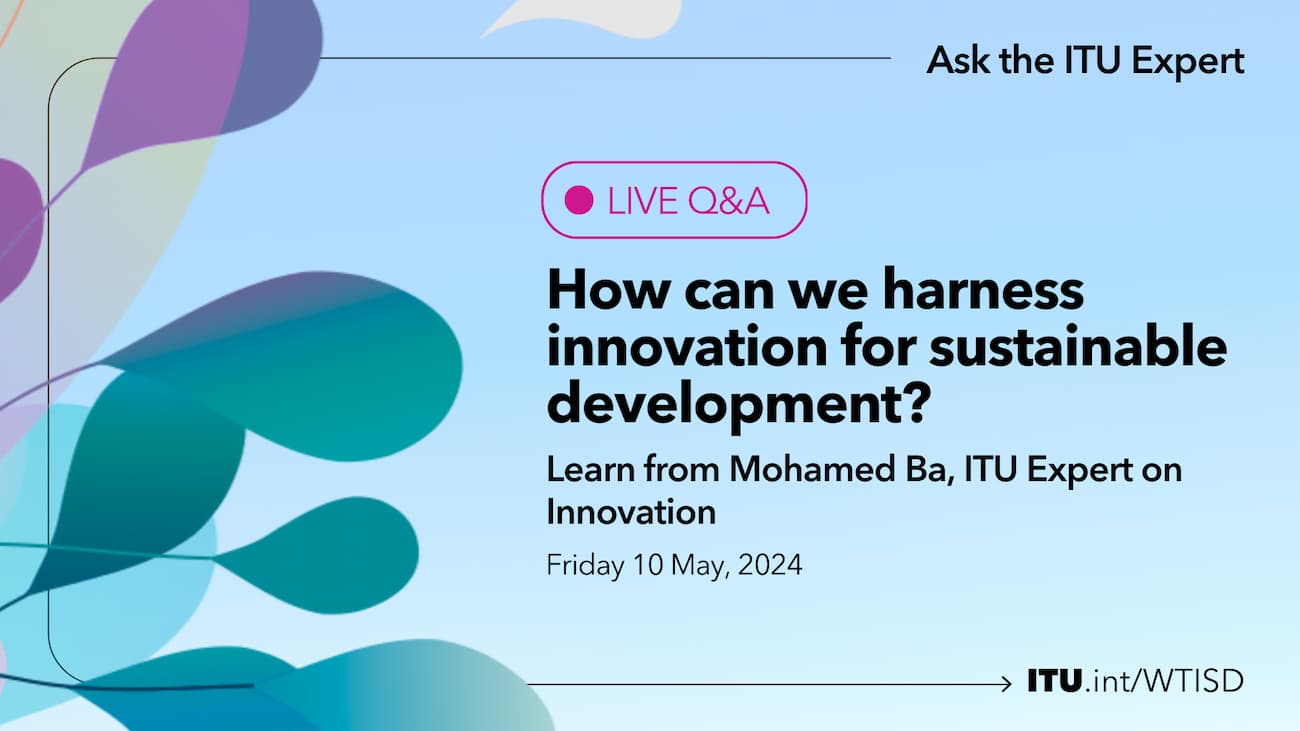
Ask an ITU Innovation expert; If you have questions about the challenges hindering global innovation? Curious about actionable solutions to overcome these hurdles? Join the ITU Live Q&A on May 10th to learn from ITU Digital Innovation Ecosystem Expert, Mohamed Ba. RSVP

COURSES & TRAININGS: Prepare for future financial services priorities; Investigate the future of FinTech and learn to think strategically about problems faced by real businesses. Apply now!. Share how your digital innovation is helping to build a better future. Submit your innovation story!


ITU initiative promote sustainable innovation

ITU International technical standards support innovation on a global scale

Digital innovation drives economic progress and global development


Partnership and collaboration are at the heart of everything we do.


STATEMENTS: Read the ITU Secretary-General statement on World Telecommunication and Information Society Day 2024, May 17th and the United Nations Secretary-General statement on World Telecommunication and Information Society Day 2024, May 17th.

ITU Secretary-general statement

ITU- Telecommunication


CAMPAIGN MATERIALS: Save the date and join us in the journey to #InnovateForProsperity!


Meaningful digital innovation doesn't happen itself.

World Telecommunication & Information Society Day 2024


Tuesday, 16 May 2023

World Telecommunication and Information Society Day 2023; May 17th.

FORUM: ‘‘Empowering the least developed countries through information and communication technologies.’’ World Telecommunication and Information Society Day 2023. The focus of this year is to raise awareness about ICT’s for the least developed countries. The ITU calls on the public and private sectors to address a pledge for universal connectivity and digital transformation in these countries through its Partner2Connect Digital Coalition. In line with the United Nations Secretary-General’s Roadmap for Digital Cooperation. The Partner2Connect Digital Coalition fosters meaningful connectivity and digital transformation globally, with a focus on but not limited to hardest- to-connect communities in Least Developed Countries (LDCs), Landlocked Developing Countries (LLDCs) and Small Island Developing States (SIDS). Mid-way through the agenda to fulfil the United Nations Sustainable Development Goals (SDGs) by 2030, those countries face daunting challenges. Please share your pledges, success stories, good practices, solutions, publications, and policies designed to meet present and future challenges of LDCs. Follow the conversations wih the hashtags #wtisd, #17May, #InformationSocietyDay, #TelecommunicationDay, #DigitalTransformation and #MeaningfulConnectivty.


EVENT: The World Telecommunication and Information Society Day 2023 will be observed on May 17th at ITU in Geneva. The Fifth Conference on the Least Developed Countries (LDC5) in Doha, Qatar, has set out an ambitious new United Nations programme of action to deliver on sustainable development for all by 2030. A high-level panel to mark the day will start at 14:30 (CEST). The WTISD 2023’s theme is a unique opportunity to showcase the work ITU does, together with its members and partners, to support Least Developed Countries (LDCs). Learn about the Partners to Connect Coalition (P2C) session during the observance.

Check out the programme and Register here to participate to the WTISD-23 and join us on this important day as we discuss the digital progress of #LDCs through three mini panels focused on #access, #affordability and #DigitalSkills. Together, let's shape our #DigitalFutureForAll.


Get the calendar of upcoming events at ITU.


Statement by the United Nations Secretary-General on World Telecommunication and Information Society Day 2023, May 17th. 

On this World Telecommunication and Information Society Day, we highlight the power of technology to advance sustainable development in Least Developed Countries. The digital revolution is a defining force of our era. The opportunities are tremendous: from transforming education and health care, to accelerating climate action and the achievement of all the Sustainable Development Goals. But to realize the promise of technology, we must confront its perils: The lack of ethical guardrails and robust governance frameworks. The proliferation of hate speech and disinformation. The amplification of social divides and economic inequalities. And the risks posed by Artificial Intelligence, from deep fakes to biased decisions by neural networks that no human can fully explain. Technology must be an instrument to reduce divides – not deepen them. As the internet becomes ever more central to value creation and innovation, Least Developed Countries risk falling further behind. We must dramatically improve accessibility and inclusivity and eliminate the digital divide. We must support the creation of digital public goods: open-source software, open data, and open content. We must invest in the capacities of public institutions so that they have the skills and resources to understand, oversee, shape, and engage with Artificial Intelligence and other transformative technologies. And we must come together around a Global Digital Compact – to avoid fragmentation, safeguard human rights, and ensure technology is a force for human wellbeing, solidarity, and progress. I commend the International Telecommunication Union for working to accelerate global connectivity for all by 2030. Let us all do our part in closing the digital divide and securing a more equitable and sustainable future everywhere.

 United Nations Secretary-General.
OTHER STATEMENTS
Tomorrow is World Telecommunication and Information Society Day and also ITU's birthday! This year's theme is empowering the least developed countries through information and communication technologies. ITU Secreatry-General on World Telecommunication and Information Society Day 2023.


Discover the latest on global digital transformation and cooperation.

 CAMPAIGN MATERIALS: 


Monday, 16 May 2022

World Telecommunication and Information Society Day 2022; May 17th

 Theme: "Digital technologies for older persons and healthy ageing​." World Telecommunication and Information Society Day 2022.


The ageing of the global population will be the defining demographic trend of the 21st century—yet our societies struggle to see the opportunities that this trend can unfold. Telecommunications and information communication technologies (ICTs) have a role to play in achieving healthier ageing, but also in helping people build smarter cities, combat age-based discrimination at the workplace, ensure financial inclusion of older persons, and support millions of caregivers across the world.


EVENTS


WTISD 2022 will allow ITU membership, partners and other stakeholders to raise awareness about the important role of telecommunications/ICTs in supporting people to stay healthy, connected and independent, physically, emotionally and financially – to a life of healthy ageing – and as critical for the sustainability of economic and health systems.

As part of ITU’s efforts towards the UN Decade of Healthy Ageing and the theme of WTISD 2022, “Digital technologies for Older Persons and Healthy Ageing”, ITU invites you to actively participate in commemorating, contributing, and innovating throughout the year with national, regional, and international initiatives to accelerate digital technologies for older persons and healthy ageing.​


“Digital technologies for older persons and healthy ageing​​​”

What: High-level panel to mark WTISD 2022 
When: Tuesday, 17 May, 13:00 to 14:30 (CET) 
Where: ITU Members, Missions to the UN in Geneva and representatives from sister UN organizations can attend in person at ITU by registering here. Badges can be collected on Tuesday, 17 May, from 11:00 to 13:30 (CET) at the ITU Headquarters, Montbrillant building. To participate remotely, through the WSIS Forum 2022, register here.
Programme: See the programme here.  

Speakers:

  • Mr Houlin Zhao, Secretary-GeneraI, International Telecommunication Union (ITU)
  • Dr Zsuzsanna Jakab, Deputy Director-General, World Health Organization (WHO)
  • H.E. Ms. Ursula Owusu-Ekuful, Minister, Ministry of Communication and Digitalization, Ghana
  • My Linh Kha, Senior Vice President and General Manager, Japan Asia-Pacific, AMGEN
  • Dr Jane Barratt, Secretary-General, International Federation on Ageing (IFA)
  • Justin Derbyshire, Chief Executive Officer, HelpAge International

Webcast live


World Telecommunication and Information Society Day (WTISD) has been celebrated annually every 17 May since 1969 to mark the founding of ITU and the signing of the first International Telegraph Convention in 1865.