עולם היום למאבק במדבור בצורת, 17 ביוני.
防治荒漠化和乾旱世界日,6月17日。
World Day to Combat Desertification and Drought, June 17.
Всемирный день по борьбе с опустыниванием и засухой, 17 июня.
Día Mundial de Lucha contra la Desertificación y la Sequía, 17 de junio.
Journée mondiale de la lutte contre la désertification et la sécheresse, le 17 Juin.
اليوم العالمي لمكافحة التصحر والجفاف، 17 حزيران.
Theme 2016 : Protect Earth, Restore Land, Engage People.
2016 טמה: להגן על כדור הארץ, שחזר לארץ, להעסיק אנשים.
Tema 2016: Proteger la tierra, recuperar las tierras comprometer a la gente.
2016年主題:保護地球,恢復土地,搞的人。
2016 Tema: защитить Землю, восстановление земли, привлечь людей.
Theme 2016 : Protéger la Terre, la restauration des terres, Engage personnes.
2016 تيما : حماية الأرض، واستعادة الأرض، إشراك الناس.
United Nations Secretary-General, Ban Ki-moon on World Day to Combat desertification and Drought 2016, June 17th.
“Protect Earth. Restore land. Engage people”
But this freedom to choose has come at a very high price: the degradation of more than 2 billion hectares of all the productive land available to humankind. Today, for every three hectares of land that was productive to start with, one hectare is virtually unusable.
Forum : World Day to Combat Desertification is observed every year on 17 June.
The Campaign "Protect Earth, Restore Land, Engage People" Promote public awareness of the issue, and the implementation of the United Nations Convention to Combat Desertification in those countries experiencing serious drought and/or desertification, particularly in Africa.
This year’s World Day to Combat Desertification advocates for the importance of inclusive cooperation to restore and rehabilitate degraded land and contribute towards achieving the overall Sustainable Development Goals. Land has been an overlooked component in sustainable development for years. Now, we view land as a vital link to provide solutions to cope with many other development challenges such as climate change, secure water and energy resources, promoting inclusive growth, and so on.
Witness to Climate Change in the Sahel
Out of Affrica, Part I, New York Times
Out of Africa Part II, New York Times
Out of Africa Part III, New York Times
Events :
CHINA :
''One Belt and One Road Joint Action to Combating Desertification Initiative”
The global observance event on 17 June 2016 will be held in Beijing, China, hosted by the State Forestry Administration of China (SFA).
As the host country of this year's global observance, China is planning a series of events. The global observance will be held on 17 June in People's Congress Hall in the morning and Beijing International Hotel in the afternoon. About 300 people are expected to participate in the event. At the global observance, China will announce the “One Belt and One Road Joint Action to Combating Desertification Initiative” together with interested countries and stakeholders.
In the afternoon of 17 June, the China Green Foudation will organize a CSO event to share cases on sustainable land management, conserving and restoring land, public awareness education, etc.
Lanzhou International Marathon is one of China's most well-known marathons held in the northwest dryland region of China. Over 40,000 runners are expected to participate in the run this year. The organizing committee will integrate the World Day message as the theme for this year's marathon. The message will be sent through the event via social media. The marathon will be held on 11 June. On the same day, a WDCD Pavilion will be held on the spot.
From 17 June to 16 July, the WDCD slogan, “Protect Earth. Restore Land. Engage People.” will be displayed in the subway trains in cities of Shanghai and Guangzhou.
NAMIBIA : In Windhoek from 15-19 August 2016. African Drought Conference will be held.
The Ministry of Environment and Tourism in Namibia calls for abstracts for the Conference
Publication : UNCCD Library online public access catalogue.
Audio/Video :
Resources :

防治荒漠化和乾旱世界日,6月17日。
World Day to Combat Desertification and Drought, June 17.
Всемирный день по борьбе с опустыниванием и засухой, 17 июня.
Día Mundial de Lucha contra la Desertificación y la Sequía, 17 de junio.
Journée mondiale de la lutte contre la désertification et la sécheresse, le 17 Juin.
اليوم العالمي لمكافحة التصحر والجفاف، 17 حزيران.
Theme 2016 : Protect Earth, Restore Land, Engage People.
2016 טמה: להגן על כדור הארץ, שחזר לארץ, להעסיק אנשים.
Tema 2016: Proteger la tierra, recuperar las tierras comprometer a la gente.
2016年主題:保護地球,恢復土地,搞的人。
2016 Tema: защитить Землю, восстановление земли, привлечь людей.
Theme 2016 : Protéger la Terre, la restauration des terres, Engage personnes.
2016 تيما : حماية الأرض، واستعادة الأرض، إشراك الناس.
 |
| Protect Earth, Restore Land, Engage People. |
United Nations Secretary-General, Ban Ki-moon on World Day to Combat desertification and Drought 2016, June 17th.
“Protect Earth. Restore land. Engage people”
Desertification, land degradation, drought and climate change are interconnected. As a result of
land degradation and climate change, the severity and frequency of droughts have been increasing, along with floods and extreme temperatures. More than 50 per cent of agricultural land is moderately or severely degraded, with 12 million hectares lost to production each year.
The livelihoods and well-being of hundreds of millions of people are at stake. Nearly 800 million people are chronically undernourished as a direct consequence of land degradation, declining
soil fertility, unsustainable water use, drought and biodiversity loss. Over the next 25 years, land
degradation could reduce global food productivity by as much as 12 per cent, leading to a 30 per cent
increase in world food prices.
Without a long-term solution, desertification and land degradation will not only affect food
supply but lead to increased migration and threaten the stability of many nations and regions. This is
why world leaders made land degradation neutrality one of the targets of the Sustainable Development Goals. That means rehabilitating at least 12 million hectares of degraded land a year.
One important approach is sustainable, climate-smart agriculture. This will not only help communities to build resilience to climate change, it will also support mitigation by taking carbon from the atmosphere and putting it back in the soil. The transition to sustainable agriculture will also alleviate poverty and generate employment, especially among the world’s poorest. By 2050, it could create some 200 million jobs across the entire food production system.
Our theme for this year’s World Day to Combat Desertification is: “Protect Earth. Restore land.
Engage people.” On this Day, I urge cooperation among all actors to help achieve land degradation
neutrality as part of a broader effort to achieve the Sustainable Development Goals and build a future of dignity and opportunity for all.
Ban Ki-moon,
United Nations Secretary-General
Protect Earth. Restore Land. Engage People.
Nearly half of the global population was living below the poverty line in 1980. By 2012 that number was down to about 13%. This means more of us today have the freedom to choose how we live: what we eat or drink, how we spend our time and, even, how we earn our incomes. But ours might be the last generation with such a sizeable global population enjoying these freedoms. Why?
The freedoms we enjoy are made possible by the wide array of land resources we draw on to develop, such as fertile soils, fresh water or the plant and animal life in grasslands and forests.
But this freedom to choose has come at a very high price: the degradation of more than 2 billion hectares of all the productive land available to humankind. Today, for every three hectares of land that was productive to start with, one hectare is virtually unusable.
Our inclination to degrade new land instead of fixing and re‐using the land that is already
degraded means future generations cannot benefit from the same resources. What’s more, the greenhouse gases we emit through our choices are changing the weather patterns so dramatically, they are hastening the destruction of the remaining land resources. Droughts, flashfloods, rainy and hot seasons that are unpredictable, more intense, frequent and widespread are stripping the land bare of its resources faster than ever before.
The rights we claim to enjoy these land resources come with a heavy moral obligation to manage them well. More so, as we may be, literally, the last generation that can significantly slow down the accelerated loss of the land resources left. This generation – our generation – has the time, human, knowledge and financial means to reverse these trends, and restore a vast amount of the degraded lands. But we must work together.
Will we rise to the occasion?
Last year, 193 countries pledged to strive to become land degradation neutral by 2030. It
means that you and I made the commitment to maintain the amount of productive land
available within our borders during the next 15 years and beyond, or better still, to increase it. If one hectare of land is degraded, we would strive to restore back to health an equal amount of some degraded land.
Ninety countries have already signed up to the challenge and are setting their national targets. This is admirable. But it is not enough when at least 169 countries are affected by land degradation or drought, and all countries are indirectly impacted by them. Actions to avoid, halt and reverse land degradation must begin now with everyone fully engaged.
The prospect of a land degradation neutral world grows dimmer if we procrastinate. But it shines brighter each time a person or country joins the campaign to restore degraded land or the battle against the degradation of new land.
Land degradation neutrality should be a top policy goal for every nation that values freedom
and choice. Conserving land and restoring that which is degraded back to health is not a
benefit that only flows to the billions of people who eke out a living directly from the land. It
is a vote to safeguard our own freedoms of choice, and those of our children. It is also a
moral standard against which we may well be judged by history.
Monique Barbut,
Executive Secretary, UNCCD


Forum : World Day to Combat Desertification is observed every year on 17 June.
The Campaign "Protect Earth, Restore Land, Engage People" Promote public awareness of the issue, and the implementation of the United Nations Convention to Combat Desertification in those countries experiencing serious drought and/or desertification, particularly in Africa.
 |
| Percentage Increase of water productivity |
This year’s World Day to Combat Desertification advocates for the importance of inclusive cooperation to restore and rehabilitate degraded land and contribute towards achieving the overall Sustainable Development Goals. Land has been an overlooked component in sustainable development for years. Now, we view land as a vital link to provide solutions to cope with many other development challenges such as climate change, secure water and energy resources, promoting inclusive growth, and so on.
Witness to Climate Change in the Sahel
Out of Affrica, Part I, New York Times
Out of Africa Part II, New York Times
Out of Africa Part III, New York Times
Events :
CHINA :
''One Belt and One Road Joint Action to Combating Desertification Initiative”
The global observance event on 17 June 2016 will be held in Beijing, China, hosted by the State Forestry Administration of China (SFA).
As the host country of this year's global observance, China is planning a series of events. The global observance will be held on 17 June in People's Congress Hall in the morning and Beijing International Hotel in the afternoon. About 300 people are expected to participate in the event. At the global observance, China will announce the “One Belt and One Road Joint Action to Combating Desertification Initiative” together with interested countries and stakeholders.
In the afternoon of 17 June, the China Green Foudation will organize a CSO event to share cases on sustainable land management, conserving and restoring land, public awareness education, etc.
Lanzhou International Marathon is one of China's most well-known marathons held in the northwest dryland region of China. Over 40,000 runners are expected to participate in the run this year. The organizing committee will integrate the World Day message as the theme for this year's marathon. The message will be sent through the event via social media. The marathon will be held on 11 June. On the same day, a WDCD Pavilion will be held on the spot.
From 17 June to 16 July, the WDCD slogan, “Protect Earth. Restore Land. Engage People.” will be displayed in the subway trains in cities of Shanghai and Guangzhou.
NAMIBIA : In Windhoek from 15-19 August 2016. African Drought Conference will be held.
The Ministry of Environment and Tourism in Namibia calls for abstracts for the Conference
 |
| UNCCD PRAIS Glossary |
Publication : UNCCD Library online public access catalogue.
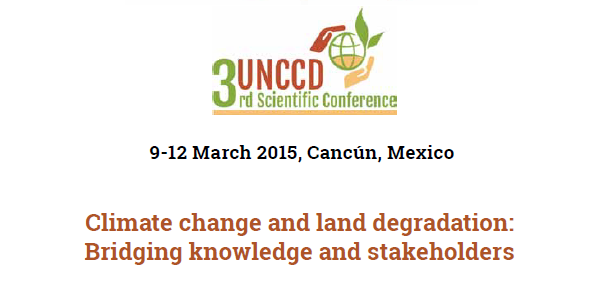 |
| Climate Change and Land Degradation |
- Investing in land degradation neutrality is a smart and cost effective way of getting things done.
- We are determined to achieve land degradation neutrality through active partnerships with all key stakeholders.
- The Great Green Wall for the Sahara and the
Sahel could play a decisive role in the future of the African continent.
News :
- Land Scan What's New
- Asia's largest desert reservoir to be expanded
- Sichuan's Tibetan areas receive environmental protection funding
- Israel Climate Action
- Land Degradation, Desertification and Climate Change
- Monique Barbut, secretaria ejecutiva de la CLD, reclama soluciones a largo plazo contra la sequía y no sólo respuestas inmediatas
Audio/Video :
Resources :

 |
| Yemen braces for locust ‘plague’ |


