Showing posts with label ElderlyAbuse. Show all posts

Wednesday, 14 June 2023

World Elder Abuse Awareness Day 2023; June 15th.

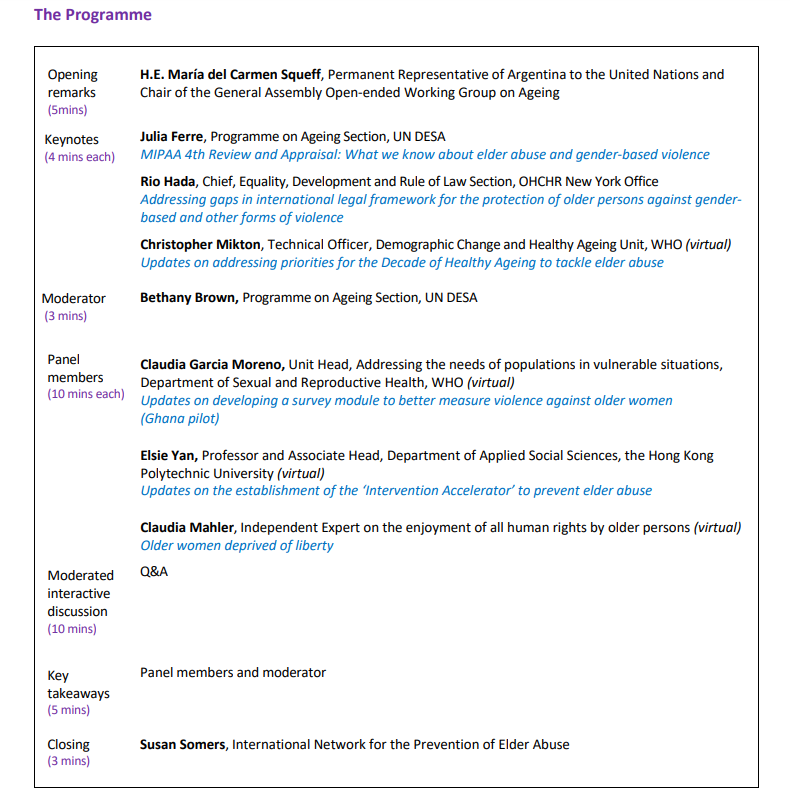
FORUM: "Addressing Gender-Based Violence in Older Age Policy, Law and Evidence-based Responses." World Elder Abuse Awareness Day 2023.

Ahead of the milestone of the 75th anniversary of the Universal Declaration of Human Rights (UDHR), this year’s commemoration of WEAAD will also connect with the year-long campaign to promote and recognise the 75th anniversary. As the month of June of the campaign will focus on showcasing the UDHR by raising awareness on its legacy, relevance and activism as relates to women’s rights, the theme of the 2023 WEAAD commemoration in the United Nations Headquarters in New York is entitled Closing the Circle: Addressing Gender-Based Violence (GBV) in Older Age - Policy, Law and Evidence-based Responses. Folllow the conversations with the hashtags: #WorldElderAbuseAwarenessDay, #15june, #WEAAD, #Elderabuse.


EVENTS: At UNHQ New York, the World Elder Abuse Awareness Day 2023 panel discussion will be held on Thursday, 15 June 2023, from 1:15pm – 2:30pm (EDT).
An expert panel will present overall trends of violence against older persons, highlight gaps and challenges of implementing the objectives in Madrid International Plan of Action on Ageing. Expert panelists will also present five priorities to combat violence against older persons in the Decade of Healthy Ageing (2021-2030).


WEBINARS: On June 15, 2023, come learn from experts and each other about the best practices for preventing elder abuse, and the latest trends among aging population at the World Elder Abuse Awareness Day Conference. SEE IT. STOP IT. PREVENT IT.  Elder Abuse Awareness


PUBLICATIONS: In the context of last year’s commemoration of World Elder Abuse Awareness Day (WEAAD), the World Health Organization in partnership with Department of Economic and Social Affairs (UN DESA), Office of the United Nations High Commissioner for Human Rights (OHCHR), United Nations Population Fund (UNFPA), UN WOMEN and with support from the International Network for the Prevention of Elder Abuse (INPEA), published Tackling abuse of older people: five priorities for the UN Decade of Healthy Ageing 2021–2030. The resource outlined key priorities to prevent and respond to abuse of older persons and, hence, contribute to improving their health, well-being and dignity. This year, the commemoration will provide an update on the implementation of the priorities.

Wednesday, 15 June 2022

World Elder Abuse Awreness Day 2022; June 15th.

 FORUM: "Combatting Elder Abuse." World Elder Abuse Awareness Day 2022.


This year, WEAAD coincides with two important events. The first is the start of the United Nations Decade of Healthy Ageing (2021-2030). This marks the beginning of ten years of concerted, catalytic and sustained collaboration with diverse stakeholders on improving the lives of older people, their families and their communities. The second is the 20th milestone of the Second World Assembly on Ageing and the fourth review and appraisal of the implementation of the Madrid International Plan of Action on Ageing (MIPAA). These provide an opportunity to generate renewed momentum for international action to advance the ageing agenda.

MIPAA represents the first time Governments agreed to link questions of ageing to other frameworks for social and economic development and human rights. The 159 Member States who signed onto the MIPAA reaffirmed the commitment to spare no effort to protect human rights and fundamental freedoms, including the right to development.

This complementarity between MIPAA and a human rights framework can be easily shown in the area of elder abuse. MIPAA includes various references to elder abuse, including “Issue3: Neglect, Abuse and Violence,” which provides two objectives relating to the elimination of all forms of neglect, abuse and violence of older persons; as well as the creation of support services to address elder abuse. Both objectives include actions to review policies, enact laws and create awareness, information, training, and research initiatives. However, in the absence of an international standard on the rights of older persons, gaps between policy and practice, and the mobilization of necessary human and financial resources, as well as the uneven progress in the implementation of MIPAA continues. An international legal instrument for older persons would advance the implementation and accountability of MIPAA.

Statement from the Independent Expert on the enjoyment of all human rights by older persons.

EVENTS


World Elder Abuse Awareness Day 2022 "Combatting Elder Abuse'' Programme #WEAAD2022

Join the NGO Committee on Ageing-NY in its observance of World Elder Abuse Awareness Day on 15 June 2022. Content experts will address the confluence of two under-reported experiences of many older persons, particularly older women: elder abuse and disability. 

Discussion will explore vulnerabilities while incorporating a strengths-based perspective. Approaches and resources to reduce situations of potential or actual mistreatment will be highlighted, including passage of a global legal instrument to protect the rights of older persons.

Date and venue: Wednesday, 15 June 2022, 1:30 p.m. – 3:00 p.m.
New York, USA.

SIDE EVENT
Combatting Elder Abuse: What’s next?Five priorities for the Decade INPEA Side event, UNECE Ministerial Conference on Ageing Rome, 16 June 2022 held in commemoration of the WORLD ELDER ABUSE AWARENESS DAY #WEAAD2022 

Date and venue: 16 June 2022.
Rome, Italy.


By standing up to adult abuse, you are also standing up for the human rights of older people everywhere.


3rd Annual World Elder Abuse Awareness Day (WEAAD) Conference hosted by the Arizona Department of Economic Security (DES), which will be back in person this year! Individuals, professional organizations and communities are invited to connect and advocate against abuse, neglect and exploitation of aging adults and residents with disabilities.


Saturday, 14 June 2014

World Elder Abuse Awareness Day 2014, June 15.

World Elder Abuse Awareness Day, Día Mundial de Toma de Conciencia de Abuso y Maltrato en la Vejez,
Всемирный день распространения информации о злоупотреблениях в отношении пожилых людей认识虐待老年人问题世界日, Journée mondiale de sensibilisation à la maltraitance des personnes âgées, اليوم العالمي للتوعية إساءة معاملة المسنين


United Nations Secretary-General's Message for the World Elder Abuse Awareness Day 2014.

Elderly people in all societies can be vulnerable to physical, psychological and financial abuse.  Older women are at particular risk due to widespread discriminatory attitudes and practices.

On this World Elder Abuse Awareness Day, I call on Member States to enact and enforce stronger laws and strategies to address all aspects of this under-acknowledged social, public health and human rights issue.

All human beings are born with equal and inalienable rights, and have the right to age with dignity, respected by their families and communities, free of neglect, abuse and violence.

Ban Ki-moon


 Neglect, Abuse, and violence Against Older Women

Women can be victims of violence across their lifespan, yet neither the women’s domestic violence movement nor the ageing empowerment movement has mobilized to end violence against older women. Elder abuse has been the object of many studies, whereas the abuse of older women has had only modest attention in the gender-based literature (Jönson & Åkerström, 2004). Older women have lacked status as battered women in domestic violence research and activism. Older women were of ten excluded in studies of violence against women and often completely absent, as though older women did not belong to the category of women. Older women were often absent from discussions about shelters and hotlines, and there has lacked debate on the circumstances and special needs of older women victims of abuse that might affect help-seeking behaviour. In general, gender analysis of violence against women and girls has focused on male dominance and subordination of women, whereas subordination seems especially relevant for older women (Jönson & Åkerström, 2004). There is growing awareness of older women victims of family mistreatment, both in terms of prevalence and in terms of commonalities and differences when compared to younger battered women. Both quantitative and qualitative research studies have begun to identify salient factors in cultural differences, age-related needs, and service needs and gaps for older women victims.

Clearly, definitional and measurement issues need to be addressed to obtain a clearer understanding of the prevalence of neglect, abuse and violence against older women. In addition, unifying themes that connect older women in developing and developed countries, and in traditional and modern societies, could be identified, as well as unifying themes that connect girls and women of all ages.

In addition, there needs to be more data on evidence-based practices for the prevention of, and intervention in, situations of neglect, abuse and violence against older women, and how they can be strengthened. Finally, a review of all laws related to neglect, abuse and violence against older women needs to be undertaken, including an analysis of their implementation and their impact on the reduction and elimination of abuse against older women.
Gender-based scholarship has begun to examine the a pplication of frameworks for working effectively with older women victims of abuse. Gerontologists are focusing more research attention on older women and abuse, and human rights experts are recognizing the special vulnerabilities of older women who are care-dependent and may lack the ability to protect themselves from undue harm without the special protection that goes beyond that needed by women of all ages who are not care-dependent. Population ageing is a global trend that is changing economies and societies around the world. The feminization of ageing, representing the intersection of age and gender, has important implications for policy as the world continues to age. It is time for neglect, abuse and violence against older women to be made visible, and made to end.


Join the Forum, World Elder Abuse Awareness Day, June 15.
Read U.N. General Assembly Resolution  A/RES/66/127 proclaming the World Elder Abuse Awareness Day

One Day to change the rest of their Lives - World Elder Abuse Awareness Day