Showing posts with label Department of Economic and Social Affairs. Show all posts

Saturday, 2 December 2023

International Day of Persons with Disabilities 2023; December 3rd.

FORUM: “United in action to rescue and achieve the SDGs for, with and by persons with disabilities.” International Day of Persons with Disabilities 2023. Given the multiple crises of today’s world, achievement of the SDGs is in peril. At the mid-point of the implementation period for the 2030 Agenda, the world is not on track to reach numerous SDGs targets by 2030. For many, progress has either stalled or regressed below the 2015 baseline. Unfortunately, the world’s poorest and most vulnerable are often the hardest hit in times of crisis. Preliminary findings from the forthcoming United Nations Disability and Development Report 2023 indicate that the world is even more off track in meeting several SDGs for persons with disabilities. Our efforts to rescue the SDGs for, with and by persons with disabilities need to be intensified and accelerated, given that persons with disabilities have historically been marginalized and have often been among those left furthest behind. A fundamental shift in commitment, solidarity, financing and action is critical. Integral to this is the inclusion of the voices, needs and priorities of the global community of persons with disabilities in all their diversity. Encouragingly, with the adoption of the Political Declaration of the SDG Summit 2023, world leaders have recommitted themselves to achieving sustainable development and shared prosperity for all, by focusing on policies and actions that target the poorest and most vulnerable, including persons with disabilities. This calls for re-energized efforts by Member States, the United Nations system, civil society and the global community of persons with disabilities, through enhanced actions and international cooperation, to make the SDGs a reality for, with and by persons with disabilities. Follow the conversations with the hashtags: #EveryoneIncluded, #3December, #DisabilityInclusionStrategy, #DisabilityDay, #IDPD on social medias.


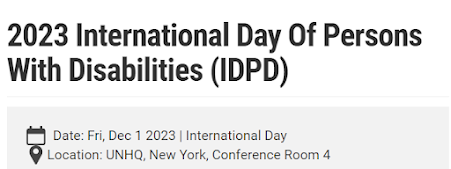
EVENTS: The United Nations will commemorate the International Day of Persons with Disabilities 2023 at the United Nations Conference room 4 in New York on December 1st, from 10am to 1pm (EDT) a hyvrid event will be held. The 2023 overarching theme of the commemoration is “United in action to rescue and achieve the SDGs for, with and by persons with disabilities.” The panel discussions will be structured around five pillars of sustainable development – People, Planet, Prosperity, Peace, and Partnerships – with a special focus on the priority areas identified in the SDG Progress Report of 2023, in the outcome document of the recent SDG Summit, in policy briefs prepared for the Summit for the Future 2024 and in the forthcoming United Nations Disability and Development Report 2023. For purposes of this discussion, the priority areas can be identified as gender equality (People), climate action (Planet), financing for development (Prosperity), a new agenda for peace (Peace) and strengthening multilateralism (Partnerships).

People: Women and girls with disabilities are acutely vulnerable to being left behind due to the intersection of gender and disability, which compounds the challenges and barriers they encounter. An intersectional lens is crucial for fulfilling the pledge that no one will be left behind.

Planet: Persons with disabilities are disproportionately affected by the impacts of climate change, owing to their greater likelihood of living in poverty, which was exacerbated by the COVID-19 pandemic . Moreover, stigma and discrimination are additional factors that increase the vulnerability of persons with disabilities to the effects of climate change .

Prosperity
: Ensuring that adequate financial resources are allocated towards disability-inclusive development must be a priority going forward, as well as the effective mainstreaming of disability in all aspects of development, including its financing. It is imperative that persons with disabilities, in all their diversity and throughout the world, actively participate in and shape these policies and processes.

Peace: Persons with disabilities are disproportionately affected by conflict in several ways, yet their needs and priorities are rarely addressed in situations of conflict. Furthermore, their role as peacemakers and peacekeepers is often ignored . Recent attempts to remedy this situation include the adoption of Security Council resolution 2475, which stipulates that respect for the human rights of persons with disabilities must be enshrined in international humanitarian law. Nevertheless, more needs to be done in this regard.

Partnerships: Despite recent setbacks, the 2030 Agenda and the SDGs remain the essential roadmap out of the multiple crises that the world is facing. A renewal of the pledge that no one will be left behind is fundamental. Success will require that all Member States, the United Nations system, civil society and the global community of persons with disabilities work together to strengthen international solidarity, and that they join in coordinated, targeted actions designed to reach the furthest behind first.
International Day for Persons with Disabilities 2023

The 2023 observance of the International Day for Persons with Disabilities (IDPD) aims to promote an understanding of disability issues and to mobilize support for the dignity, rights and well-being of persons with disabilities. 

Opening (10 - 10.30 a.m. EST): featuring messages from high-level representatives from the United Nations, Member States and civil society, to be held in person; Online panel discussion (10.40 a.m. - 1 p.m. EST): a moderated panel discussion to address major gaps in the realization of inclusive and sustainable development for, with and by persons with disabilities and to call for enhanced actions and greater international cooperation. The Event organised by UN DESA with the support of the UN Youth Office, the Department of Global Communications, the Permanent Missions of Tunisia and New Zealand, the Civil Society Coordination Mechanism and the World Institute on Disability. The commemorative event will take place in a hybrid mode. In-person attendance will be open only to those who have a valid ground pass. The deadline to register for joining us online is on November 28, 2023, by midnight (New York time). Read the 2023 IDPD concept note and Register to participate!

Monday, 16 October 2023

International Day for the Eradication of Poverty 2023; October 17th.

FORUM: “Decent Work and Social Protection: Putting Dignity in Practice for All.” International Day for the Eradication of Poverty 2023.

During the day, we will highlight these intimately linked ‘decent work’ and ‘social protection’ as drivers in ending poverty and achieving dignity in practice. To achieve our goals, choices have to be made between racing to the bottom or racing to the top. Let us choose the latter and aspire to attain the highest standards for every human being giving a chance for everyone to shine and offer their best to family, community and the world. As required by international human rights law, we urge the States to use maximum available resources to progressively fulfil their human rights obligations.


October 17 shines as a ray of hope, a day to honour the millions of people enduring the silent and sustained violence of poverty. It’s our chance to live up to the promise of putting the furthest behind first, to stand together with them and pledge our commitment to ensure that dignity in practice for all becomes a reality.


People living in extreme poverty, many of whom work in the informal economy – unregistered, unrecognised and unprotected under labour legislation – face difficult and dangerous conditions. The most excluded have no choice but to accept unacceptable situations and are often seen and treated as ‘disposable’. Despite working long hours, they are unable to earn enough to support themselves and their families. The International Labour Organisation (ILO) estimates that almost 2/3 of the world’s working population, over two billion people, are informal workers with Latin America and sub-Saharan Africa having the highest levels of informality. In 2020, only 46.9% of the global population were effectively covered by at least one social protection benefit, leaving more than half of the world’s population wholly unprotected.

Informal work is also present in high income countries especially among the marginalised and undocumented workers. And even those who have access to social protection often suffer from the stigma and control that come with it. For the people experiencing persistent poverty, their lack of decent working conditions and respectful social protection creates insecurity that denies them to take charge of their lives and exposes them to exploitation, humiliation and feelings of futility preventing them from participating fully in their communities. Over the next decade, the World Bank estimates that one billion young people will try to enter the job market, but less than half of them will actually find formal jobs.

People directly impacted by extreme poverty will face discrimination, unable to obtain decent work because of their socio-economic status, lower levels of education and training received as well as the stigma attached to being poor. UNICEF estimates that in the least developed countries, slightly more than one in four children (ages 5 to 17) are engaged in labour that is detrimental to their health and development, jeopardising the possibility to ever lift themselves and their families out of poverty.

Discrimination is also felt by women, who according to the ILO women form 58% of the informal labour force. Women are likely to be the lowest paid, most marginalised and more susceptible to sexual harassment at work. Despite women’s work contributing to the economy, well-being of individuals, families and societies, the care and household work is unpaid, undervalued and left out of policy agendas. Similarly, the most excluded among us also perform useful jobs, often under precarious conditions. They have, for example, been on the forefront of environment protection and trendsetters in repair, reuse and recycle long before the ‘circular economy’ concept became popular. Despite their economic, social and environmental contribution, their work is not recognised or dismissed by society.

Dignity of the human person
is inherent and yet the lived experience of people in poverty, the reality of their situation, access to decent work and social protection are a far cry from the promise of the right to work and a life in dignity enshrined in the Universal Declaration of Human Rights and reaffirmed in Agenda 2030 for Sustainable Development to end poverty in all its forms everywhere. The reality check is all the more shocking in view of the tremendous wealth, know how and technological advances that could have ended poverty already many decades ago. Yet the discriminatory social institutions, unjust systems, laws, policies and actions cause poverty to persist and inequalities to increase. 


In aspiring for the highest attainable standards, we call for:


Decent work for all – The ILO defines decent work as “productive work for women and men in conditions of freedom, equity, security, and human dignity.” Ensuring that jobs enable women and men to work in conditions of dignity is key to ending poverty. Decent work must be understood in the context of a dignified life and address the hidden dimensions of poverty, the social and institutional maltreatment, the unrecognised contributions that disempowers people living in poverty and causes suffering of the body, mind and the heart. In addressing the hidden dimensions, decent work combats social exclusion and promotes cohesion by inviting excluded individuals, those who have been left behind back into public life. It provides an environment supportive of non-judgement context assisting and most wider excluded individuals to access decent jobs in locations close to where they live. Decent work transforms unequal power relations by recognising the worker as a rights holder who needs to be supported and provided with the necessary education and training to do their work, who has the right to a fair wage, social security and safe working conditions. Decent work is work that empowers and enables their control over income earned. The income security that comes with social protection provides agency for people to confidently plan their future. Moreover, the dignity of work gives respect to the worker without discrimination, thereby regarding work as ‘bearer of humanity’ .


Universal social protection (USP) – Life’s journey is full of uncertainties and everyone, including those outside the labour force (eg. children, elderly and people not able to work), have a right to income security, to be ‘protected against poverty and risks to livelihoods and well-being’. States are required to deploy their maximum available resources to make social protection a reality for all. Anyone who needs social protection should be able to access it and barriers to accessing social protection rights should be addressed. In doing so, special attention must be paid to the most excluded and people trapped in extreme poverty, some of whom do not take up their rights due to lack of legal identity or shame associated with being poor. In designing and operationalising universal social protection schemes, states must involve the rights holders to ensure effective take up by those in need. In our efforts to move forward, let us use dignity as our compass, so the attainment of fundamental human rights and social justice is at the heart of national and global decision making. Using dignity as our compass will also help shape a global economy that prioritises the wellbeing of the people and planet over maximisation of corporate profits and ensure social justice, peace and prosperity. In moving forward, strong partnerships are needed. In this regard, Global Partnership for Universal Social Protection, and Global Coalition for Social Justice to reduce and prevent inequalities should be supported.


Follow the conversation with the hasgtags: #Dignity4All, #PovertyDay, #17october, #EndingPoverty, #GlobalGoals, #SDG1.


In our world of plenty, poverty should have no home.

Yet, as we mark the International Day for the Eradication of Poverty, nearly 700 million people are barely scraping by, living on less than $2.15 per day.

Over a billion people are deprived of basic needs like food, water, health care and education. Billions more lack sanitation and access to energy, jobs, housing and social safety nets.

Meanwhile, conflicts, the climate crisis, discrimination and exclusion — particularly against women and girls — are deepening the distress.

This is compounded by an outdated, dysfunctional and unfair global financial system that hinders developing countries from investing in alleviating poverty and achieving the SDGs.

At current rates, almost 500 million people will still be living in extreme poverty in 2030.

This is unacceptable.

At the SDG Summit in September, world leaders recognized the need to reform the international financial architecture and committed to a bold plan to rescue the Sustainable Development Goals and accelerate efforts to eradicate poverty everywhere.

This includes support for an SDG Stimulus of at least $500 billion per year in financing for investments to achieve this.

Leaders also agreed on targeted action aimed at alleviating poverty and suffering for all people — from transformed food and education systems, to decent jobs and expanded social protection, as this year’s theme highlights.

Ending poverty is the challenge of our time.

But it is a challenge we can win.

On this important day, let’s renew our commitment to a world free of poverty.

United Nations Secretary-General.


EVENTS: Commemoration of the International Day for the eradication of poverty 2023 entitled ”Decent work and social protection: Putting Dignity in practice for all.” on October 17th at UNHQ. Register to participate and Get the agenda programme!


More information about initiatives, events and activities to mark October 17 around the world can be found at UNDESA and overcoming poverty website.


Celebrated since 1987 as the World Day for Overcoming Extreme Poverty and recognized by the United Nations in 1992, the International Day for the Eradication of Poverty promotes dialogue and understanding between people living in poverty and their communities, and society at large.“It represents an opportunity to acknowledge the efforts and struggles of people living in poverty, a chance for them to make poor people concerns heard, and a moment to recognize that poor people are in the forefront in the fight against poverty.” (United Nations, Report of the Secretary General, A/61/308,
para. 58
)

Sunday, 14 May 2023

International Day of Families 2023; May 15th.

 FORUM:" Demographic Changes and Families.'' International Day of Families 2023.

Issues for discussion: • What are the impacts of demographic change on families? • What are the current trends in population ageing? • What is the state of care arrangements for older persons? • What are the inequality trends in an ageing world? • What is the state of intergenerational solidarity in an ageing world? • What family-oriented policies have been most effective in responding to current demographic trends? • What civil society initiatives can ensure family well-being? • What is the importance of the Civil Society Declaration for IYF+30?

Follow the conversations with the hashtags: #InternationalDayofFamilies, #DemographicTrends, #15May.


EVENT: Observance of the International Day of Families 2023. Monday, 115 May, 1:15-2:30 PM (EST) Conference Room 11 UN HQ New York. Watch the plenary sessions!

 Programme Agenda of the 2023 International Day of Family "Families and Demographic Change".

Moderator Masumi Ono Chief, Social Inclusion and Participation Branch Division for Inclusive Social Development, DESA

 Launch of Background Paper & Keynote Address Zitha Mokomane, PhD. Professor & Head of Department Department of Sociology, University of Pretoria

  “The Impact of Demographic Change on Families” Panelists: Jonathan Perry Social Affairs Officer

“Leaving No One Behind in an Ageing World: Findings from the 2023 UN World Social Report” Ernest Gonzalez, PhD. James Weldon Johnson Professor of Social Work Director of the Center for Health and Aging Innovation, New York University Silver School of Social Work 

“Intergenerational Equity & Solidarity: Good practices from the field” Angela Fallentine Doha International Family Institute Representative Elisabeth Mueller European Large Families Confederation Representative José Alejandro Vázquez Alarcón, PhD. 

International Federation for Family Development Representative “Civil Society Declaration for IYF+30”.


Wednesday, 15 June 2022

World Elder Abuse Awreness Day 2022; June 15th.

 FORUM: "Combatting Elder Abuse." World Elder Abuse Awareness Day 2022.


This year, WEAAD coincides with two important events. The first is the start of the United Nations Decade of Healthy Ageing (2021-2030). This marks the beginning of ten years of concerted, catalytic and sustained collaboration with diverse stakeholders on improving the lives of older people, their families and their communities. The second is the 20th milestone of the Second World Assembly on Ageing and the fourth review and appraisal of the implementation of the Madrid International Plan of Action on Ageing (MIPAA). These provide an opportunity to generate renewed momentum for international action to advance the ageing agenda.

MIPAA represents the first time Governments agreed to link questions of ageing to other frameworks for social and economic development and human rights. The 159 Member States who signed onto the MIPAA reaffirmed the commitment to spare no effort to protect human rights and fundamental freedoms, including the right to development.

This complementarity between MIPAA and a human rights framework can be easily shown in the area of elder abuse. MIPAA includes various references to elder abuse, including “Issue3: Neglect, Abuse and Violence,” which provides two objectives relating to the elimination of all forms of neglect, abuse and violence of older persons; as well as the creation of support services to address elder abuse. Both objectives include actions to review policies, enact laws and create awareness, information, training, and research initiatives. However, in the absence of an international standard on the rights of older persons, gaps between policy and practice, and the mobilization of necessary human and financial resources, as well as the uneven progress in the implementation of MIPAA continues. An international legal instrument for older persons would advance the implementation and accountability of MIPAA.

Statement from the Independent Expert on the enjoyment of all human rights by older persons.

EVENTS


World Elder Abuse Awareness Day 2022 "Combatting Elder Abuse'' Programme #WEAAD2022

Join the NGO Committee on Ageing-NY in its observance of World Elder Abuse Awareness Day on 15 June 2022. Content experts will address the confluence of two under-reported experiences of many older persons, particularly older women: elder abuse and disability. 

Discussion will explore vulnerabilities while incorporating a strengths-based perspective. Approaches and resources to reduce situations of potential or actual mistreatment will be highlighted, including passage of a global legal instrument to protect the rights of older persons.

Date and venue: Wednesday, 15 June 2022, 1:30 p.m. – 3:00 p.m.
New York, USA.

SIDE EVENT
Combatting Elder Abuse: What’s next?Five priorities for the Decade INPEA Side event, UNECE Ministerial Conference on Ageing Rome, 16 June 2022 held in commemoration of the WORLD ELDER ABUSE AWARENESS DAY #WEAAD2022 

Date and venue: 16 June 2022.
Rome, Italy.


By standing up to adult abuse, you are also standing up for the human rights of older people everywhere.


3rd Annual World Elder Abuse Awareness Day (WEAAD) Conference hosted by the Arizona Department of Economic Security (DES), which will be back in person this year! Individuals, professional organizations and communities are invited to connect and advocate against abuse, neglect and exploitation of aging adults and residents with disabilities.