Showing posts with label UNOOSA. Show all posts

Sunday, 20 July 2025

International Moon Day 2025; July 20th.

FORUM: ‘‘The first human footprints on the moon.’’ International Moon Day 2025. For thousands of years, human civilizations have looked up to the sky pondering the origin and mysteries of the Moon – our only natural satellite. Ground-based observations enabled by the invention of the first telescopes opened a new chapter in our understanding of our celestial companion. With the birth of space activities, the Moon became the ultimate destination of countless missions, including crewed flights that brought the first human footprints to another place in the universe. As Moon exploration efforts continue taking shape with ambitious plans, this global celebration will serve not only as a reminder of success in the past, but as an annual testimony to future endeavours. The International Moon Day is a good opportunity to educate the public, promote and raise awareness on the status and prospects for humanity. Follow the conversations with the hashtags: #InternationalMoonDay, #lunarbeauty, #20july, #firstlandingonmoon, #Themoon, #spacescience, #moonphases, #sustainablemoonexploration.


EVENTS: On Sunday July 20th, the United Nations General Assembly with the United Nations Office of the Outer Space Affairs (UNOOSA) will host a virtual event to celebrate the International Moon Day 2025 and the 56 years since Apollo 11 moon landing at the United Nations Headquarters. Join us to mark the anniversary of the first landing by humans on the Moon as part of the Apollo 11 lunar mission. Register to participate!

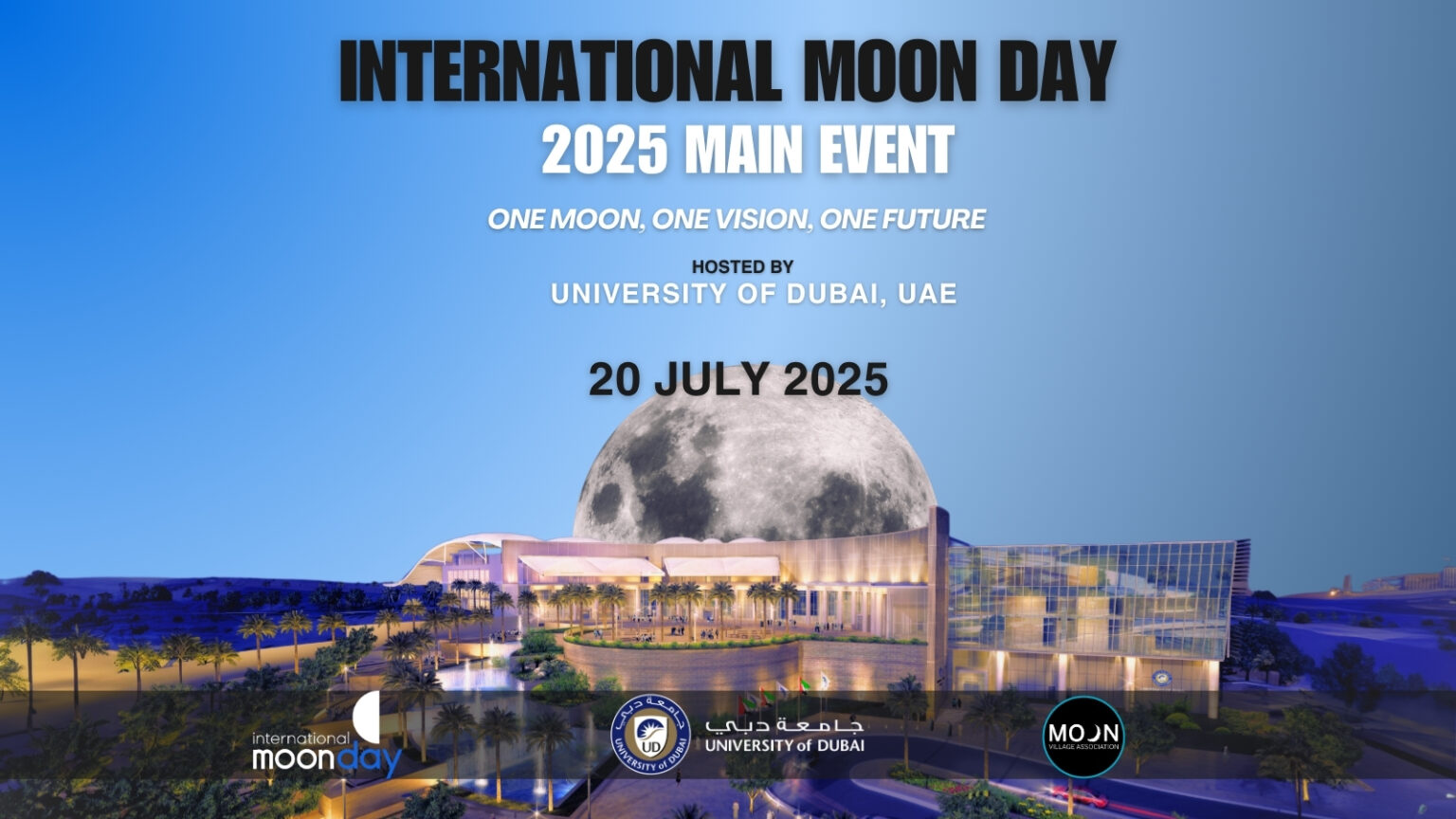
On July 20th, 2025 In the UEA, the global celebration will take place at the University of Dubai. This flagship event entitled “One Moon, One Vision, One Future.” organized by the Moon Village Association in partnership with the University of Dubai, will bring together international space leaders, astronauts, students, and innovators to inspire dialogue and collaboration around lunar exploration. 


One Moon, One Vision, One Future.

Join us for the global celebration of International Moon Day 2025, taking place at the University of Dubai on July 20th. This flagship event, organized by the Moon Village Association in partnership with the University of Dubai, will bring together international space leaders, astronauts, students, and innovators to inspire dialogue and collaboration around lunar exploration.

Agenda Programme

Master of Ceremonies: Ms. Sara Alessa
9:00 AM – 9:30 AM | Opening 
- Dr. Eesa Bastaki, President of the University of Dubai
- Dr. Giuseppe Reibaldi, President of the Moon Village Association
Greetings by
- Mr. Driss El Hadani, Deputy Director, United Nations Office for Outer Space Affairs (UNOOSA)
- Prof. Wu Weiren, Director General, Deep Space Exploration Laboratory (DSEL)
- Dr. Hiroshi Yamakawa, President, Japan Aerospace Exploration Agency (JAXA)
- Prof. Teodoro Valente, President, Italian Space Agency (ASI)
9:30 AM- 10:20 AM | Key Notes
- Dr. Nasr Alsahaf, Chairman, International Moon Day (IMD)
- HE Dr. Sultan Al Neyadi, UAE Minister of Youth, Astronaut, (TBC)
- Mr. John C. Mankins, CEO, Mankins Space Technologies Inc.
- Mr. Atsushi Saiki, Executive Fellow, ispace, inc.
10:20 AM – 10:50 AM | Emirates Lunar Mission
Session Speaker: Eng. Amna Khalifa Busoud; Rover Design and Mobility Lead, Emirates Lunar Mission
10:50 AM – 11:10 AM | Networking and Refreshments Break

Exhibition Area: Displays from space organizations (MBRSC, UAE Space Agency, private space startups)
Student project displays showcasing lunar concepts, models, and innovations (this has to be announced and worked out in advance and presented during the celebration)
11:10 M – 11:20 AM | “Lunar Governance – industry perspective” – Fireside chat with Mr. Mike Gold and Dr. Giuseppe Reibaldi

Discussion on Lunar Governance between Mr. Mike Gold, President, Civil and International Space at Redwire and Dr. Giuseppe Reibaldi, President, Moon Village Association.
11:20 AM – 12:00 PM | Expert Panel Session 1: “Moonshots: Innovation & Lunar Markets”

Panel of space experts, entrepreneurs and industry discussing innovation opportunities, space startups, and commercial programs opening new lunar markets

Moderator: 
Dr. Saeed Aldhaheri, Director, Center of Future Studies
Mr. Satoru Kurosu, Yokogawa Electric & MVA
Ms. Fatima Al Khateri, Director of Sharjah Astronomical Planetarium Department at SAASST
Mr. Serdar Baycan, Solar Space Technologies

12:00 PM – 12:30 PM | Student Recognition & Awards Ceremony
Celebrate winners of competitions, award certificates, trophies, and announce special recognitions.
Short speech by distinguished guests acknowledging students’ creativity and enthusiasm.
UAE Mission Moonlight 2050 Challenge: Students must design a moonbase for UAE settlement on the moon by 2050, using digital arts and generative AI tools. The challenge will be announced before the event and winners will be invited to come present their designs and will be recognized during the event.
Presentation and Recognizing the UAE team winner of the NASA International Space Apps Challenge

12:30 PM – 1:30 PM | Lunch Break
1:30 PM – 2:15 PM | Panel Session 2: Lunar Governance: Challenges and Opportunities

This panel explores the challenges and opportunities for coordination and cooperation of lunar activities, including the Artemis and ILRS programmes. Considering the increasing number of stakeholders involved in lunar missions and the lack of definition of the existing space treaties, new way to define lunar governance are required at the level of the United Nations.

Moderator: 
- Mr. Driss El Hadani, Deputy Director, United Nations Office for Outer Space Affairs (UNOOSA)
- Prof. Scott Pace, Professor of Practice of International Affairs, George Washington University
- Ms. Ulpia-Elena Botezatu, Co-Chair, UN Action Team on Lunar Consultation Activities (ATLAC)
- Eng. Hoor Al Mazmi, Senior Researcher, Space Science, UAE Space Agency
- Prof. Ilias Fernini, College of Science, UAE University

2:15 PM – 2:30 PM | Closing Remarks by Dr. Eesa Bastaki and Dr. Giuseppe Reibaldi
Announcements
Final thoughts and invitation to participants for future involvement in space initiatives.
Networking and photo opportunities with guests, speakers, astronauts, and student participants.

LIVESTREAM: July 20th conference in University of Dubai.

The Main Event will be Live Streamed. The Live Stream starts at 9:00 AM Dubai Time.


Worldwide Activities: 
July 20 to July 24, starting at 17:00 ending at 18:30 will be held the IMD-25 Moon Day and Moon Workshop at the Al-Qebliya School Cultural Center and Kuwait National Planetarium, Kuwait Al Ma'arri St, Kuwait City.

On July 21th, from 14:00 - 17:00 will be held the International Moon Day Space Exploration workshop in Nanjing ILEWG NUAA at the NUAA Nanjing Aerospace University, China Nanjing.

On July 21th, from 10:00 - 10:30 will be held a virtual event to mark the International Moon Day from ExoSpaceHab Express Moon Base from France - Online

On July 21th, from 10:30 - 13:00; you are invited to participate to the panel discussion entitled ‘‘Understanding Moon through Demonstrations’ at Regional Science Centre and Planetarium, Calicut, Kerala, India Jafferkhan Colony, Calicut.

Saturday, 12 April 2025

International Day of Human Space Flight 2025, April 12th.

FORUM: ''Honoring the spirit of discovery and the boundless potential of space for all of humanity." International Day of Human Space Flight 2025.

 On April 12, 1961, the world witnessed an event of universal scale (or the universe witnessed an event of global scale) - Soviet cosmonaut Yuri Gagarin on the Vostok-1 spacecraft made the first manned space flight in history, which lasted 108 minutes and opened the era of human exploration of outer space. The Vostok-1 spacecraft was a spherical descent vehicle 4.3 meters long, 2.43 meters in diameter and with a launch weight of 4,725 kilograms. It was equipped with a life support system, automatic control and communications equipment. It was designed for one crew member with a flight duration of up to 10 days. The launch vehicle for the spacecraft was developed on the basis of the two-stage R-7 intercontinental ballistic missile with the addition of a 3rd stage. Its length was 38.2 meters, its diameter was 10.3 meters, and its launch weight was about 287 tons. The rocket could launch a payload of up to 4.5 tons into space. The flight was controlled automatically, but Gagarin had the option to take control if necessary. For safety reasons, the cosmonaut wore a spacesuit during the entire flight. In case of cabin depressurization, the spacesuit contained a four-hour oxygen supply, which protected the cosmonaut when ejecting the seat at an altitude of up to 10 kilometers. The launch took place from the Baikonur Cosmodrome at 9:07 Moscow time. The ship made one orbit around the Earth and landed near the village of Smelovka in the Saratov Region at 10:53. At an altitude of about 7 kilometers, Gagarin ejected from the descent vehicle and landed separately on a parachute. Vostok 1 gave rise to a series of Soviet spacecraft, and even after the completion of the main program, various modifications continued to be used later, serving as the basis for a number of Soviet and Russian satellites. Follow the conversations with the hashtags: #12April, #YuriGargarin, #HumanSpaceFlightDay, #YurisNight, #soyuz.


EVENT: On April 12th, a virtual event will held to mark the International Day of Human Space Flight 2025. 

Statement by the President of Russia on the Cosmonautics Day 2025.

“Please accept my most sincere greetings on Cosmonautics Day, a holiday that brings together all generations of the country’s citizens. My warmest words go to the pioneers and veterans of the rocket and space industry, whose selfless work laid the foundation for a tradition of devoted service to their calling, to the Motherland and to the people.

The legendary launch of Yury Gagarin on April 12, 1961, will forever remain a most prominent and truly milestone event of the 20th century, a great triumph of our Fatherland. We are also deeply proud of the illustrious constellation of outstanding space scientists, designers, cosmonauts, engineers, military and civilian specialists – true patriots and visionaries who stood at the origins of the national space programme.

Today, Russia’s rocket and space industry is tackling vital tasks to strengthen the country’s research and technology capabilities, to improve its manufacturing facilities and ground infrastructure, develop advanced equipment for space exploration, and implement important defence programmes – including those related to the special military operation.

The exploration of the Universe, the use of space systems is a field of strong global competition. To maintain global leadership and ensure the achievement of national development goals, it is essential to constantly move forward, with businesses and research centres joining their efforts to boost the production of satellites, introduce innovative components, new materials, digital and nuclear technology, and develop promising manned spacecraft and launch vehicles. The rocket and space industry should become one of the growth drivers of the national economy, ensuring the country’s technological sovereignty, and improving the quality of life in all regions of Russia.”

Saturday, 29 June 2024

International Asteroid Day 2024; June 30th.


FORUM: “Small is Beautiful.” International Asteroid Day 2024. 116 years ago, a bolide exploded over Tunguska, flattening about 80 million trees. This year forum will be built around seven panel discussions that will tell the full story of asteroids; from the formation of the Solar System, 4.6 billion years ago, to the scientific work taking place today, and our future prospects as we begin to imagine ways to utilise the resources asteroids contain. The panels will explore: the origin of the solar system, how we discover and track Near-Earth asteroids, how we characterise an asteroid according to its composition, orbit and other physical properties, how we will defend Earth if and when we spot a threatening asteroid, what resources we may find on asteroids and elsewhere in the Solar System, how we can utilise space in a sustainable way, and what future missions and technology we have to look forward to. Follow the conversations with the hashtags: #asteroids, #comets, #30june, #asteroidday.


Asteroids Day Space Lecture


EVENTS: June 30th marks the anniversary of the Tunguska impact over Siberia, Russian Federation in 1908. The Tunguska asteroid event was the Earth's largest asteroid impact in recorded history. The UNOOSA, The European Space Agency, The National Aeronautics and Space Administration (NASA), The Luxembourg Space Agency and The Asteroid Foundation held a webinar on June 30th. Running the entire month of June, Asteroid Day TV have prepared a collection of asteroid-related content including interviews, documentaries, cartoons, missions in progress and much more. The content streamed will be suitable for a range of ages and knowledge basis – you don’t need to be an expert to understand.


Explore the 3D world of Asteroids, Comets and NEOs. Learn about past and future missions, tracking and predicting orbits, and close approaches to Earth.

Thursday, 11 April 2024

International Day of Human Space Flight 2024; April 12th.

FORUM: “Celebrating the first Human Space flight.” International Day of Human Space Flight 2024. Yuri Gagarin became the 1st human to orbit the Earth. He visited the United Nations with fellow astronaut Valentina Tereshkova after she became the 1st woman in space. The mission of the Federal Space Agency (Roscosmos) is to implement government policy and legal regulation, to provide government services and to manage state property in the field of space exploration, international space cooperation and joint projects and programmes in space, space research, missile and space technology for military purposes, strategic missile systems, coordination of the maintenance, further development and use of the Global Navigation Satellite System (GLONASS) in the interests of civilian consumers, including commercial consumers, and international cooperation in this sphere, as well as the general coordination and management of the activities being carried out at the Baikonur space centre. The goals of the "Cosmonautics day" online class hour are to introduce the first cosmonaut, to promote career in space science and technology and reflect on the future of outer space. Follow the conversations with the hashtags: #12April, #YuriGargarin, #HumanSpaceFlightDay, #YurisNight.


EVENTS: Celebration of the 63rd anniversary of Yuri Gagarin's first manned flight into space. Every year on April 12th at 9:07 am Moscow time on #CosmonauticsDay, we start counting minutes until Gagarin’s return home in 1961. Launched from Baikonur Cosmodrome, his spacecraft, Vostok 1, completed a full orbit around the Earth, landing in the Saratov Region. The flight lasted for 108 minutes. Two days later, the capital and the entire country welcomed the space hero back. The world applauded the space pioneer. On Cosmonautics Day 2024, all of Russia’s regions hold special festive events, exhibitions, excursions, exhibitions, festivals, concerts, flash-mobs, quests and art contests for children.

Space Foundation Presents Yuri's Night 2024: After the view of the Total Solar Eclipse, immerse yourself in an atmosphere of out-of-this world excitement marking space milestones being celebrated around the world. Indulge in delectable culinary and cocktail offerings, participate in cosmic hands-on activities, get bidding in a silent auction packed with amazing offerings, and meet real-life astronauts – all while supporting educational programming offered by Space Foundation!. Come celebrate past space exploration and what is yet to be discovered. By participating, you'll enjoy a cosmic experience AND contribute to the advancement of STEAM education for future space explorers and innovators worldwide. Join us for Colorado Springs’ own Yuri's Night, the ultimate event for space enthusiasts and party lovers alike. Explore Yuris Night Agenda and get your tickets today for this stellar celebration!


FILM SCREENING - Apollo 11 - First Steps Edition Screening.

Apollo 11 - First Steps Edition Screening


Celebrating Women Astronauts 2024.


LIVE: Russia Makes Third Attempt to Launch its First Heavy lift Spacecraft Angara-A5. 


Russia embarks on a third attempt to proceed with a test launch of its Angara-A5 space rocket after technical glitches prompted officials to abort missions at the very last minute for two days in a row. The launch of the Angara is intended to showcase Russia’s post-Soviet space ambitions and the growing role played by Vostochny. The Angara launch vehicle is capable of carrying payloads bigger than 20 tonnes into orbit. 


This launch is the first from Vostochny. Due to its location closer to the equator, Angara-A5 can deliver a heavier payload to orbit if launched from there rather than from Plesetsk, a Soviet-era facility where Russia has previously carried out three successful Angara test launches. Watch the Lanch of the Angara- A5 Space rocket!


Tuesday, 11 April 2023

International Day of Human Space Flight 2023; April 12th.

FORUM: HOW SPACE CAN BE USED IN SUPPORT OF THE 2030 AGENDA FOR SUSTAINABLE DEVELOPMENT. International Day of Human Space Flight 2023.

On 4 October 1957 the first human-made Earth satellite Sputnik I was launched into outer space, thus opening the way for space exploration. On 12 April 1961, Yuri Gagarin became the first human to orbit the Earth, opening a new chapter of human endeavour in outer space. 


Yuri’s Night is the global celebration of humankind’s achievements in space. Yuri’s Night is celebrated every year on or around April 12th. Follow the conversation with the hastags: #12April, #YurisNight, #HumanSpaceFlight, #InternationalDayofHumanSpaceFight.


EVENTS: Gala to celebrate Cosmonautics Day 2023.
WEBINARS: Space science and technologies for the Achievement of the Sustainable Development Goals.


SPACE FOR SDG


Despite the growing global economy and the technological progress observed in the past decades, there are still many societal challenges that need to be overcome to enhance human development. The United Nations, involving more than 190 Member States, has developed the 2030 Agenda for Sustainable Development in order to address these challenges in the form of 17 Sustainable Development Goals (SDGs) with 169 associated specific targets.

The importance of the role of Earth Observation (EO) and geolocation (provided by GNSS) in supporting the achievement of the development goals is recognised by the UN ( General Assembly resolution A/RES/70/1: Transforming our world: the 2030 Agenda for Sustainable Development ). However, the potential of space in supporting the SDGs is much wider. Space-based services and technologies are key in understanding climate change and during the full disaster management cycle; only two examples among countless applications to which space can contribute to.


The Sustainable Development Goal 1 (Space for SDG) calls for an end to poverty in all its manifestations by 2030. It aims to ensure social protection for the poor and vulnerable, increase access to basic services and support people harmed by climate-related extreme events and other economic, social and environmental shocks and disasters. 

Space technologies are central, among other things, in:
  • Forecasting natural disasters and better coordinate subsequent aid provision
  • Optimising sustainable utilisation of natural resources
  • Providing efficient support to vulnerable populations
  • Mapping populated areas and their access to basic services

Overall, space technologies can contribute to the prevention of people falling below the poverty line and help target specific support to those in need.


The Sustainable Development Goal 2 (Space for SDG) aims to end hunger and all forms of malnutrition. It also commits to universal access to safe, nutritious and sufficient food throughout the year. This require sustainable food production systems and resilient agricultural practices, equal access to land, technology and markets, and international cooperation on investments in infrastructure and technology to boost agricultural productivity.

Space technologies are key to:
  • Optimising crop productivity through informed management process and increased efficiency in the use of existing resources, including land, seeds, fertilisers, plant protection agents and water
  • Improving livestock management through enhanced monitoring and identification of suitable grazing


The Sustainable Development Goal 3 (Space for SDG) seeks to ensure health and well-being for all, at every stage of life. The Goal addresses all major health priorities, including reproductive, maternal and child health; communicable, non-communicable and environmental diseases; universal health coverage; and access for all to safe, effective, quality and affordable medicines and vaccines. It also calls for more research and development, increased health financing, and strengthened capacity of all countries in health risk reduction and management.

Space technologies are essential in a range of health applications, including, but not limited to:

  • Studying disease epidemiology, by enabling increased use of spatial analysis to identify the ecological, environmental and other factors that contribute to the spread of vector-borne diseases, monitoring disease patterns and defining areas that require disease-control planning
  • Addressing issues related to vision, cognition and disability assistance
  • Monitoring factors that affect human health and well-being, like air quality and traffic
  • Supporting health promotion and disease prevention, through the use of wearable monitoring devices
  • Enabling remote healthcare

Overall, space technologies can contribute to the prevention of people falling below the poverty line and help target specific support to those in need.


The Sustainable Development Goal 4 (Space for SDG) aims at ensuring inclusive and equitable quality education and promote lifelong learning opportunities for all. This goal ensures that all girls and boys complete free primary and secondary schooling by 2030. It also aims to provide equal access to affordable vocational training, to eliminate gender and wealth disparities and achieve universal access to a quality higher education. Estimates show that, among those 59 million children, 1 in 5 of them had dropped out and recent trends suggest that 2 in 5 of out-of-school children will never set foot in a classroom. The Sustainable Development Goals clearly recognise that this gap must be closed, even as the international community more explicitly addresses the challenges of quality and equity in education.

Space technologies can provide, among others:

  • High-speed internet connectivity and tailored online educational content delivered via satellite
  • Electronic attendance monitoring and provision of incentives for parents to reduce dropout rates
  • Remote learning, e-learning and lifelong learning opportunities for remote and isolated communities

Sustainable Development Goal 5 (Space for SDG) seeks to achieve gender equality and empower all women and girls. Gender equality and women's empowerment have advanced in recent decades. Women's and girls' access to education has improved; the rate of child marriage has fallen and progress has been made in the area of sexual and reproductive health and reproductive rights, including fewer maternal deaths. Nevertheless, gender equality remains a persistent challenge for countries worldwide and the lack of equality is a major obstacle to sustainable development, as gender and wealth disparities persist and obstruct universal access to a quality higher education.

Space technologies can support women's empowerment through:

  • Access to quality education even in remote and isolated communities
  • Support for female entrepreneurship, through access to training, soft infrastructure, information and safety in the work environment
  • Career development opportunities, often within STEM

The Sustainable Development Goal 6 (Space for SDG) pursues to ensure availability and sustainable management of water and sanitation for all. Clean, accessible water for all is an essential part of the world we want to live in. There is sufficient fresh water on the planet to achieve this. However, every year millions of people, most of them children, die from diseases associated with inadequate water supply, sanitation and hygiene. Clean water, basic toilets and good hygiene practices are essential for the survival and development of children. Today, there are around 2.4 billion people who do not use improved sanitation, and 663 million who do not have access to improved water sources. Every day, over 800 children die from preventable diseases caused by poor water, and a lack of sanitation and hygiene.
    Space technologies enable, among others:
  • Water quality monitoring
  • Meteorological forecasting
  • Access to infrastructural support and technical know-how

The Sustainable Development Goal 7 (Space for SDG) aims at ensuring access to affordable, reliable, sustainable and modern energy for all. Energy is central to nearly every major challenge and opportunity the world faces today. Sustainable energy is an opportunity to transform lives, economies and the planet. Still, one in five people lack access to electricity and, as demand continues to rise, there needs to be a substantial increase in the production of renewable energy across the world. The proportion of the world's population with access to clean fuels and technologies for cooking increased from 51% in 2000 to 58% in 2014, although there has been limited progress since 2010.

Space technologies are central in:

  • Critical infrastructure monitoring, particularly with regards to energy networks
  • Power grid synchronisation
  • Seismic surveying
  • Identification of optimal sites for the production of renewable energy
  • Solar and wind energy production forecasting to estimate the amount of energy that needed from other sources

The Sustainable Development Goal 8 (Space for SDG) promotes sustained, inclusive and sustainable economic growth, full and productive employment and decent work for all. Roughly half the world's population still lives on the equivalent of about US$2 a day, and in too many places, having a job does not guarantee an escape from poverty. Slow and uneven progress in this area requires us to rethink and retool our economic and social policies aimed at eradicating poverty. A continued lack of decent work opportunities, insufficient investments and under-consumption lead to an erosion of the basic social contract underlying democratic societies: that all must share in progress. Sustainable economic growth will require societies to create the conditions that allow people to have quality jobs that stimulate the economy while not harming the environment.

Space technologies support:
  • Global economies and GDP growth, contributing to a range of sectors, particularly service delivery, utilities, banking and finance, agriculture and communications
  • Lone workers monitoring, establishing safe and secure working environments

The Sustainable Development Goal 9 (Space for SDG) seeks to build resilient infrastructure, promote inclusive and sustainable industrialisation and foster innovation. This SDG encompasses three important aspects of sustainable development: infrastructure, industrialisation and innovation. Infrastructure provides the basic physical systems and structures essential to the operation of a society or enterprise. Industrialisation drives economic growth, creates job opportunities and thereby reduces income poverty. Innovation advances the technological capabilities of industrial sectors and prompts the development of new skills. Inclusive and sustainable industrial development is the primary source of income generation, allows for rapid and sustained increases in living standards for all people, and provides the technological solutions needed for environmentally sound industrialisation.

Space technologies play a key role in:
  • Infrastructure mapping and monitoring, including maintenance of road infrastructure in rural environments, where the most reliable technology is satellite-based
  • Construction surveying though machine automation
  • Smart mobility, e.g. reduced fuel consumption by smarter planning and monitoring of driving behaviour

Sustainable Development Goal 10 (Space for SDG) aims at reducing inequality within and among countries. This SDG calls for reducing inequalities in income as well as those based on age, sex, disability, race, ethnicity, origin, religion or economic or other status within a country. The goal also addresses inequalities among countries, including those related to representation, migration and development assistance. The international community has made significant strides towards lifting people out of poverty. The most vulnerable nations - the least developed countries, the landlocked developing countries and the Small Island developing States - continue to make inroads into poverty reduction. However, inequality still persists and large disparities remain in access to health and education services and other assets.

Space technologies can contribute in various ways, for example through:
  • Connectivity in remote and isolated areas
  • Remote participation in democratic processes
  • Reliable access to information
  • Connectivity in remote and isolated areas
  • Remote participation in democratic processes
  • Reliable access to information

The Sustainable Development Goal 11 (Space for SDG) is focused on cities, as more than half of the world's population lives in them. Cities are hubs for ideas, commerce, culture, science, productivity, social development and much more; they have enabled people to advance socially and economically. However, many challenges exist to maintaining cities in a way that continues to create jobs and prosperity without straining land and resources.

Space technologies are utilised for:
  • Urban planning, to pinpoint structures and reference points for cadastral and urban planning purposes
  • Smart Cities, through the application of Global Navigation Satellite Systems, Earth Observation and Satellite Telecommunications
  • Improvement of city services, such as smart waste management systems
  • Air quality monitoring
  • Disaster management
  • Infrastructure monitoring
  • Search and rescue operations

The Sustainable Development Goal 12 (Space for SDG) aims at ensuring sustainable consumption and production patterns. SDG 12 is about promoting resource and energy efficiency, sustainable infrastructure, and providing access to basic services, green and decent jobs and a better quality of life for all. Its implementation helps to achieve overall development plans, reduce future economic, environmental and social costs, strengthen economic competitiveness and reduce poverty. Sustainable consumption and production aims at "doing more and better with less", increasing net welfare gains from economic activities by reducing resource use, degradation and pollution along the whole lifecycle, while increasing quality of life.

Space technologies can assist with:
  • Natural resources management
  • Food and dangerous goods traceability
  • Monitoring of endangered species trafficking and products of human slavery
  • Smart Agriculture by combining Earth observation, satellite telecommunications and Global Navigation Satellite Systems
  • Spin-offs of In-situ resources utilization (ISRU), such 3d printing technologies to create structures in orbit, could have applications on Earth

The Sustainable Development Goal 13 (Space for SDG) urges to take action to combat climate change and its impacts*. Climate change is now affecting every country on every continent. It is disrupting national economies and affecting lives, costing people, communities and countries dearly today and even more tomorrow. People are experiencing the significant impacts of climate change, which include changing weather patterns, rising sea levels, and more extreme weather events. Greenhouse gas emissions from human activities are driving climate change and are continuing to rise. They are now at their highest levels in history. Without action, the world's average surface temperature is projected to rise over the 21st century and is likely to surpass 3ºC this century-with some areas of the world expected to warm even more.*Acknowledging that the United Nations Framework Convention on Climate Change is the primary international, intergovernmental forum for negotiating the global response to climate change.

Space technologies play a central role in:
  • Climate change monitoring
  • Weather forecasting
  • Disaster management
  • Search and rescue operations

The Sustainable Development Goal 14 (Space for SDG) pursues to conserve and sustainably use the oceans, seas and marine resources for sustainable development. The world's oceans - their temperature, chemistry, currents and life - drive global systems that make the Earth habitable for humankind. Our rainwater, drinking water, weather, climate, coastlines, much of our food, and even the oxygen in the air we breathe, are all ultimately provided and regulated by the sea. They are particularly crucial for people living in coastal communities, who represented 37% of the global population in 2010. Oceans provide livelihoods and tourism benefits, as well as subsistence and income. They also help regulate the global ecosystem by absorbing heat and carbon dioxide from the atmosphere and protecting coastal areas from flooding and erosion. In fact, coastal and marine resources contribute an estimated $28 trillion to the global economy each year through ecosystem services.

Space technologies support:
  • Mapping and monitoring of natural and protected areas
  • Fishing vessel tracking and navigation
  • Monitoring of illegal, unregulated and unreported fisheries
  • Fishery product traceability (endangered species, exploitation of fishery resources)
  • Assessment and monitoring of marine and coastal resources
  • Climate change monitoring, particularly water temperature
  • Identification of algal blooms

The Sustainable Development Goal 15 (space for SDG) seeks to protect, restore and promote sustainable use of terrestrial ecosystems, sustainably manage forests, combat desertification, and halt and reverse land degradation and halt biodiversity loss. Preserving diverse forms of life on land requires targeted efforts to protect, restore and promote the conservation and sustainable use of terrestrial and other ecosystems. Goal 15 focuses specifically on managing forests sustainably, restoring degraded lands and successfully combating desertification, reducing degraded natural habitats and ending biodiversity loss.

Space technologies can be utilised for:
  • Bio-geophysical land surface monitoring
  • Terrestrial biodiversity monitoring
  • Monitoring of poaching and identification of smuggling routes

The Sustainable Development Goal 16 (Space for SDG) promotes peaceful and inclusive societies for sustainable development, provide access to justice for all and build effective, accountable and inclusive institutions at all levels. Peace, justice and effective, accountable and inclusive institutions are at the core of sustainable development. Several regions have enjoyed increased and sustained levels of peace and security in recent decades. But many countries still face protracted armed conflict and violence, and far too many people struggle as a result of weak institutions and the lack of access to justice, information and other fundamental freedoms.

Space technologies are pivotal in:
  • Conflict monitoring
  • Enabling participation of remote and isolated communities in democratic processes
  • Enforcement of legislation.
  • Access to reliable information

The Sustainable Development Goal 17 (Space for SDG) seeks to strengthen the means of implementation and revitalise the Global Partnership for Sustainable Development. A successful sustainable development agenda requires partnerships between governments, the private sector and civil society. These inclusive partnerships, built upon principles and values, a shared vision, and shared goals that place people and the planet at the centre, are needed at the global, regional, national and local levels.

Space technologies enable: International cooperation initiatives
  • Exchange of data and information
  • Open source databases
  • Sharing of infrastructure and exchange of technical know-how


EVENTS:
 
- United Nations Office for Outer Space Affairs Events Calendar.
The calendar lists all activities of UNOOSA.
- Yuri's Night 2023 Worldwide events.


We Dream Big, We Work Together. NASA benefits all humanity and our workforce is key to making this happen. Take a look at the universe of NASA missions and projects made possible by our commitment to teamwork, collaboration, equity and inclusiveness.