FORUM: "Overcoming disruption, transforming the AIDS response." World AIDS Day 2025. Highlighting the impact of disruptions on the AIDS response, showcasing the resilience of countries and communities, and calling for global solidarity to end AIDS by 2030. On December 1st, speak up for health equity. Help us ensure that everyone, everywhere, has the right to quality healthcare services in the fight against HIV and AIDS. Follow the conversations with the hashtags: #Worldaidsday, #1December on social medias.
EVENT: On December 1st, the WHO joins partners and communities to commemorate the World AIDS Day 2025, under the theme "Overcoming disruption, transforming the AIDS response".
The WHO, UNAIDS and The Global Fund are co-hosting a joint commemoration event at UNAIDS headquarters in Geneva. The event will showcase how the disruptions caused by the funding crisis are threatening to unravel decades of progress and will highlight examples of resilience from countries and communities, and make a strong and urgent call for global solidarity.
The Geneva event will be livestreamed around the world. It will be followed by a commemorative walk organized by the Group of people living with HIV in Geneva (PVA Genève).
Statement by the United Nations Secretary-General of the United Nations, on World AIDS Day 2025.
This World AIDS Day reminds us that we have the power to transform lives and futures, and end the AIDS epidemic once and for all. The progress we have made is undeniable. Since 2010, new infections have fallen by 40 per cent. AIDS-related deaths have declined by more than half. And access to treatment is better than ever before. But for many people around the world, the crisis continues. Millions still lack access to HIV prevention and treatment services because of who they are, where they live or the stigma they endure. Meanwhile, reduced resources and services are putting lives at risk and threatening hard-won gains. Ending AIDS means empowering communities, investing in prevention and expanding access to treatment for all people. It means uniting innovation with action, and ensuring new tools like injectables reach more people in need. At every step, it means grounding our work in human rights to ensure no one is left behind. Ending AIDS as a public health threat by 2030 is within grasp. Let’s get the job done.
António Guterres,
SPEAKERS
▪ H.E. Mr. Sérgio França Danese, Ambassador, Permanent Representative of Brazil to the UN
▪ H.E. Mrs. Lise Gregoire-van Haaren, Ambassador, Permanent Representative of the Netherlands to the UN
▪ Mr. Jesús Aguais, President, Aid for AIDS
▪ Ms. Keren Dunaway, UNAIDS PCB NGO Delegate / LLAVES and ICW Global (online)
▪ Dr. César Nuñez, UNAIDS NYO Director, moderato
EVENTS: On December 1st; The WHO joins partners and communities to commemorate the World AIDS Day 2024 under the theme “Take the rights path: My health, my right!”, WHO is calling on global leaders and citizens to champion the right to health by addressing the inequalities that hinder progress in ending AIDS.
"Ending AIDS as a public health threat by 2030 is achievable. But reaching this goal requires breaking down the barriers keeping people from vital services. Every 25 seconds, someone in the world is infected with HIV. One-quarter of people living with HIV — more than nine million people — lack access to lifesaving treatment. Discriminatory laws, policies and practices punish and stigmatize vulnerable people — especially women, girls and minorities — preventing their access to proven preventions, testing, treatment and care. This year’s World AIDS Day reminds us the fight against AIDS can be won if leaders take a rights-based approach to ensure that everyone — especially the most vulnerable — can get the services they need without fear. The inspirational advances made in the global HIV response have been powered by global solidarity and human rights. We will overcome AIDS if the rights of everyone, everywhere, are protected. I call on all leaders to heed this year’s theme and take the “rights” path.
Make Your Voice Count!
On 1 December, speak up for health equity. Help us ensure that everyone, everywhere, has the right to quality healthcare services in the fight against HIV and AIDS.
Health is a human right.
Everyone should have access to the health services they need, including HIV prevention, treatment and care services when and where they need them. Protecting rights means ensuring that healthcare is available to everyone, without any discrimination, regardless of their HIV status, background, gender, or where they live.
Prevention empowers and protects.
Empowering individuals with access to HIV prevention tools, education, and services protects not only their health but also their rights. Equal access to prevention is key to stopping new infections.
Address stigma and discrimination.
Stigma and discrimination undermine the fight against AIDS. Protecting human rights is essential to achieving universal HIV care and breaking down barriers to access.
Prioritize and reach vulnerable and key populations.
Ending AIDS requires that we prioritize and engage everyone who is living with, at risk for or affected by HIV, including vulnerable and marginalized populations - children, men who have sex with men, transgender people, people who use drugs, sex workers, and people in prisons and other closed settings. This is essential to ensure an effective and durable response to HIV that honor’s the right to health.
Champion access to life-saving treatment to achieve HIV viral suppression.
With early diagnosis and consistent antiretroviral therapy, people living with HIV can lead long, healthy lives—just like those who are HIV-negative. Achieving and maintaining an undetectable viral load by taking antiretroviral therapy as prescribed means zero risk of transmission, empowering individuals and protecting communities.
CALL TO ACTION
General public
Advocate for policies that ensure everyone has access to HIV prevention, treatment, and care - share your support on social media using # #WorldAIDSDay2024;
Learn about the inequalities driving the AIDS epidemic and educate others;
Support local health initiatives working to end AIDS;
Join global and local campaigns demanding health as a fundamental right.
Health workers
Advocate for access to essential HIV services;
Incorporate HIV into routine health interventions;
Deliver care that is kind, respectful of human rights and without stigma.
Ministries of Health, National AIDS Commissions and other public health leaders
Allocate sufficient resources improve the quality of HIV services and make them more resilient and sustainable;
Focus efforts to reach populations that are vulnerable or that are key to the HIV response, including, children, men who have sex with men, transgender people, people who use drugs, sex workers, and prisoners;
Empower communities to combat stigma and discrimination.
Support and empower frontline health workers (nurses, midwives and community health workers) to deliver high-quality HIV services, while recognizing their critical contributions in providing HIV services;
Ensure appropriate and safe working environment to improve the safety of working conditions in health care settings.
Civil society
Help to reach vulnerable, stigmatized and other difficult-to-reach populations;
Speak out against stigma and discrimination;
Help young people take leadership in the AIDS response.
Community leaders
Ensure essential HIV services are maintained in the community;
Reach out to key and vulnerable populations and assist them to access HIV services when needed;
Ensure that adolescents, youth at risk, pregnant women and infants receive adequate care that incorporates HIV;
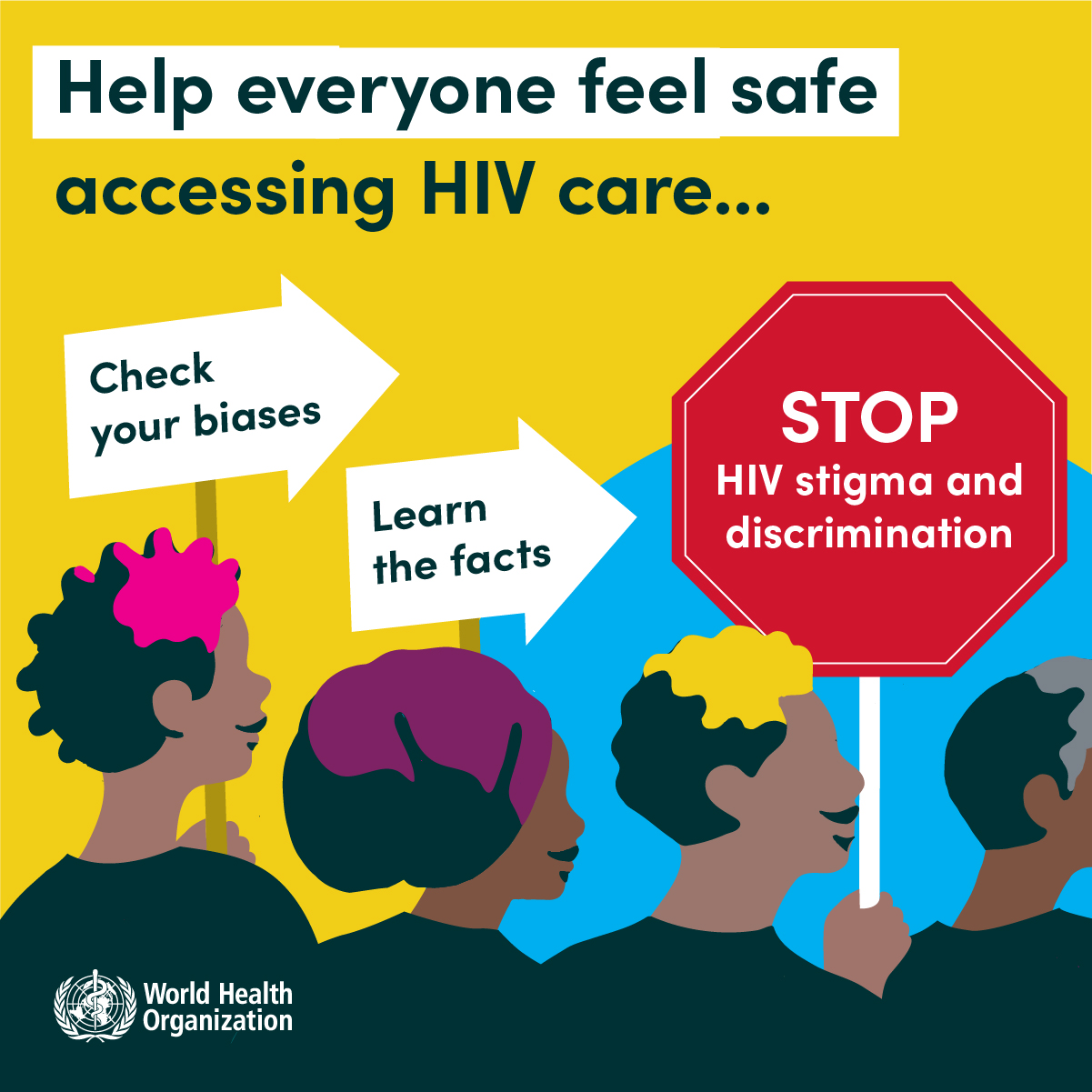
Combat stigma and discrimination to ensure that everyone feels safe to access HIV services;
Support health workers to provide HIV services to everyone in the community.
HIV program managers
Focus on key and vulnerable populations for delivery of HIV services.
Support and empower health workers to deliver high quality HIV services to everyone who needs them;
Ensure adequate training in HIV services for health workers.
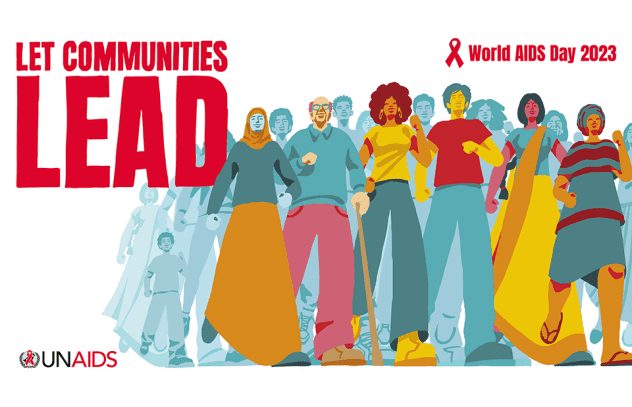
CAMPAIGN: This World AIDS Day is more than a celebration of the achievements of communities; it is a call to action to enable and support communities in their leadership.
NEW YORK, USA - In New York on 28 November, the UNSG Spokesperson’s Noon Briefing will include guest Angeli Achrekar, Deputy Executive Director, to brief media on the World AIDS Day report, ‘Let communities lead’.
Europe
LONDON, United Kingdom | 28 and 29 November
On 28th November afternoon, Executive Director Winnie Byanyima, along with
leaders from communities and the UK government, will launch the UNAIDS
World AIDS Day report, ‘Let communities lead’, attended by media,
livestreamed to the world, as part a conference organized by STOPAIDS. On 29
November, Winnie and civil society partners will attend a reception in the UK
Parliament.
BRUSSELS, Belgium | 29 November
The European Parliament on 29 November is hosting a conference on Ending
AIDS in Europe. Christine Stegling, Deputy Executive Director, will speak about
the power of community-led responses.
BERLIN, Germany | 30 November - For 30 November, UNAIDS and Ukrainian community-led organizations are
organizing an event on the vital role of community-led organizations in the
response in Ukraine and amongst Ukrainians displaced across Europe, at
which Christine Stegling, Deputy Executive Director, is set to speak.
GENEVA, Switzerland | 1 December - On December 1st, UNAIDS is supporting PVA Genève, the network of people
living with HIV, who are leading along with the Hospital of the University of
Geneva (HUG) and other partners in organizing an inter-faith service at the St.
Joseph’s Church at 18:30 local time followed by a silent march with candles in
Geneva that will start at 19:30 at the church and end with a gathering and
concert at the Maison de Quartier des Pâquis at 20:30. All staff and friends are
encouraged to attend these events.
Africa
VICTORIA FALLS AND HARARE, Zimbabwe | 1 December and beyond - On World AIDS Day, 1 December, Executive Director Winnie Byanyima will be
in Victoria Falls. In the morning she is set to commemorate the many lives lost
to AIDS with the government and leaders of the HIV response in Zimbabwe; in
the afternoon, she will visit a community-led initiative enabling key
populations to access services. This is followed by ICASA, the 22nd edition of
the largest HIV conference in Africa, taking place from 4 December in Harare,
with a number of pre-meetings taking place just before then in Victoria Falls.
ICASA will also highlight the importance of enabling communities in their
leadership role.
ADDIS-ABABA, Ethiopia | 1 December - The Minister of Health proposed commemorating WAD 2023 in Addis-Ababa
city on 1 December at the UN Compound. The planned WAD events will
include among others an official commemoration in place to be
communicated with official addressing, a panel discussion on selected topics
by inviting technical experts through TV including the use of sign language,
use of other media outlets including social media and the production and
dissemination of messages on HIV prevention using banners and posters.
From 28 to 29 November there will be a community-led monitoring national
workshop. This workshop will bring together 80 people from all Ethiopian
regions and will discuss how better to engage the community not only in
HIV/AIDS response but also in monitoring. This will include a discussion on the
digitalization of CLM.
MOROGORO, Tanzania | November/December - On 25 November, World AIDS Day week will be launched in Morogoro with
the presence of the Morogoro Regional Commissioner. The week will be
marked by AIDS Trust Fund sensitization and fundraising events and protests.
The National Scientific Symposium on HIV and AIDS will be held on 27-28
November and will be attended by the Minister of Health, Ummy Mwalimu.
On 30 November, the main Youth WAD will be held with the presence of the
Minister of State, Prime Minister's Office, Jenista Mhagama.
On 1 December there will be another WAD led by the Prime Minister of the
United Republic of Tanzania, Hon. Kassim Majaliwa.
ZAMBIA | 1 December - The National World AIDS Day event will be tentatively held at the Baha’i
temple and attended by the Minister of Health, Sylvia Masebo and the UCD of
Zambia, Tharcisse Barihuta.
World AIDS Day satellite events (testing, outreach, awareness) take place
across the country starting from 6 November.
ESWATINI | November - World AIDS Day will begin with a launch by the Minister of Health, followed by
regional activities that will serve as a build-up to the main event on 1
December 2023.
• The Shiselweni region event for the WAD targeting adolescent girls and
Young Women (AGYW) will be held on 17 November.
• The Hhohho region event for the WAD targeting Key population will be
held on 24 November.
• The National World AIDS Day event targeting the mobile population will
be held on 1 December.
LESOTHO | November - There will be a two-day national dialogue hosted on November 22 to 23 for
stakeholders to reflect on and discuss the extent to which communities’
leadership in the national HIV response is enabled. The main event of the WAD
Commemoration 2023 will take place at Matsieng, Maseru on 1 December. It
will start with a peaceful walk which will be done in the spirit of showcasing the
achievements of civil society organizations in the national response to HIV. His
Majesty the King will deliver the keynote address in which he will outline and
congratulate all stakeholders on achievements of the national response, charge
all stakeholders to act towards enabling communities’ leadership in the national
response and on the Path to End AIDS.
KWAZULU-NATAL, South Africa | November - The National World AIDS Day will be led by the South Africa National AIDS
Council.
KENYA | 25 November - In advance of World AIDS Day, a day of dialogue entitled "Youth Leading the
Way to End AIDS" will focus on the best practices of youth-led organisations.
Latin America and the Caribbean
BRASÍLIA, Brazil | 30 November to 10 December - On 30 November, UNAIDS, in collaboration with the Ministry of Health and
various other partners, will inaugurate the "HIVIDA - Celebrating Life to
Eliminate the AIDS Epidemic" project. This groundbreaking initiative will unite
a wide array of public and cost-free activities spanning 10 days, from 1
December (World AIDS Day) to 10 December (International Human Rights
Day). Its overarching objective is to galvanize society into urgently confronting
the impact of inequalities in HIV/AIDS and pandemic response. It will
underscore the pivotal role of communities as well as the critical importance
of upholding and respecting human rights across all dimensions as the path to
end AIDS. The initiative will encompass a rich tapestry of artistic expressions,
workshops, lectures, exhibitions, performances, music, visual projections,
healthcare services, and civic engagement initiatives, among other offerings.
TEGUCIGALPA, Honduras | 1 December -
On December 1st; Luisa Cabal, Regional Director for Latin America and the
Caribbean, along with Regional Directors of USAID and Global Fund, and
stakeholders from Honduras, will launch the UNAIDS World AIDS Day
report, ‘Let communities lead’, attended by media, and promote the regional I
AM KEY campaign focused on community-led HIV responses.
Asia Pacific
ONLINE | 30 November
Virtual communities share fairs to report launches and focus on community to-community learning around social media and news media engagement.
The Director of RST Asia Pacific, Eamonn Murphy will attend the event.
IRAN | December
The official World AIDS Day event will take place on 3 December around the
country and will be attended by the Minister of Health and Medical Education.
The National Congress on HIV and AIDS will be held on 29 November at the
Shahid Beheshti University of Medical Sciences.
On the 1 of December, the National Congress of Epidemiology will be held at
the Iran University of Medical Sciences, where specialists, physicists, faculties,
and students among others will participate in the event.
CHINA | November
World AIDS Day commemorative event to be held by the government on 28th
November, among the participants will be the National Bureau of Disease
Control and Prevention, China CDC and NCAIDS. UNAIDS is expected to be
invited for the keynote speech.
The Red Ribbon Foundation will hold the event “Uniting social forces to fight
AIDS together”: 2023 World AIDS Day Welfare Activity on 26 November. The
heads of the China Red Cross and NCAIDS will be the key participants in an
event where the best HIV advocacy videos produced by college students will
be screened and awarded.
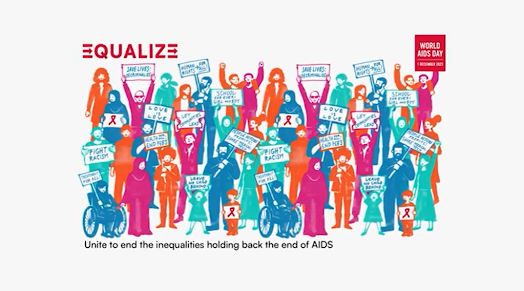
The world has promised to end AIDS by 2030.We are off track. To end AIDS, we must end the inequalities that are blocking progress. Today, we risk millions more new infections and millions more deaths. So, on this World AIDS Day, we are calling out in one voice. Equalize! The “Equalize” slogan is a call to action. A call to adopt the proven practical actions that will help end AIDS. More availability, quality and suitability of services for HIV treatment, testing and prevention. That means more financial resources. Better laws, policies and practices to tackle the stigma and exclusion faced by people living with HIV, especially marginalized populations. Everyone needs respect and to be welcomed. And better sharing of technology to enable equal access to the best HIV science, especially between the global South and North. The inequalities that perpetuate the AIDS pandemic can and must be overcome. We can end AIDS. If we Equalize.
World AIDS Day is a moment to honour over 40 million lives lost to AIDS, take stock of the AIDS response, and commit to ending AIDS. This week we launched a powerful new report, Dangerous Inequalities. In it, we called the world’s attention to a painful reality: currently, we are not on track to end AIDS by 2030, and the reason is inequality. But there is good news: by equalizing, we can end AIDS.
EVENTS
Press conference for global launch of UNAIDS Report ''Dangerous Inequalities', ahead of World AIDS Day from Dar es Salaam, Tanzania.