The focus of this year’s IMD, sustainable tourism in mountains, highlights how innovative and transformative approaches to mountain tourism contribute to economic, social and environmental sustainability.
Mountain destinations attract around 15-20 percent of global tourism.
Mountain tourism, particularly when linked to nature and rural tourism, can promote sustainable food systems and value local products.
Tourism can play a key role in valuing and protecting the natural and spiritual heritage of mountains, and the cultural diversity and traditional practices of mountain peoples.
Low-impact tourism can help limit threats to mountain ecosystems and their biodiversity.
Since COVID-19, visits to open air, less crowded, domestic destinations have increased, opening new opportunities for mountain destinations to rethink their products and services.
The United Nations General Assembly has designated 11 December, from 2003 onwards, as International Mountain Day. the day aims create awareness about the importance of mountains to life, to highlight the opportunities and constraints in mountain development and to build partnerships that will bring positive change to the world’s mountains and highlands.
DOCUMENTARY: The voice of the Hindu Kush Himalaya A call to action from the pulse of the planet Premiering at COP26
On Human Rights Day this year, we’re calling for a new social contract with equality at its core. By addressing deep-seated discrimination with human rights, we can move towards a fairer and more inclusive world – because we’re all human, and we’re all equal.
What does equality Mean to You?; Join the conversation with the hashtags #StandUp4HumanRights.
On #HumanRightsDay, the UN Human Rights Chief says equality is the solution to global setbacks exacerbated by COVID-19: Equality means that we embrace our diversity and demand that we are all treated without any kind of discrimination.
“The past two years have demonstrated, all too painfully, the intolerable cost of soaring inequalities. Inequalities that the Universal Declaration of Human Rights, adopted by the UN General Assembly 73 years ago on 10 December 1948, sought to eradicate in its effort to pave a path to a better world.
The decades since then saw some very significant progress – gradual, uneven progress, with frequent set-backs, but definite progress nonetheless. The world as a whole grew richer, and people lived longer. More children went to school, and more women were able to gain a greater measure of autonomy. More people in more countries had more opportunities to break the shackles of poverty, class, caste and gender.
However, over the past twenty years, since 2001, a succession of global shocks have undermined that progress. And the onset of this devastating pandemic in 2020 has laid bare many of our failures to consolidate the advances we had made.
Inequalities have fuelled the pandemic, and continue to do so. In turn, the pandemic has fed a frightening rise in inequalities, leading to disproportionate transmission and death rates in the most marginalized communities, as well as contributing to soaring poverty levels, increased hunger, and plummeting living standards. These in turn risk fuelling grievances, social unrest and even full-blown conflict.
Women, low-income and informal workers, younger and older people, and those with disabilities, as well as members of ethnic, racial and religious minorities and indigenous peoples are among those hit hardest, creating even greater age, gender and racial inequalities.
Inequalities have widened both within and between countries, with most developed economies forecast to grow in 2022, while the lowest-income countries are projected to endure continued recession, pushing their people even further behind.
This divergence has been aggravated by shockingly unequal vaccine coverage – by 1 December, barely 8% of adults had received one dose of vaccine in low-income families, compared to 65% in high-income countries – and by shortfalls in social protections, which in the developed world kept many people afloat during the worst months of the crisis. In Europe, for example, according to the IMF at least 54 million jobs were supported between March and October 2020, keeping people and companies from going under. Such assistance was less available in other regions.
The environmental crisis is further exacerbating discrimination, marginalization, and inequity. A total of 389 climate-related disasters were recorded in 2020 – resulting in the deaths of more than 15,000 people, affecting 98 million others, and inflicting $171 billion in economic damage. Climate-related migration is also on the rise. Actions to address these crises are not sufficient to avert these devastating human rights consequences, with affected communities often shut out of environmental decision-making processes where their input is essential.
A growing debt crisis is also weighing heavily on many countries. Globally, over half of least-developed and low-income countries are now in, or at high risk of, debt distress. In East and Southern Africa, debt-servicing costs grew, on average, from 60 percent of GDP in 2018 to nearly 70 percent of GDP in 2021. This is due in part to sharply shrinking economic activity and falling commodities prices. The need to repay loans has already led to fiscal austerity measures that will limit the fiscal space for key investments in rights and sustainable recovery.
Austerity budgets often target health, education, infrastructure investment, and poverty reduction efforts. They disproportionally impact people in vulnerable situations – increasing inequalities that were already stark. This is a critical period in world affairs. Humanity is reeling from the setbacks sparked by COVID-19, and struggling to make the radical changes necessary to prevent further environmental disaster.
Yet the measures needed to prevent catastrophic climate change are well-known. And, even in resource-poor environments, we have the knowledge and means to establish universal social protection measures and take the necessary actions to end discrimination, advance the rule of law and uphold human rights.
The Common Agenda set out by the UN Secretary-General in September 2021 calls for renewed solidarity between peoples and future generations; a new social contract anchored in human rights; better management of critical issues involving peace, development, health and our planet; and a revitalised multilateralism that can meet the challenges of our times.
This is an agenda of action – and an agenda of rights.
It means moving from the temporary pandemic measures to shore up health care and income protection to long-term investments in universal social protections – including universal health coverage – as well as decent housing, decent work, and access to quality education. It also means investment to bridge the digital divide. It means decisive action to uphold climate justice and the universal human right to a healthy environment. It means empowering people everywhere to speak up freely, and protecting civic space so that individuals can meaningfully participate in decisions that may have a dramatic impact on their lives. Equality is at the heart of human rights, and at the heart of the solutions required to carry us through this period of global crisis. That doesn’t mean we must all look the same, think the same or act the same. Quite the opposite. It means that we embrace our diversity and demand that we are all treated without any kind of discrimination.
Equality is about empathy and solidarity and about understanding that, as a common humanity, our only way forward is to work together for the common good. This was well understood during the years of rebuilding after World War II – the years that saw the development of the Universal Declaration of Human Rights and the subsequent elaboration of the all-embracing system of international human rights law. However, our failure to build back better after the financial crisis a decade ago, coupled with the social and economic turmoil caused by COVID-19 and the rapidly accelerating impacts of climate change, suggests we have forgotten the clear and proven remedies rooted in human rights and the importance of tackling inequalities. Remedies we must bring back to the forefront if we want to maintain progress – not just for those who suffer from the gross inequalities that blight our planet, but for the sake of all of us.
On this Human Rights Day, I invite everyone to join efforts to enhance equality for everyone everywhere, so that we can recover better, fairer and greener from this crisis, and rebuild societies that are more resilient and sustainable.”
Michelle Bachelet; UN Human Rights Commissioner.
Ms. Bachelet and UN Secretary-General António Guterres took the opportunity to take stock of progress made, lessons learned, and put forward a new Agenda for Peace that presents a multidimensional vision of global security.
“This is an agenda of action – and an agenda of rights,” Ms Bachelet said.
‘Our Common Agenda’ a framework set out by the UN Secretary-General in September 2021 is a new social contract firmly anchored in human rights, calling for renewed solidarity across the world.
The Agenda proposes to deepen collective action by addressing the root causes of insecurity, increasing investment in resilience and early warning systems, developing multilateral partnerships, and more sustained efforts in peacebuilding and fighting the effects of climate change. Progress under threat
Ms Bachelet acknowledged that since the UDHR was first signed, “the world as a whole grew richer, and people lived longer. More children went to school, and more women were able to gain a greater measure of autonomy. More people in more countries had more opportunities to break the shackles of poverty, class, caste and gender.”
Despite this progress however, she noted that over the past twenty years, a succession of global shocks and the onset of the pandemic in 2020 undermined these developments.
‘New threats’ to human rights: Guterres
With the world “at a crossroads”, new threats have emerged to basic human rights, such as the pandemic, digital technology’s overreach, and the climate crisis, said UN chief Guterres, in his message for Human Rights Day marked on Friday.
“Public space is shrinking. Poverty and hunger are rising for the first time in decades. Millions of children are missing out on their right to education. Inequality is deepening - but we can choose a different path”, he assured.
Mr. Guterres noted that recovery from the pandemic “must be an opportunity to expand human rights and freedoms, and to rebuild trust.”
Trust needs to be restored in the justice and impartiality of laws and institutions everywhere, he added, and dignity restored, together with the faith that “people can get a fair hearing, and resolve their grievances peacefully.”
“The United Nations stands for the rights of every member of our human family”, he continued, pledging that “today and every day, we will continue to work for justice, equality, dignity and human rights for all.”
Equality, and the common good
Ms. Bachelet, ended her statement saying the equality was “at the heart of human rights”.
“Equality is about empathy and solidarity and about understanding that, as a common humanity, our only way forward is to work together for the common good.” She said that had been “well understood” in the period of global reconstruction after World War Two. “However, our failure to build back better after the financial crisis a decade ago, coupled with the social and economic turmoil caused by COVID-19 and the rapidly accelerating impacts of climate change, suggests we have forgotten the clear and proven remedies rooted in human rights and the importance of tackling inequalities”, she said.
If progress is to be maintained, that fundamental lesson needs to be learned once more, “not just for those who suffer from the gross inequalities that blight our planet, but for the sake of all of us.”
She invited everyone to join the new collective project of rebuilding, with equality as the driver, “so that we can recover better, fairer and greener from this crisis, and rebuild societies that are more resilient and sustainable.”
EVENTS
Tune in tomorrow to watch UN Human Rights Chief Michelle bachelet answer your questions in a LIVE Q&A on #HumanRightsDay.
📅 When: Friday 10 December at 15:30 CET | 09:30 am EST | 20:00 IST
Corruption and crime threaten the positive contribution of sport in the cultural, educational, social and economic spheres. Governments, sport organizations and athletes need to commit to tackling corruption and crime in and through sport to overcome the impact the COVID-19 crisis has had on sport and ensure it remains a force for development and peace.
The 2021 International Anti-Corruption Day seeks to highlight the rights and responsibilities of everyone – including States, Government officials, civil servants, law enforcement officers, media representatives, the private sector, civil society, academia, the public and youth – in tackling corruption.
Air tourism is important to geographic, cultural and personal discovery. It can also help restore prosperity and critical revenue streams to communities affected by the pandemic.
The purpose of International Civil Aviation Day is to help generate and reinforce worldwide awareness of the importance of international civil aviation to the social and economic development of States, and of the unique role of ICAO in helping States to cooperate and realize a truly global rapid transit network at the service of all mankind.
As the UN and world nations have now adopted Agenda 2030, and embarked on a new era in global sustainable development, the importance of aviation as an engine of global connectivity has never been more relevant to the Chicago Convention’s objectives to look to international flight as a fundamental enabler of global peace and prosperity. The work programme and activities conducted under the Strategic Objective on Safety cross-referenced six of the 17 SDGs, showing the strong benefits of enhancing aviation safety. These areas of work included:
• capacity-building projects aimed at air cargo services to support improved and efficient movement of sensitive cargo, such as vaccinations, medications and technical equipment;
• provision of air traffic flow data for UN field operations, including Peacekeeping Operations, in case of epidemics or infectious diseases;
• development and conduct of training and instructional material in the area of safety;
• ensuring, through the No Country Left Behind initiative, that all States have access to the socio-economic benefits of a safe air transport system; and
• strengthening the implementation of safety-related SARPs by promoting existing partnerships and developing new partnerships.
• Recognizing that investments are necessary to maintain or further enhance aviation safety, ICAO developed a tool to assist States in analysing the economic benefits of safety improvement investments.
Volunteering is giving, sharing, standing by others, supporting causes you care about and creating a better future for everyone. We aim to inspire people, whether they are decision makers or citizens of this world, to take action NOW for people and the planet.
CAMPAIGN: Help us spread the message and volunteer for our campaign by: Posting a photo, video or graphic to show how you Volunteer Now for our common future! You can find visuals and other resources for common use in the campaign on this Trello Board ‘Nominating’ another person to also "volunteer now for our common future", by tagging them with the hashtags #passiton, #volunteernow , #IVD2021. Example: “I volunteer to raise awareness about environmental sustainability/pant trees/do clean ups in my community. I #passiton to @UNVenture to also volunteer now for climate action.”
Key messages about the power of volunteerism
- Volunteerism is universal and strengthens civic engagement, social inclusion, solidarity, and ownership. - A top priority for the United Nations is avoiding climate disasters and reducing global warming.
- Through volunteering these goals, for tomorrow’s generations, are more likely to be achieved. - Volunteers promote people’s engagement and civic participation, which is key to achieving the Sustainable Development Goals (SDGs).
On International Volunteer Day, An Expo will celebrate the heroes of communities around the world. Volunteers play an invaluable role in working to improve the lives around them. The specialist event brings together Expo's Partner ecosystem to explore how emerging volunteer models can be a pathway for building equal and inclusive societies within the pursuit of achieving the SDGs, and encouraging volunteerism worldwide.
Salinization of soil negatively impacts plant development and induces land degradation. Saline earths show lower agricultural productivity, worsen farmers’ wellbeing, and the economic situation in the region. Managing soil salinity at early stages helps to reverse it. However, heavy contamination leads to complete loss of farmlands and desertification due to the negative effect of salinity on soil properties. The United Nations University states that about 5,000 acres have been lost daily all over the world because of salinization since the 1990s, as of 2014. In this regard, the problem requires immediate addressing.
What Is Soil Salinization?
Salinization of soil is an excessive accumulation of water-soluble salts. Typically, it is table salt NaCl. The list is far more extensive and includes various compounds of sodium, potassium, calcium, magnesium, sulfates, chlorides, carbohydrates, and bicarbonates. In general, salt-affected earths are categorized as saline, sodic and saline-sodic, depending on the content.
The major soil salinity effect on plant growth is tampering with water absorption. Even with sufficient soil moisture, crops wade and die due to the inability to take up enough water. At a global span, according to the report of the Intergovernmental Science-Policy Platform on Biodiversity and Ecosystem Services (IPBES) of 2018: ° about 190 million acres are completely lost; ° 150 million acres are damaged; ° 2.5 billion acres are impacted by salinization.
What Causes Soil Salinization?
Soil salinization occurs when soluble salts are retained in the earth. It happens either naturally or because of improper anthropogenic activities, particularly farming practices. Besides, some earths are initially saline due to low salt dissolution and removal. Soil salinization causes include: ° dry climates and low precipitations when excessive salts are not flushed from the earth; ° high evaporation rate, which adds salts to the ground surface; ° poor drainage or waterlogging when salts are not washed due to a lack of water transportation; ° irrigation with salt-rich water, which amplifies salt content in earths; ° removal of deep-rooted vegetation and a raised water table as a consequence; ° leakage from geological deposits and penetration into groundwater; ° sea-level rise when sea salts seep into lower lands; ° breezes in the coastal areas that blow salty air masses to the nearby territories; ° seawater submergence followed by salt evaporation; ° inappropriate application of fertilizers when excess nitrification accelerates soil salinization.
Indicators Of Soil Salinity
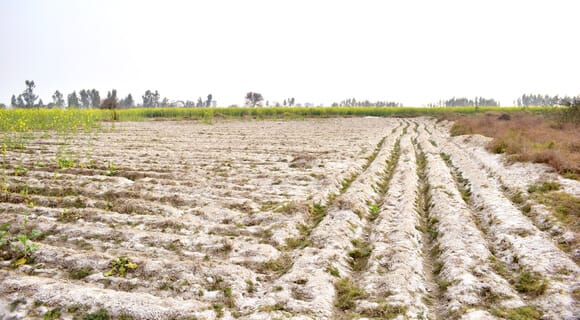
Salinization can be noticed visually by analyzing the soil surface, speed of water infiltration, and vegetation state. As salinization proceeds, signs get more severe. For example, slight whitening on the surface changes into distinct salt crystals. Apart from visual changes, there are indirect indicators of extra salt concentration. These are poorer water quality or animal behavior when livestock refuses to drink water due to its salty taste.
- Surface Changes Because Of Salinization - damp areas and waterlogging; - ground whitening at early stages and salt crystals at late ones; - increased water level in furrows; - bare soils (where plants fail to grow due to salinization); - deterioration of roads, buildings, etc.; - white or dark circles around water bodies. - Salinization-Related Indicators In Vegetation - plant withering; - crop loss; - reduction of biodiversity; - appearance of salt-tolerant plants in the area and their further dominance.
Soil Salinity Measurement
Apart from visual estimation, there are more reliable methods to measure soil salinity, e.g., to assess the earth’s electric conductivity with specific devices. With a rise of salt concentration in the solution, its conductivity rises, too. Other types of soil salinity tests find out the exchangeable sodium percentage or sodium absorption ratio.
Besides laboratory tests, salinization is estimated on farmlands or remotely. Salinity sensors are used for monitoring surface soil salinity in the field. Satellites retrieve data with SWIR and NIR bands for remote sensing analytics of water absorption and its possible correlation with salinity. Adverse Effects Of Salinization
Soil salinization consequences are far from positive, covering multiple aspects of ecology and human life. It affects crop production and water supply industries, induces the risk of floods and soil erosion, and decreases biodiversity. Agricultural Production
Water saturation in plants depends on the level of salts in groundwater and the plant itself. Water is absorbed in the process of osmosis and flows from less salt-concentrated areas to more concentrated ones. When the salt concentration is too high, it means that the soil’s osmotic potential is essentially negative. Plants suffer from osmotic stress when they fail to take up water, even when it is present in the soil. Basically, the process is similar to drought stress due to a lack of moisture in the ground. As a result, vegetation dies. Salinization tampers with nitrogen uptake too, which slows plant development and causes a yield loss.
Another soil salinity effect on agriculture is ionic stress due to harmful ions in soil salts, e.g., chloride or sodium. Apart from their toxic impact as such, these positively charged ions impede the acquisition of other positively charged ions vital for crop growth (particularly potassium and calcium). The result is the same as with osmotic stress due to salinization – vegetation dies