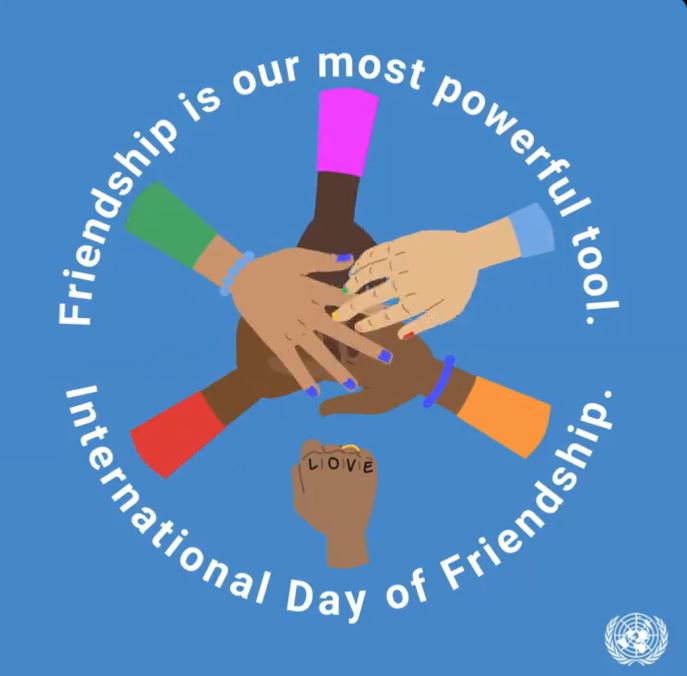
FORUM: "Together, we can create a world where friendship and mutual respect pave the way for a better future." International Day of Friendship 2025. Friendship is a powerful tool in addressing many challenges our world faces today, such as poverty, violence, and human rights abuses. By fostering bonds of trust and mutual respect, we can create a more stable and compassionate world. Friendship helps in Promoting Peace by encouraging dialogue and understanding between different communities; In Building Trust by developing strong ties that contribute to social harmony and cooperation; In Creating Solidarity by uniting people in the shared goal of achieving a better world. Let's fostering friendships,building bridges and fostering harmony across all boundaries;Follow the conversation with the hashtags: #FriendshipDay, #30july, #Friendship, #Diplomaticrelationship.
EVENTS: On July 30th, the International Day of Friendship 2025 will be celebrated at UN Headquarters and at the Regional Information centres worldwide. The celebrations will focus on the role of friendship in promoting peace and understanding across the globe. During the day, we will develop initiatives that promote dialogue, mutual understanding, and reconciliation. Register to participate!
ACTIVITIES: To mark this important day, various activities and events are organized to highlight the significance of friendship and to promote a culture of peace:
Friendship Exhibitions: Explore virtual tours showcasing the efforts of communities in fostering friendships and peace.
Webinars: Join discussions with experts in the field to understand the importance of friendship in building a better world.
Workshops: Participate in interactive sessions focused on improving community ties and fostering mutual respect.
Film Screenings: Watch documentaries that highlight the power of friendship and its impact on global peace.
Educational Resources: Access a wealth of articles, research papers, and multimedia content dedicated to the theme of friendship.
How You Get involved!
As we commemorate the International Day of Friendship; Engage in activities, learn from different cultures, and support initiatives that promote peace and solidarity.
Inspire actions:
Raise Awareness: Share information about the significance of friendship and the role it plays in promoting peace.
Support Community Activities: Get involved in local or international efforts to foster friendships and build bridges.
Volunteer: Participate in community service projects that bring people together and promote understanding.
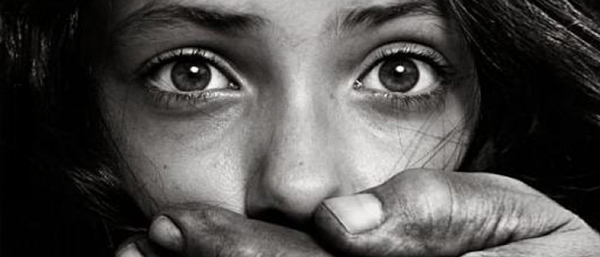
FORUM: “Human trafficking is Organized Crime – End the Exploitation.” World Day against Trafficking in Persons 2025. This year’s campaign will highlight the vital role of law enforcement and the criminal justice system in dismantling organized trafficking networks while ensuring a victim-centred approach. Human trafficking continues to be a global threat driven by organized crime. More and more victims are being trafficked every year, across greater distances, with greater violence, for longer periods of time and for greater profit. From 2020 to 2023, there were more than 200,000 detected victims globally, which is just the tip of the iceberg. The actual number of unreported cases is believed to be significantly higher. Organized criminal networks are driving this victimization and exploitation, using migration flows, global supply chains, legal and economic loopholes and digital platforms to facilitate cross-border trafficking at a massive scale. They profit from forced labour, sexual exploitation and coercion into criminal activities, such as online scams and drug smuggling. Despite some progress, criminal justice responses fall short in tackling this rapidly evolving crime. To end human trafficking, law enforcement must enforce strict laws, conduct proactive investigations, strengthen cross-border cooperation, target criminal finances, and leverage technology to identify and dismantle trafficking networks..Follow the conversations with the hashtags: #endHT, #30July, #worlddayagainsttraffickinginpersons, #EndHumanTrafficking on all digital platforms.
EVENTS: On July 30th, the United Nations Office for Drug and Crime (UNODC) will host a high-level event to mark the World Day against Trafficking in Persons 2025. The event will showcase the ways to ensure justice for survivors which requires holding perpetrators accountable and to provide a victim-centred approach to protection, support and access to justice.We particularly encourage law enforcement agencies, including police departments, border security, international agencies, and specialized task forces, to take an active role by utilizing online platforms and conducting in-person outreach at high-traffic areas such as transportation hubs. This way we can reach a wide audience, raise public awareness and promote reporting channels for suspected trafficking cases. The participants active involvement will bridge the gap between the campaign’s global reach and local realities, to ensure that it effectively connects with those impacted by human trafficking. Register to participate!
Human trafficking is a horrific crime and a gross violation of human rights. It is one of the fastest-growing forms of organized crime – run by ruthless networks that prey on vulnerability and profit from pain.
This is a brutal, highly organized enterprise built on deception, coercion and exploitation. And it is evolving rapidly.
Criminal groups are operating across borders with alarming speed and sophistication. They exploit legal loopholes, infiltrate legitimate industries and supply chains, take advantage of migration flows, and use technology to recruit, control and abuse – including through online sexual exploitation or forcing victims into cyber-scams.
We must respond with unity and urgency.
We can do so by breaking the business model that sustains human trafficking – ending impunity, cutting off illicit profits, and strengthening law enforcement and justice systems. Perpetrators must be held accountable.
We must also forge strong alliances -- with civil society, and the private sector including technology companies – to raise awareness and promote reporting channels to prevent exploitation and protect the vulnerable.
And we must strive to ensure justice for survivors, support the displaced, and tackle root causes – from poverty and inequality to conflict and climate disruption.
On this World Day Against Trafficking in Persons, let us act together to stand with victims, hold perpetrators to account and build a world where no one is bought, sold, or exploited.
Human trafficking no longer hides in the shadows – it operates under a thin disguise, embedded in our economies and daily lives. And it’s growing more organized, more structured, and more ruthless. UNODC data shows that organized criminal networks are behind 74 per cent of detected cases. Traffickers are infiltrating legitimate industries, from agriculture to construction and hospitality, masked by legal contracts and buried in supply chains. Forced labour now accounts for 42 percent of detected trafficking victims, the highest on record. Trafficking for forced criminality is also surging, jumping from 1 per cent a decade ago to 8 per cent today. And traffickers are adapting, using technology and digital platforms to recruit, ensnare, and abuse. From fake job offers to dating apps, women and girls are being lured into online sexual exploitation, while victims are being made to commit cyber-scams and fraud as part of a billion-dollar industry. The exploitation is more systematic than ever. And the world is fighting back. Over 180 countries now have legislation criminalizing human trafficking in all its forms. Protection mechanisms are expanding, helping more survivors with better support. And international cooperation is growing. But we cannot be complacent. We must act faster and smarter. By standardizing the way we look at data, to understand global and national trends. By equipping criminal justice systems to dismantle trafficking networks and end impunity. And by building bridges with the private sector, tech companies, and financial institutions. On this World Day against Trafficking in Persons, let us work together for a world where traffickers have nowhere to hide, and justice leaves no one behind.
FORUM: “Sharing the human spirit through friendship.” International Day of Friendship 2024. In a world full of challenges, friendship is often our most powerful tool. The International Day highlights the importance of friendship in promoting peace and unity across cultures and continents. Through friendship — by accumulating bonds of camaraderie and developing strong ties of trust— we can contribute to the fundamental shifts that are urgently needed to achieve lasting stability, weave a safety net that will protect us all, and generate passion for a better world where all are united for the greater good. Follow the conversation with the hashtags: #FriendshipDay, #30july, #Friendship, #Diplomaticrelationship .
EVENTS: On July 30th, to mark the International Day of Friendship 2024, the United Nations encourages governments, international organizations and civil society groups to hold events, activities and initiatives that contribute to the efforts of the international community towards promoting a dialogue among civilizations, solidarity, mutual understanding and reconciliation.
FORUM: “Leave No Child Behind in the Fight Against Human Trafficking.” World Day Against Trafficking in Persons 2024. This year's global campaign urges to accelerate action to end child trafficking. Children represent a significant proportion of trafficking victims worldwide, with girls being disproportionately affected. 1 in 3 victims of human trafficking globally is a child. Additionally, children are twice as likely to face violence during trafficking than adults, according to the UNODC's Global Report on Trafficking in Persons (GLOTIP). Regions such as Sub-Saharan Africa, North Africa, and Latin America and the Caribbean bear a disproportionate burden, with children making up for 60 per cent of detected trafficking victims. Amid overlapping crises such as armed conflicts, pandemics, economic hardships, and environmental challenges, children are increasingly vulnerable to trafficking. Furthermore, the proliferation of online platforms poses additional risks as children often connect to these sites without adequate safeguards. Traffickers exploit online platforms, social media, and the dark web to recruit and exploit children, utilizing technology to evade detection, reach wider audiences, and disseminate exploitative content. The causes of child trafficking are as diverse as the ways in which children are exploited. Children are subjected to various forms of trafficking, including exploitation in forced labour, criminality or begging, trafficked for illegal adoption, recruitment into armed forces, and online and sexual abuse and exploitation. Root causes are manifold, including poverty, inadequate support of unaccompanied children amidst rising migration and refugee flows, armed conflicts, dysfunctional families, and lack of parental care. Notably, in low-income countries, children are often trafficked for forced labour, whereas in high-income countries, sexual exploitation remains prevalent among child victims. Identification and protection of child victims remain challenging due to underreporting, lack of awareness, and inadequate resources for victim support services. Traffickers often employ coercion, deception, and threats to maintain control over their victims, making it difficult for authorities to intervene. To effectively combat this scourge, concerted efforts are needed at both national and international levels. States must prioritize child protection, bolster legislation, improve law enforcement, and allocate more resources to combat child trafficking. Prevention efforts should target root causes like poverty and inequality to reduce children's vulnerability. Special attention must be paid to trafficking of children on the move. Strengthening child protection systems and implementing child-sensitive justice mechanisms are crucial for supporting victims and holding perpetrators accountable. The way to address online child exploitation requires innovative strategies, collaboration between tech companies and law enforcement, and robust legal frameworks. Follow the conversations with the hashtags: #endHT, #30July, #worlddayagainsttraffickinginpersons, #EndHumanTrafficking on all digital platforms. EVENTS: As we observe the 10th edition, it is crucial to address the shortcomings and accelerate action to End HumanTrafficking. On July 30th, the UNODC will celebrate the World Day Against Trafficking in Persons 2024 under the theme "Leave No Child Behind in the Fight Against Human Trafficking" as part of awareness-raising events. Civil society organizations, the private sector, and communities have a vital role in raising awareness, providing support services, and advocating for policy reforms. The UNODC Regional office and the UNODC partners will also organize many activities in cities across the countries. Get involved!
Human trafficking is a horrific crime that targets the most vulnerable in our societies.
On this World Day Against Trafficking in Persons, we focus on the most vulnerable among us – children.
Children account for one-third of trafficking victims, suffering unspeakable abuse – whether they are forced into labour, sold off as brides, recruited as soldiers, or coerced into criminal activities. Rising inequalities and globalization have fuelled complex trafficking networks that challenge traditional legal frameworks, creating new forms of slavery. Online platforms further expose children to sexual exploitation and gender-based violence and allow traffickers to exploit victims across borders.
The physical and psychological scars of these crimes persist long into adulthood, robbing them of their innocence, futures and fundamental rights. We must strengthen protection responses – including child-sensitive justice mechanisms, raise awareness, support unaccompanied children on the move, provide care for survivors, and tackle the root causes of exploitation by helping vulnerable families.
I call upon governments, civil society, and the private sector, including tech companies, to intensify their efforts and collaboration so that no child is victimized and no trafficker goes unpunished.
On this day, let us renew our commitment for a future where every child is safe and free.
UNODC Executive Director’s Message on World Day Against Trafficking in Persons, 30 July 2024. Arabic | English | French | Spanish
Human trafficking leaves deep scars.
And when the victims are children, those scars can come to define the rest of their lives. This year’s theme for World Day Against Trafficking in Persons focuses on child victims, which have tripled over the past 15 years.
According to UNODC data, children account for more than a third of victims detected globally, and in some regions, they constitute the majority.
Poverty, conflict, climate change, and inadequate parental support are leaving too many children, easy prey for traffickers.
And once trafficked, they endure horrific abuse.
They are forced to work under horrendous conditions in sweatshops, on farms, and construction sites.
They are made to beg on the street, commit crime, or work as domestic servants.
They are recruited as child soldiers, while others are trafficked as they attempt to flee the shadow of war.
And many, particularly girls, face gender-based violence, sexual exploitation, and forced marriage.
Meanwhile, digital technologies are enabling exploitation, with artificial intelligence generating thousands of images of child sexual abuse.
Last year, the United Nations policy forum on human trafficking, ICAT, called for united action to end child trafficking.
Now we must heed that call, by stepping up responses and working across all sectors of society, including governments, the private sector, tech companies, schools, healthcare, and social workers.
As a mother and a grandmother, I want to leave behind a world where no child is exploited, trafficked, or abused.
Let’s work together to make the world safer for all children.
“Use and abuse of technology” is the theme of the World Day Against Trafficking in Persons 2022. Prevention and awareness-raising activities on the safe use of the internet and social media could help mitigate the risk of people falling victim of trafficking online. Cooperation with the private sector is important to harness innovation and expertise for the development of sustainable technology-based solutions to support prevention and combatting of human trafficking.
Human trafficking is a horrific crime and an all-out assault on people’s rights, safety and dignity.
Tragically, it is also a problem that is growing worse — especially for women and girls, who represent the majority of detected trafficked persons globally.
Conflicts, forced displacement, climate change, inequality and poverty have left tens of millions of people around the world destitute, isolated and vulnerable.
The COVID-19 pandemic has separated children and young people from their friends and peers, causing them to spend more time alone and online.
Human traffickers are taking advantage of these vulnerabilities, using sophisticated technology to identify, track, control and exploit victims.
Online platforms allow them to deceive and recruit people with false promises. The dark web lets them conceal their identities while spreading their vile materials, including those that sexually exploit children. And technology gives consumers the ability to anonymously demand increasingly dangerous and degrading content that fuels human trafficking.
But as the theme of this year’s World Day Against Trafficking in Persons — “Use and Abuse of Technology” — reminds us, while technology can enable human trafficking, it can also be a critical tool in fighting it.
We need governments, regulators, businesses and civil society joining forces to invest in policies, laws and technology-based solutions that can identify and support victims, locate and punish perpetrators, and ensure a safe, open and secure internet for all. As part of 2023’s Summit of the Future, I have proposed a Global Digital Compact to rally the world around the need to bring good governance to the digital space.
On this important day, I call on the world to give this issue the attention and action it deserves and work to end the scourge of human trafficking once and for all.
Statetement by the Executive-Director of UNODC on World Day Against Trafficking in Persons 2022; July 30th.
Connecting with each other online and over messaging platforms is part of daily life for billions of people around the world, especially youth.
The Internet has become a vital lifeline as the COVID-19 pandemic has restricted travel and kept us apart. But the advantages and potential of digital technologies to bring us together and better our lives are also being increasingly exploited by criminals.
Trafficking in persons is a crime that exploits vulnerability, desperation, and trust.
Traffickers take advantage of social media and other online platforms to exploit victims.
The borderless nature of information and communications technologies enables traffickers to expand their reach and profits with even greater impunity.
More than 60 per cent of detected human trafficking victims over the last 15 years have been women and girls, most of them trafficked for sexual exploitation.
Countless more people are in danger of being exploited today, as conflicts and crises increase misery, and criminals target the desperate with false promises of opportunities, jobs, and a better life.
To protect people, we need to protect digital spaces from criminal abuse. To do so, we must support countries to harness technologies for good.
Partnerships with tech companies and the private sector can keep traffickers from preying on the vulnerable and stop the circulation of online content that amplifies the suffering of trafficking victims.
We can assist law enforcement authorities to use, with technical support and appropriate safeguards, artificial intelligence, data mining and other tools to detect and investigate trafficking networks.
We can do more to raise awareness and keep social spaces online safe through cooperation with civil society and all stakeholders.
On this World Day Against Trafficking in Persons, let us commit to preventing online exploitation and promoting the power of tech to better protect children, women and men, and support victims.
ACTION: Show your support for victims of human trafficking by helping to raise awareness, share safety tips and information, and educate others!
Individuals are encouraged to
Share, like and comment on the social media messages for the World Day.
Be vigilant in the online sphere and report suspicious pages or activities to the authorities, e.g., by making use of dedicated online mechanisms or helplines.
Donate to the United Nations Voluntary Trust Fund for Victims of Human Trafficking, which provides on-the-ground assistance and protection to victims of trafficking.
Member States are encouraged to:
ensure that what is illegal and prosecuted offline is also illegal and prosecuted online.
expand their attention in the fight against human trafficking to cyberspace, including by providing resources for law enforcement and ensuring policies and regulations are in place.
join the Blue Heart Campaign and support victims of Human Trafficking via the UN Voluntary Trust Fund (UNVTF).
Technology-based private sector companies, especially tech companies are called to
:ensure measures and restrictions are in place which prevent the use of technological platforms and tools for trafficking.
use technological ingenuity to fight human trafficking.
proactively identify illegal and harmful material online and take immediate and effective steps to remove it.
All over the world, tens of millions of people are desperately seeking
refuge, many of them far from home and even farther from safety. Migrants and
refugees face imposing physical obstacles and bureaucratic barriers. Sadly, they
are also vulnerable to human rights violations and exploitation by human
traffickers.
Human traffickers prey on the most desperate and vulnerable. To end this
inhumane practice, we must do more to shield migrants and refugees -- and
particularly young people, women and children -- from those who would exploit
their yearnings for a better, safer and more dignified future. We must govern
migration in a safe and rights-based way, create sufficient and accessible
pathways for the entry of migrants and refugees, and ultimately tackle the root
causes of the conflicts -- extreme poverty, environmental degradation and other
crises which force people across borders, seas and deserts.
These issues will be central to the UN Summit for Refugees and Migrants, to
be held in New York on 19 September 2016. This meeting aims amongst other goals
to win renewed commitment for intensified efforts to combat human trafficking
and smuggling of migrants and refugees, ensure protection and assistance for the
victims of trafficking and of abusive smuggling, as well as all those who suffer
human rights violations and abuse in the course of large movements, and promote
respect for international law, standards and frameworks.
I call on every nation -- whether country of origin, transit or destination
-- to recognize our shared responsibility. As a first step, we need a strong
legal basis for action. I encourage all States to adopt and implement the UN
Convention against Transnational Organized Crime and its protocol on human
trafficking as well as all core international human rights instruments.
On this World Day against Trafficking in Persons, I urge everyone to recommit
to protect, respect and fulfil the human rights of all migrants and refugees.
Creating and supporting well-governed, safe and human rights-based migration and
asylum procedures will be an important step towards ending the abhorrent
practice of profiting from human despair and misery.
Thank you for joining us for this event to mark the 2016 World Day Against Trafficking in Persons.
I would also like to thank our distinguished panellists for their participation.
This day to call attention to the plight of trafficking victims is needed more than ever.
The international community is struggling with what UN Secretary-General Ban Ki-moon has called the biggest refugee and migration crisis since the Second World War.
Meanwhile, human traffickers, as well as migrant smugglers, are taking advantage of misery to turn a huge profit.
Criminals prey on vulnerable people in need and without support, and they see migrants, especially women and children, as easy targets for exploitation, violence and abuse.
Armed conflicts and humanitarian crises expose those caught in the crossfire to increased risk of being trafficked for sexual exploitation, forced labour, organ removal, servitude and other forms of slavery.
The scope of the violence and criminal exploitation the world has witnessed appears to know no bounds.
An ongoing investigation by Italian authorities into smuggling groups operating in the Mediterranean has found that these criminals are highly organized, working together to manage most of the business in this region.
Migrants who can pay are crammed into boats and shipped out. Thousands of children, men and women have died on these perilous sea crossings, while the criminals responsible escape justice.
The terrible fate of migrants who run out of money and cannot pay the smugglers thousands of dollars is beyond imagination.
Investigators have uncovered evidence suggesting that these people are being sold, fifteen thousand dollars per person, to other criminal groups, who kill them and harvest their organs for sale.
While not all migrants are vulnerable to being trafficked, the forthcoming UNODC Global Report on Trafficking in Persons 2016 identifies a clear pattern linking undocumented migration to trafficking in persons.
Certain migration flows appear particularly vulnerable to human trafficking.
Nationals from Honduras, Guatemala and El Salvador represent about twenty per cent of the victims detected in the United States, while the legal migration flows from these countries represent about five per cent of the total.
Similar patterns are found in Western Europe, where citizens from South Eastern European countries comprise a large share of detected victims.
The UNODC report, which will be released later this year, further highlights the links between human trafficking and refugee flows from countries including Syria and Eritrea, and involving refugees from Myanmar and Bangladesh.
We clearly need to do much more to stop human traffickers and migrant smugglers, as part of coordinated and comprehensive responses to the refugee crisis and migration challenges we are facing around the world.
In order to do this, I urge governments to ratify and effectively implement the UN Convention against Transnational Organized Crime and its Protocols on human trafficking and migrant smuggling.
By strengthening action under the Protocols, we can better protect vulnerable children, women and men.
The Convention and the Protocols also underpin the international cooperation needed to bring criminals to justice.
Too often and for too long, migrant smugglers and human traffickers have gone about their business with impunity.
But we know how to fight this fight.
The migrant smuggling investigation I referred to earlier is using the Convention's provisions on mutual legal assistance and extradition to pursue the alleged criminals across borders.
The Italian investigation is built on the instruments and expertise honed through many years of anti-mafia action, including tracking the financial proceeds of crime.
This shows that we can and we must make better use of the tools and frameworks that we already have in place, also in cases involving human trafficking.
I very much hope that Member States will take the opportunities presented by the UN Summit for Refugees and Migrants in September, and the Conference of the Parties to the UNTOC in October, to reinforce these efforts.
I also urge you to contribute to the UN Voluntary Trust Fund for Victims of Trafficking in Persons, which works across the globe to provide trafficking victims with shelter and vocational training and schooling, as well as access to health, psychosocial, legal and economic services.
Ladies and gentlemen,
The challenges presented by the unprecedented flows of people around the world are many. But as the Secretary-General has said, this is not a crisis of numbers, it is a crisis of solidarity.
This is true too of our efforts to protect people from human trafficking and other crimes.
Working together, we can give trafficking victims, as well as the many children, women and men vulnerable to abuse and exploitation, a much-needed voice and a helping hand.
You can count on UNODC to support you, as ever.
Speaking ahead of World Day Against Trafficking in Persons on Saturday 30 July,
United Nations human rights expert Maria Grazia Giammarinaro urged all States to
protect people, particularly women and children, from trafficking in persons,
and made a special appeal to those countries hosting victims and potential
victims of trafficking among persons fleeing conflict around the world.
“Walls, fences and laws criminalising irregular migration do not prevent
human trafficking; on the contrary, they increase the vulnerabilities of people
fleeing conflict, persecution, crisis situations and extreme poverty, who can
fall easy prey to traffickers and exploiters.
Women and girls raped and sexually exploited during their journey, often
pregnant, men who have lost all their possessions and are indebted with their
smugglers and bound to work without a salary for years, children begging or
working to support their families in precarious circumstances, children
travelling alone sent by their families abroad in the hope of a better future:
all these people trying to reach a safe place, during their journey have
probably been already subjugated by traffickers, or are at high risk of being
trafficked.
Over the past years thousands of people including many
children fleeing conflict have lost their lives in the Mediterranean Sea. In
the first half of 2016 only, the International Organization for Migration
estimated 2.856 deaths or missing persons. Such tragedies have fostered enormous
emotion and solidarity in the public opinion, but unfortunately have not
substantially changed the terms of the discussion at the government level.
The Syrian conflict in particular is causing a massive exodus that should be
seen as a global humanitarian crisis, which requires a shared responsibility
approach at the European and international level.
Unfortunately, EU countries have mostly failed to detect trafficked persons
and address protection needs among people fleeing the Syrian and other
conflicts. Some countries have adopted restrictive approaches, which exacerbated
vulnerabilities of migrants, refugees and asylum seekers to human trafficking.
States should establish or adapt existing procedures and services aimed at
providing assistance and protection, including gender- and child-sensitive
measures, to victims of trafficking, and consider extending some assistance
measures – especially help for job opportunities - to people at risk of
trafficking and exploitation.
Such national procedures and mechanisms should be established, in close
cooperation with civil society organizations, in all hotspots, reception and
administrative detention centers, where situations of trafficking and risk of
trafficking and exploitation can be detected and addressed.
It is time to take action, and put in place policies based on shared
responsibilities, aimed at ensuring survival, relocation and social inclusion of
people fleeing conflict, and preventing trafficking and exploitation in the
context of mixed migration flows of people.”
Ms. Maria Grazia Giammarinaro (Italy) was appointed as Special Rapporteur on
trafficking in persons, especially women and children by the UN Human Rights
Council in June 2014, to promote the prevention of trafficking in persons in all
its forms, and to encourage measures to uphold and protect the human rights of
victims. Ms. Giammarinaro has been a Judge since 1991. She served as a Pre-Trial
Judge at the Criminal Court of Rome, and currently serves as a Judge in the
Civil Court of Rome. She was the Special Representative and Co-ordinator for
Combating Trafficking in Human Beings of the OSCE, and served in the European
Commission’s Directorate-General for Justice, Freedom and Security in Brussels,
where she was responsible for combating human trafficking and sexual
exploitation of children. She drafted the EU Directive on preventing and
combating trafficking in human beings and protecting its victims.
The Special Rapporteurs are part of what is known as the Special Procedures
of the Human Rights Council. Special Procedures, the largest body of independent
experts in the UN Human Rights system, is the general name of the Council’s
independent fact-finding and monitoring mechanisms that address either specific
country situations or thematic issues in all parts of the world. Special
Procedures’ experts work on a voluntary basis; they are not UN staff and do not
receive a salary for their work. They are independent from any government or
organization and serve in their individual capacity.Maria Grazia Giammarinaro, United Nations Human Rights.
Poverty, violence, human rights abuses and other major problems on the global agenda have in common a failure to respect fundamental norms and values developed over millennia. When greed supersedes concerns about the health of our planet or its inhabitants, when fanatic attachment to ideology is pursued at all costs, and when people suffer human rights violations because they are considered somehow less than equal, the heritage of humanity is betrayed and our future wellbeing is placed in peril.
In confronting these crises, we must address their roots by promoting and defending a shared spirit of human solidarity. On a global level, this can manifest in many ways, from international assistance to political advocacy. And on an individual level, it can take the simple and timeless form of friendship.
Friendship is a joy in itself, conferring happiness and a sense of wellbeing. And the accumulation of bonds of camaraderie around the world can contribute to fundamental shifts that are urgently needed to achieve lasting stability.
The forces of division that actively try to undermine peace, security and social harmony are no match for the simple but powerful act of extending a hand in our own personal circles and especially beyond. Ties of trust can weave a safety net that will protect us all. As understanding and awareness grow, we can build compassion and generate passion for a better world where all are united for the greater good.
On this International Day of Friendship, let us resolve to cherish and cultivate as many warm relationships as possible, enriching our own lives and enhancing the future.
The UN encourages governments, international organizations and civil society groups to hold events, activities and initiatives that contribute to the efforts of the international community towards promoting a dialogue among civilizations, solidarity, mutual understanding and reconciliation.
The International Day of Friendship was initiated by an individual who had a
simple but profound vision: that the forces of animosity and hatred in our world
are no match for the power of the human spirit.
I had the opportunity, earlier this year in Paraguay, to commend that
pioneer, Dr. Ramón Bracho, for his conviction that just as friendship builds
bridges between people, it can also inspire peace in our world.
This is of paramount importance as we confront the discrimination, malice and
cruelty that drive conflicts and atrocities afflicting millions of people today.
We must counter these destructive trends with a renewed commitment to finding
our common humanity and fostering shared progress.
On this International Day of Friendship, let us strengthen bonds among
individuals and generate greater respect and understanding in our world.
Although people have often dismissed
online social media as the domain of the lonely, or an escape from the
deep connections made in the “real” world, our most recent data over at the Science of Friendship project pokes holes in that assumption. People
are not only making friends online, they are making deep and meaningful
friendships. Over 68% of those surveyed* made a friend they considered a
close friend in the last year, and over 80% of those close friendships
were made online. That’s over 54% of people who made a close friend
online in the last year.
Around the world, criminals are selling people for profit. Vulnerable women
and girls form the majority of human trafficking victims, including those driven
into degrading sexual exploitation.
Trafficked persons are often tricked into servitude with the false promise of
a well-paid job. Migrants crossing deadly seas and burning deserts to escape
conflict, poverty and persecution are also at risk of being trafficked.
Individuals can find themselves alone in a foreign land where they have been
stripped of their passports, forced into debt and exploited for labour.
Children and young people can find their lives stolen, their education blocked
and their dreams dashed. It is an assault on their most basic human rights and
fundamental freedoms.
Criminal trafficking networks thrive in countries where the rule of law is
weak and international cooperation is difficult. I call on all countries to
fight money laundering and sign and ratify the UN Conventions against corruption
and transnational organized crime, including the latter’s human trafficking
protocol.
We must also provide meaningful assistance to those in need, including
protection and access to justice and remedies I applaud the donors who have
enabled the UN Voluntary Trust Fund for Victims of Trafficking in Persons Fund
to assist thousands of people. At the same time, I urge greater contributions to
help the many million other victims of this crime move forward with their lives.
Every country must join together to overcome this transnational threat by
supporting and protecting victims while pursuing and prosecuting the criminals.
On the World Day Against Trafficking in Persons, let us resolve to act as one in
the name of justice and dignity for all.
14 Apr 2015 - The high-level
event on the United Nations Voluntary Trust Fund for Victims of Trafficking in
Persons presented the major achievements of the Trust Fund and highlight the
challenges in its first five years of existence.
United Nations Secretary-General’s Message for the International Friendship Day 2014.
This year’s International Day of Friendship comes at a time of
widespread war, violence and mistrust in many parts of the world.
People who have previously lived in harmony find themselves in conflict
with their neighbours; people who have no choice but to live together
find themselves ever farther apart. Whatever the cause, and however powerful the forces that drive
animosity and armed violence, the human spirit is potentially much
stronger. It is our solemn duty to see that it prevails.
In these difficult and unpredictable times, it is vital that we
reach out to one another in order to prevent conflict and build the
long-term foundations of lasting peace. On this International Day of Friendship, let us remember the ties
that bind us together, regardless of race, religion, gender, sexual
orientation or borders. Let us cultivate solidarity as a single human
family on our one and only planet. Let us pursue true and lasting
friendship.
Ban Ki-moon
FRIENDSHIP VALUES AND QUALITIES
Generosity
GENEROSITY: A good friend is openly generous
in personality and character. They will be generous with both their time
and their money, and they won't hesitate to help you when needed.
Honesty
HONESTY : Honesty may be the most important quality for Friendship
as it is difficult to befriend anyone who tells you lies and can't be
trusted. If you can trust someone to do the right thing in all
situations and they are not tempted by temporary gain, it's a goof bet
they will make a lasting friend.
Humor
HUMOR : Life is better when approached with a good Sense of humor
and people that are happy and outgoing are a lot more fun to be around
than someone who is depressed, moody and sees the empty half of the
glass all the time.
Intelligence
INTELLIGENCE : Being a good friend involves
being aware of your needs and recognizing your values, and when a person
is ignorant and uncaring, it is hard to consider them as a friend.
Listening
LISTENING : If someone just doesn't " hear " what you are saying when you confide in them, they won't make a very goof friend. Communication is a two-way street and being a good listener is one half of the equation.
Loyalty
LOYALTY: Loyalty
is a quality that everyone looks for in a friend. A loyal friend will
stick with you no matter what the situation is and you can always count
on them being on your side.
Sensitivity
SENSITIVITY : Sensitive people make Good Friends because they often see life on their own terms which allows them to understand the thoughts and Feeling of others.
Supportive
SUPPORTIVE : Good Friends
will be supportive of you and your goals, and they will act
accordingly. A true friend will help you become the person you want to
be and know how to help you handle problems.