Showing posts with label #WYSD. Show all posts

Wednesday, 15 July 2026

World Youth Skills Day 2026; July 15th.


FORUM: " Skills for a Shared future." World Youth Skills Day 2026. This year's theme will focus on how skills systems can empower young people to thrive as learners, workers, citizens and agents of change in an increasingly complex world. The celebration shines a spotlight on young people as changemakers and architects of a more inclusive, resilient and human-centered future.Nearly 40 per cent of skills workers rely on now could change or become outdated by 2030. Choosing a path for the future has never been easy, but for young people today, such rapid technological change as artificial intelligence (AI) is making it increasingly difficult to predict which skills will remain relevant in the years ahead. Highlighting the importance of equipping young people with what is needed for employment, decent work and entrepreneurship, the observance raises an important question related to its 2026 theme, Skills for the Shared Future: how can young people prepare for labour market needs that will continue to evolve throughout their lives? Follow the conversation with the hashtags: #15July, #WYSD#Skillsforasharedfuture, #youthskills, #WorldYouthSkillsDay.


EVENTS: On July 15th, the celebration of the World Youth Skills Day 2026 will be held from 8:30 to 10:00 Eastern Time / 14:30 - 16:00 CEST at the ILO Office at the United Nations Headquarters in New York. The Permanent Mission of Sri Lanka to the UN and the Permanent Mission of Portugal to the UN, together with the International Labour Organization, UNESCO and the United Nations Youth Office will spotlight young people as key drivers of a more inclusive, resilient and human-centred future. The event will focus on strengthening education and training systems, expanding access to decent work and ensuring young people are equipped with the skills needed to thrive and lead in their communities. This event will bring together relevant stakeholders to advance efforts to strengthen education and training systems, enabling every young person to develop the skills to thrive, access decent work aligned with their aspirations, strengthen their communities and lead positive change for sustainable development. Register to participate and  Watch the livestream!

World Youth Skills Day 2026


WEBINAR: At UNESCO-UNEVOC Office in Bonn, from 10:00 to12:30 Central European Summer Time (CEST) will held a virtual-event. Get the list of speakers, the Survey slides, and the opportunities for youth. Follow the UNESCO-UNEVOC 2026 World Youth Skills Day event live.


CAMPAIGN:  ''Youth voices Matter '' campaign. Share your videos about the future of skills

SURVEY: Youth future - skills survey. 
Answer the survey: What skills are most important for the future?

PHOTO COMPETITION: Skills in Action Photo Competition. Capture inspiring moments in TVET and submit them.


INTERVIEWS

“I think young people today need to be more open-minded, more flexible, more adaptable,” said Francesca Fanelli, senior associate director of graduate career development at Columbia University.

Amid helping students and recent graduates navigate today’s competitive and rapidly changing job market, she spoke with UN News about some of the best ways to rise to the challenge.

Skills for an uncertain future

The World Economic Forum estimates that nearly 40 per cent of the skills workers rely on now could change or become outdated by 2030, making adaptability and lifelong learning more important than ever.

The answer is not to search for an “AI-proof” career, Ms. Fanelli said.

While some students are reconsidering their career choices and showing greater interest in skilled trades, which are widely viewed as less vulnerable to automation, she cautioned against basing decisions primarily on assumptions about which jobs will be least affected by AI and technological change.

Instead, she advises young people to focus on their interests and strengths while building a broad “toolkit” of transferable skills that can serve them across different roles throughout their careers.

Rather than committing themselves to a single career path, Ms. Fanelli encourages students to explore opportunities across different industries and remain open to new directions as the world of work continues to evolve.

With AI, ‘you’re still the problem solver’

While the future of work may be difficult to predict, Ms. Fanelli believes one thing is already clear: knowing how to use AI effectively is becoming a valuable workplace skill.

“AI literacy is a skill now that employers look for,” she says. “They want to make sure that people entering their office know how to use the tool.”

This includes knowing how to ask the right questions and write clear prompts while taking responsibility for fact-checking the information AI produces and deciding how to apply it.

“You have to use it as an assistant rather than as a problem solver,” Ms. Fanelli says. “You’re still the problem solver.”

Making AI work for you

For job seekers, AI can be useful throughout the application process. Ms. Fanelli recommends using it to analyse job descriptions, identify the skills employers are seeking, tailor application materials and prepare for interviews. The quality of the results largely depends on the quality of the instructions provided, she noted.

At the same time, she stressed that every application should reflect the candidate’s own experience and personality.

“Make sure it’s in your voice, that there are no phrases that you would never find yourself saying,” she advises.

Turning skills into a job

Yet, learning to use AI is only one part of preparing for the job market. For many students and recent graduates, the process itself can feel deeply uncertain and overwhelming.

“The whole process, I think, feels really overwhelming,” Ms. Fanelli says. “Students are just feeling overwhelmed by the process and discouraged before they even start.”

Pointing to data showing that it takes job seekers in the United States an average of 6.6 months to secure employment, she said sustaining a search over such a long period requires an effective strategy and the resilience to cope with rejection and self-doubt.

Many graduates also find themselves caught in what she described as a frustrating paradox. Despite having strong academic qualifications, they often worry that they lack practical experience, leaving them feeling “both overqualified and underqualified”.

Feeling unqualified does not necessarily mean that graduates lack the skills employers need. Ms. Fanelli said many underestimate the value of the abilities they have already developed during their studies.

“Every job posting, I still see collaboration, communication, teamwork. You’re most likely developing those skills in your education. You just have to think about how you can communicate those skills to an employer in a way that they’ll understand,” she said.

Beyond a dream job

As young people prepare for an uncertain future, Ms. Fanelli encourages them not to put too much pressure on themselves to find the “perfect” career.

“The dream job might not be exactly what you think it is,” she said.

Rather than searching for a role that fulfils every expectation, she advises young people to look for work that offers a sense of fulfilment in at least one respect, while recognising that purpose can come from many different parts of life.

Family, friendships, community and personal interests can all be sources of meaning, she said, and work does not have to provide everything.

“A job sometimes is just for financial stability, and that’s okay.”.

PUBLICATION: A moment of choice:Harnessing artificial intelligence for decent work. From the ILO. Artificial intelligence (AI) is transforming many aspects of our economies and societies. I see its applications expanding rapidly across the world of work, reshaping how work is organized, how value is created and how decisions are made. For the ILO and its constituents, this is a moment of both excitement and disquiet. On the one hand, AI can boost productivity and create new opportunities for workers and enterprises alike. It can also improve public services and labour administration, including by strengthening labour market governance and social protection systems. On the other hand, it raises profound concerns about rights, equality and social inclusion – and about social justice more broadly. Some voices have gone further, predicting a future marked by large-scale job scarcity, in which work becomes the exception rather than the norm. I do not dismiss these concerns. They reflect real anxieties about the pace and scale of technological change. But I also believe that they risk overshadowing what we know from experience. History has shown that technological change often goes hand in hand with market expansion and the creation of new jobs in roles that were previously unforeseen. It is clear that exposure to AI varies widely – across tasks, occupations and sectors, and depending on skills, gender, age and national context. These differences reflect the persistent digital divides. While some economies lead in AI investment and deployment, many low- and middle-income countries are experiencing its effects more indirectly, through broader processes of digitalization rather than large-scale AI development. For this reason, I am persuaded that technological change is not an irresistible force producing uniform outcomes. We are not powerless in the face of disruption. Policy choices, institutions and governance matter. Human intelligence matters. In adopting the ILO Centenary Declaration for the Future of Work (2019), we committed ourselves to a human-centred approach to shaping the future of work. In the context of AI, I believe that this means something very concrete: not assuming that technological progress will automatically advance decent work and social justice, but taking a proactive role in shaping its direction – by managing risks and harnessing opportunities in line with the ILO’s mandate. As the Declaration of Philadelphia reminds us, work is not only a source of income. It is also a foundation of dignity, autonomy and human development. How AI reshapes this meaning of work is therefore central to a human-centred future of work. For me, this reflection on harnessing AI for decent work is particularly timely. It takes place not only in a context of uncertainty about the future of work, but also amid strained multilateralism and democratic backsliding. As I have stressed in my previous reports to the International Labour Conference, work and democracy are in a symbiotic relationship. It is for this reason that a sober and evidence-informed examination of the implications of AI – and of the policy choices before us – is essential. I am confident that the ILO, with its tripartite structure and normative mandate, is uniquely placed to contribute to this examination. By bringing together governments, employers and workers, we can help shape a human-centred approach to AI – one that keeps people, rights and dignity at the core of this new chapter of technological progress. Gilbert F. Houngbo Director-General.  Read the full report!

A moment of choice, Harnessing artificial intelligence for decent work


Sunday, 14 July 2024

World Youth Skills Day 2024; July 15th.

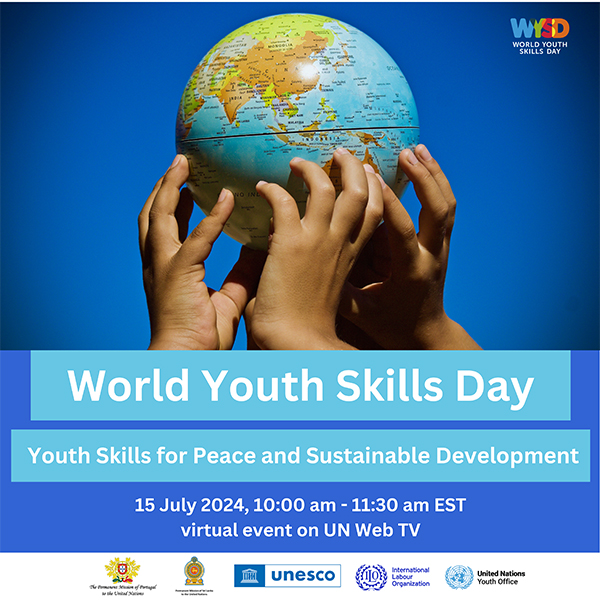
FORUM: “Youth Skills for Peace and Development.World Youth Skills Day 2024. Reflecting on progress made and setting directions for future initiatives, the international community’s commitment to empowering youth with comprehensive skills for peace and sustainable development is crucial, particularly as young people are at the forefront of global efforts in shaping a peaceful, prosperous, sustainable and inclusive future. This ongoing commitment ensures that the educational strides we make are not only maintained but also adapted to meet the evolving challenges and opportunities of our global society. This observance will underscore the crucial role young people play in peacebuilding and conflict resolution. The world faces a multitude of challenges today, many of which affect the youth. Violent conflicts disrupting education and stability, a polarized online environment fostering negativity, and persistent economic inequality limits opportunities. These issues threaten not only individual futures but also the overall stability of societies. It is crucial to equip youth with the necessary skills for fostering a culture of peace, nurturing responsible global citizens, and promoting sustainable development to build a more just, inclusive, and sustainable future for all. On this World Youth Skills Day, let us unite in recognizing the potential of young people as agents of peace and commit to providing them with the skills and opportunities to address challenges and contribute to a peaceful, prosperous, and sustainable future. Follow the conversation with the hashtags: #15July, #WYSD, #WorldYouthSkillsDay.


EVENTS: At UNHQ; On July 15th; from 10:00apm - 11.30am EDT, to observe the World Youth Skills Day 2024, a hIgh level event entitled ’’Youth Skills for Peace and Development.’’ organized by the Permanent Mission of Portugal and Permanent Mission of Sri Lanka to the United Nations New York, in collaboration with UNESCO-UNEVOC, the International Labour Organization, the Office of the Secretary-General's Envoy on Youth, with Member States, young experts, social partners, teachers and educators, and other stakeholders, will be held. This event will bring also together students, governments, United Nations agencies, the private sector, and civil society representatives, to analyze the impact of current crises on youth globally and debate the options for young people to quickly adapt to the demands of an ever-changing world. The virtual panel discussion objectives are to: • Review effective practices and interventions to advance skills development that enables youth to contribute actively to peace and sustainable development. • Highlight youth’s contribution to the acceleration of the achievement of the SDGs especially those related to skills and decent work for peace and resilience, • Highlight the positive experiences and skills of young people that have contributed to a workplace free from violence and harassment. • Explore ways to foster social and emotional learning into education and training systems to equip youth with skills for empathy, resilience, and conflict resolution. • Explore ways to foster global citizenship education and integrate it in curricula at all levels of education, including TVET, to enhance understanding of global issues and empower youth to act as agents of change. More details on the event and Get involved!


From UNESCO; On July 15th, from 10:00 - 12:30 EST, a virtual event entitled ‘‘Building an equitable and inclusive future of work that fosters peace, global citizenship, and sustainable development.’’ will be held. Register to participate!

Building an equitable and inclusive future of work that foster peace, global citizenship, and sustainable development.

From UNESCO; On July 15th, from 10:00 - 12:30 EST, a virtual event entitled “AI Skills for the Future of Work." will be held. The rapid integration of Artificial Intelligence (AI) technologies across various industries is transforming the landscape of work. To prepare youth for the jobs of the future, it is crucial to equip them with the necessary AI skills. The Global Skills Academy will host a dedicated session on "AI Skills for the Future of Work" to address this pressing need. Register to participate!


Virtually; On July 15th, Join us at the HESI Global Forum On "The Future of Higher Education for Sustainable Development." to engage in discussions on education, innovation, and sustainability with a focus on AI. Register to participate!

AI Skills for the Future of Work -a Global Skills Academy Session on WYSD 2024


Statement of the United Nations Secretary-General on World Youth Skills Day 2024; July 15th.

The future of humanity and our planet depends on young people.

But it also depends on ensuring they have the skills to tackle today’s challenges and shape a more peaceful tomorrow.

We know there is a clear link between countries that enjoy high levels of peace, spending on education, and school completion rates.

Yet today, almost a quarter of the world’s youth are not in education, employment, or training – with that figure more than twice as high for young women.

Meanwhile the financing gap for education in low and middle-income countries stands at a massive 100 billion dollars a year.

This year’s World Skills Day shines a spotlight on skills for peace and sustainable development.

Around the world, young people are already working to build safer and stronger communities. They can make an even bigger difference for our shared future with training for the burgeoning green and digital economies, education to help break the cycle of hate speech and misinformation, tools to enhance mediation and dialogue, and so much more.

Today, and every day, let’s work to transform education.

And let’s ensure that youth have what they need to build skills for shaping a more peaceful, sustainable future for all.

United Nations Secretary-General.


LIVETREAM: From UNHQ, New York - World Youth Skills Day 2024 - Youth Skills for Peace and Sustainable Development. Virtual event/ Stay tuned on 15 July 2024 starting at 10:00 am ending at 11:30 am EST.

Ten years ago, in December 2014, the United Nations General Assembly established World Youth Skills Day as to emphasize the critical importance of equipping young people with essential skills for employment, decent work, and entrepreneurship, as well as for addressing global challenges and advancing sustainable development. 2024 marks a significant milestone to reflect on the transformative progress made in youth skills development over the past decade, but also the gaps that remain and the challenges that still need to be addressed, in the context of a constantly evolving world of work. The international community has amplified its efforts to bridge the gap between education and employment, adapting to rapid technological advancements and shifting economic priorities. Today's youth face increasing challenges that threaten not only their individual futures but also the overall peace and stability of societies around the world. Among the most disruptive of these challenges are conflicts, whose induced polarization renders educational and training environments unsafe and inaccessible, puts a break to job creation, and weakens the enabling environment for young workers and young entrepreneurs to thrive. Conflicts contribute to cycles of violence and instability, impacting young people's ability to contribute to their communities. Additionally, youth today must navigate an increasingly divided online environment where hate speech, cyberbullying and disinformation campaigns are prevalent, further disrupting their social interactions and undermining their mental well-being. At the same time, expectations towards a workplace free from harassment, violence and conflict have gained momentum. In many workplaces, gender-based violence and harassment are no long tolerated.

 The ILO RC190 - Violence and Harassment Convention, 2019 (No. 190) details actions member states are expected to take to protect workers from violence and harassment. The convention is particularly important for young people that have often less negotiating power in their job experiences. Skills development where peace is adequately mainstreamed is an important part of the answer to conflicts. Skills development interventions strengthen mutual understanding and trust between groups. Skills development also increases young people‘s employability reducing conflict around the control of income generating assets; skills development can also address grievances and perceptions of injustice. The goal is therefore to equip young people affected by conflict with market relevant technical skills, including the skills demanded by the digital and green economies; core skills including social and emotional learning (SEL) skills to build up agency, resilience, empathy; interpersonal skills, and the skills to effectively engage in the peace and security agenda. The recent report by the Secretary-General on Youth and Peace and Security highlights the need to promote youth inclusion in peace and security and calls on member states and regional organizations to provide young people with the necessary skills and knowledge for engaging in peace processes, conflict prevention, climate justice, and peacebuilding

Similarly, UNESCO’s “Recommendation on Education for Peace, Human Rights, and Sustainable Development” provides guidance on education and skills development efforts for young people to become agents of change and lead efforts toward a more peaceful, just and inclusive future. Additionally, the Youth Declaration on Transforming Education calls for a comprehensive education framework based on peace and human rights and urges decision-makers to establish a safe learning environment, free from all forms of violence and discrimination