Showing posts with label 17 July. Show all posts

Wednesday, 16 July 2025

International Criminal Justice Day 2025; July 17th.


FORUM: “Building a more just World.International Criminal Justice Day 2025. 17 July is the Day of International Criminal Justice. It marks the anniversary of the adoption of the Rome Statute on 17 July 1998, the founding treaty of the ICC, which seeks to protect people from genocide, crimes against humanity, war crimes and the crime of aggression. It’s an occasion to unite all those who wish to support justice, promote victims' rights, and help prevent crimes that threaten the peace, security and well-being of the world. This year, we underscore the urgent need for coordinated, principled action to uphold the international justice system and ensure that all survivors of atrocity crimes can access their right to truth, justice, and reparation. Follow the conversations with the hashtags: #Romestatute, #MoreJustWorld, #JusticeMatters, #17july, #criminaljustice, #SDG16, #Internationalcriminaljusticeday.

Join us in Building a more just world.


EVENTS: Marking the 27th anniversary of the adoption of the Rome Statute.

On July 17th at The Hague, during the International Criminal Justice Day 2025; The ICC will celebrate the Twenty-Seventh Anniversary of the Adoption of the Rome Statute. The organizers calls on States and international actors to reaffirm their commitment to inclusive, survivor-centered justice. In the face of mounting political pressure, systemic inequality, and selective accountability, we stand with survivors and civil society actors who continue to lead the charge against impunity—often at great personal risk.
On July 17th; At the United Nations Headquarters in New York from 15:00 to 16:30 will be held the Commemoration of the Day of International Criminal Justice; The President of the Assembly of States Parties to the Rome Statute of the International Criminal Court, Ms. Päivi Kaukoranta (Finland) invite you to participate to the celebration at in the Ecosoc Chamber. The Opening remarks will be made by the moderator: Ms. Päivi Kaukoranta, President, Assembly of States Parties to the Rome Statute; The Panel members are: Judge Tomoko Akane, President, International Criminal Court; Judge Rosario Salvatore Aitala, First Vice-President, International Criminal Court; H.E. Mr. Michael Imran Kanu, Vice-President, Assembly of States Parties; Mr. Pablo de Greiff, Former United Nations Special Rapporteur on truth, justice, reparation and guarantees of non-recurrence. The panel discussion will be followed by question & answer segment. Requests for inscription on the list of speakers for States and other stakeholders wishing to pose a question should be mad via email at: asp@icc-cpi.int specifying the name and title of the speaker. Participants will be inscribed on the speakers list on a first come, first served basis with States Parties being given priority. Participants are kindly requested to keep their questions to a maximum of three minutes. Register to participate!

STATEMENTS: Read the Joint Statement of the Global Initiative Against Impunity on the Day of International Criminal Justice 2025. and the Joint Statement of the Mechanism Principals’ on the Day of International Criminal Justice 2025.

TAKE ACTION: Reflect on what you can do in your family, community or career to help build a more peaceful, more just world. Get involved in Building a more just world!

Tuesday, 16 July 2024

International Criminal Justice Day 2024; July 17th.


FORUM: “Truth, Memory and Justice: Engaging victims of mass atrocities in international criminal justice.” International Criminal Justice Day 2024. 17 July is the Day of International Criminal Justice. It marks the anniversary of the adoption of the Rome Statute on 17 July 1998, the founding treaty of the ICC, which seeks to protect people from genocide, crimes against humanity, war crimes and the crime of aggression. It’s an occasion to unite all those who wish to support justice, promote victims' rights, and help prevent crimes that threaten the peace, security and well-being of the world. This year, the Day of International Criminal Justice would be devoted to victims of mass atrocities and to mechanisms to ensure their meaningful involvement and participation in international criminal proceedings since the early stages. Follow the conversations with the hashtags: #Romestatute, #JusticeMatters, #17july, #criminaljustice, #SDG16, #Internationalcriminaljusticeday.


EVENTS: Marking the 26th anniversary of the adoption of the Rome Statute. On 17 July 2024; during all the day; The ICC will celebrate the Twenty-Sixth Anniversary of the Adoption of the Rome Statute. Explore the commemorative events overview!
At the United Nations Headquarters in New York on July 17th from 15:00 to 16:30 will be held the Commemoration of the Day of International Criminal Justice; The President of the Assembly of States Parties to the Rome Statute of the International Criminal Court, Ms. Päivi Kaukoranta (Finland) invite you to a panel discussion entitled “Truth, Memory and Justice: Engaging victims of mass atrocities in international criminal justice” at in the Ecosoc Chamber. The voices of those who suffer the consequences of international crimes and their quest for truth lay at the foundation of international criminal justice, the Rome Statute and the International Criminal Court. The commemorative event will focus on three main issues: 1. How to protect the memory of mass atrocities that have involved millions of people since the inception of the 20th century. 2. How to properly address the quest for justice of victims and survivors of war crimes, crimes against humanity and genocide within the system of the International Criminal Court. 3. How to improve the statutory framework to allow a deeper and more meaningful participation of victims in the Court’s proceedings since their beginning, including by providing victims with means of judicial redress before the Pre-Trial Chamber during the investigative stage of the proceedings as well as rights of participation as parties to the proceedings and rights of appeal. The discussion will not refer to any situation before the Court. The Opening remarks will be made by the moderator: Ms. Päivi Kaukoranta, President, Assembly of States Parties to the Rome Statute; The Panel members are: Judge Tomoko Akane, President, International Criminal Court; Judge Rosario Salvatore Aitala, First Vice-President, International Criminal Court; H.E. Mr. Michael Imran Kanu, Vice-President, Assembly of States Parties; Mr. Pablo de Greiff, Former United Nations Special Rapporteur on truth, justice, reparation and guarantees of non-recurrence. The panel discussion will be followed by question & answer segment. Requests for inscription on the list of speakers for States and other stakeholders wishing to pose a question should be made from 11 July until the end of Tuesday, 16 July via email at: asp@icc-cpi.int and copied to Estera.Luteranova@icc-cpi.int specifying the name and title of the speaker. Participants will be inscribed on the speakers list on a first come, first served basis with States Parties being given priority. Participants are kindly requested to keep their questions to a maximum of three minutes. Read the concept note and get the Invitation!


LIVESTREAMReviewing the ICC's Jurisdiction over the Crime of Aggression: Addressing Double Standards in International Law.

Reviewing the ICC's Jurisdiction over the Crime of Aggression - Addressing Double Standards in International Law


The panel will discuss the importance of States using the mandated review of the Kampala amendments on the crime of aggression to harmonize the ICC's jurisdiction over all four of its core crimes.

Sunday, 16 July 2023

Day of International Criminal Justice 2023; July 17th.

FORUM: Marking the 25th anniversary of the adoption of the Rome Statute." International Criminal Justice Day 2023.

17 July is the Day of International Criminal Justice. It marks the anniversary of the adoption of the Rome Statute on 17 July 1998, the founding treaty of the ICC, which seeks to protect people from genocide, crimes against humanity, war crimes and the crime of aggression. 17 July unites all those who wish to support justice, promote victims' rights, and help prevent crimes that threaten the peace, security and well-being of the world.


EVENTS: On 17 July 2023; The ICC will celebrate the Twenty-fifth Anniversary of the Adoption of the Rome Statute.

Overview of the three commemorative events 

1. Opening of the exhibit “Life After Conflict” in The Hague, Netherlands.
 Date: Wednesday, 12 July 2023 at 17:00, followed by a reception.
Venue: The Hague City Hall, Atrium C, The Hague, Netherlands 

An International Criminal Court (ICC) exhibition entitled “Life After Conflict” will be on display in The Hague in July/August 2023. The 2023 display will be part of the commemorations for the twenty-fifth anniversary of the Rome Statute on 17 July 2023. Through stories told by survivors of atrocity crimes, the exhibit shows the impact of the Rome Statute system and the Court’s work. The photographs, by award-winning photographers Rena Effendi, Pete Muller and Finbarr O’Reilly, cover stories from five countries in which the ICC has conducted investigations, all at different stages of the ICC process. 

Date: Monday, 17 July 2023.
 Duration: one day (two segments of three hours each from 10:00 to 13:00 and 15:00 to 18:00) Interpretation into English, French and Spanish (to be confirmed).

The commemorative day at the United Nations will be divided in two sessions of three hours each. The programme will be conveyed in the coming weeks. 
The morning session will encompass an opening ceremony and will be followed by a brief high-level, inperson Ministerial Roundtable on the strategic vision for the next decade of the Court open only to the Ministerial Level Representatives and a representative of the Coalition for the International Criminal Court (CICC).  The morning session will end with a treaty ceremony for depositories of instruments of ratification/accession, amendments to the Rome Statute, as well as the signing of voluntary cooperation agreements or the Agreement on Privileges and Immunities with the Court. 

The afternoon session will be devoted to a continuation of the discussion on the strategic vision for the next decade: how to ensure consistent and sustainable support for the ICC through three distinct panels organized around some key themes for the Court and the Rome Statute system. These will include:

 a. Connecting the dots: Strengthening the international criminal law ecosystem: The role of the ICC as part of a global ecosystem of justice, intended to allow for a discussion of the complementarity regime and current cooperative trends with national systems and other accountability efforts; 
b. Ensuring adequate remedy to victims of Rome Statute crimes, dedicated to a reflection on victims participation and reparation within the Rome Statute system; and 
c. Strengthening the Rome Statute system: The Review Mechanism and beyond: The strengthening of the Rome Statute system through the current Review process will be coming to a closure in 2023. This panel is intended to take stock of what has been accomplished and to identify the way forward after its conclusion. The commemorative event will be followed by a reception at the United Nations Headquarters hosted by the Permanent Mission of Italy to the United Nations. 

3. Commemoration event to take place at the Siracusa International Institute for Criminal Justice and Human Rights.
Date: Thursday, 12 and Friday, 13 October 2023.
Duration: 1.5 days 
Hybrid event, with online interaction from invitees, to be streamed on social platforms aimed at continuing and broadening the discussion initiated in New York on the strategic vision for the next decade: how to ensure consistent and sustainable support for the ICC. A declaration or recommendations resulting from discussions in New York and Siracusa, if any, may be adopted by State Parties at the twenty-second session of the Assembly of States Parties to be held in New York from 4 to 14 December 2023.


EVENTS
DATEEVENTVENUE
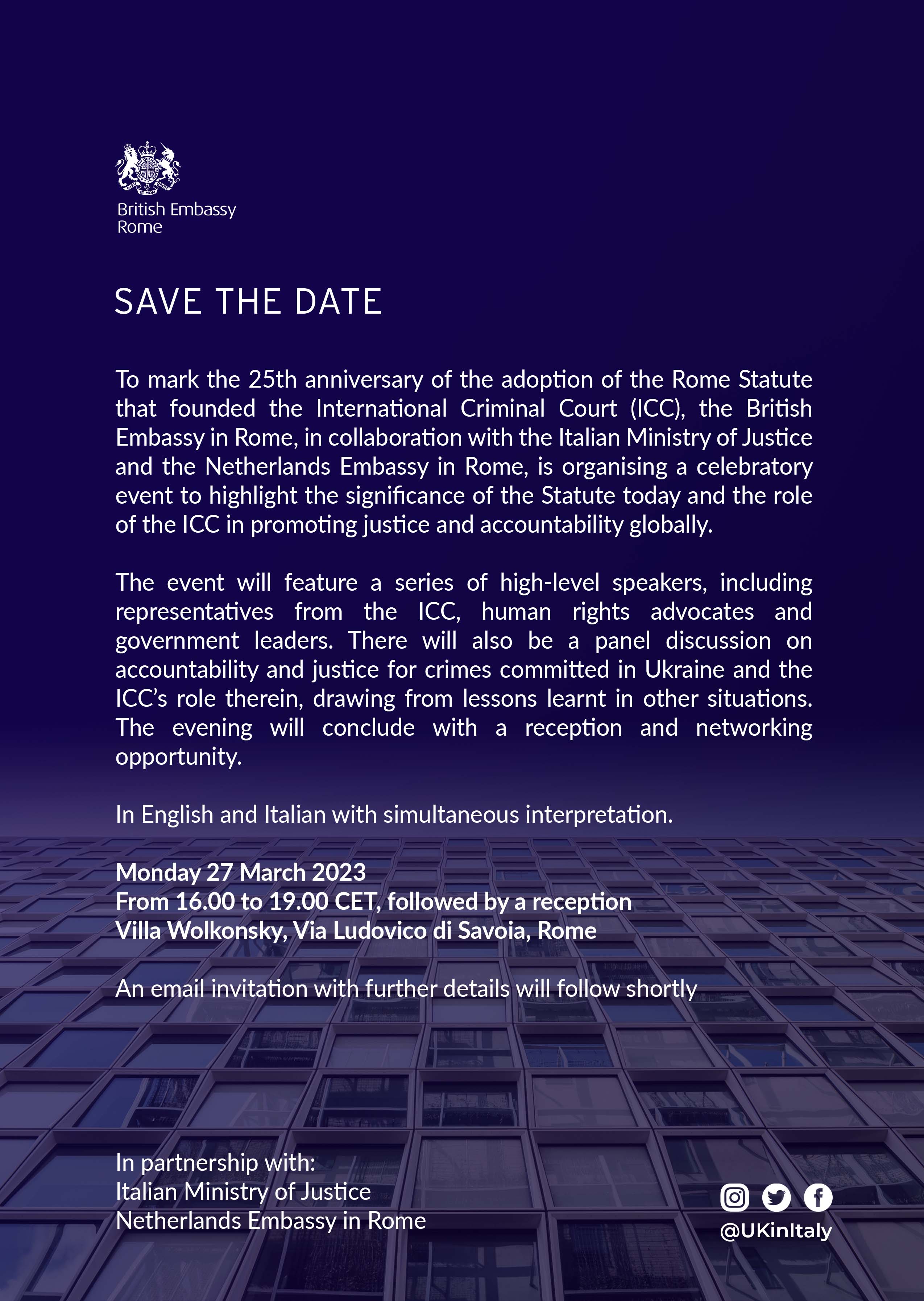
27 MarchRome Statute 25th Anniversary EventVilla Wolkonsky, Rome, Italy
12 July

Commemoration of the 25th anniversary of the adoption of the Rome Statute

Concept note -English | Español | Français 

Programme -English


The Hague City Hall, The Hague, Netherlands
17 July

Commemoration of the 25th anniversary of the adoption of the Rome Statute

Concept note - English | Español | Français 

Invitation States English | Español | Français 

Programme - English

Ministerial Roundtable - States - English |  Español | Français 

Letter from the President of the Assembly on Treaty ceremony - English

Letter from the Permanent Mission of Liechtenstein to the UN - English

Morning segment – additional information - English

Biographies - English

Information sheet - English

APIC, PASP letter on ratifications - English

Español Français 


United Nations Headquarters, New York, USA
6-7 October

25th anniversary of the Rome Statute: Conference on possible future amendments of the Rome Statute

Concept note - English

University of Vienna, School of Law, Vienna, Austria
12-13 October

Commemoration of the 25th anniversary of the adoption of the Rome Statute

Concept note - English | Español | Français 

Rome, Italy


Source
Assembly of States Parties


CAMPAIGN: Building a more just world.


The Rome Statute of the International Criminal Court was adopted on 17 July 1998, 25 years ago. It is the founding treaty of the International Criminal Court (ICC), which seeks to protect people from genocide, crimes against humanity, war crimes and the crime of aggression.

- Opening Ceremony
- Strategic vision for the next decade: How to ensure consistent and sustainable support for the ICC
- Treaty Ceremony

Sunday, 17 July 2022

International Criminal Justice Day 2022; July 17th.


International Justice Day, is an international day celebrated throughout the world on July 17 as part of an effort to recognize the emerging system of international criminal justice.


ICC at 20, Session 1: From the crimes to the courtroom: preliminary examinations, investigations and confirmation of charges


ICC at 20, Session 2: Lifecycle of an ICC case in the courtroom and beyond: trials, appeals and reparations.


ICC at 20, Session 3: Looking back & looking forward.


​The International Criminal Court ("ICC" or "the Court") today marks 17 July, the Day of International Criminal Justice. 


Twenty years ago today, the Rome Statute came into force. It was a tremendous achievement. It is a recognition that the rule of law was there to provide protection, particularly to the most vulnerable and to ensure accountability for individuals that independent Judges found guilty for genocide, crimes against humanity and war crimes or the crime of aggression. It has indeed been a tremendous achievement but this is also a moment to pause, to reflect and to try to refresh the process of international justice. The ICC simply must make an impact in the real lives of people. We need to work closer with affected communities that have lost so much, and to try to speed up and improve the quality and delivery of justice. This requires all of us to work together. We must all try to do better and to rededicate ourselves to these principles of justice which are owned by all humanity. If we work in a collective manner, international justice can, I’m sure, advance. And in twenty years to come, we can see the world better than it is for so many of our fellow brothers and sisters today. About the ICC’s 20th anniversary

EVERYONE CAN WORK TO BUILD A MORE JUST WORLD.


Join us in building a #MoreJustWorld

ICC's 20th anniversary


The #ICC thanks all States Parties for their continued support and commitment to the cause of justice, and all States who voluntarily cooperate with the Court and share its values.


Friday, 15 July 2016

International Criminal Justice Day 2016, July 17.

Journée de la justice pénale internationale, le 17 Juillet.
International Criminal Justice Day, July 17.
Día de la Justicia Penal Internacional, 17 de Julio.
Международный день уголовного правосудия, 17 июля.
 國際刑事司法日, 7月17日.
يوم العدالة الجنائية الدولية، 17 يوليو تموز.


Theme 2016  : Justice Matters.


Statement by the United Nations Secretary General on the International Criminal Justice Day 2016, July 17th.


I am pleased to send warm greetings to all participants at this commemoration of International Criminal Justice Day.  I thank Italy and the International Criminal Court (ICC) for organizing this gathering.
As we mark the eighteenth anniversary of the adoption of the Rome Statute, we can celebrate the common goals shared by the ICC and the United Nations.  Both strive to maintain international peace and security, promote respect for human rights and secure the rule of law.  The Court’s goals of ending impunity and ensuring accountability are closely aligned with the work of the United Nations.
To realize our shared vision of a more peaceful, just and sustainable future, we must hold perpetrators of the most serious crimes of international concern to account.  This may seem like an obvious imperative, but the very idea of international criminal law and the International Criminal Court poses a challenge to authoritarians.  International criminal law limits what they may do to acquire, exercise and retain power.  The International Criminal Court stands as a guarantee, if all else fails, of such limits.
Thanks to the Court, criminals can no longer be confident that force will win them impunity.  That is why the ICC can expect to face constant challenges to its authority, attempts to destroy public trust in it, and other efforts to undermine its work.  The cause of international criminal justice, and of the International Criminal Court, is a constant struggle.
We must always be ready to confront those who would reverse progress.  We must do our utmost to give our children an inheritance of justice, accountability and determined, principled action against impunity.
The lifetime of this Court coincides with the birth and growth of an age of accountability.  As we seek to advance this cause, the International Criminal Court can rely on the full and unwavering support and commitment of the United Nations, now and in the future.

Ban Ki-moon, United Nations Secretary-General.


Situations under investigation.
 
Upon referrals by States Parties or by the UNSC, or on its own initiative and with the judges' authorisation, the Office of the Prosecutor (OTP) conducts investigations by gathering and examining evidence, questioning persons under investigation and questioning victims and witnesses, for the purpose of finding evidence of a suspect's innocence or guilt. OTP must investigate incriminating and exonerating circumstances equally. OTP requests cooperation and assistance from States and international organisations, and also sends investigators to areas where the alleged crimes occurred to gather evidence. Investigators must be careful not to create any risk to the victims and witnesses.


ICC Situations Under Investigation


Preliminary examinations :
 
Before an investigation can begin, the Office of the Prosecutor (OTP) conducts a preliminary examination to decide whether there is enough information on crimes of sufficient gravity, providing a reasonable basis to open an investigation. During this examination, OTP analyses whether or not the ICC has jurisdiction (a crime listed in the Rome Statute appears to have been committed by a national of a State Party or on the territory of a State Party, after 1 July 2002); whether an investigation would be admissible (a national court is not already dealing with it); and whether or not an investigation would be in the interests of justice and of the victims (here OTP considers whether, regardless of jurisdiction and admissibility, there is some good reason not to take on this situation).


ICC Preliminary examinations


FORUM : World Day For International Justice - July 17th.
Interacting with communities affected by crimes

States Parties to the Rome Statute, 14th Session Official Records
The International Criminal Justice Day is commemorated on 17 July; this is the day that marks the entry into force of the Rome Statute for the International Criminal Court (ICC), which took place ten years ago in 2002.


ICC launches #JusticeMatters social media campaign to mark 17 July, the Day of International Criminal Justice


Protecting the Integrity of the International Criminal Court

 Get Involved :

Browse, read and hear stories of the people who work to make justice happen and the people for whom justice matters most.
Engage directly with the Court and get information catered specifically to your information needs.
Help raise awareness of the global fight against impunity with these resources.
 The ICC exhibit Justice Matters uses intimate portraits and videos to explore how justice is crucial to survivors of the world's most heinous crimes, and how it matters to the world as we strive together to achieve lasting peace.


 #JusticeMatters


EVENTS : Commemoration of International Criminal Justice Day 2016

Towards stability and lastin​g peace.
Justice is a key prerequisite for lasting peace. International justice can contribute to long‐term peace, stability and equitable development in post‐conflict societies. These elements are foundational for building a future free ​of violence.

Argentina, as the first ICC Prosecutor, April 21, 2003. (UN Photo/Eskinder Debebe)


PUBLICATIONS :

ICC’s ‘complementarity’ explained in new handbook.

The International Center for Transitional Justice in New York has published a new handbook for non-specialists, journalists and activists, that walks them through the intricacies of “complementarity,” a fundamental principle of the International Criminal Court (ICC).


An Introduction to the role of Nations Courts and the ICC in Prosecuting International Crimes. HANDBOOK ON COMPLEMENTARITY


Audio : Latest News from the International Criminal Court.

Activists from across Africa clarify misconceptions about the International Criminal Court and highlight the need for African governments to support the court in this video by 21 African and international nongovernmental organizations.


NEWS :

Thursday, 17 July 2014

International Criminal Justice Day 2014 , July 17th

International Criminal Justice Day, 17 July.
 Международный день уголовного правосудия, 17 июля.
Día de la Justicia Penal Internacional, 17 de julio.
 Journée de la justice pénale internationale, 17 Juillet.
 يوم العدالة الجنائية الدولية، 17 يوليو


Day of International Criminal Justice - The UN and the ICC: Partners of Shared Values
17 Jul 2014 “Day of International Criminal Justice – The UN and the ICC: Partners of Shared Values” - Marking the Tenth Anniversary of the Relationship Agreement (2004-2014). Organized by the Permanent Mission of Italy to the United Nations. 

 United Nations Secretary-General remarks on International Criminal Justice Day 2014

I thank the Permanent Mission of Italy for hosting this important event.
Today we are marking two milestones.  First, this is of course International Criminal Justice Day.
And second, we celebrate ten years of our Relationship Agreement with the International Criminal Court.
This is a day for all of us to underscore a crucial point: justice matters.
Accountability for serious crimes of international concern is central to our global commitment to peace, security human rights and fundamental freedoms.
So let me begin by once again calling for universal ratification of the Rome Statute.
I also encourage all Member States who are parties to the Rome Statute to do their part to strengthen the International Criminal Court.
Excellencies,
Ladies and Gentlemen,
The drafters of the Rome Statute always envisaged a vital role for the United Nations in support of the Court and its work.

The Relationship Agreement between the United Nations and the Court is founded in a shared belief that the cause of peace can only be served if those responsible for the most serious crimes of international concern are prosecuted and brought to justice.
The world’s commitment to the success of this Court is reflected in the fact that that the Relationship Agreement was approved by the General Assembly without opposition.
The objectives of the Court and the United Nations are clearly aligned.
The Relationship Agreement established a solid foundation for mutual cooperation.
It has served as the basis for a host of supplementary agreements that cover the full range of our common efforts to bring perpetrators of international crimes to justice.
These include detailed arrangements on a number of issues – from the sharing of evidence to the use of modern information technology to facilitating interviews with our officials and experts.
Perhaps most notable are the cooperation agreements with our peacekeeping operations in the Democratic Republic of Congo, Côte d’Ivoire and, soon, Mali.
These agreements allow for the Court to operate more efficiently, in part, because it can rely on the Organization for information and logistical support.
Indeed, one of our child protection officers, Ms. Kristine Peduto, was the first person to testify before the Court in its first trial, that of the warlord, Thomas Lubanga.
Excellencies,
Ladies and Gentlemen,
The Court is the centerpiece of our system of international criminal justice but it is a court of last resort.
We at the United Nations are proud to remain deeply involved in assisting Member States to better address impunity at the national level.
Allow me to commend the Court, and specifically its Prosecutor, for her invaluable work with the States Parties to the Rome Statute.
They have the primary responsibility to investigate and prosecute the serious crimes of genocide, crimes against humanity and war crimes.
I am confident that the relationship between the United Nations and the International Criminal Court will continue to strengthen and grow – through the Office of Legal Affairs and my Legal Counsel, who serve as focal point for cooperation.
The Court will always find in the United Nations a committed partner, a staunch ally and a firm friend.
We look forward to our ongoing close cooperation in the years ahead.
Thank you.
Ban Ki Moon


The Hague, 17 July 2014
CS /1607e,

Together with International Criminal Tribunal for Rwanda (ICTR) President Vagn Joensen, President Theodor Meron in his capacity as both ICTY and MICT President sent a letter to International Criminal Court (ICC) President Song today offering their congratulations on the Day of International Criminal Justice, a day that commemorates the adoption of the Rome Statute on 17 July 1998.
In their letter, President Meron and President Joensen said that today’s commemoration offers an opportunity to reflect on the achievements of international criminal justice in the last twenty years, including the establishment of the ICC, ad hoc international courts and the hybrid criminal courts.

“Together these courts—including those over which the two of us preside—have helped to transform the political and legal landscape. Calling senior political and military leaders to account for their acts before courts of law is increasingly the expectation, rather than the exception. This is a heartening development, and one to be both acknowledged and lauded,” the letter stated.

In concluding their letter, they noted that the Day of International Criminal Justice also serves as a reminder that there is still work to be done at both national and international levels “to bring an end to impunity and, more importantly, to prevent the commission of war crimes, crimes against humanity, and genocide in the first place.”

 International Criminal Tribunal for the former Yugoslavia President.


 President Joensen and ICTY President Meron congratulate the ICC on the Day of International Criminal Justice, Jul 17, 2014         
    

Together with International Criminal Tribunal for the former Yugoslavia (ICTY) and Mechanism for International Criminal Tribunals (MICT) President Theodor Meron, ICTR President Vagn Joensen sent a letter to International Criminal Court (ICC) President Song today offering their congratulations on the Day of International Criminal Justice, a day that commemorates the adoption of the Rome Statute on 17 July 1998.

In their letter, President Meron and President Joensen said that today’s commemoration offers an opportunity to reflect on the achievements of international criminal justice in the last twenty years, including the establishment of the ICC, ad hoc international courts and the hybrid criminal courts.

“Together these courts—including those over which the two of us preside—have helped to transform the political and legal landscape. Calling senior political and military leaders to account for their acts before courts of law is increasingly the expectation, rather than the exception. This is a heartening development, and one to be both acknowledged and lauded,” the letter stated.

In concluding their letter, they noted that the Day of International Criminal Justice also serves as a reminder that there is still work to be done at both national and international levels “to bring an end to impunity and, more importantly, to prevent the commission of war crimes, crimes against humanity, and genocide in the first place.”


International Criminal Court (ICC) Messages for the Day of International Criminal Justice Day 2014.


 Statement of the ICC President: 17 July, 2014 - A day to unite in building a more just world,


When representatives of 120 States adopted the Rome Statute of the International Criminal Court (ICC), on 17 July 1998, they did so to build a more just world. Conscious that all people are connected, and that mass atrocities committed anywhere threaten the delicate mosaic of modern societies as well as world peace and security, they set up a permanent, international justice system to address crimes against humanity, war crimes and genocide by holding individuals accountable either at the national or international level. Through such action, the Rome Statute system aims to help prevent such crimes, to protect all peoples from them, and to uphold what is best, but also most fragile, within us: the shared sense of justice that is a common bond of all humanity. 
Years later, when States Parties to the Rome Statute decided to name the 17th of July as the Day of International Criminal Justice, they invited all of us to commemorate the tremendous efforts of the many international courts and tribunals created in the last two decades while looking forward to what remains to be done. Among these courts is the ICC, the first and only permanent international criminal court with jurisdiction granted by States through a multilateral treaty.
By commemorating 17 July, we recognize past efforts that have fostered reconciliation in societies across the world and have positively affected the lives of hundreds of thousands of victims. We also look to the future, and reaffirm the international community’s commitment to fight against impunity for the most serious crimes, and thereby to stop them from ever being repeated again. 
We are all exposed on a daily basis to news of massacres, crimes and war in multiple regions of the world. Where the ICC has jurisdiction, it endeavours to bring justice to the victims of these crimes. And where it is already involved, the Court’s intervention has galvanised more international attention to communities affected by crimes and the efforts essential to aiding the survivors. However, we are all conscious of the limits of the ICC’s current jurisdiction, which have to be remedied by continued progress towards universal ratification of the Rome Statute.
We recognize that the ICC is only one element in the wider Rome Statute system, the core of which is the responsibility of States themselves to investigate and prosecute the Rome Statute crimes whenever possible. The Statute is built on the principles of universality, complementarity and State cooperation, with the ICC itself as a court of last resort. Like many other parts of the emerging international system, it is still under construction. We continue our efforts and engagement  with the international community so that this new global system can be established with firm foundations, where the law is sovereign and respected, and where  justice for all is recognised as being crucial for peace, stability and development worldwide.
We cannot succeed on our own. All States, organisations and individuals have a role to play in the fight against impunity. Each of us can make a difference. Every year, on 17 July, we review and rededicate our efforts to build a more just world, because we are all connected, and because justice matters to us all.
Audio and video statement, ICC President Judge Sang-Hyun Song:


Each new State Party brings us closer to universal protection from atrocious crimes #17July #Justice Matters
Unite against these 4 atrocious crimes.


Judge Theodor Meron President, International Criminal Tribunal for the former Yugoslavia President, Mechanism for International Criminal Tribunals.

Remarks for Celebration of the Day of International Criminal Justice 10 July 2014,
The Hague.

I am delighted to take part in today’s celebration of international criminal justice day.Today, of course, we commemorate the anniversary of the adoption of the Rome Statute. I was honoured to serve as a member of the US delegation to the Rome Conference back in 1998 , and it is with profound pride that I have witnessed all that the International Criminal Court has achieved in the intervening years As we know from the experiences of the International Criminal Tribunal for the former Yugoslavia and the International Criminal Tribunal for Rwanda, the early years of an international criminal court are fraught with challenges.

 The creation of effective and efficient internal policies and practices,the cultivation of cooperative relationships with affected States, and the development of a coherent body of substantive and procedural jurisprudence based on legal rules and provisions sometimes being applied for the first time—these are but a few of the challenges that can face an international criminal court as it strives to carry out its mandate during the early years of its existence. It is a tribute not just to the International Criminal Court but also to all of the ad hoc international and hybrid criminal courts that,today, calling political and military leaders to account for their acts before courts of law is increasingly the expectation, rather than the exception; that, today, we speak of ensuring accountability for violations of international law not just at a few courtrooms here in The Hague but in national courtrooms the world over; and that, today, we stand, in many ways, in a world transformed from that which existed just two decades ago. But if today is a day to reflect on all that has been achieved since 1998, it is also a day to renew our commitment to the work that remains to be done.

Today is a day to remember that international criminal courts are, and should be, courts of last resort and that it is imperative that States do all they can to ensure the implementation and application of international law in their domestic legal frameworks.

Today is a day to remember that respect for court orders and rulings, even where one may disagree with them, is essential to strengthening respect for the rule of law.

Today is a day for States to renew their commitment to cooperating with and supporting the work of international courts, and for individuals to pause and reflect on why fair and impartial justice is so vital to us all. And today is a day to recall that while international justice is tremendously important, court proceedings alone cannot bring about reconciliation, heal the rifts in a society , or offer closure to victims and survivors. Indeed, such aims, valuable though they may be, fall outside the core mandates entrusted to criminal courts, and where expectations are created to the contrary, it can often seem—erroneously—that international justice is failing. So, today, even as we celebrate all that has been achieved since 1998, we must remember the importance of ensuring a better understanding of international justice.

 We must remember that, without the full commitment of national jurisdictions to international law and to the principles and standards of international law observed by international criminal courts in their proceedings, we will never be able to truly bring an end to impunity and ensure accountability for international crimes. At the same time, we must remember that courts are just part of a panoply of transitional justice measures, including effort s focused on history, memory, community reconciliation, and caring for victims and survivors. And even as we salute international criminal justice today, we must also pay tribute to the many individuals and groups who work so hard every day to bring lasting peace , stability , and respect for the rule of law to their communities in other ways.

Thank you.


 Mr. James Stewart, Deputy Prosecutor of the International Criminal Court Celebration of the Day of International Criminal Justice Brief Remarks.

Your Excellencies,
Honourable Judges,
President Song, Mr Registrar,
Ladies and Gentlemen,

On behalf of the Prosecutor, I am delighted to make a few brief remarks on this important occasion, marking the 16th anniversary of the adoption of the Rome Statute and the strengthening international criminal justice. To begin, I would like to join with others to thank the organizers, and especially Ambassador Korac, for hosting this event, for this kind invitation, and for their dedication to the International Criminal Court and the cause of international criminal justice. Since its genesis, the ICC has indeed come a long way, from an innovative design on paper to a fully-functioning independent judicial institution.

The Court has faced many challenges along the way, and continues to face them, but the ICC has taken its place in the world as an indispensable legal institution promoting justice, giving a meaningful voice to victims, and helping to prevent mass crimes that threaten the peace, security and wellbeing of humanity. While the Court can point to solid achievements, much work lies ahead. As we improve our own capacity at the Court to do justice and to fulfil the mandate the international community has given us, consistent support of States Parties and the international community is needed to ensure the ICC reaches its full potential. States Parties must strengthen their will and national capacities to exercise their primacy of jurisdiction over mass crimes. Political will and diplomatic endeavour are necessary to ensure that crimes are addressed at the national level in accordance with the standards set by the Rome Statute.

When it becomes necessary for the Court to exercise its jurisdiction, however, the full and timely cooperation from States Parties remains necessary if the Court is to do justice effectively. As the Office charged with investigating and prosecuting the most heinous international crimes, we carry great responsibility, first and foremost toward the victims and communities affected by atrocities, but also to the international community as a whole. Cooperation is essential to enable us to discharge these responsibilities. Generally speaking, our requests for cooperation receive positive responses from both States Parties and States not party to the Rome Statute. There are exceptions and challenges, of course, but these are to be expected, since “push-back” in some quarters was inevitable as we implemented our mandate under the Rome Statute. The support and cooperation we receive, nonetheless, strengthens us and allows us to conduct our work in order to bring well prepared cases, built on solid foundations, before the Chambers.

The on-going implementation of the Office’s Strategic Plan is only reinforcing our ability to enhance the quality of our operations and to ensure success. The road to the achievement of justice in a complex, often violent, world is not without pitfalls. It can be a rocky road. But we relish the journey and do not fear the challenges we will meet along the way. Indeed, what other choice have we? The Court was created to advance the international rule of law and to deter the commission of mass crimes that shock the conscience of humanity and inflict great suffering. We must fulfil its promise.

The ICC represents the triumph of hope for a better, more just and peaceful world over a human history marred by mass atrocities and unchecked impunity. In its respect for due process, in its mandate to investigate and prosecute the perpetrators of mass crimes, in its striving to give voice to victims and bring them a measure of justice, the ICC represents the best hope of the international community to realise the ideals of international criminal justice.

As we are gathered here to commemorate International Criminal Justice Day, may I conclude by borrowing from a very different context the words of the late Martin Luther King Jr. in a speech he delivered in 1968, only months before his assassination. He stated: "It may be true that the law cannot change the heart but it can restrain the heartless. It may be true that the law cannot make a man love me, but it can restrain him from lynching me; and I think that is pretty important also. And so while the law may not change the hearts of men, it does change the habits of men if vigorously enforced, and through changes in habits, pretty soon attitudinal changes will take place and even the heart may be changed in the process. […]

With this faith [in the power of the law] we will be able to transform the jangling discords of all the nations in the world, into a beautiful symphony of brotherhood and speed up the day when all over the world justice will roll down like waters, and righteousness like a mighty stream.” The ICC offers us the opportunity to advance the cause of justice the world over.

Together we can ensure that justice – will always – matter. Thank you for your attention.

"The most serious crimes of concern to the international community as a whole must not go unpunished." The Rome Statute

  Resources :