PUBLICATION: The Sustainable Development Goals Progress Chart 2022 presents a snapshot of global and regional progress of selected targets under the 17 Goals of the 2030 Agenda for Sustainable Development. The progress assessment is based on the most up-to-date data and for some of the Sustainable Development Goals (SDGs) also reflect the impacts of the COVID-19 pandemic. Due to data collection challenges related to pandemic-related measures, measuring the full impact of COVID-19 is limited for the other Goals. The Progress Chart 2022 clearly demonstrates the deterioration of progress towards many targets, such as poverty, food security, ending the epidemic of malaria, immunization coverage, and employment, caused by the impacts of the COVID-19 pandemic, climate change and conflict. Recent cascading crises have magnified the challenges of achieving the SDGs. Urgent, scaled-up and coordinated actions by all countries are needed to accelerate SDG implementation and avert the devastating impacts in order to get on track and chart a course for better recovery. The progress chart presents two types of information:
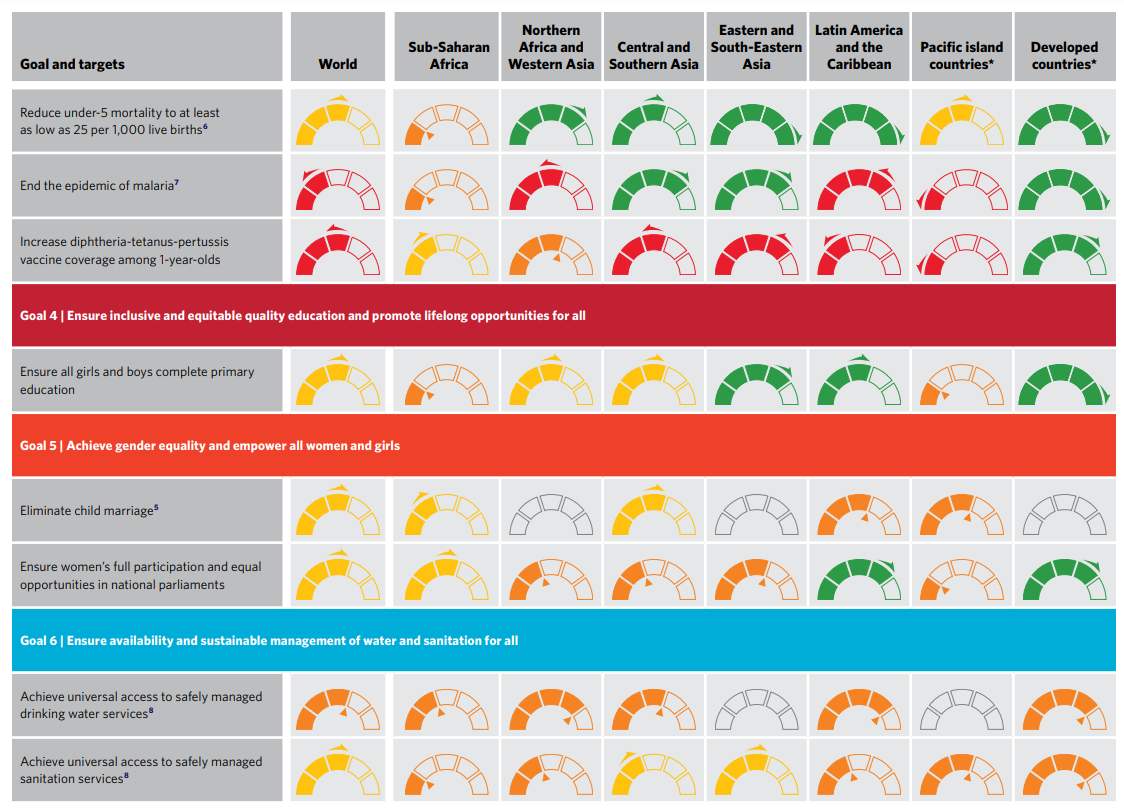
1) a trend assessment using stoplight colours to measure progress towards the target (from a baseline year to the most recent data point), and
2) a level assessment using a gauge meter to measure the current level of development with respect to the distance from a target, using the latest data. The chart is based on a limited number of indicators and information available as of June 2022. For most of the indicators, the latest available data are from 2019 to 2021. A baseline year of around 2015 or 2010 is used for the trend assessment.
2022 Progress towards SDG1, SDG2, SDG3.
2022 Progress towards SDG4, SDG5, SDG6.
2022 Progress towards SDG7 SDG8, SDG9, SDG10.
2022 Progress towards SDG11 SDG12, SDG13, SDG14 and SDG15.
2022 Progress towards SDG16 and SDG17.
Notes
* The category “Pacific island countries” refers to Oceania excluding Australia and New Zealand. The category “developed countries” includes Europe, Northern America, Australia and New Zealand.
1 The latest data used for both trend and level assessments are 2021 nowcasts with high uncertainty.
2 Due to improvement in data quality and availability, 2020 estimates for Northern Africa and Western Asia, Latin America and the Caribbean, and Pacific Island Countries are not comparable with
baseline values. Only level assessments are available for these regions.
3 Trend assessment uses a baseline year of 2012.
4 Level assessment is based on 2020 data, with five levels of stunting prevalence: very high (1 bar), high (2 bars), moderate (3 bars), low (4 bars), and very low (5 bars).
5 Trend assessment uses a baseline year of 2011.
6 Trend assessment uses a baseline year of 2010.
7 Trend assessment is based on the WHO Global Technical Strategy for Malaria 2016–2030, which is reducing malaria case incidence by at least 90 per cent by 2030. Level assessment is classified into
five levels of malaria case incidence: very high (1 bar), high (2 bars), moderate (3 bars), low (4 bars), and target achieved (5 bars).
8 Assessment for “developed countries” refers to Europe and Northern America only.
9 Level assessment is based on the level of energy intensity, with five levels: high (1 bar), medium-high (2 bars), medium (3 bars), medium-low (4 bars), and low (5 bars).
10 Baseline value is the average annual growth rate of real GDP per capita from 2000 to 2015. The level assessment is based on the average annual real GDP per capita growth from 2015 to 2020.
The trend assessment is the comparison of the expected average annual growth rate of real GDP per capita from 2015 to 2030 with the baseline value or target value of 2 per cent.
11 Assessment is based on the Gini Index. The latest data is from 2019. Level assessment is classified into five levels of inequality: very high (1 bar), high (2 bars), moderately high (3 bars), moderately
low (4 bars), and low (5 bars).
12 Assessment is only at the global level.
13 Assessment for “developed countries” refers to Europe only.
14 Level and trend assessment are based on the Red List Index and regional disaggregations of the index.
15 Level assessment is classified into five levels of unsentenced detainees rate: very high (1 bar), high (2 bars), moderate (3 bars), low (4 bars), and very low (5 bars)..
16 Trend assessment is based on progress from 2017 to 2020.
For regional groupings, country data and technical note for the progress chart, please refer to: https://unstats.un.org/sdgs. Country experiences in each region may differ significantly from the
regional average. Due to updated data and revised methodologies, this Progress Chart is not comparable with previous versions.
Sources. United Nations, based on the latest available data and estimates as of June 2022: provided by: Department of Economic and Social Affairs (DESA), Food and Agriculture Organization (FAO),
International Energy Agency (IEA), International Labour Organization (ILO), Inter-Parliamentary Union (IPU), International Renewable Energy Agency (IRENA), International Telecommunication
Union (ITU), International Union for Conservation of Nature (IUCN), Office of the United Nations High Commissioner for Human Rights (OHCHR), Organization for Economic and Cooperation and
Development (OECD), Partnership in Statistics for Development in the 21st Century (PARIS21), Secretariat of the United Nations Framework Convention on Climate Change (UNFCCC), United Nations
Children’s Fund (UNICEF), United Nations Educational, Scientific and Cultural Organization (UNESCO), United Nations Entity for Gender Equality and the Empowerment of Women (UN-Women),
United Nations Environment Programme (UNEP), United Nations Human Settlements Programme( UN-Habitat), United Nations Industrial Development Organization (UNIDO), United Nations Office
on Drugs and Crime (UNODC), World Bank Group, World Health Organization (WHO).
By adopting the historic 2030 Agenda for Sustainable Development, world
leaders expressed their resolve to seek shared progress and prosperity based on
a spirit of global solidarity. The Paris Agreement on climate change marks
another important milestone for our planet and all people.
These
achievements were driven by two complementary goals: to leave no one behind,
and to build a life of dignity for all. This spirit of global solidarity t must
now inspire our collective response to other major challenges facing
humankind.
This is especially true in addressing plight of the record number of people
around the world forced from their homes and communities. Far too many have
fled violent extremists only to be victimized again by xenophobia,
discrimination and abuse. We must collectively challenge all those who stoke
unfounded fears. Helping the vulnerable elevates us all.
With diversity under verbal and violent attack in so many parts of the world,
let us make the most of International Human Solidarity Day by reaffirming our
common humanity, defending our shared values and creating a better future for
all.
This Report starts with a fundamental question—how can work enhance human development? The Report takes a broad view of work, going beyond jobs and taking into account such activities as unpaid care work, voluntary work and creative work—all of which contribute to the richness of human lives.