Showing posts with label 27 January. Show all posts

Sunday, 26 January 2025

International Day of Commemoration in memory of the victims of the Holocaust 2025; January 27th.

FORUM: "Holocaust Remembrance for Dignity and Human Rights." International Day of Commemoration in memory of the victims of the Holocaust 2025. This year marks 80 years since the end of the Second World War and the Holocaust. Eighty years ago, in response to the atrocities of the war and the Holocaust, governments of the world established the United Nations, pledging to work together to build a just world where human rights were enshrined, and all could live with dignity, in peace. Acknowledging the milestone year, the Holocaust and the United Nations Outreach Programme has chosen as its guiding theme for 2025, “Holocaust remembrance and education for dignity and human rights”. The theme reflects the critical relevance of Holocaust remembrance for the present, where the dignity and human rights of our fellow global citizens are under daily attack. The Holocaust shows what happens when hatred, dehumanization and apathy win. Its remembrance is a bulwark against the denigration of humanity, and a clarion call for collective action to ensure respect for dignity and human rights, and the international law that protects both. Holocaust remembrance safeguards the memories of survivors and their testament of life before the Holocaust – of vibrant communities, of traditions, of hopes and dreams, of loved ones who did not survive. Safeguarding the history brings dignity to those the Nazis and their collaborators sought to destroy. Remembrance of the Holocaust is a victory against the Nazis and their collaborators, and against all who would try to continue their legacy through spreading hatred, Holocaust distortion and denial into the 21st century. Share your reflections with the hashtags: #27January, #HolocaustRemembranceDay.

Holocaust Remembrance for Dignity and Human Rights.


On 27 January 1945, 80 years ago today, horrified and exhausted Soviet troops entered the Auschwitz-Birkenau German Nazi concentration and extermination camp and liberated the approximately 7,000 prisoners who had survived.Every year, this symbolic date urges the international community to remember the 6 million Jews who were murdered alongside countless other victims of Nazi brutality.At a time when there are fewer and fewer direct witnesses of the Holocaust, marking the twilight of what historian Annette Wieviorka calls "the era of the witness", we must commit ourselves with ever greater gravity to the perpetuation of its memory. Firstly, we must do so by preserving the very places where the horror occurred, so that we never stop believing in what was an utterly unbelievable event. In 1979, UNESCO proclaimed Auschwitz-Birkenau a world heritage site, thus contributing to the memorial nature of the structure which had housed a death camp. This inscription affirmed the mobilization of universal awareness with regard to a phenomenon which had consisted in the desire to sever off part of humanity. UNESCO's ongoing contribution to this memorial structure is reflected in a historic agreement signed just one year ago. After 14 years of diplomatic negotiations conducted under the aegis of our Organization, this agreement between the six States of the former Yugoslavia provides for the reopening of a permanent exhibition designed by the architect Daniel Libeskind, in a renovated shared pavilion. UNESCO also supports the Counter Extremism Project's creation of a new centre for research on hate, extremism and radicalization in the former house of the commandant of Auschwitz, Rudolf Höss, directly adjacent to the camp. This centre, called ARCHER at House 88, will offer fellowship programmes for young researchers, in conjunction with UNESCO university chairs dedicated to research on the Holocaust, violent pasts, and the prevention of antisemitism and extremism.Honouring the memory of the victims of the Holocaust also means valuing the Jewish cultural heritage which the Nazis set out to destroy. To this end, UNESCO inscribed, in 2021, the sites of Speyer, Worms and Mainz on the World Heritage List, and, in 2023, the sites of Erfurt and the El Ghriba synagogue in Djerba. Yet we cannot cultivate the memory of a place without conveying its meaning to the younger generations. In this respect, education plays an essential role, as it enables us to pass on an understanding of the history of the Holocaust in its universal dimension. For the Holocaust reveals something about the human species which cannot be reduced to a single era or a single people. The worst can happen again wherever the necessary conditions are present.
In order to prevent antisemitic, racist and xenophobic violence from being unleashed amid ignorance of the past, UNESCO and the United States Holocaust Memorial Museum jointly developed the International Program on Holocaust and Genocide Education. For 10 years now, UNESCO has thus worked with 24 countries to ensure that school curricula and textbooks reflect violent pasts based on the facts. We must face reality: teaching people about the memory of the Holocaust has become an increasingly difficult task in the light of the resurgence of antisemitism on a massive scale. That is why UNESCO, in conjunction with the European Commission and the Organization for Security and Cooperation in Europe (OSCE), has set up a training programme for teachers - who are on the front line when it comes to dealing with hate speech in schools. Already available in 12 countries, these training courses are being extended to all European Union Member States this year.In the age of social networks, where hate speech proliferates anonymously, it is also vital to adapt our actions. Algorithms amplify Holocaust denial, as shown by UNESCO in a report published in partnership with the World Jewish Congress: AI and the Holocaust: Rewriting History? The fight against Holocaust denial and the distortion of the history of the Holocaust must be waged on all fronts. Also in conjunction with the World Jewish Congress, UNESCO has persuaded Meta and TikTok to redirect people seeking information about the Holocaust to a reliable site: About Holocaust.org. Available in 19 languages, the site received over 4.4 million visitors in 2024 alone. On this International Day of Commemoration in Memory of the Victims of the Holocaust, UNESCO calls on the international community to remain fully mobilized on all fronts to ensure that we never let happen again what the American lawyer Samuel Pisar called "the greatest catastrophe ever perpetrated by man against man". 

Ms Audrey Azoulay, UNESCO Director-General.

On January 27th, the UNOV will hold a Commemorative Ceremony to mark the International Day of Commemoration in Memory of the Victims of the Holocaust. Watch the ceremony!


 The official ceremony of the United Nations Office at Geneva will pay tribute to those who perished in Nazi death camps. Mr. Ivan Lefkovits, Holocaust survivor of the Bergen-Belsen concentration camp, will speak about his family experience of loss and survival. After watching a video message from the United Nations Secretary-General, Mr. António Guterres, the following speakers will deliver remarks: • Ms. Tatiana Valovaya, Director-General of the UN Office at Geneva • His Excellency Mr. Daniel Martin Meron, Ambassador and Permanent Representative of Israel to the United Nations Office at Geneva • Her Excellency Lotte Knudsen, Ambassador and Head of the Permanent Delegation of the European Union to the United Nations Office at Geneva Musical performance by children's choir from the La Châtaigneraie Choir (Ecolint). Watch the observance!


The annual Holocaust Memorial Ceremony is the central event organized in observance of the International Day of Commemoration in memory of the victims of the Holocaust. The ceremony will be held on 27 January 2025 in the United Nations General Assembly Hall, under the theme "Holocaust Remembrance for Dignity and Human Rights". The Holocaust Memorial Ceremony takes place on the 80th anniversary of the liberation of Auschwitz on 27 January 1945. The observance will be hosted by Ms. Melissa Fleming, United Nations Under-Secretary-General for Global Communications. Survivors of the Holocaust will share their testimonies along with invited speakers who include the United Nations Secretary-General; the President of the 79th session of the General Assembly and representatives of Member States. Watch the commemoration!

 

Friday, 26 January 2024

International Day of Commemoration in Memory of the Victims of the Holocaust 2024; January 27th.


FORUM: “Recognizing the Extraordinary Courage of Victims and Survivors of the Holocaust". International Day of Commemoration in Memory of the Victims of the Holocaust 2024. During the Holocaust, the Nazis went to great lengths to dehumanize their victims. Defying the Nazis took extraordinary courage. In 2024, the United Nations is paying tribute to the bravery of all those who stood up to the Nazis, despite the grave risks. We will honor their legacy with their remarkable stories and history. In the memory of all victims and survivors, we will step up our efforts to counter Holocaust denial, antisemitism and racism. Share your reflections with the hashtags: #27January, #HolocaustRemembranceDay.


COMMEMORATIONS: On 26 January 2024, 11:00 a.m. EST will be held the annual Holocaust Memorial Ceremony central event organized in observance of the International Day of Commemoration in memory of the victims of the Holocaust 2024 at the United Nations General Assembly Hall. Survivors of the Holocaust will share their testimonies along with invited speakers who include the United Nations Secretary-General; the President of the 78th session of the General Assembly (through recorded message); the Permanent Representative of Israel and a representative of the Permanent Mission of the United States to the United Nations.. The Holocaust Memorial Ceremony will be hosted by Ms. Melissa Fleming, United Nations Under-Secretary-General for Global Communications. Invited speakers include the Permanent Representative of Israel and the United States Special Envoy to Monitor and Combat Antisemitism. Watch at UN WebTV, YouTube and X.

From 22 January to 23 February 2024 will be held an exhibition entitled “Fighting for the Whole World" – Lower Saxony under Nazi Rule at the Visitors' Lobby, United Nations Headquarters. This exhibition traces how events unfolded from 1933 to 1945 in what is today’s state of Lower Saxony, Germany. How the Nazi regime shaped society in Lower Saxony to reflect Nazi ideology, the state-sanctioned crimes, state-fomented violence and intimidation, and responses to the actions of the state and its agents, reflects the experience across Germany and in occupied territories. A closer look at Lower Saxony illuminates the larger history of the Holocaust and expands our knowledge and awareness of the experiences of all who were caught up in the history.

 On Tuesday, 27 February 2024 will be held a Book Talk entitled “The Counterfeit Countess: The Jewish Woman Who Rescued Thousands of Poles during the Holocaust" - 1:00 p.m. EST at UN Bookshop, United Nations Headquarters. Jewish mathematician Dr. Josephine Janina Mehlberg operated in Lublin, headquarters of Aktion Reinhard, the SS operation that murdered 1.7 million Jews in occupied Poland. Masquerading as a Polish aristocrat, the “Countess” persuaded SS officials to release thousands of Poles from Majdanek concentration camp. She secured permission to deliver food and medicine for thousands more inmates, and she smuggled supplies and messages to incarcerated resistance fighters. Incredibly, she eluded detection, survived the war, and emigrated to the United States. Join co-authors Elizabeth B. White and Joanna Sliwa as they discuss how they pieced together Dr. Mehlberg's history and ask why so little about this unrecognized hero is known by the broader public. Elizabeth B. White is the former Research Director for the Center for the Prevention of Genocide at the United States Holocaust Memorial Museum, and Joanna Sliwa is the historian at the Conference on Jewish Material Claims Against Germany.


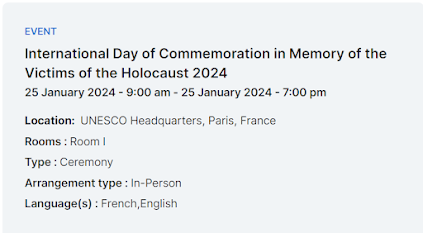
COMMEMORATION AT UNESCO

Concert and official ceremony start at 6 p.m. in Room I, UNESCO Paris. Doors open 5 p.m. Entrance from Avenue de Suffren.


In 2024, UNESCO will mark the International Day with a series of events organized at UNESCO Headquarters, commemorating the memory of millions of victims of the Holocaust and reflecting on the universal legacy of this genocide through music, art and survivor testimonies.

The 2024 commemoration is organized in partnership with the Foundation "Institute of Concentrationary Music Literature", the USC Shoah Foundation and the Shoah Memorial. The events are generously supported by the Permanent Delegations of Belgium, Germany, Italy and Monaco to UNESCO and the Foundation for the Memory of the Shoah.

UNESCO also acknowledges the valuable support from the Montreal Holocaust Museum and "We are the tree of life" association.


Commemoration ceremony and concert reviving the music from the Holocaust

Thursday 25 January 2024, 6 p.m. - 7 p.m.
UNESCO Paris, Room I, doors open at 5.15 p.m. Early arrival is advised.

To commemorate the victims and survivors of the Holocaust, UNESCO will host a world premiere of a special concert reviving music from the concentration camps and ghettos. Italian composer and conductor Francesco Lotoro spent years recovering compositions created and played under Nazi persecution - a powerful reminder of the endurance of the human spirit in the face of unimaginable horrors. At the concert, his orchestra will bring these melodies to life on stage for the first time since World War II, coupled with survivors’ testimonies. The ceremony will also include traditional Jewish prayers in the memory of Holocaust victims, including a recital of Kol Nidre (All Vows) on a violin rescued from the Auschwitz-Birkenau camp and Kaddish, performed by the opera singer David Serero.
  • In the presence of: Audrey Azoulay, UNESCO Director-General
  • Francois Heilbronn, Vice-President of the Shoah Memoria
  • Charlotte Knobloch, World Jewish Congress Holocaust Memory Commissioner and President of the Jewish Community of Munich and Upper Bavaria
The commemoration ceremony will be moderated by Stefania Giannini, UNESCO Assistant Director-General for Education.

"Blue skies": exhibition reflecting on collective trauma and remembrance

From 23 January to 9 February 2024, Monday to Friday from 9 to 5.30 p.m.,
UNESCO Paris, Pas Perdus Hall

The multimedia exhibition “Blue Skies” by Belgian artist Anton Kusters is a striking reflection on collective trauma and remembrance. Kusters spent 6 years photographing empty skies above Nazi concentration and extermination camps across Europe - locations where millions were killed, yet little physical evidence remains today. Each of his 1078 blue sky images, stamped with GPS coordinates and victim numbers and accompanied by a video installation and a sound piece by Ruben Samama, explores how we witness, process pain and choose to remember almost 80 years after the liberation of the last camp. The Blue Skies Project is curated by Monica Allende.

CAMPAIGN MATERIALS


Other statements
  1. Statement from President Joe Biden on International Holocaust Remembrance Day 2024
  2. Holocaust Memorial Day 2024 - House of Lords Library
  3. International Holocaust Remembrance Day 2024: The fragility of freedom - European Parliament Think Tank
  4. Holocaust Martyrs' and Heroes' Remembrance Day 2024 - Yad Vashem
  5. About the Holocaust Remembrance Day and Yom ha Shoah - Jüdisches Museum Berlin.

UNOV Commemorative Ceremony to mark the International Day of Commemoration in Memory of the Victims of the Holocaust 2024

Thursday, 26 January 2023

International Day of Commemoration in Memory of the Victims of the Holocaust 2023; January 27th.


FORUM:“Home and Belonging”. International Day of Commemoration in Memory of the Victims of the Holocaust 2023.
The United Nations General Assembly designated January 27th as International Holocaust Remembrance Day. to mark the anniversary of the liberation of Auschwitz-Birkenau.This year, the theme is “home and belonging”, two concepts that were systematically ripped away from Jewish citizens, once the Nazi Party took control of Germany in 1933. Share your reflections about International Holocaust Remembrance Day with the hashtags: #27January#HolocaustRemembranceDay.


Exploring how victims adjusted their ideas of “home” and “belonging” as they faced the violent, antisemitic onslaught during the Holocaust, and what “home” and “belonging” meant to survivors in the immediate post-war years will frame the outreach programme. In 1933, the Nazi Party took control of the government of Germany and put its ideology into practice, identifying who could claim Germany as home and who belonged. The process of definition and exclusion went beyond legislation and propaganda campaigns of disinformation and hate speech, to state-sanctioned acts of terror that destroyed people’s places of worship, livelihood and homes. The definition of who belonged and who did not, soon extended to all who fell within the expanding borders of the Nazi Reich and was reproduced by collaborator governments.


The Nazis and their racist collaborators rendered many millions homeless and stateless before and during the Second World War. We consider how those who sought refuge from 1933 negotiated the meaning of “home” and “belonging”. We consider those who survived by hiding and the impact of this experience on their sense of “home”. We will examine the ways in which survivors as displaced persons in displaced persons’ camps, and the children born in these camps, navigated the post-War world - a world in which the meaning of “home” and “belonging” had been challenged radically by the perpetrators of the Holocaust.


Holocaust remembrance and education that includes opportunities to develop a deeper appreciation of the victims and survivors and their agency, can inform our response to the plight of contemporary victims. Placing the victims and survivors in the centre of historical research, learning and remembrance illuminates the humanity of victims of atrocities today, and the impact of antisemitism fuelled by disinformation and the distortion of history. Focusing on the humanity of the victims prompts us to remember our humanity, and our responsibility to combat hate speech, combat antisemitism and prejudice - to do all we can to prevent genocide.


EVENTS: On this annual day of commemoration, the UN urges every member state to honor the six million Jewish victims of the Holocaust and millions of other victims of Nazism and to develop educational programs to help prevent future genocides.


10 January – 23 February 2023: Exhibition “After the End of the World: Displaced Persons and Displaced Persons Camps”

Europe emerged from the Second World War utterly broken, with millions of refugees scattered across many countries. The United Nations Relief and Rehabilitation Administration (UNRRA) was created to resettle those displaced by the mayhem of the war and the Holocaust. The fragments from the past illuminate the work of UNRRA administrators, and chart how, in the aftermath of catastrophic loss, Holocaust survivors navigated their new lives in displaced persons camps. The exhibition is sourced with artefacts and documents from the archives of the United Nations and the YIVO Institute for Jewish Research, and draws upon the expertise of the Center for the Study of the Holocaust, Genocide, and Crimes Against Humanity at the Graduate Center—CUNY. The exhibition was created by the Holocaust and the United Nations Outreach Programme and Professor Debórah Dwork, together with the YIVO Institute for Jewish Research Archives, the United Nations Archives and Records Management Services, and with generous support of Stockton University.

Visitor Information: The exhibition is free and open to the public. Guests are welcome to visit the exhibition during regular hours (Monday-Friday, 9 am – 5 pm). For more information, please, check the United Nations Visitor Centre entry guidelines.


16 January – 20 February 2023 - Exhibition “#FakeImages: Unmask the Dangers of Stereotypes"

Stereotypes and conspiracy theories against Jews, Roma, migrants, LGBTQIA+ or other groups are not new. During the Second World War, the antisemitic propaganda of the Nazis and their racist collaborators used stereotyping, false images, disinformation and conspiracy thinking to encourage hatred, with deadly consequences. The propaganda and lies foreshadowed the genocide. The exhibition exposes how the Nazi's false and manipulative imaging worked and continues to find expression today. The interactive exhibition challenges us to take action to unmask the lies that continue to divide and polarise our world. The exhibition was curated by Kazerne Dossin, in collaboration with the "Arthur Langerman Archive for the Study of Visual Antisemitism Foundation" (ALAVA) and the Center for Research on Antisemitism at the Technische Universität Berlin. The exhibition is supported by the Ministry of Foreign Affairs of Belgium, the Ministry of Foreign Affairs of Germany, and the Permanent Missions of Belgium and Germany to the United Nations.

Visitor Information:
The exhibition is free and open to the public. Guests are welcome to visit the exhibition during regular hours (Monday-Friday, 9 am – 5 pm). For more information, please, check the United Nations Visitor Centre entry guidelines.


26 January – 17 February 2023: Exhibition “The Yad Vashem Book of Names of Holocaust Victims

Yad Vashem - The World Holocaust Remembrance Center has specially updated its exhibition, "The Yad Vashem Book of Names of Holocaust Victims" for display at United Nations Headquarters. "The Yad Vashem Book of Names of Holocaust Victims" details alphabetically the name of each of the approximately 4.8 million Holocaust victims that Yad Vashem has currently documented and confirmed. Whenever possible, "The Yad Vashem Book of Names of Holocaust Victims" shows the date of birth, home town and place of death of the respective victim. The names are taken from Pages of Testimony in Yad Vashem's Hall of Names, as well as from various lists compiled during and following the Holocaust, and subsequently reviewed by Yad Vashem experts. The display of "The Yad Vashem Book of Names of Holocaust Victims" at the United Nations is supported by the Permanent Mission of Israel to the United Nations.

View the opening event here:

Visitor Information:
The exhibition is free and open to the public. Guests are welcome to visit the exhibition during regular hours (Monday-Friday, 9 am – 5 pm). For more information, please, check the United Nations Visitor Centre entry guidelines.


26 January 2023 - Opening of Exhibition “The Yad Vashem Book of Names of Holocaust Victims”

The exhibition will be opened by the United Nations Secretary-General, with remarks by the Permanent Representative of Israel and the Chair of Yad Vashem, the World Holocaust Remembrance Center. Singer Hadar Orshalimy and Pianist Yaniv Taubenhouse will perform. The Under-Secretary-General for Global Communications hosts the event. View the opening event here.


Thursday, 26 January 2023: Each Life a World: Survivors in Their Own Words.
12:00 p.m. EST; Streaming live on B’nai B’rith’s YouTube channel

Continuing its series of annual events in conjunction with United Nations commemoration of the victims of the Holocaust, this virtual B’nai B’rith program will feature testimony by Professor Ivan Lefkovits, a Holocaust survivor, as well as a discussion between B’nai B’rith International CEO Daniel S. Mariaschin and the Illinois Holocaust Museum and Education Center's Senior Vice President of Education and Exhibitions Kelley Szany.

Ivan Lefkovits was born in Prešov (in today’s Slovakia) in 1937. His father was murdered in Budapest, where his family attempted to escape growing anti-Jewish persecution. In the fall of 1944, Lefkovits, his mother and his older brother were deported to the Ravensbrück concentration camp, where his brother, who was 15, was also murdered. Lefkovits later survived the Bergen-Belsen concentration camp, along with his mother. He came to Basel, Switzerland, in 1969 as a professor to establish the new Basel Institute for Immunology.


The Illinois Holocaust Museum and Education Center has introduced innovative technologies—including the first virtual reality (VR) Holocaust exhibit and an interactive holographic experience—to preserve the legacy of Holocaust survivors in immersive exhibits. Kelley Szany will discuss this new approach to Holocaust remembrance and the role VR and other emerging technologies will play in teaching current and future generations about the horrors of the Shoah.


Friday, 27 January 2023: United Nations Holocaust Memorial Ceremony 2023.

11:00 a.m. EST, United Nations Headquarters
Download the Programme.

Ms. Melissa Fleming, United Nations Under-Secretary-General for Global Communications will host the ceremony. The event includes remarks by United Nations Secretary-General; the President of the 77th session of the General Assembly, the Permanent Representative of Israel and the Deputy Representative of the United States to the United Nations. Professor Debórah Dwork will deliver the keynote address. Mr. Jacques Grishaver of the Netherlands will share his testimony as a survivor of the Holocaust. Professor Ethel Brooks will speak to the persecution and mass murder of the Roma and Sinti. Two grandchildren of Holocaust survivors will present - Professor Karen Frostig and Mr. Michael Shaham. Musicians include Ms. Shoshana Shattenkirk, Mr. Michael Shaham (who will perform on a Violin of Hope). Professor Renée Jolles will perform a piece for violin specially composed by Ms. Victoria Bond for the 2023 Holocaust memorial ceremony. Cantor Nissim Saal will recite the memorial prayer. Registration is now closed. The event will also be live-streamed.


Tuesday, 31 January 2023
International Mock Trial on Human Rights.

3:00 p.m. EST, United Nations Headquarters

The International Mock Trial on Human Rights is the culmination of a year-long programme organized by The Social Excellence Forum (SEF) for a diverse group of 20-30 young leaders, ages 15-22 years, from several countries. The students will interrogate the actions and responsibilities of Ernst Rudin, the so-called father of Nazi Racial Hygiene. The Mock Trial will cover the subject of human rights violations, racism and discrimination, and the responsibility of leaders for the consequences of their incitement and actions. The International Mock Trial on Human Rights is organized by The Social Excellence Forum (SEF), with the support of the Holocaust and the United Nations Outreach Programme. The Social Excellence Forum (SEF) is a non-profit youth leadership training initiative.

Register here the attend the Mock Trial. Registration will close on Thursday, 26 January 2023. The event will be livestreamed here.


Thursday, 9 February 2023: Film Screening “The U.S. and the Holocaust” and Panel Discussion

6:30-8:00 p.m. EST, United Nations Headquarters.

A screening of a special 40-minute version of "The U.S. and the Holocaust", a film by Ken Burns, Lynn Novick and Sarah Botstein will be followed by a discussion with Ken Burns, Lynn Novick and historian Daniel Greene. The documentary combines first-person accounts of Holocaust witnesses and survivors and interviews with leading historians and writers. Inspired in part by the United States Holocaust Memorial Museum’s “Americans and the Holocaust” exhibition and supported by its historical resources, the film examines the rise of Hitler and Nazism in Germany in the context of global antisemitism and racism, the eugenics movement in the United States and race laws in the American south. The documentary tackles a range of questions that remain essential to our society today, including how racism influences policies related to immigration and refugees as well as how governments and people respond to the rise of authoritarian states that manipulate history and facts to consolidate power. Register here to attend the film screening. The registration will close on Monday, 6 February 2023.


Thursday, 16 February 2023: Civil Society Briefing "Social Media and the Holocaust - Education or Distortion?"

11:00 a.m. EST, United Nations Headquarters

A diverse panel will consider the relationship between social media and Holocaust education and remembrance - why some disseminate "dangerous speech"; how youth navigate the digital landscape; strategies to counter online disinformation and hate speech and maximize the potential of social media for education and mutual respect. The report by the United Nations and UNESCO, "History Under Attack: Holocaust Denial and Distortion on Social Media" will be presented. Registration


EXIBITS: The Moment She Lost Her Family Captured in a Photo; This special episode of the Museum’s award-winning Stay Connected Live virtual series will feature Irene Weiss, a survivor of Auschwitz who volunteers at the Museum. Watch live on Friday, January 27, 2023, at 9:30 a.m. ET.


Wednesday, 26 January 2022

International Day of Commemoration in Memory of the Victims of the Holocaust 2022; January 27th.


The United Nations Marks the 2022 International Day of Commemoration in Memory of Holocaust Victims under the theme, 'Memory, Dignity and Justice'.

Statement by António Guterres, Secretary-General of the UN, on the International day of Commemoration in Memory of the Victims of the Holocaust.

Today we remember the six million Jewish men, women and children who perished in the Holocaust, the Roma and Sinti, and the countless other victims of its unprecedented horror and calculated cruelty. The Holocaust defined the United Nations. Our very name was coined to describe the alliance fighting the Nazi regime and its allies. Our Charter was drafted in San Francisco as the Dachau concentration camp was liberated. The United Nations must always be on the frontline of the fight against antisemitism and all other forms of religious bigotry and racism. Today, we witness an alarming resurgence of xenophobia and hate. Antisemitism – the oldest and most persistent form of prejudice – is rising yet again. Attempts to downplay or downright deny the Holocaust are proliferating. No society is immune to irrationality or intolerance. We must never forget that the Holocaust could have been prevented. The desperate pleas of the victims fell on deaf ears. Too few spoke out, too few listened – fewer still stood up in solidarity. Remembering the past is crucial to safeguarding the future. Silence in the face of hatred is complicity. Today, let us commit to never be indifferent to the suffering of others, and never forget what happened or let it be forgotten by others. Let us pledge to always be vigilant and uphold human rights and dignity for all. Thank you.

U.N. Secretary-General.


EVENTS

The United Nations annual ceremony marking the International Day of Commemoration in Memory of the Victims of the Holocaust will take place virtually this year, and will be livestreamed worldwide on 27 January at 11 a.m. Under the theme “Memory, Dignity and Justice”, the ceremony is an expression of the United Nations unwavering commitment to promoting human rights, countering anti-Semitism and racism, and to preventing future genocide.

Melissa Fleming, United Nations Under-Secretary-General for Global Communications, will host the ceremony. Speakers include the Secretary-General; the President of the General Assembly; and the Permanent Representatives of Israel and the United States. Holocaust scholar and philosopher, Professor John K. Roth will deliver the keynote address.

The ceremony will include testimonies from the Holocaust survivors from Canada, Israel, South Africa and the United States; children and grandchildren of Jewish and Romani Holocaust survivors; and speakers from diverse regions, age, gender and ethnicity, who will share how their values, choices and commitments to advancing human rights have been shaped by their encounters with the history of the Holocaust. Alice Nderitu, Special Adviser on the Prevention of Genocide is featured.

Violinist Pinchas Zukerman and pianist Shai Wosner will perform Berceuse Sfaradite (Sephardic Lullaby) by Paul Ben-Haim (1897–1984). Rabbi Arthur Schneier of Park East Synagogue and Cantor Daniel Mendelson of Congregation Kol Ami in White Plains, New York, will recite memorial prayers.

The ceremony can be watched on UN Web TV, the United Nations YouTube channel or the Twitter and Facebook pages of UN WebTV. Guests are invited to register and receive links and updates about the ceremony, or follow the conversation on social media with the hashtag #HolocaustRemembrance.

Other Holocaust remembrance and education events in early 2022 include the exhibition “After the End of the World: Displaced Persons and Displaced Persons Camps” on view at United Nations Headquarters through 20 February; a virtual civil society briefing “The Future of Memory: Holocaust Remembrance, History and New Media” (3 February); virtual screenings and discussion of the documentary The Last Survivors (10 February); and a virtual discussion with Elisabeth Anthony, author of The Compromise of Return: Viennese Jews after the Holocaust (17 February).

The Holocaust and the United Nations Outreach Programme, Department of Global Communications, was established by General Assembly resolution 60/7 in 2005 to remind the world of the perspective that the Holocaust provides relevant to preventing future genocides. The Programme has established a global network of partners and developed versatile initiatives including educational resources, professional development programmes, panel discussions and exhibitions.

For more information, please contact Tracey Petersen at email: petersen3@un.org.


CONCERTS

On 27 January 2022, the anniversary of the liberation of the Auschwitz death camp, the United Nations Chamber Music Society of the United Nations Staff Recreation Council, will perform a virtual concert in memory of the victims of the Holocaust. The classical music programme will feature Jewish composers, to instill the memory of the tragedy in future generations to prevent genocide from occurring again. It will also feature special performances from musicians from Maestro Daniel Barenboim’s West–Eastern Divan Orchestra.


In addition, the concert will feature artwork by Roy Nachum. Founded in 2016, the United Nations Chamber Music Society carries out the United Nations’ mission of peace, understanding and cooperation, through the universal language of music.


EXHIBITS


On 27 January 2022 we will commemorate the 77th anniversary of the liberation of the German Nazi Auschwitz concentration and extermination camp. Due to the coronavirus pandemic, only a small group of guest, mainly survivors, will take part in the commemoration at the site of the Memorial. The entire event will be available in online broadcast.


As part of UNESCO’s annual events to mark the International Day of Commemoration in Memory of the Victims of the Holocaust, UNESCO and the Royal Photographic Society of Great Britain present the exhibition “Generations: Portraits of Holocaust Survivors” on the fences of UNESCO Headquarters in Paris. This virtual launch highlights the over 50 contemporary photos of Holocaust survivors and their families included in the exhibition, shining a light on the full lives they have lived and the collective responsibility to cherish their stories. #HolocaustRemembrance #WeRemember

Exhibition launch: Generations – Portraits of Holocaust survivors.


'Generations: Portraits of Holocaust Survivors'. RPS Gallery, 27 Jan - 27 Mar 22


Tuesday, 26 January 2016

International Day of Commemoration in memory of the victims of the Holocaust 2016 , January 27th.


Día Internacional de Commemoracion en memoria de las victimas del Holocausto, 27 de Enero.
紀念國際日大屠殺的受害者的記憶, 1月27日.


International Holocaust Remembrance Alliance
 
 
During the Second World War, six million Jews were systematically rounded up and exterminated.  The Nazis also murdered Sinti and Roma, political prisoners, homosexuals, persons with disabilities, Jehovah’s Witnesses and Soviet prisoners of war.
The Holocaust was a colossal crime.  No-one can deny the evidence that it happened.  By remembering the victims and honouring the courage of the survivors and those who assisted and liberated them, we annually renew our resolve to prevent such atrocities and reject the hateful mentality that allows them.
From the shadow of the Holocaust and the cruelties of the Second World War, the United Nations was established to reaffirm faith in the dignity and worth of every person and to uphold the rights of all to live in equality and free from discrimination.
These principles remain essential today.  People worldwide – including millions fleeing war, persecution and deprivation – continue to suffer discrimination and attacks.  We have a duty to remember the past – and to help those who need us now.
For more than a decade, the Holocaust and the United Nations Outreach Programme has worked to educate young people about the Holocaust.  Many partners – including Holocaust survivors – continue to contribute to this essential work.
The memory of the Holocaust is a powerful reminder of what can happen when we stop seeing our common humanity.  On this day of Holocaust remembrance, I urge everyone to denounce political and religious ideologies that set people against people.  Let us all speak out against anti-Semitism and attacks against religious, ethnic or other groups.  Let us create a world where dignity is respected, diversity is celebrated, and peace is permanent.


EVENTS :  2016 Calendar of Holocaust Remembrance.
The theme for the Holocaust remembrance and education activities in 2016, including the Holocaust Memorial Ceremony, is “The Holocaust and Human Dignity”. The theme links Holocaust remembrance with the founding principles of the United Nations and reaffirms faith in the dignity and worth of every person that is highlighted in the United Nations Charter, as well as the right to live free from discrimination and with equal protection under the law that is enshrined in the Universal Declaration of Human Rights. The Holocaust, which resulted in the destruction of nearly two thirds of European Jewry, remains one of the most painful reminders of the international community’s failure to protect them.
 
Monday, 25 January 2016
  • Exhibit Opening "Holocaust by Bullets” (Private reception by invitation only)
    Venue: Visitors’ Lobby, General Assembly Building
    Time: 6:00 p.m. to 8:00 p.m.

    Contact: valerie.guillamo@diplomatie.gouv.fr
    The exhibition "Holocaust by Bullets" presents the results of hundreds of days of fieldwork that enabled Yahad-In Unum to collect evidence of massacres during the Second World War in order to in order to return memory and dignity to Jewish victims. It also underscores the "Holocaust by Bullets" as a precursor and model for mass crimes today. The exhibit is organized by the Permanent Mission of France to the United Nations. Special guest at the exhibit opening: Father Patrick Desbois, President of Yahad-In Unum. The exhibition will be on view through 9 February 2016.
Tuesday, 26 January 2016
  • Exhibit Opening “Life after Survival” (by invitation only)

    Venue: Visitors’ Lobby, General Assembly Building
    Time: 6:00 p.m. to 8:00 p.m.

    Contact: katharina.kalaschnikow@diplo.de

    “Life after Survival” opening of an exhibit on child Holocaust survivors cared for by the United Nations Relief and Rehabilitation Administration at Kloster Indersdorf, in the American Zone in Germany. Sponsored by Concentration Camp Memorial Site Flossenbürg, Permanent Mission of Germany to the United Nations, and Heimatverein Indersdorf and Lagergemeinschaft Dachau. Special guests at the exhibit opening: several Holocaust survivors who appear in the historical photos and Anna Andlauer, exhibition curator. The exhibition will be on view through 9 February 2016.
Wednesday, 27 January 2016
  • United Nations Holocaust Memorial Ceremony
    International Day of Commemoration in memory of the victims of the Holocaust
    Venue: General Assembly Hall
    Time: 11:00 a.m. to 1:00 p.m.

    Contact: holocaustremembrance@un.org 

    The event will be hosted by Ms. Cristina Gallach, Under-Secretary-General for Communications and Public Information. Invited speakers include United Nations Secretary-General Ban Ki-moon; H. E. Mr. Mogens Lykketoft, President of the seventieth session of the General Assembly; H.E. Mr. Danny Danon, Permanent Representative of Israel to the United Nations; H.E. Ms. Samantha Power, Permanent Representative of the United States to the United Nations and H.E. Mr. Felix Klein, Special Representative for relations with Jewish Organizations, issues relating to Anti-Semitism and Holocaust Remembrance. In addition, Mr. Szabolcs Takács, the Chair of the Holocaust Remembrance Alliance will make a statement. Ms. Barbara Winton will open a video tribute to her father, Sir Nicholas Winton, who rescued 669 children from the Holocaust on the Czech Kindertransport.    
    Mrs. Beate Klarsfeld (Germany) will be keynote speaker. Personal testimony will be delivered by Jewish Holocaust survivors Mrs. Marta Wise and Mr. Haim Roet, and by Mr. Zoni Weisz, a Sinto survivor. The Holocaust memorial prayers will be recited by cantor Gideon Zelermyer. He will be accompanied by Shaar Hashomayim Synagogue Choir from Montreal (Canada). Roma musicians Antal Kopar (guitar) and Bela Horvath (violin) will play during the ceremony. The event will conclude with a performance by the United States Military Academy at West Point Jewish Chapel Choir.
  • Concert and Lecture (by invitation only)

    In Memoriam: Hungarian Composers – Victims of the Holocaust

    Venue: Permanent Mission of Hungary to the United Nations
    Time: 6:00 p.m. to 8:30 p.m.

    Contact: EvaSchafer@mfa.gov.hu
    “In Memoriam: Hungarian Composers – Victims of the Holocaust” will introduce the work of Hungarian composers of Jewish origin who were murdered during the Holocaust. The stories of these composers remain largely unknown. All of them died young, before being able to fulfill their potential. In spite of the adverse circumstances, they had produced work of value. The event will feature a concert by the professors of the Ferenc Liszt Academy of Music: Vilmos Szabadi (violin), Mariann Marczi (piano) and Eszter Karasszon (cello), who will perform pieces by Hungarian composers Béla Bartók, Zoltán Kodály, Lajos Delej, György Justus and Imre Sárossi. The program will include a lecture by Agnes Kory, founder of the Béla Bartók Centre for Musicianship in London. The event is part of the commemorative events dedicated to Hungary’s Chairmanship of the International Holocaust Remembrance Alliance (IHRA).
Thursday, 28 January 2016
  • United Nations Department of Public Information NGO Briefing
    “The Future of Holocaust Education”
    Venue: Conference Room 4
    Time: 11:00 a.m. to 12:30 p.m.

    Contact: undpingo@un.org 

    This briefing brings together experts from academic institutions and international organizations, researchers, educators and authors who will examine current trends in Holocaust research and education. Key questions to be addressed include how to expand teacher training and Holocaust education around the world; how to adapt to a changing environment with the rise of multicultural classroom settings and fewer and fewer eye witnesses to testify to the Holocaust and what role international organizations have to play in the field.

    The panellists will include Szabolcs Takács, Chair of IHRA, International Holocaust Remembrance Alliance; Debórah Dwork, Rose Professor of Holocaust History and Director, Strassler Center for Holocaust and Genocide Studies, Clark University; Professor Zehavit Gros, Chairholder, UNESCO/Burg Chair in Education for Human Values, Tolerance and Peace, Bar-llan University; Cecilie Felicia Stokholm Banke, Senior Researcher, Danish Institute for International Studies and Jane Jacobs-Kimmelman, Director of the International Relations Department at the International School for Holocaust Studies at Yad Vashem. The discussion will be moderated by Kimberly Mann, the Chief of the Education Outreach Section in the Outreach Division of the United Nations Department of Public Information.
Thursday, 28 January 2016
  • Film Screening "Woman in Gold"

    Venue: Trusteeship Council
    Time: 6:30 p.m. to 9:00 p.m.

    Contact: holocaustremembrance@un.org 

    The Holocaust and the United Nations Outreach Programme, in partnership with the World Jewish Congress and the Weinstein Company, will organize the film screening and discussion that will shed light on the loss of personal property and humiliation that Jewish families endured in Nazi-occupied Europe, and how difficult it has been for them to attain justice. Participants will gain insight into the desperate situation faced by the victims of the Holocaust under a reign of terror and the complete breakdown of fair legal practice. For many families, the plunder of art and personal assets remains one of many unsolved transgressions committed by the Nazis.

    Directed by Simon Curtis, Woman in Gold is the remarkable true story of one woman’s journey to reclaim her heritage and seek justice for what happened to her family. Sixty years after she fled Vienna during the Second World War, Maria Altmann (Helen Mirren), an elderly Jewish woman, starts her journey to retrieve family possessions seized by the Nazis,among them Klimt's famous painting Portrait of Adele Bloch-Bauer I. Together with her inexperienced but plucky young lawyer, Randy Schoenberg (Ryan Reynolds), she embarks upon a major battle that takes them all the way to the heart of the Austrian establishment and the United States Supreme Court, and forces her to confront difficult truths about the past along the way.

    Participants at the New York event will include Ms. Cristina Gallach, United Nations Under-Secretary-General for Communications and Public Information; Mr. Simon Curtis, Director, Woman in Gold, Ms. Evelyn Sommer, Chair, World Jewish Congress, North America, Ms. Monica Dugot, International Director of Restitution, Christie’s, and Mr. Simon Wesley A. Fisher, Director of Research, Conference on Jewish Material Claims Against Germany, Inc. and Head of Claims Conference-WJRO Looted Art and Cultural Property Initiative.


Worldwide Events : International Holocaust Remembrance Alliance


RESOURCES :


Holocaust Museums and Memorials
 

Friday, 1 February 2013

International Day of Commemoration in Memory of the Victims of the Holocaust - 27 Janvier

Secretary-General's video message on the International Day of Commemoration in Memory of the Victims of the Holocaust

It is a great pleasure to greet all the good friends of the United Nations who have gathered for this observance of the International Day of Commemoration in memory of the victims of the Holocaust. I welcome in particular the Holocaust survivors and World War II veterans who have joined this solemn ceremony. Ladies and Gentlemen, Courage is a rare and precious commodity. Today, we celebrate those who had the courage to care. Throughout the Second World War, Jews, Roma and Sinti, Soviet prisoners of war and others who failed to conform to Hitler’s perverted ideology of Aryan perfection were systematically murdered in death camps such as Auschwitz-Birkenau. But some were able to avoid the slaughter. They escaped because a few brave souls risked their lives and their families to rescue Jews and other victims of persecution from almost certain death. Some sheltered the intended victims in their homes; others helped families to obtain safe passage. Some of the accounts of the rescuers have achieved iconic prominence. But many are known only to those whose lives were saved. This year’s observance is meant to give those unsung heroes the regard they deserve. I thank the Righteous Among the Nations Programme at Yad Vashem, which is celebrating its 50th year, for identifying and rewarding them. The Holocaust and the United Nations programme has produced an education package on the rescuers that will be used in classrooms around the world. I also congratulate another crucial partner, the United States Holocaust Memorial Museum, on its 20th anniversary. Its theme of “Never Again: What You Do Matters” resonates deeply. Acts of genocide illustrate the depths of evil to which individuals and whole societies can descend. But the examples of the brave men and women we celebrate today also demonstrate the capacity of humankind for remarkable good, even during the darkest of days. On this International Day, let us remember all the innocent people who lost their lives during the Holocaust. And let us be inspired by those who had the courage to care – the ordinary people who took extraordinary steps to defend human dignity. Their example is as relevant today as ever. In a world where extremist acts of violence and hatred capture the headlines on an almost daily basis, we must remain ever vigilant. Let us all have the courage to care, so we can build a safer, better world today.