Showing posts with label African countries. Show all posts

Tuesday, 19 November 2024

Africa Industrialization Day 2024; November 20th.

FORUM: “Leveraging Artificial Intelligence (AI) and Green Industrialization to Accelerate Africa's Structural Transformation”. Africa Industrialization Day 2024. The theme focuses on harnessing emerging technologies like AI and innovations in green manufacturing to accelerate Africa's industrialization in a sustainable manner. The event aims to build stronger policy advocacy; harness the power of AI in reviving Africa's industrial sectors; improve efficiency; boost productivity; and foster innovation in Africa's industrialization agenda. Follow the conversation with the hashtags #ArtificialIntelligence, #AccelerateafricasIndustrialization, #AIW2024, #integratedmarket, #AfricaIndustrializationDay, #Industrialization, #20november, #AfricaIndustrialization, #AfricaIndustrializationWeek, #IndustrializingAfrica.


Statement of the United Nations Secretary-General for Africa Industrialization Day 2024; November 20th.

On Africa Industrialization Day, we celebrate the inspiring progress and economic growth the continent has achieved over the decades.

From the promise of the African Continental Free Trade Agreement to the Continent’s young, innovative and entrepreneurial population, to Africa’s growing leadership in renewable energy, Africa is fast becoming an integrated global economic force across diverse sectors.

This year’s theme emphasizes the enormous potential of emerging technologies — especially artificial intelligence — to power African growth in green manufacturing.

Artificial intelligence can sharpen the continent’s competitive edge in green manufacturing — boosting productivity, job-creation and African prosperity — while also reducing greenhouse gas emissions.

In September, leaders adopted the Global Digital Compact to enhance global cooperation and capacity-building in groundbreaking technologies like artificial intelligence. The Compact includes the first truly universal agreement on the international governance of artificial intelligence to give every country a seat at the AI table. It also highlights how digital public infrastructure — like digital payment systems — can boost economic activity and regional integration.

I urge Africa to seize this opportunity to harness the transformative potential of technology and drive inclusive and environmentally conscious development and economic growth. The United Nations proudly stands with all Africans in this essential effort.


António Guterres’ United Nations Secretary-General.


PUBLICATION: The crucial challenge facing policy makers in government and the multilateral agencies is that of framing a new industrial strategy for sub-Saharan Africa in the 21st century. Whatever its limited success in other fields, structural adjustment has failed signally not just in reversing the recent trend towards de-industrialization but also in creating an appropriate policy environment for sustained industrial growth. … A fresh start—a new approach—is needed. Read the IMF report entitled ''10 Africa: Industrialization Strategy In the Context of Globalization''!


This year, Africa Industrialization Week is set to take place in Kampala, Uganda, from the 25th to the 29th of November 2024, under the theme “Leveraging Artificial Intelligence (AI) and Green Industrialization to Accelerate Africa's Structural Transformation”.

Consequently, the 3rd Edition of the African Women in Processing Summit (3rd AWIP) will be held on the margins of the Africa Industrialization Week. This summit will focus on empowering women entrepreneurs in Africa's processing industries.


The overall objective emphasizes building synergies between policy, investments, innovation, and capacity building across sectors to effectively leverage AI and green solutions for inclusive and sustainable industrial development in Africa, as underlined below. Specifically;

  • To build stronger policy advocacy around leveraging AI and green industrialization for Africa's sustainable development.
  • To highlight strategies and best practices for harnessing the power of AI to boost productivity and efficiency across industrial sectors in Africa.
  • To promote investments in AI solutions that can help revive and transform key industries in Africa.
  • To facilitate experience and knowledge sharing between policymakers, industries, academia, civil society and development partners on integrating AI in production systems.
  • To explore collaborative initiatives between public and private sector for increased funding in AI research and development for industrial applications.
  • To enhance technical skills and capabilities in AI and green technologies critical to Africa's industrial growth and global competitiveness, in line with the existing Continental Education Strategy for Africa (CESA7 2016-2025), SDG 2030 and the AU Agenda 2063 which aims to transform and revitalize education in Africa.
  • To showcase innovative use cases of AI and green industrialization by youths and women entrepreneurs in Africa.
  • To formulate policy recommendations and actionable strategies for mainstreaming AI and green industry in Africa's industrialization planning and development agenda.


Expected Outcomes

  • Stronger policy frameworks and advocacy plans formulated to integrate AI and green industrialization in Africa's development policies and strategies at national, regional and continental levels.
  • Increased awareness and knowledge on the applications of AI in enhancing productivity, efficiency and competitiveness across Africa's industrial sectors.
  • New partnerships and investment commitments established to fund AI and green technology R&D and scale up deployment in Africa's industries.
  • Enhanced collaboration between policymakers, industries, academia and other stakeholders to develop sector-specific AI adoption roadmaps.
  • Increased skills, capabilities and technical expertise in AI and green industrial technologies across industrial workforce and institutions in Africa.
  • New databases and knowledge exchange platforms developed to showcase AI and green technology innovations by youths and women entrepreneurs in Africa.
  • Valuable case studies and best practices documented on the implementation of AI and green industry solutions in Africa.
  • Comprehensive policy recommendations and action plans developed for mainstreaming AI and green industrialization in Africa's development policies and strategies.
  • Commitments from stakeholders to implement strategies and actions for harnessing AI and green industry to advance Africa's industrialization.

Tuesday, 24 May 2022

Africa Day 2022; May 25th.

FORUM: Let's celebrate Africa!. The Africa Day 2022’s programme will be dedicated to the youths and young adults of Africa and the Diaspora.


This year’s celebration will be dedicated to the youths and to the young adults of Africa and of the diaspora who have made their mark in the world by their achievements in various areas such as Social Activism, Science, Technology, Sports, Art, Film, and literature etc. The goal is to identify six (6) such individuals who have excelled in their respective fields and have been recognized by their peers or by their professional Association as reaching the highest standard. We have invited recommendations from the United Nations system entities as well as from African Associations in the United States and Youth organizations in Africa. The individuals selected will be invited to participate in the Africa Day event so as to shine a spotlight on them and on their achievements as an example of what this generation of Africans are able to produce when given the opportunity.


AFRICA DAY AT THE UNITED NATIONS
 25 May 2022, 3:00pm New York Time, 
Trusteeship Council Room 

Special Guest, Queen Makhadzi, Member of the Royal Family of the Venda and Pedi People of South Africa


What is celebrated today as Africa Day was initially African Liberation Day, so named to mark the day when the Organization of African Unity (the OAU) was formed when thirty newly independent nations in Africa came together to sign a groundbreaking charter to be united in an organization and to collectively support the struggles of freedom fighters in South Africa, Angola, Mozambique, and Southern Rhodesia. This meeting took place in Addis Ababa, Ethiopia on 25 May 1963 resulting in 25 May being declared Africa Day. In 2002 African Liberation Day was renamed Africa Day. Today, with all fifty-four countries in Africa becoming independent, in addition in celebrating the creation of the African Union, Africa Day has become an occasion to celebrate the wonderful and diverse cultures of Africa, including its music, art, fashions, unique fabric designs, dance, cuisines, its sporting accomplishments, and technological advancement. Africa Day is celebrated in many capitals around the world. The African Renaissance and Diaspora Network was among the first organizations in New York City and certainly within the Diplomatic Community to celebrate AFRICA day. For several years now that task had fallen to the African Union Observer Mission to the UN and their gala event At the Manhattan Center had become a feature in the Diplomatic calendar. Unfortunately, due to the Covid-19 pandemic and the restrictions implemented the Gala celebratory events were not held in 2020 and 2021. 


YOUNG PEOPLE AND THE SUSTAINABLE DEVELOPMENT GOALS. It is a known fact that Africa has the youngest population of all the continents in the world. Seventy percent of all people in Sub Saharan Africa are under the age of thirty. This is a unique driver for economic growth and development, a vehicle for creating several million jobs, reducing poverty, and lifting the standard of living of this and the next generation of Africans. However, to achieve the development that we seek, young people must be empowered to fulfill their potential and be able to participate in decision making at all levels. They must not simply be observers at the meetings of policy making bodies. It is this potential that must be nurtured and allowed to flourish by creating educational opportunities, ensuring the health and wellbeing of all, and eliminating gender disparities which deny millions of women and girls the opportunities for self-realization. 

PROPOSED PROGRAMME. ARDN and partners propose to host this year’s Africa Day celebration at the United Nations. This year’s celebration will be dedicated to the youths and to the young adults of Africa and of the diaspora who have made their mark in the world by their achievements in various areas such as Social Activism, Science, Technology, Sports, Art, Film, and literature etc. Our goal is to identify six (6) such individuals who have excelled in their respective fields and have been recognized by their peers or by their professional Association as reaching the highest standard. We have invited recommendations from the United Nationssystem entities as well as from African Associations in the United States and Youth organizations in Africa. The individuals selected will be invited to participate in the Africa Day event so as to shine a spotlight on them and on their achievements as an example of what this generation of Africans are able to produce when given the opportunity. The Africa Day celebration will focus particularly on the following Sustainable Development Goals:

Within the framework of ARDN’s Red Card Campaign to empower, and to end all forms of discrimination and violence against, women and girls, the Africa Day celebration will further ensure that the young people spotlighted will highlight young women leaders across various sectors, as well as young male leaders focused on advancing the equality, dignity and rights of women and girls. 

CO-ORGANIZERS. ARDN’s co-organizers for this programme include the Permanent Observer Mission of the African Union to the United Nations, the Permanent Mission of the Republic of Nigeria to the United Nations, the United Nations Population Fund (UNFPA), the Africa Bureau of the United Nations Development Programme (UNDP), the United Nations Entity for Gender Equality and the Empowerment of Women (UN Women), the United Nations Human Settlements Programme (UNHabitat), the Pan-African Youth Organization and the Iteka Youth Organization based in Kigali, Rwanda. [Final List TBD] 

RED CARD CAMPAIGN.Women’s rights are human rights. In the game of football (soccer), a red card symbolizes a significant infraction of the rules. ARDN Red Card Campaign seeks to mobilize individuals from all sectors of society to commit to giving a red card to all forms of discrimination and violence against women and girls. The Red Card Campaign falls within the framework of the Pathway to Solution’s Initiative, an international, multilateral special project for the United Nations, spearheaded by ARDN, to popularize the Sustainable Development Goals, in collaboration with United Nations system entities, the international community, civil society, the private sector, academia, the world of sport and culture and governments. To sign the Red Card Pledge:  For more about Pathway to Solutions.

CONTACT For more information, please contact Ms. Arlene Katzive, Director of External Relations, African Renaissance and Diaspora Network, at arlene.katzive@ardn.ngo


Friday, 30 December 2011

Día de la Industrialización de Africa (20 de noviembre)

Día de la Industrialización de Africa (20 de noviembre) 
 
La Asamblea General proclamó el 20 de noviembre Día de la Industrialización de África (resolución 44/237, de 22 de diciembre de 1989), en el marco del Segundo Decenio del Desarrollo Industrial para África. La observancia del Día tiene por objeto movilizar a la comunidad internacional en favor de la industrialización de África.

Sunday, 25 December 2011

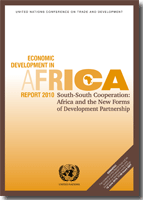
Making South-South Cooperation Work for Africa: Policy Recommendations

 South-South Cooperation  / AFRICA AND THE NEW FORM OF DEVELOPMENT PARTNERSHIP


 Economic Development in Africa Report 2010 - UNCTAD

Quick Links:
More on Africa-South cooperation:

Making South-South Cooperation Work for Africa / Policy Recommendations

---------Recommendations for African countries

* Mainstream South-South cooperation into national development strategies.

* African countries should adopt a well-defined strategy for South-South cooperation to ensure that it furthers rather than hinders the achievement of national and regional development goals. This means that South-South cooperation should be mainstreamed into national development strategies as well as efforts to promote regional cooperation within Africa.

* Take a proactive approach to the partnership process.

* A proactive approach by African governments and sharing of experiences with developing country partners will accelerate mutual policy learning, which should enhance the effectiveness of interactions for both parties.

* Ensure that cooperation with developing countries complements existing partnerships with developed countries.

* Developed countries have been and will continue to be important development partners for Africa. Consequently, it is important that the regions´ engagement with developing countries complements rather than substitutes for relations with traditional partners.

* Involve more local stakeholders in partnerships with the South.

* African governments should make efforts to get parliaments, the private sector and civil society more involved in the process, to ensure effective national ownership of the process and outcomes of the evolving partnerships.

* Strengthen efforts to develop productive capacities.

* African countries to achieve the average 7 per cent growth rate needed to meet the Millennium Development Goals, they have to promote public and private investment, structural transformation and the development of productive capacities.

* Play a more active role in coordination of support from partners.

* African countries to play a more active role in the coordination of support from developing and developed countries to reduce transaction costs and increase the development impact.

* Avoid accumulation of unsustainable debt.

* African countries to pay more attention to the structure as well as management of external debt to avoid a debt crisis.

* Adopt a developmental approach in seeking foreign direct investment.

The focus of African countries should be on creating linkages between FDI and the domestic economy and also directing it to sectors where it can catalyze domestic investment, create employment, spur regional integration and boost productive capacity.


---------Recommendations for developing country partners

* Broaden the scope of engagement to include sectors other than the extractive industries.

* Developing countries´ engagement in Africa is that their trade and, to a lesser extent, investment activities are heavily concentrated in the natural resource sector. Developing country partners to use their resource flow to enhance technology transfer and technological learning between African countries and other developing countries.

----------Strengthen support for regional integration in Africa.
It would be desirable for developing country partners to provide more support for regional projects as an important step towards developing regional markets and laying the foundation for a sustainable and mutually beneficial relationship with the region.

* Enlarge country coverage to facilitate South-South trade and ensure that the gains are more evenly distributed across countries.

* Developing country partners to explore ways and means to involve more countries, particularly the LDCs, in their partnerships with the region.

* Provide more information on development activities in the region.

* Developing country partners to increase transparency in their development cooperation with Africa as an important step towards improving accountability and establishing a sustainable relationship with the region.

------Ensure that projects have positive impact on the environment.

* Developing country partners to pay more attention to the environmental consequences of their activities in Africa.

* Address the transactions costs associated with the multiplicity of partnership initiatives.

* Developing country partners to coordinate and consolidate these initiatives to reduce participation costs for Africa for better development results.

 ------Recommendations for developed country partners

* Provide more support for Africa-South cooperation.

* Traditional development partners increasingly provide support for Africa-South cooperation by financing triangular cooperation activities. Africa´s traditional partners to resist any pressures that may arise to reduce financing for triangular cooperation projects in response to the global economic slowdown.

* Strengthen dialogue with Southern partners.

* Traditional partners to strengthen dialogue with developing country partners to enhance coordination and sharing of experiences and best practices.

 -------Recommendations for regional and multilateral institutions

* Coordinate the development of statistics and collection of information on Africa-South cooperation.

* Provide more support to research on the impact and sustainability of developing countries´ activities in Africa.

* Establish financing facilities for Africa-South cooperation.

* Regional and multilateral finance institutions to make more resources available for support of South-South cooperation projects.