Showing posts with label Day of Remembrance of the Victims of the Rwanda Genocide. Show all posts

Thursday, 9 April 2026

2026 International Day of Reflection on the 1994 Genocide Against the Tutsi in Rwanda; April 7th.


Thirty-two years ago, Rwanda endured one of the darkest chapters in human history. In just 100 days, more than a million people were murdered – primarily Tutsi, but also Hutu and others who opposed the genocide. Entire families were brutally erased.


On the International Day of Reflection on the 1994 Genocide Against the Tutsi in Rwanda, we mourn the victims and honour their stolen dignity. We pay tribute to the survivors, whose resilience shows the strength of the human spirit. And we recall, with humility and shame, the international community’s failure to heed warnings and take immediate lifesaving action.


It’s not enough to remember the dead. We must learn from past failures and protect the living – by rejecting hatred, inflammatory rhetoric and incitement to violence; by investing in the social fabric to deepen community resilience; and by strengthening institutions that help prevent mass atrocities. I call on all countries to become parties to the Genocide Convention without delay – and to implement it fully.

The United Nations stands with the people of Rwanda. And we stand with all those, everywhere, who refuse to surrender our future to fear, division, or silence.


Let this day reaffirm our commitment to remember, to listen, and to act. With history as our guide, and the prevention of genocide as our goal.

U.N. Secretary General.

On April 9th at the United Nations Office at Vienna (UNOV); Starting at 14:45 PM GMT, The Commemorative ceremony to mark the International Day of Reflection on the 1994 Genocide Against the Tutsi in Rwanda.

On April 7th, Starting at 09:00 AM GMT; The Director-General of UNON in collaboration with the Rwanda High Commission will be leading to mark the 32nd Anniversary of International Day of Reflection on the 1994 Genocide against the Tutsi in Rwanda.

Watch the 32nd Anniversary of The International Day of Reflection on the 1994 Genocide against the Tutsi in Rwanda!


01:55:29 - Meetings & Events.


On April 7th; Starting at 16:00 PM EST; The Memorial Ceremony to commemorate the International Day of Reflection on the 1994 Genocide Against the Tutsi in Rwanda, organized by the Department of Global Communications and the Permanent Mission of Rwanda to the United Nations.

Watch the International Day of Reflection on the 1994 Genocide Against the Tutsi in Rwanda - Annual Commemoration!


On Tuesday, 7 April 2026, at 10:00 a.m. EDT in the General Assembly Hall, United Nations Headquarters. 2026 marks the 32nd anniversary of the genocide against the Tutsi in Rwanda, one of the darkest chapters in human history. More than one million people - overwhelmingly Tutsi, but also Hutu and others who opposed the genocide - were systematically killed in less than three months. On this Day, we honour those who were murdered and reflect on the suffering of those who survived. The Department of Global Communications in cooperation with the Permanent Mission of Rwanda to the United Nations, will hold a ceremony to commemorate the International Day of Reflection on the 1994 Genocide Against the Tutsi in Rwanda. Ms. Melissa Fleming, United Nations Under-Secretary-General for Global Communications will host the proceedings. Speakers will include the Chef de Cabinet, the President of the General Assembly, a representative of the African Union and the Minister of Justice and Attorney General of the Republic of Rwanda. The commemoration will also feature remarks by the President of Ibuka USA, testimony of a genocide survivor, the lighting of memorial candles and musical elements.

Related Sites and Documents: Website & Programme (pdf)01:25:32 High-level Events


On April 7th, starting at 16:00 PM EST, the United Nations Office at Geneva will commemorate the International Day of Reflection on the 1994 Genocide against the Tutsi in Rwanda, which was established by the United Nations General Assembly in 2003. The United Nations Office at Geneva will commemorate the International Day of Reflection on the 1994 Genocide against the Tutsi in Rwanda, which was established by the United Nations General Assembly in 2003. 7 April marks the beginning of the genocide perpetrated against members of the Tutsi minority by the Hutu extremist-led government. Within just over 100 days, more than 1 million Tutsi were systematically murdered. Moderate Hutu and others who opposed the massacres were also killed during this period.

Saturday, 6 April 2024

International Day of Reflection on the Genocide against the Tutsi in Rwanda 2024; April 7th.

FORUM: “Remember-Unite-Renew.” International Day of Reflection on the Genocide against the Tutsi in Rwanda 2024.


Mr. President of the General Assembly,
Honorable Ministers,
Excellencies, ladies and gentlemen,

The genocide against the Tutsi in Rwanda 30 years ago is a stain on our collective consciousness and a brutal reminder of the legacy of colonialism, and the consequences of hate speech.

Over the course of 100 days, one million people were killed.

The vast majority were Tutsi, but also Hutu and others who opposed the genocide.

Neighbours turned on neighbours.

Friends became murderous foes.

Entire families were wiped out.

The carnage was driven by an explicit intent to destroy members of a group simply because of their ethnic identity.

These 100 days reflected the worst of humanity.

But the aftermath revealed the best of the human spirit: resilience, reconciliation, courage and strength.

The survivors’ stories stand as a testament to the power of hope and forgiveness.

People like Laurence Niyonangira, a survivor of the genocide who lost 37 relatives in 1994.

She chose to forgive one of those responsible for the slaughter of her family after he confessed and served time in prison for his crimes.

“As survivors,” Laurence said, “we can only heal our wounds with the people who created them.”

Her powerful story, and others like it, are part of the exhibits on display for this event reminding us of the imperative of forgiveness, reconciliation, and justice.

Excellencies,

This year, we focus on the rancid root of all genocides — hatred.

Genocides culminate in mass violence and death.

But they start with the weapon of words.

The genocide in Rwanda was fuelled by decades of hate speech targeting the Tutsi.

Three decades later, the verbal violence of hate speech is still all around us.

Nowadays, divisive and dangerous ideologies are delivered through the global megaphone of social media.

But the vile messages remain all-too-familiar.

Racism, misogyny, lies, anti-Semitism, anti-Muslim bigotry, stigmatization, discrimination and the outright denial — or even glorification — of past genocides, including the Holocaust and genocide against the Tutsis.

The global community must stand as one against this torrent of hate speech, and denounce it wherever it’s found.

We must also stand together in a renewed global push to ratify and fully implement the Convention on the Prevention and Punishment of the Crime of Genocide, while strengthening prevention mechanisms, educating new generations about past genocides, and countering the mis- and disinformation that fuels hate speech and genocidal intent and action.

Excellencies, ladies and gentlemen,

I want to convey a special message to the young people from Rwanda joining us today here and online.

Dear friends,

We will never forget the horrors of those terrible 100 days.

But we need your help.

We need your voice and your activism to keep alive the memory of those who were killed.

And to call out hatred wherever you hear or see it.

In your cities, towns, and neighbourhoods. In your schools. Online. Anywhere and everywhere.

Let’s all push back against hatred and intolerance, wherever we find it.

May the memory of the victims spur our actions, and inspire our commitment to ensure a better, safer world for all people.

The United Nations will always stand with you in this important effort.

Thank you.

António Guterres.


EVENTS: 30th Commemoration of the 1994 Genocide against the Tutsi in Rwanda (Kwibuka30) : The AUC/PAPS of the Agrican Union, in collaboration with the RwandainAddis, commemorates the 1994 genocide against the Tutsi in Rwanda as #Kwibuka30, under the theme: “Remember-Unite-Renew” at the AUHQ


The International conference kwibuka30 at the Kigali Memorial Center on April 7th 2024 marks the start of Kwibuka 30, the 30th commemoration of the Genocide against the Tutsi.


The Kigali Genocide Memorial commemorates the 1994 Rwandan genocide. The remains of over 250,000 people are interred there. There is a visitor centre for students and others wishing to understand the events leading up to the genocide that occurred in Rwanda in 1994.


Special Event- Kwibuka 30


Memorial Ceremony to mark the 30th anniversary of the 1994 Genocide against the Tutsi in Rwanda, organized by the Department of Global Communications and the Permanent Mission of Rwanda to the United Nations.

12 April 2024 | UN General Assembly Hall | 10:00 a.m. to 11 a.m.

Commemorative activities 
- Moment of silence, candle lighting ceremony -Video honoring Kwibuka 30 - Testimony from Mr. Claver Irakoze, song writer, author of That Child is Me and Transmitting Memories in Rwanda, Founder of Umurage 

Special message from Rwandan children 
- H.E. Mr. António Guterres, UN Secretary-General 
- H.E. Mr. Dennis Francis, President of the 78th session of the General Assembly 
- H.E. Ambassador Ernest Rwamucyo, Permanent Representative of Rwanda to the UN
- H.E. Ambassador Fatima Kyari Mohammed, Permanent Observer of the African Union to the UN 
- Honorable Dr. Jean Damascene Bizimana, Minister of National Unity and Civic Engagement

Master of Ceremonies: Ms. Melissa Fleming, Under-Secretary General for Global Communications Music by the United Nations Staff Recreation Council Symphony Orchestra


2024 Commemoration of the International Day of Reflection on the 1994 Genocide against the Tutsi in Rwanda - United Nations General Assembly. Get the agenda programme!

Wednesday, 6 April 2022

International Day of Reflection on the 1994 Genocide in Rwanda 2022; April 7th.

On 7 April, let's commemorate the International Day of Reflection on the 1994 Genocide against the Tutsi in Rwanda. 

FORUM: Kwibuka28 Commemoration. Join the conversation with the hashtags  #Kwibuka28.


WEBINARS
: The Embassy of the Republic of Rwanda in Washington D.C., in collaboration with the Rwandan Community in the United States, Friends of Rwanda, Ibuka-US and other partners joined efforts to organize Kwibuka 28 event in Washington DC. Kwibuka 28 in Washington, D.C. USA.


EVENTS

PUBLIC LECTURES


Rwanda has faced war and migration since 1959, and genocide against the Tutsi in 1994. Currently Rwanda is inhabited by native groups, people who have migrated from other countries, and migrated Congolese people who have received nationality. The Batwa or “Abasigajwe inyuma n’amateka”, literally translated as those who were neglected by history, form an isolated and marginalized group in Rwandan society. Batwa are widely stigmatized, the Impunyu above all. Taboos surround eating together or even using utensils used by Batwa.

Batwa tradition is rich in song, dance and music. Dance, instinctively arising from music, is one of the most spectacular expressions of the Rwandan culture. The IDARC project (Intercultural Dialogue Awareness Rising for Cooperation) uses dance to play an important role in civil, economic and social life of the Rwandans. Further, the IDARC project promotes freedom of speech and thought by creating an intercultural dialogue space for peace and development in Rwanda. This project solves two problems; it enables the marginalized ethnic group to express their thoughts and ideas through sharing their culture to the cultural lives of other Rwandans and it promotes understanding and cooperation among Rwandan citizens.

Monday, 7 April 2014

International Day of Reflection on the Genocide in Rwanda - April 7, 2014.


The start date of the 1994 genocide in Rwanda, 7 April, has been designated by the UN General Assembly as the International Day of Reflection on the Genocide in Rwanda. On or around that date, the UN organizing or participating in commemorative events in many countries this year, including in Armenia, Bangladesh, Belgium, Burkina Faso, Burundi, Colombia, Congo, Czech Republic, India, Indonesia, Iran, Italy, Kenya, Madagascar, Mexico, Morocco, Nigeria, Poland, Russia, Senegal, South Africa, Tanzania and Zambia.

The memorial ceremony at UN Headquarters in New York will take place on 16 April, at 6:15 p.m. It will be webcast live at webtv.un.org. The memorial ceremony will be followed by the opening of an exhibit organized by the Government of Rwanda in the UN Visitors Centre.


Kwibuka 20 - Commemoration ceremony at the Amahoro National Stadium (Kigali, Rwanda).
7 Apr 2014 - Kwibuka 20 - Commemoration ceremony marking the 20th anniversary of the Rwandan genocide at the Kigali’s National Stadium Amahoro (“peace”) where, in 1994, thousands of Rwandans found refuge.


President Kagame to light flame in memory of victims of 1994 massacres amid fresh diplomatic row with France.


A torch commemorating the 20th anniversary of the Rwandan genocide in which 800,000 died is to be lighted in the capital Kigali, amid renewed claims of France being complicit in the killings.
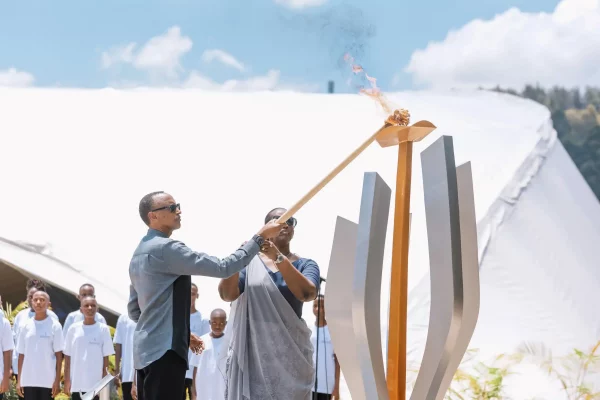
A flame of remembrance touring the small nation from village to village will arrive at the national genocide memorial on Monday.

President Paul Kagame will light the torch that will burn for 100 days, the length of time it took government soldiers and Hutu militia to kill hundreds of thousands of people, largely Tutsis, in 1994.

People everywhere should place themselves in the shoes of the vulnerable, and ask themselves what more they can do to build a world of human rights and dignity for all.
Ban Ki-Moon, UN Secretary General 

Custodians of the memorial said it contains the bones of a quarter of a million people killed in massacres of brutal intensity, now carefully stored in vast concrete tombs.

Wreathes will also be laid, before ceremonies in Kigali's football stadium, where UN Secretary General Ban Ki-moon and several African leaders are due to attend.

But the commemorations have been overshadowed by a furious diplomatic row with France, which is now sending its ambassador in Kigali to attend the ceremonies, instead of a top level delegation.
The French government initially announced that it was pulling out of the events after Kagame again accused France, an ally of the Hutu nationalist government prior to the 1994 killings, of aiding the murder of 800,000 ethnic Tutsis.

Speaking to the weekly Jeune Afrique, Kagame denounced the "direct role of Belgium and France in the political preparation for the genocide", and said French soldiers were both accomplices and "actors" in the bloodbath.
Paris has repeatedly denied the accusations and insisted that French forces had striven to protect civilians.
Former colonial power Belgium, which unlike France has apologised to Rwanda for failing to prevent the genocide, has sent a senior delegation for the commemorations.

Ban Ki-moon, Commemoration of the 20th anniversary of the Rwandan genocide (Kigali, Rwanda)
7 Apr 2014 - Remarks by United Nations Secretary-General Ban Ki-moon at the commemoration ceremony marking the 20th anniversary of the Rwandan genocide (Kwibuka 20), Kigali, Rwanda


10,000 killed everyday

The UN chief has said the commemorations were a chance to remind the world to do all it can to ensure such crimes never happen again. The UN was heavily criticised in 1994 for not doing more to stop the killings.
"The scale of the brutality in Rwanda still shocks: an average of 10,000 deaths per day, day after day, for three months," Ban said in a statement ahead of commemorations.


He said the impact of the massacres are still being felt across an "arc of uncertainty in Africa's Great Lakes region - and in the collective conscience of the international community".
"People everywhere should place themselves in the shoes of the vulnerable, from Syria to the Central African Republic, and ask themselves what more they can do to build a world of human rights and dignity for all," Ban added.

US President Barack Obama also paid tribute to the victims, saying that the genocide was "neither an accident nor unavoidable".

"It was a deliberate and systematic effort by human beings to destroy other human beings," Obama said in a statement.
Many in Rwanda are remembering the victims in their own deeply personal and reflective way.
Rwanda's Red Cross has boosted its support staff for those hit hard by the memory of trauma.
The official "Kwibuka" mourning - meaning "remember" in Kinyarwanda - ends on July 4, Rwanda's liberation day.


7 billion Others - Day of Remembrance of the Victims of the Rwanda Genocide (07 April).
'They said that the Tutsis were bad, this is why we killed them'. Let’s commit to remember the more than 800,000 innocent people so brutally murdered, as we pay tribute to the bravery and resilience of the survivors.


Video portraits from Rwanda to celebrate the Day of Remembrance of the Victims of the Rwanda Genocide 2014. On selected days the United Nations Regional Information Centre for Western Europe, in partnership with the Good Planet Foundation, posts video clips from the 7 billion Others project to communicate the fears, dreams, ordeals and hopes of citizens from all over world.
Rwanda, 20 Years Later.

 April 7, 1994 marked the beginning of the Rwandan genocide. This massacre took place over the course of 100 days, killing almost 20% of the population. 20 years on from this brutal tragedy, Rwanda has transformed itself into a thriving nation with significant development gains. With the support of the UN, Rwanda is on track to achieving nearly all the Millennium Development Goals. Over a million people have been lifted out of extreme poverty. Economic growth has averaged 8% a year. Infant mortality is down 61%, while three quarters of the population now have access to drinking water. Following parliamentary elections last year, women make up 64% of MPs, the highest proportion in the world. So, while we must never forget and continue to honor the lives lost and the bravery of so many survivors. We can also use this commemoration to be inspired. A country, once consumed with violence, has shown the world that it can rebuild and reunite. (Photos: UNDP, UNICEF)