FORUM: "Designing a World without Nuclear Weapons" International Day for Disarmament and Non-Proliferation Awareness 2026. The observance seeks to promote better awareness and understanding of disarmament issues among the public, especially young people. Since the founding of the United Nations, the goals of multilateral disarmament and arms limitation have been central to the Organization’s efforts to maintain international peace and security. Weapons of mass destruction, in particular nuclear weapons, continue to be of primary concern, owing to their destructive power and the threat that they pose to humanity. The excessive accumulation in conventional weapons and the illicit trade in small arms and light weapons jeopardizes international peace and security and sustainable development, while the use of explosive weapons in populated areas is seriously endangering civilians. New and emerging weapon technologies, such as autonomous weapons, pose a challenge to global security and have received increased attention from the international community in recent years. Why Do You think disarmament is important?; Follow the conversation with the hashtags: #IDDNPA, #Disarmament, #disarmamentawarenessday, #5march, #nonproliferationawarenessday #VCS, #peaceandsecurity.

EVENTS: Find below the International Day for Disarmament and Non-Proliferation Awareness 2026 events open to the public, both hybrid and in-person events, along with the way to register.
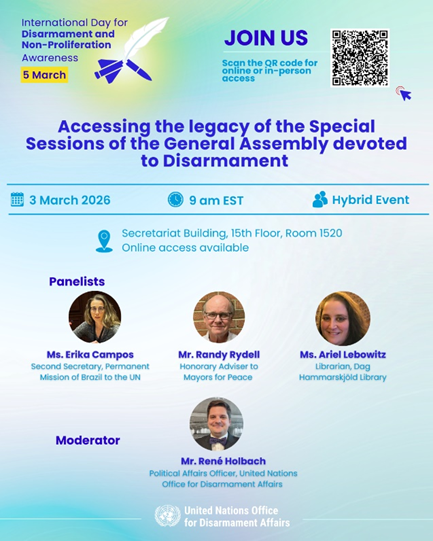
The United Nations General Assembly has held three Special Sessions on Disarmament (SSOD), which fundamentally shaped the disarmament architecture and the subsequent discussions within it. Despite repeated calls since 1995, including recently in the Pact for the Future, a fourth special session remains elusive. This event examines the lasting impact of these sessions and explores a critical question: can the international community overcome current divisions to convene SSOD-IV?
Implications of the Secretary-General’s Report on Military Expenditure for Asia and the Pacific.
Thursday, 5 March – 10:15am UTC +5:45 (Nepal Time) – Virtual Event
Register to participate!
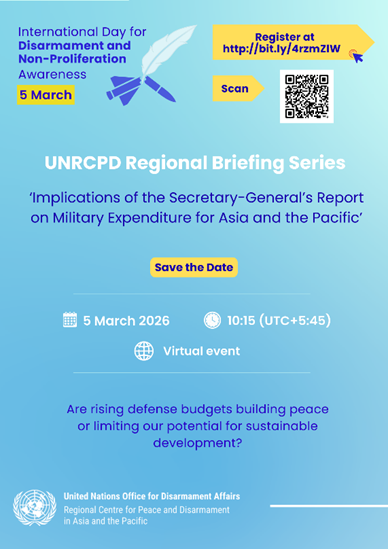
This virtual briefing will discuss the United Nations Secretary-General’s report on military expenditure, “The Security We Need: Rebalancing Military Spending for a Sustainable and Peaceful Future.” Participants will hear key findings from the report and learn from regional experts about what they mean for peace, security, and sustainable development in Asia and the Pacific. This briefing is the first session of UNRCPD’s 2026 regional briefing series and is open to a general audience, including academia, think tanks, civil society and youth, and interested members of the public.
More info: https://www.unrcpd.org/iddnpa1
On Thursday, from 5 March to 3PM EST - Launch of UNODA Occasional Paper No. 47 – Revisiting Consensus in Multilateral Disarmament Discussions: Trends, Challenges and the Way Forward.
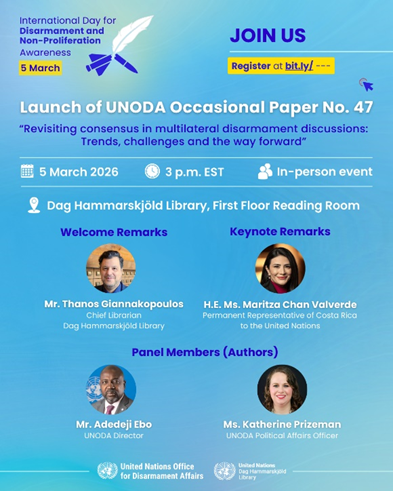
The Occasional Papers series was developed to give wider dissemination of input from expert panels and seminars, sponsored by the United Nations Office for Disarmament Affairs (UNODA). In this Occasional Paper, Adedeji Ebo (Director and Deputy to the High Representative for Disarmament Affairs) and Katherine Prizeman (Political Affairs Officer in UNODA's Science, Technology and International Security Unit) explore the role that consensus has played in specific, recent disarmament discussions and offer some recommendations on the way forward.
Read Occasional Paper No. 47 here.
Interactive Exhibit on Military Expenditure – Schwedenplatz, Vienna
Thursday, 5 March – Afternoon
In-person attendance at Schwedenplatz
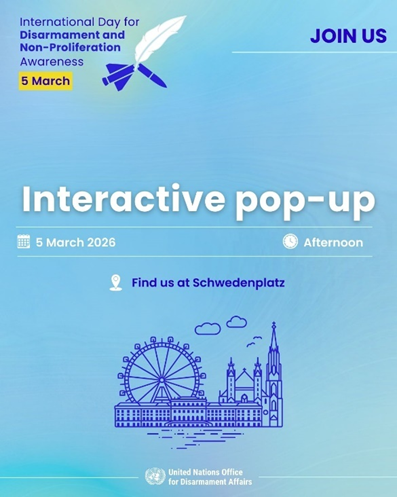
A second edition of the interactive “ballot-box” installation will take place at Schwedenplatz, in the afternoon, bringing the conversation beyond the United Nations and into the public square. Open to all, the exhibit invites participants to cast their ballots on where global spending priorities should lie.
Other events: We will also be hosting events targeted at the youth:
UN Regional Center for Peace and Disarmament in Africa (UNREC) Meets with Students from Togo
On 5 March, the UN Regional Center for Peace and Disarmament in Africa (UNREC) will convene with high school students from the Sacré-Coeur Avépozo Institute to discuss small arms and light weapons and autonomous weapons systems. This represents a key moment to mobilize Togolese youth against illicit arms proliferation and towards a safer future!
Follow along on X @odaunrec!
UN Office for Disarmament Affairs Meets with Students from Hiroshima, Japan
On the sideline of the International Day for Disarmament and Non-Proliferation Awareness, on 6 March, UNODA will convene with high school students from Hiroshima to discuss the Office’s work. Youth lead the way in advancing disarmament and peacebuilding efforts!
*A VIC Grounds Pass is required to attend this event.
Suzuka Nakamura, a Japanese peace activist and third‑generation hibakusha (atomic bomb survivors) from Nagasaki, has been advocating for a world free of nuclear weapons since high school. Selected as one of the UN Youth Office's 17 Young Leaders for the Sustainable Development Goals (SDGs) for 2025-2027, she is now determined to create a mobile atomic bomb museum as a new way to bring the urgent call for nuclear disarmament to communities across the world.
Our dream of peace is in peril.
The threat of nuclear weapons use is the highest in decades. Global tensions are pushing military spending to stratospheric levels. Small arms and light weapons are proliferating. And emerging technologies are making conflicts even deadlier.
We must lower the temperature. On this International Day for Disarmament and Non-Proliferation Awareness, I urge leaders to step back from the brink. Stop rattling the nuclear saber. Halt the arms races.
It’s time to invest in the architecture of peace, not the tools of war. That means living up to disarmament obligations. Rebuilding trust. And strengthening the systems and tools that prevent the proliferation, testing and use of deadly weapons.
Together, we can prevent catastrophes and ensure a safe and peaceful world for all.
António Guterres, United Nations Secretary-General.
EVENTS: Find below the International Day for Disarmament and Non-Proliferation Awareness 2026 events open to the public, both hybrid and in-person events, along with the way to register.
In-person attendance in the Rotunda of the UN Vienna International Centre*
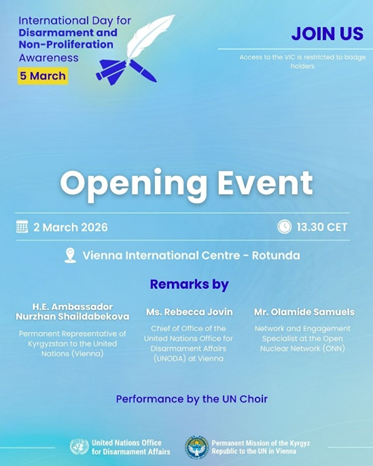
From 2 to 6 March, the Rotunda of the Vienna International Centre (VIC) will host an interactive “ballot-box” installation inviting visitors to cast their vote on global spending priorities. With global military expenditures having reached a record of $2.7 trillion in 2024, this installation creates a space to reflect on how resources are allocated — and how they could be redirected toward sectors such as education, health and climate action. The installation will open on 2 March at 1:30 PM CET with welcoming remarks by the Permanent Representative of Kyrgyzstan, the Chief of the UNODA Vienna Office and Olamide Samuels (ONN), followed by a performance by the UN Choir and a reception.
Accessing the legacy of the Special Sessions of the General Assembly devoted to Disarmament.
Tuesday, 3 March 2026, starting at 9am EST.
Hybrid event with in-person attendance on the 15th Floor of the Secretariat Building, Room 1520**.
Register to participate!
From 2 to 6 March, the Rotunda of the Vienna International Centre (VIC) will host an interactive “ballot-box” installation inviting visitors to cast their vote on global spending priorities. With global military expenditures having reached a record of $2.7 trillion in 2024, this installation creates a space to reflect on how resources are allocated — and how they could be redirected toward sectors such as education, health and climate action. The installation will open on 2 March at 1:30 PM CET with welcoming remarks by the Permanent Representative of Kyrgyzstan, the Chief of the UNODA Vienna Office and Olamide Samuels (ONN), followed by a performance by the UN Choir and a reception.
Accessing the legacy of the Special Sessions of the General Assembly devoted to Disarmament.
Tuesday, 3 March 2026, starting at 9am EST.
Hybrid event with in-person attendance on the 15th Floor of the Secretariat Building, Room 1520**.
Register to participate!
The United Nations General Assembly has held three Special Sessions on Disarmament (SSOD), which fundamentally shaped the disarmament architecture and the subsequent discussions within it. Despite repeated calls since 1995, including recently in the Pact for the Future, a fourth special session remains elusive. This event examines the lasting impact of these sessions and explores a critical question: can the international community overcome current divisions to convene SSOD-IV?
Implications of the Secretary-General’s Report on Military Expenditure for Asia and the Pacific.
Thursday, 5 March – 10:15am UTC +5:45 (Nepal Time) – Virtual Event
Register to participate!
This virtual briefing will discuss the United Nations Secretary-General’s report on military expenditure, “The Security We Need: Rebalancing Military Spending for a Sustainable and Peaceful Future.” Participants will hear key findings from the report and learn from regional experts about what they mean for peace, security, and sustainable development in Asia and the Pacific. This briefing is the first session of UNRCPD’s 2026 regional briefing series and is open to a general audience, including academia, think tanks, civil society and youth, and interested members of the public.
More info: https://www.unrcpd.org/iddnpa1
On Thursday, from 5 March to 3PM EST - Launch of UNODA Occasional Paper No. 47 – Revisiting Consensus in Multilateral Disarmament Discussions: Trends, Challenges and the Way Forward.
In-Person attendance in the First Floor Reading Room of the Dag Hammarskjöld Library*
Registration to participate!
Registration to participate!
The Occasional Papers series was developed to give wider dissemination of input from expert panels and seminars, sponsored by the United Nations Office for Disarmament Affairs (UNODA). In this Occasional Paper, Adedeji Ebo (Director and Deputy to the High Representative for Disarmament Affairs) and Katherine Prizeman (Political Affairs Officer in UNODA's Science, Technology and International Security Unit) explore the role that consensus has played in specific, recent disarmament discussions and offer some recommendations on the way forward.
Read Occasional Paper No. 47 here.
Interactive Exhibit on Military Expenditure – Schwedenplatz, Vienna
Thursday, 5 March – Afternoon
In-person attendance at Schwedenplatz
A second edition of the interactive “ballot-box” installation will take place at Schwedenplatz, in the afternoon, bringing the conversation beyond the United Nations and into the public square. Open to all, the exhibit invites participants to cast their ballots on where global spending priorities should lie.
Other events: We will also be hosting events targeted at the youth:
UN Regional Center for Peace and Disarmament in Africa (UNREC) Meets with Students from Togo
On 5 March, the UN Regional Center for Peace and Disarmament in Africa (UNREC) will convene with high school students from the Sacré-Coeur Avépozo Institute to discuss small arms and light weapons and autonomous weapons systems. This represents a key moment to mobilize Togolese youth against illicit arms proliferation and towards a safer future!
Follow along on X @odaunrec!
UN Office for Disarmament Affairs Meets with Students from Hiroshima, Japan
On the sideline of the International Day for Disarmament and Non-Proliferation Awareness, on 6 March, UNODA will convene with high school students from Hiroshima to discuss the Office’s work. Youth lead the way in advancing disarmament and peacebuilding efforts!
*A VIC Grounds Pass is required to attend this event.
**A UNHQ Grounds Pass is required to attend this event
Story from a young peace activist.


