Showing posts with label Disaster Preparedness. Show all posts

Sunday, 13 October 2024

International Day for Disaster Risk Reduction 2024; October 13th.

International Day for Disaster Risk Reduction 2024


FORUM: “Empowering the next generation for a resilient future.International Day for Disaster Risk Reduction 2024. Increasing disasters, many of them driven and exacerbated by climate change, threaten the well-being of children and youth. According to UNICEF, approximately one billion children worldwide are at extremely high risk due to climate impacts, including climate-related disasters. In 2022, the number of children affected by flooding in Chad, Gambia, Pakistan and Bangladesh was the highest in over 30 years . Beyond the risk of death and injury, children in the aftermath of a disaster face cascading impacts such as disruptions in schooling, nutrition, and healthcare and protection issues. To protect children from disasters, countries must consider their vulnerabilities and needs when designing national and local disaster risk reduction strategies. It is equally important that children and youth be empowered and provided “the space and modalities to contribute to disaster risk reduction,” as called for in the Sendai Framework for Disaster Risk Reduction 2015-2030. This also aligns with the calls to action of the Political Declaration of the Midterm Review of the Sendai Framework, which called for “the full, equal, meaningful and inclusive participation” of youth and the promotion of "a culture of disaster prevention.” Empowering children, especially through education, can enable them to protect themselves and to become agents of change in their families and communities by sharing what they learned. This is particularly relevant in the context of the global push to expand early warning systems under the UN Secretary-General’s Early Warnings for All initiative. To achieve the goal of the Sendai Framework of reducing global disaster risks and losses, the theme of the International Day for Disaster Risk Reduction (IDDRR) 2024, which falls on 13 October, will highlight the role of education in protecting and empowering youth for a disaster-free future. The theme is aligned with the Summit of the Future, planned for September 2024, where ‘youth and future generations’ will be one of its five priorities. The observance of the International Day for Disaster Risk Reduction 2024 calls on countries to harness the education sector to reduce the disaster risks of school-aged children, especially by investing in two key areas: 1. Protect children and youth through safe schools and education facilities: children are entitled to be safe in their schools and this starts with ensuring schools are disaster-resilient and are part of disaster early warning systems. 2. Empower children and youth to be safe through age-appropriate education to understand and act on the risks they face. This includes building their preparedness to take early action in response to early warnings. Empowered children become agents of change for more resilient communities. 3. Endorse and implement the Comprehensive School Safety Framework 2022-2030 , developed by the Global Alliance for Disaster Risk Reduction and Resilience in the Education Sector (GADRRRES), which is chaired by UNESCO and UNICEF. Follow the conversation with the hashtags: #ResilienceForAll, #DRRday, #13October, #SendaiFramework, #DisasterRiskReduction, #AreYouReady24, #SafeChildrenSafeSchools.

Empowering the next generation for a resilient future.


EVENTS: On October 13th, a webinar will be held to mark the International Day for Disaster Risk Reduction 2024. Partners are encouraged to publish and share success stories around the calls to action. Examples include: • Publicizing national endorsements of the Comprehensive School Safety Framework. • The retrofitting or construction of schools to be resilient to disasters. • Insertion of disaster risk reduction and climate change adaptation in school curricula. • School-organized disaster evacuation drills. • Creation of engaging learning materials and activities, such as cartoons, comics, competitions, songs or films, aimed at educating children about disaster risks. • Teacher-led demonstrations of the UNDRR-created ‘Stop Disasters’ video game.Get the list of Upcoming events!

Activities for kids: See the latest materials including children's books, textbooks, lesson plans, activities, games, and online resources on disaster prevention and school safety. Explore materials!

Colouring Pages: These colouring pages can be printed and used in pedagogical activities with children to raise awareness on disaster preparedness. Print and color!

Interactive maps: Explore the most Significant Disasters, Earthquakes, Tsunamis, and Tropical Storms!


PUBLICATION: This guide “Engaging Children and Youth in Disaster Risk Reduction in Resilience Building.” offers specific advice on implementing a feasible, people-centered approach to supporting and engaging children in disaster risk reduction and resilience-building. Read the guide!

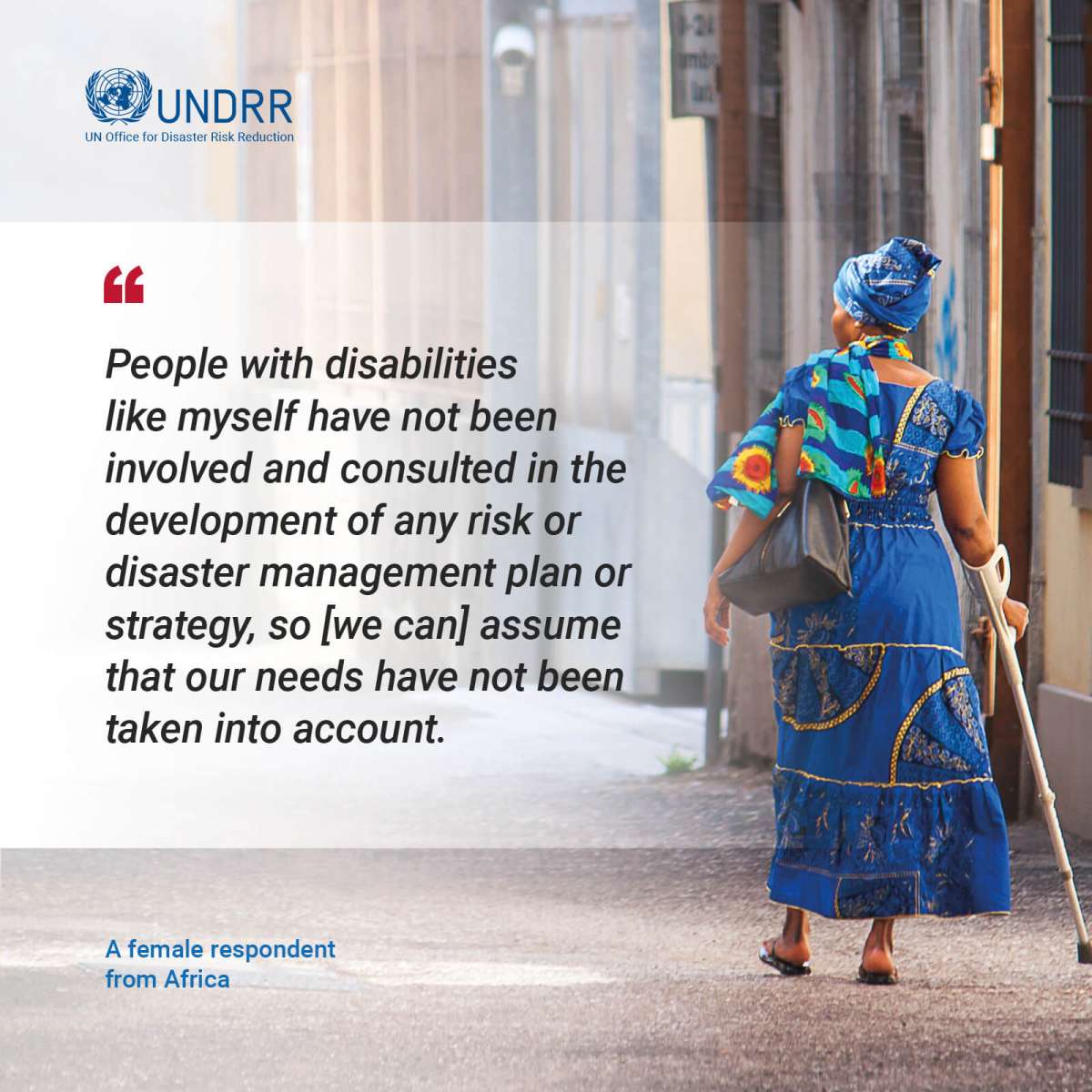
The UNDRR has released the results of the 2023 Global Survey on Persons with Disabilities and Disasters, which is the first global look at how persons with disabilities perceive current national and local disaster risk reduction measures since 2013.

STATEMENTS


Climate disasters are hurting countries and economies like never before.

Ever-rising greenhouse gas emissions are supercharging extreme weather events across the planet.

I saw first-hand the devastation unleashed by the recent floods in Pakistan.

These increasing calamities cost lives and hundreds of billions of dollars in loss and damage.

Three times more people are displaced by climate disasters than war.

Half of humanity is already in the danger zone.

The world is failing to invest in protecting the lives and livelihoods of those on the front line.

Those who have done the least to cause the climate crisis are paying the highest price.

Entire populations are being blindsided by cascading climate disasters without any means of prior alert.

People need adequate warning to prepare for extreme weather events.

That is why I am calling for universal early warning coverage in the next five years.

Early warning systems – and the ability to act on them – are proven life-savers.

This is shown clearly by a new report today from the World Meteorological Organization and United Nations Office of Disaster Risk Reduction.

The report reveals that such services are woefully lacking for those who need them most.

At the COP27 climate conference in Egypt, I will launch an action plan to provide early warning systems for all within five years.

I urge all governments, international financial institutions and civil society to support it.

This new report is yet another reminder that real and concrete action on loss and damage must be global priority.

Delivering on loss and damage at COP27 will be an important litmus test for rebuilding trust between developed and developing countries.

On this International Day for Disaster Risk Reduction, I call on all countries to invest in early warning systems and support those who lack capacity.

Extreme weather events will happen.

But they do not need to become deadly disasters.

UN Secretary-General António Guterres.


For this year's International Day for Disaster Risk Reduction, we are calling on countries to do more to protect and empower children and youth through education.

First, we have to ensure that every single school that is built - in our efforts to achieve universal education - every single school that is built has to be built in a manner that it can withstand disasters that are likely to occur in the areas that they are built. And where we already have schools, we have to begin to retrofit them so that they can withstand the hazards that they are exposed to.

The second ask we have is that all children must have access to the best possible information and knowledge on different aspects of disaster risk management.

They should be aware of the hazards that they are exposed to.They should be fully equipped with knowledge to deal with those hazards to keep themselves safe in the face of those hazards and take this message home to their families as well so that they can challenge their parents.

They can challenge their elder ones.To invest in resilience, to be aware of the risks that they are exposed to and to take necessary steps.

The third ask we have is that all countries endorse the Comprehensive School Safety Framework 2022 to 2030, which supports the implementation of the Sendai Framework for Disaster Risk Reduction.I would like all countries to sign off on that program and make sure that by 2030 we have 100% coverage in terms of school safety across the world if we do that, we will be really acting with a sense of responsibility towards ourselves, towards our society and towards our future generations.

UNDRR head Mr. Kamal Kishore.


LIVESTREAM: GAR Special Report 2024 - The Disaster Forensic Approach.


Thursday, 12 October 2023

International Day for Disaster Risk Reduction 2023; October 13th.


FORUM:
Fighting inequality for a resilient future. International Day for Disaster Risk Reduction 2023. The 2023 edition takes place shortly after the Midterm Review of the Sendai Framework for Disaster Risk Reduction 2015-2030, where the United Nations General Assembly in May 2023 adopted a political declaration to accelerate action to strengthen disaster resilience. The Day’s theme aligns with the Sendai Framework, the international agreement to prevent and reduce losses in lives, livelihoods, economies and basic infrastructure. It has seven global targets and 38 indicators for measuring progress. The Sendai Framework complements the Paris Agreement on climate change, with both frameworks interlinked to achieve the Sustainable Development Goals. In 2023, the International Day will look at the reciprocal relationship between disasters and inequality. Inequality and disaster vulnerability are two sides of the same coin: unequal access to services, such as finance and insurance, leaves the most at risk exposed to the danger of disasters; while disaster impacts exacerbate inequalities and push the most at risk further into poverty. How are YOU fighting inequality for a resilient future?;Follow the conversation with the hashtags: #ResilienceForAll, #BreakTheCycle, #DRRday, #13October,#SendaiFramework, #DisasterRiskReduction.


EVENTS: Launch of the 2023 Global Survey on Persons with Disabilities and Disasters during the observance of the International Day for Disaster Risk Reduction 2023 on October 13th. Disasters impact everyone but have a disproportionate impact on persons with disabilities – not because of individual impairments but society’s barriers. That is why UNDRR has been championing disability inclusion since before the adoption of the Sendai Framework when it commissioned the first global survey on disability and disasters in 2013. The results of an updated survey, will be published to show what progress has been made and what barriers remain. Participate in an event, promote one, or join the conversation on fighting inequality for a resilient future. Get the list of Upcoming Events!


STATEMENTS: 


2023 has shattered temperature records, and seen record drought, fire and floods around the world. Poverty and inequality are exacerbating these disasters.

Those with least are often at greatest risk from extreme weather. They may live in places that are more susceptible to flooding and drought; and they have fewer resources to deal with damage and to recover from it. They suffer disproportionately as a result, and may be pushed further into poverty.

Fighting inequality for a resilient future, is the theme of this year’s International Day for Disaster Risk Reduction. Countries must work to break the cycle of poverty and disaster by honouring the Paris Agreement, striving to achieve the Sustainable Development Goals and implementing the Sendai Framework for Disaster Risk Reduction.

We must also tackle inequality at the global level, by operationalizing the Loss and Damage Fund at COP28 [twenty-eighth session of the Conference of the Parties to the United Nations Framework Convention on Climate Change] this year and ensuring that every person on Earth is covered by an early warning system by 2027.

This International Day for Disaster Risk Reduction let us reaffirm our commitment to investing in resilience and adaptation, and building a safe and just future for everyone, everywhere.

United Nations Secretary-General.


90% of climate-related deaths occur in poorer countries. Even in wealthier countries, the majority of disaster victims are the poorest and those already facing social and economic inequality.

In the shocking findings of our disability survey, launched today, 84% of persons with disabilities feel they are unprepared to respond in the event of a disaster.

Inequality, in all its forms, is a major driver of disaster risk. That is because poverty and inequality create the conditions that force communities to live in hazardous areas, with weak infrastructure and housing. Inequality inhibits access to information, services and warnings.

And after a disaster, it takes vulnerable communities much longer to recover and people are often driven further into poverty. We must break this cycle of inequality, disaster, repeat.

On the 2023 International Day for Disaster Risk Reduction we say: “No more”. No more inequality. No more leaving people behind. No more climate injustice. No one is safe from the threat of disasters, until everyone is safe.

This means countries must urgently prioritise the roll out of inclusive, multi-hazard early warning systems so that everyone, regardless of where they are, is protected and prepared.

It also means adequately funding disaster risk reduction, whether that is through international assistance, public or private investment, and prioritising developing countries to help them avoid disasters.

By supporting the poorest and most vulnerable countries and taking care of the most at-risk within all countries, we can ensure no one is left behind and empower people to prosper with equality and resilience.

With the right decisions and actions now, we can protect every life from disasters.

We can and we must.

Thank you.

UNDRR Director general.


KEY MESSAGES
  • Poverty, inequality and discrimination are causes and consequences of growing disaster risk.
  •  Inequality creates the conditions that render people exposed and vulnerable to disasters. Disasters also disproportionately impact the poorest and most at risk people, thus worsening inequality. Reducing vulnerability to disasters requires addressing these dimensions.
  • By 2030, with current climate projections, the world will face some 560 disasters per year. An additional estimated 37.6 million people will be living in conditions of extreme poverty due to the impacts of climate change and disasters by 2030. A “worst case” scenario of climate change and disasters will push an additional 100.7 million into poverty by 2030.
  • We can curb the destructive power of hazards—in other words, stop them from turning into disasters—through careful and coordinated planning that is designed to reduce people’s exposure and vulnerability to harm. 
  • Greater investments are needed in the collection and use of disaggregated data, both to better understand disproportionate disaster impacts and exposure, and to inform resilience-building plans.
HOW TO GET INVOLVED:
  • We must break the cycle of disaster > growing inequality > repeat. 
  • We can curb the destructive power of hazards—in other words, stop them from turning into disasters—through careful and coordinated planning that is designed to reduce people’s exposure and vulnerability to harm. 
  • We must accelerate the implementation of the Early Warnings for All initiative to ensure everyone on earth is covered by early warnings in the next four years, prioritizing the most at-risk communities
  • Greater investments are needed in the collection and use of disaggregated data, both to better understand disproportionate disaster impacts and exposure, and to
  • Member States must prioritise their commitments to achieving the Sendai Framework and SDGs, especially the reduction of poverty and inequality, while urgently addressing disaster risk and vulnerability with a focus on the most vulnerable communities 
  • Global decision makers must make our financial system fit for purpose in delivering finance for the most climate-vulnerable countries. 
  • We need to deliver economic resilience for the most at risk from disastersCountries must engage, build capacity and empower groups in all DRR decision making processes. 
  • Countries must ensure that the most at risk, including women, older persons and persons with disabilities are meaningfully included.

Saturday, 14 March 2015

Focus on The Third UN World Conference on Disaster Risk Reduction (3rdWCDRR)


Third UN World Conference on Disaster risk reduction ; ‪#‎WCDRR


The Third UN World Conference on Disaster Risk Reduction and its preparatory process welcome the participation and contributions of all relevant stakeholders, including parliaments, civil society, the International Red Cross and Red Crescent Movement, non-governmental organizations, national platforms for disaster risk reduction, focal points for the Hyogo Framework for Action, local government representatives, scientific institutions and the private sector, as well as organizations of the United Nations system and intergovernmental organizations.
  

UN Secretary-General calls for massive investment in disaster risk reduction


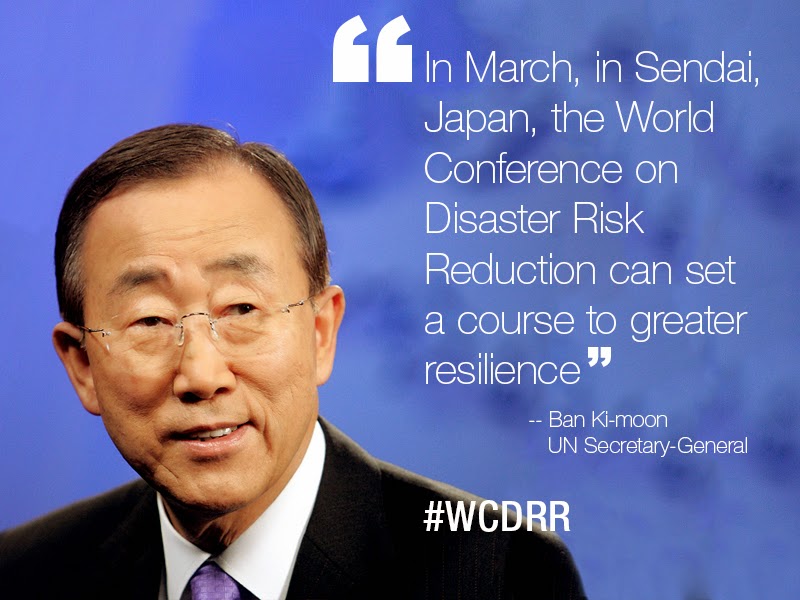
March 14, 2015 : The UN Secretary-General, Ban Ki-moon, today opened the Third UN World Conference on Disaster Risk Reduction, stating that annual economic losses now exceed US$ 300 billion annually.
“We can watch that number grow as more people suffer. Or we can dramatically lower that figure and invest the savings in development. Six billion dollars allocated each year can result in savings of up to US$360 billion by 2030, the Secretary-General said.

He said he had met earlier in the day with Vanuatu President, Baldwin Lonsdale, and extended his condolences to the people of Vanuatu amidst fears that Cyclone Pam may have caused widespread damage and destruction over the weekend.

The Secretary-General told the 4,000 participants – including representatives of 186 governments - attending the opening day of the five day event: “You have made this the highest-level meeting on disaster risk reduction in history. This is the first stop on our journey to a new future. Disaster risk reduction advances progress on sustainable development and climate change.”
He praised the existing global agreement on disaster risk reduction, the Hyogo Framework for Action (HFA), which was adopted ten years ago in Kobe, Japan. He said it “has saved thousands of lives. Now we must respond to the world’s growing needs by empowering individuals, supporting communities and backing promises with resources.”

Work is continuing at the Conference to agree on a new framework for disaster risk reduction which will update the HFA.

Mr. Ban Ki-Moon said: “Our thoughts are with all disaster victims. Our best possible tribute will be to make this Conference a success.”


Lists of Natural Hazards
  • Avalanche snow avalanche, snow slide
  • Cold Wave extreme weather, extreme temperature, cold temperatures
  • Cyclone hurricane, tropical storm, tropical depression, typhoon
  • Drought deficiency of precipitation, desertification, pronounced absence of rainfall
  • Earthquake seismic, tectonic
  • Epidemic & Pandemic epidemic: bubonic plague, cholera, dengue, non-pandemic diseases, typhoid; pandemic: H1N1, HIV, smallpox, tuberculosis
  • Flood inundation; includes: flash floods
  • Heat Wave extreme weather, extreme temperature, high temperatures
  • Insect Infestation locust, plague, African bees
  • Land Slide debris flow, mud flow, mud slide, rock fall, slide, lahar, rock slide and topple
  • NBC - Nuclear, Biological, Chemical biohazard risk, chemical contamination, nuclear radiation risk
  • Storm Surge coastal flood, wave surge, wind setup
  • Technical Disaster chemical spill/leak, explosions, collapses, gas leaks, urban fire, oil spill, technical failure
  • Tornado waterspout, twister, vortex
  • Tsunami
  • Volcano crater, lava, magma, molten materials, pyroclastic flows, volcanic rock, volcanic ash
  • Wild Fire bush fire, forest fire, uncontrolled fire, wildland fire
Loss Events Worldwide 2014

The United Nations General Assembly Resolution adopted in 2013 (68/211) on International Strategy for Disaster Reduction states that the World Conference will result in a concise, focused, forward-looking, and action-oriented outcome document and will have the following
objectives:

To complete assessment and review of the implementation of the Hyogo Framework for Action;
• To consider the experience gained through the regional and national strategies/institutions and plans for disaster risk reduction and their recommendations as well as relevant regional agreements within the
implementation of the Hyogo Framework of Action;
• To adopt a post-2015 framework for disaster risk reduction;
• To identify modalities of cooperation based on commitments to implement a post-2015 framework for disaster risk reduction;
• To determine modalities to periodically review the implementation of a post-2015 framework for disaster risk reduction.


The Third UN World Conference on Disaster Risk Reduction


The global community needs a plan on how it will build resilience against natural hazards, according to the director of Kenya's National Disaster Operation Centre.Nathan Kigotho, who is in Sendai, Japan for the Third UN World Conference on Disaster Risk Reduction, says Kenya is mostly affected by drought.In 2005, a 10-year plan called the Hyogo Framework for Action was adopted to help protect the world from natural disasters. A new plan is now needed to replace it. Nan Zheng began by asking Mr Kigotho what he hopes the outcome of the conference will be.

The Global Assessment Report on Disaster Risk Reduction (GAR) 2015

 The Global Risk Data Platform is a multiple agencies effort to share spatial data information on global risk from natural hazards. Users can visualise, download or extract data on past hazardous events, human & economical hazard exposure and risk from natural hazards. It covers tropical cyclones and related storm surges, drought, earthquakes, biomass fires, floods, landslides, tsunamis and volcanic eruptions. The collection of data is made via a wide range of partners (see About for data sources). This was developed as a support to the Global Assessment Report on Disaster Risk Reduction (GAR) and replace the previous PREVIEW platform already available since 2000. Many improvements were made on the data and on the application.


Support the Global Risk Data Platform
  

The GAR is a comprehensive review and analysis of disaster risk and risk management. It is published every two years.GAR15 was launched in March 2015, it looks at how to make development sustainable. Visit the GAR15 website


Draft post-2015 framework for disaster risk reduction (revised on 13 March 2015)
Education for Disaster Risk Reduction (DRR) takes into account the relationships between society, environment, economy, and culture and their impacts. It also promotes critical thinking and problem-solving as well as social and emotional life skills that are essential to the empowerment of groups threatened or affected by disasters.
Natural Disaster Preparedness and Education for Sustainable Development - UNESCO

Media 

United Nations - Interview of Margareta Wahlström, Special Representative of the Secretary-General for Disaster Risk Reduction ahead of the opening of the Third UN World Conference on Disaster Risk Reduction (Sendai, Japan, 14-18 March 2015)

UNISDR : Resilient Cities Connect is a platform where cities, development partners and businesses can exchange their knowledge, services and capacities to increase the local resilience of people, public services and businesses


Queries on the preparations 


Ms. Elena Dokhlik
Tel: +41 22 91 78861
Fax: +41 22 73 39531, +41 2 27 339855
Email: wcdrr2015@un.org


Thursday, 11 October 2012

Ban Ki-moon Message on the International Day for Natural Disater Reduction 2012

Secretary-General's Message for 2012

 This year’s observance of the International Day for Disaster Reduction seeks to highlight the need for women and girls to be at the forefront of reducing risk and managing the world’s response to natural hazards. Across the world, women and girls are using their roles within families and communities to strengthen risk reduction. In Bangladesh, women organized themselves to prepare for and respond to floods by teaching other women how to build portable clay ovens and elevate houses.

 In South Africa, marginalized adolescent girls have been empowered to help design plans to reduce the impact of drought and severe wind storms.


 In the Bolivian altiplano, indigenous women have consolidated traditional agricultural and climatic knowledge, which resulted in significant reduction of crop losses from hail, frost and flooding.

 In Viet Nam, villagers have been introduced to disaster reduction issues through customized radio soap operas that incorporate real-life examples and stories from local women.

And following the tsunami and earthquake in Fukushima, Japan, women played a central role in re-establishing income opportunities, with a special focus on single mothers. Such efforts advance understanding of how communities can benefit from encouraging women to take leadership roles in disaster risk reduction, and will only become more valuable as climate change intensifies and as the world struggles to cope with extreme weather and disasters that affect an average of more than 200 million people annually

. On this International Day for Disaster Reduction, let us recognize that, as the theme of this year’s observance declares, women and girls are the “[in]Visible Force of Resilience”.

 Ban Ki-moon

Thursday, 22 September 2011

The 2011 CGI Annual Meeting


Watch live streaming video from cgi_plenary at livestream.com