Showing posts with label Economic and social rights. Show all posts

Friday, 20 February 2026

World Day of Social Justice 2026, February 20th.

20 February


FORUM: "Renewed commitment to Social Development and Social Justice." World Day of Social Justice 2026. The celebration of this day is of particular relevance as it takes place in the aftermath of the Second World Summit for Social Development and the adoption of the Doha Political Declaration. Building on the 2025 theme of strengthening a just transition for a sustainable future, the 2026 commemoration seeks to build on the momentum generated by the World Social Summit and the 64th session of the Commission for Social Development (CSocD64) for advancing social development and social justice through effective policy coordination, equity and inclusion. In 2025, the ILO launched a new report on The State of Social Justice: A work in progress showing major gains in education, poverty reduction and productivity over the past three decades, while entrenched inequalities, fragile trust in institutions and slow progress in key areas continued to hold back social justice worldwide. Key achievements since the first World Social Summit in 1995 include halving the rate of child labour among 5- to 14-year-olds from 20 to 10 per cent, reducing extreme poverty from 39 to 10 per cent, raising primary school completion rates by 10 percentage points, and achieving social protection coverage for over half of the world’s population. At the same time, stark deficits remain. Informality has fallen by only two percentage points in two decades and still affects 58 per cent of workers; the gender labour force participation gap has narrowed by just three percentage points since 2005 and remains at 24 per cent; and trust in institutions has been declining worldwide since 1982. The report stresses the need to place social justice at the core of policymaking – from finance and industry to health and climate – and to strengthen cooperation among governments, international institutions and social partners to deliver coherent responses to global challenges. The findings of the United Nations World Social Report 2025 echoes this call asserting the need for a new global policy consensus to accelerate social progress, anchored in equity, economic security for all, and solidarity. At the Second World Summit for Social Development in Doha, Qatar, Member States of the United Nations demonstrated the political will to deliver social justice and advance social development as a shared global responsibility. The Doha Political Declaration, adopted at the Summit, reaffirms and renews the commitments made in the 1995 Copenhagen Declaration, centring poverty eradication, employment, and social inclusion, as the three critical and interrelated pillars of social development. At the same time, the Doha outcome acknowledges today’s global realities and their impact on social development, from the climate crisis and digital transformation to demographic change. The Doha Political Declaration asserts the need for macroeconomic policies that generate decent jobs and living wages, supported by stronger labour institutions and universal social protection for all, and underlines the need for fair and inclusive transitions in the digital and green economies, and greater investment in the care sector to create quality jobs to meet growing demand for care services. It urges stronger action to promote gender equality, expand opportunities for young people, and help workers and enterprises move from the informal to the formal economy. And, in reaffirming the global commitment to promote inclusive and sustainable economic growth, full and productive employment and decent work for all, it acknowledges the work of the Global Coalition for Social Justice.In outlining the process of follow-up, the Doha Political Declaration reaffirms the Commission for Social Development as the primary platform for and review of the implementation of the Copenhagen Declaration and Programme of Action and the outcome of the Doha Summit. In the first session of the Commission following the Summit, Member States considered the theme, “Advancing Social Development and Social Justice through Coordinated, Equitable and Inclusive Policies”, taking first steps to articulate the policy guidance needed for Doha implementation. Follow the conversations with the hashtags: #20February, #SocialJusticeDay.


High-level Panel discussions


EVENTS: At UNHQ New York; On February 20th, from 01:15 PM. -02:30 PM. (EST); Conference Room 6; The 2026 World Day of Social Justice, convened by the Permanent Mission of the Kyrgyz Republic to the United Nations and the International Labour Organization (ILO), in collaboration with the Division for Inclusive Social Development at the UN Department of Economic and Social Affairs (UN DESA), Within this context, this year’s World Day will focus on “Renewed Commitment to Social Development and Social Justice”. It aims to build on the momentum generated by the Second World Summit for Social Development and the first follow-up session of the Commission for Social Development to advance social justice for all. The event will provide an opportunity to examine how the renewed focus of the multilateral system on social development and social justice can be leveraged to strengthen the social dimension of sustainable development, accelerate the implementation of the Sustainable Development Goals, and promote social justice for all through concrete and actionable outcomes. Guided by the Doha Political Declaration and the deliberations and outcomes of CSocD64, the event will foster forward-looking dialogue on how progress in advancing social justice can be sustained and further strengthened, while addressing persistent and emerging challenges. Particular emphasis will be placed on multi-stakeholder collaboration in advancing shared goals and priorities, and how existing initiatives, such as the Global Coalition for Social Justice, Doha Solutions Platform, and other initiatives showcasing relevant policy and partnerships, can generate political commitments, mobilize investments and deliver concrete action. Register to participate, get the concept note and watch the livestream!


On February 20th 2026; From 15:00 - 16:00 GMT+1 at ILO Headquarters in Geneva, Switzerland, the event entitled ''From Doha commitment to action for social justice'' will advocate for sustained engagement by governments, social partners, and key stakeholders to advance the commitments outlined in the Political Declaration and through the implementation of the Coalition’s Key Interventions. Watch the event!

Agenda Programme

Opening session

Annalena Baerbock; President, 80th Session of the General Assembly, United Nations (UN).

Keynote intervention: Growth, innovation and social justice by Philippe Aghion; Nobel Laureate in Economics 2025.

Panel discussion: Operationalizing the Doha Declaration through collaboration and collective action

Colin Jordan; Minister of Labour, Social Security and the Third Sector, Barbados.
Christine Nkulikiyinka; Minister of Public Service and Labour, Rwanda.
Datuk Syed Hussain Syed Husman; President, Malaysian Employers Federation (MEF).
Luc Triangle; General Secretary, International Trade Union Confederation (ITUC).
Gilbert F. Houngbo; Chair of the Panel discussion and Director-General, International Labour Organization (ILO).

Closing remarks

Li Junhua; Secretary-General of the Second World Summit on Social Development and Under-Secretary-General for Economic and Social Affairs, United Nations (UN).


INITIATIVES: "Bridging Gaps and Building Alliances". A ground-breaking initiative will be launched to help intensifying collective efforts to urgently address social justice deficits and accelerate the implementation of the 2030 Agenda for Sustainable Development, the Sustainable Development Goals and the Decent Work Agenda. In support of the Global Coalition for Social Justice.


ILO Headquarters, Geneva, Switzerland


STATEMENTS
: Read the Statement of the United Nations Secretary-General on World Day of Social Justice 2026; February 20th and the Statement of the ILO Director General on World Day of Social Justice 2026; February 20th.

LIVESTREAM: At UNHQ; The celebration of the World Day of Social Justice, 20 February, is a global reminder of The urgent need to build fairer, inclusive, and sustainable societies. The 2026 observance is of particular significance as it follows the Second World Summit on Social Development, held in Doha in November 2025. In this context this 60-minute online event seeks to carry forward the momentum generated by the adoption of the Doha Political Declaration by reaffirming social justice as a shared global priority. The event will provide a timely opportunity to underscore the urgency of translating political commitments into meaningful action. Serving as a moment of reflection and a call to action, the event will advocate for sustained engagement by governments, social partners, and key stakeholders to advance the commitments outlined in the Political Declaration and through the implementation of the Coalition's Key Interventions. Watch rom Doha commitments to action for Social Justice!

International Labour Organization (ILO)


Agencies, Funds & Programmes

Wednesday, 19 February 2025

World Day of Social Justice 2025; February 20th.


FORUM: "Strengthening a Just Transition for a Sustainable Future." World Day of Social Justice 2025. The observance of the day help remind us of the need to build a fairer and more equitable world and to urge all efforts to combat unemployment, social exclusion, and poverty. Strengthening a just transition for a sustainable future means making sure our move toward low-carbon economies benefits everyone, especially the most vulnerable. It requires a holistic approach that weaves environmental sustainability with social justice, ensuring that workers, indigenous peoples, and marginalized communities receive the support they need—through retraining, job creation, and strong social protection measures. In other words, decarbonization and economic transformation should go hand in hand with policies that fight poverty, reduce inequality, and open up opportunities for all. At the heart of this vision is the idea of integrating “just transition” principles into both global and national policies. When these principles are built into sustainable development agendas—such as those discussed at the Second World Summit for Social Development (WSSD2)—policymakers can create a fairer environment where the costs of change are shared equitably. For example, targeted green skills training, comprehensive social protection, and community-led economic diversification can help ensure that the decline of fossil fuel industries doesn’t lead to long-term unemployment or increased social inequality. Instead, these measures redirect investments into emerging green sectors, building a resilient workforce and a more equitable society. Ultimately, strengthening a just transition is about re-imagining our economic and environmental systems to prioritize people as much as the planet. It’s a call to shift the focus from simply decarbonizing to also redistributing opportunities and resources so that sustainable growth benefits everyone. Through collective action and inclusive policies, we can create a future where environmental integrity and social equity go hand in hand, forming the foundation of a truly sustainable global economy. Follow the conversations with the hashtags: #20February, #SocialJusticeDay.


EVENTS: At UNHQ New York; On February 20th, from 01:15 PM. -02:30 PM. (EST); Conference Room 6; The 2025 World Day of Social Justice, convened by the Permanent Mission of the Kyrgyz Republic to the United Nations and the International Labour Organization (ILO), in collaboration with the Division for Inclusive Social Development at the UN Department of Economic and Social Affairs (UN DESA), will focus on “Strengthening a Just Transition for a Sustainable Future.” This year's event takes on special significance as the world prepares for the Second World Summit for Social Development (WSSD2). As the global community faces unprecedented challenges from climate change, economic transitions, and social inequalities, the event will explore how inclusive policies can ensure that climate action leads to more and better jobs, reduces inequalities, and fosters sustainable development. Key topics for panel discussions include:
  • The role of macroeconomic policies and trade frameworks in ensuring inclusive economic growth, climate resilience, and social justice.
  • Strategies for an equitable transition to a low-carbon, job-rich economy, particularly in sectors such as renewable energy, critical minerals, and green infrastructure.
  • Innovative financing mechanisms to support low-income and climate-vulnerable countries in transitioning to sustainable economies.
  • The importance of social protection systems, education, and skills development in preparing workers for the emerging green economy.

The event will also emphasize multi-stakeholder collaboration, leveraging the Global Coalition for Social Justice to align the efforts of governments, businesses, trade unions, and civil society. Join the conversation on 20 February 2025 to explore actionable solutions that advance social justice and build a sustainable future for all. Read the Concept Note | Flyer and Register here

On February 20th, On the occasion; The ILO will mark World Day of Social Justice 2025 with a series of five events held in major cities around the globe. The events will bring together high-level speakers from across the world of work to discuss how to put social justice at the centre of international, national and regional policy agendas. The International Labour Organization (ILO) brings together leading figures from academia, politics and the world of work with the ILO Director-General to discuss how to advance social justice in the world. The conference will be held by the International Labour Organization (ILO), in partnership with the International Telecommunication Union (ITU) and the United Nations Conference on Trade and Development (UNCTAD) and the UN Department of Economic and Social Affairs (UN DESA).

From From 05:00 - 06:00 (GMT-5), a panel discussion entitled “Achieving universal social health protection for social justice in Asia and the Pacific.” will be held. Join ILO Regional Office for Asia Pacific, Director, representatives of academics, members of the Mahidol University, Bangkok, and experts in the field of Social Protection as they discuss how to reinforce commitment to universal social health protection through inclusive policies and to strengthen knowledge-sharing for advancing social health protection. Watch the live event!

From: 07:00 to 08:00 (GMT-5), a panel discussion entitled “Social justice in the digital era: AI's impact on the labour market.’’ will be held. The European Economic and Social Committee (EESC), in partnership with the International Labour Organization (ILO) and the ILO Regional office for Europe, is hosting a high-level discussion featuring ILO Director-General Gilbert F. Houngbo, EESC President Oliver Röpke, Ministers of Labour from various EU member countries and partners of the Global Coalition for Social Justice, and senior representatives from EU institutions, European social partners, academia, and civil society. The event will explore how Artificial Intelligence is set to transform the world of work, focusing on opportunities to harness AI to promote decent work, foster inclusive labour markets, and advance gender equality. Watch the live event!

From 09:00 - 10:00 (GMT-5), a panel discussion entitled “Decent work in Africa: A key component of Social Justice.’’. To mark the day, the Regional Office for Africa is hosting a high-level panel discussion on how to advance social justice through decent work in Africa. The event will highlight the impact of ILO projects on improving lives and fostering greater social justice. The panel will feature representatives from the government, the ILO Regional Director for Africa, a young entrepreneur, a cultural sector representative, and a partner from the Global Coalition. Watch the live event!

From 11:00 - 12:00 (GMT-5), a panel discussion entitled “Social justice in the field of work: A new social contract for Latin America.’’. Join the ILO Regional of for Latin America and the Caribbean, the co-authors of the book Justicia Social y Trabajo: desde la perspectiva de América Latina y el Caribe, and a representative from the European Union in Peru for an insightful discussion on the challenges and opportunities of advancing social justice in the region through the framework of a new social contract. Watch the live event!

From 13:30 - 14:30 (GMT-5), a panel discussion entitled “Strengthening a just transition for a sustainable future.’’ Join key representatives from the United Nations in New York, Member States, the International Trade Union Confederation (ITUC), and the International Organisation of Employers (IOE), along with the Special Advisor on Climate Action and Just Transition (TBC) and the UN Secretary-General’s Envoy on Technology (TBC), for an engaging discussion on driving sustainable climate action through a Just Transition. The session will also highlight opportunities to build a socially inclusive and empowered low-carbon economy. Watch the live event!

Get the agenda Programme and Watch the Commemorative Event.

INITIATIVES: "Bridging Gaps and Building Alliances". A ground-breaking initiative will be launched to help intensifying collective efforts to urgently address social justice deficits and accelerate the implementation of the 2030 Agenda for Sustainable Development, the Sustainable Development Goals and the Decent Work Agenda. In support of the Global Coalition for Social Justice.

Conferences and summits: This includes the Fourth International Conference on Small Island Developing States, the Third United Nations Conference on Landlocked Developing Countries, the Summit of the Future, as well as preparations for the World Social Summit.

STATEMENTS: Read the Statement of the United Nations Secretary-General on World Day of Social Justice 2025; February 20th and the Statement of the ILO Director General on World Day of Social 


LIVESTREAM

 PANEL 5


 PANEL 4

    
 PANEL 3

    
 PANEL 2

   
 PANEL 1 


Saturday, 10 December 2022

Human Rights Day 2022; December 10th.

 FORUM: ''Dignity, Freedom and Justice for All'' Human Rights Day 2022.

In the decades since the adoption of the Universal Declaration of Human Rights in 1948, human rights have become more recognised and more guaranteed across the globe. It has since served as the foundation for an expanding system of human rights protection that today focuses also on vulnerable groups such as persons with disabilities, indigenous peoples and migrants. However, the promise of the UDHR, of dignity and equality in rights, has been under a sustained assault in recent years. As the world faces challenges new and ongoing – pandemics, conflicts, exploding inequalities, morally bankrupt global financial system, racism, climate change – the values, and rights enshrined in the UDHR provide guideposts for our collective actions that do not leave anyone behind. The year-long campaign seeks to shift the needle of understanding and action towards greater knowledge of the universality of the UDHR and the activism associated with it. Follow the conversations with the hashtags: #10December, #HumanRightsDay,#StandUp4HumanRights, #UDHR75.


Statement by the Secretary-General of the United Nations, on Human Rights Day 2022; December 10th. 

"The world is facing unprecedented and interlocking challenges to human rights. Hunger and poverty are increasing – an affront to the economic and social rights of hundreds of millions of people. Civic space is shrinking. Media freedom and the safety of journalists are in dangerous decline in almost every region of the world. Trust in institutions is evaporating, especially among young people. The COVID-19 pandemic has led to increased levels of violence against women and girls. Racism, intolerance and discrimination are running rampant. New human rights challenges are emerging from the triple planetary crisis of climate change, biodiversity loss and pollution. And we are only beginning to grasp the threat posed to human rights by some new technologies. These trying times call for a reignition of our commitment to all human rights - civil, cultural, economic, political and social. The Call to Action I launched in 2020 positions human rights at the centre of solutions to the challenges we face. This vision is reflected in my report on Our Common Agenda, which calls for a renewed social contract, anchored in human rights. The 75th anniversary of the landmark Universal Declaration on Human Rights next year must be an opportunity for action. I urge Member States, civil society, the private sector and others to put human rights at the heart of efforts to reverse today’s damaging trends. Human rights are the foundation for human dignity, and the cornerstone of peaceful, inclusive, fair, equal and prosperous societies. They are a unifying force and a rallying cry. They reflect the most fundamental thing we share – our common humanity. On this Human Rights Day, we reaffirm the universality and indivisibility of all rights, as we stand up for human rights for all".

António Guterres, Secretary-General of the United Nations.


EVENTS: Join us for a year-long campaign to promote and recognise the 75th anniversary of the Universal Declaration of Human Rights.

The 75th anniversary of the Universal Declaration of Human Rights will be celebrated on 10 December 2023. Ahead of this milestone, starting on this year's Human Rights Day on 10 December 2022, we will launch a year-long campaign to showcase the UDHR by focusing on its legacy, relevance and activism.


HOW TO GET INVOLVED!


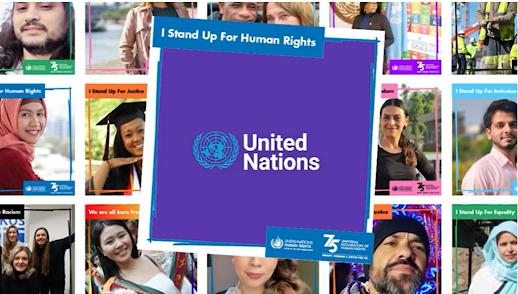
 Get the campaign materials and add your photo to one of the filters, inspired by the Declaration of Human Rights, and share it on social media.