Showing posts with label World Day of Social Justice. Show all posts

Friday, 20 February 2026

World Day of Social Justice 2026, February 20th.

20 February


FORUM: "Renewed commitment to Social Development and Social Justice." World Day of Social Justice 2026. The celebration of this day is of particular relevance as it takes place in the aftermath of the Second World Summit for Social Development and the adoption of the Doha Political Declaration. Building on the 2025 theme of strengthening a just transition for a sustainable future, the 2026 commemoration seeks to build on the momentum generated by the World Social Summit and the 64th session of the Commission for Social Development (CSocD64) for advancing social development and social justice through effective policy coordination, equity and inclusion. In 2025, the ILO launched a new report on The State of Social Justice: A work in progress showing major gains in education, poverty reduction and productivity over the past three decades, while entrenched inequalities, fragile trust in institutions and slow progress in key areas continued to hold back social justice worldwide. Key achievements since the first World Social Summit in 1995 include halving the rate of child labour among 5- to 14-year-olds from 20 to 10 per cent, reducing extreme poverty from 39 to 10 per cent, raising primary school completion rates by 10 percentage points, and achieving social protection coverage for over half of the world’s population. At the same time, stark deficits remain. Informality has fallen by only two percentage points in two decades and still affects 58 per cent of workers; the gender labour force participation gap has narrowed by just three percentage points since 2005 and remains at 24 per cent; and trust in institutions has been declining worldwide since 1982. The report stresses the need to place social justice at the core of policymaking – from finance and industry to health and climate – and to strengthen cooperation among governments, international institutions and social partners to deliver coherent responses to global challenges. The findings of the United Nations World Social Report 2025 echoes this call asserting the need for a new global policy consensus to accelerate social progress, anchored in equity, economic security for all, and solidarity. At the Second World Summit for Social Development in Doha, Qatar, Member States of the United Nations demonstrated the political will to deliver social justice and advance social development as a shared global responsibility. The Doha Political Declaration, adopted at the Summit, reaffirms and renews the commitments made in the 1995 Copenhagen Declaration, centring poverty eradication, employment, and social inclusion, as the three critical and interrelated pillars of social development. At the same time, the Doha outcome acknowledges today’s global realities and their impact on social development, from the climate crisis and digital transformation to demographic change. The Doha Political Declaration asserts the need for macroeconomic policies that generate decent jobs and living wages, supported by stronger labour institutions and universal social protection for all, and underlines the need for fair and inclusive transitions in the digital and green economies, and greater investment in the care sector to create quality jobs to meet growing demand for care services. It urges stronger action to promote gender equality, expand opportunities for young people, and help workers and enterprises move from the informal to the formal economy. And, in reaffirming the global commitment to promote inclusive and sustainable economic growth, full and productive employment and decent work for all, it acknowledges the work of the Global Coalition for Social Justice.In outlining the process of follow-up, the Doha Political Declaration reaffirms the Commission for Social Development as the primary platform for and review of the implementation of the Copenhagen Declaration and Programme of Action and the outcome of the Doha Summit. In the first session of the Commission following the Summit, Member States considered the theme, “Advancing Social Development and Social Justice through Coordinated, Equitable and Inclusive Policies”, taking first steps to articulate the policy guidance needed for Doha implementation. Follow the conversations with the hashtags: #20February, #SocialJusticeDay.


High-level Panel discussions


EVENTS: At UNHQ New York; On February 20th, from 01:15 PM. -02:30 PM. (EST); Conference Room 6; The 2026 World Day of Social Justice, convened by the Permanent Mission of the Kyrgyz Republic to the United Nations and the International Labour Organization (ILO), in collaboration with the Division for Inclusive Social Development at the UN Department of Economic and Social Affairs (UN DESA), Within this context, this year’s World Day will focus on “Renewed Commitment to Social Development and Social Justice”. It aims to build on the momentum generated by the Second World Summit for Social Development and the first follow-up session of the Commission for Social Development to advance social justice for all. The event will provide an opportunity to examine how the renewed focus of the multilateral system on social development and social justice can be leveraged to strengthen the social dimension of sustainable development, accelerate the implementation of the Sustainable Development Goals, and promote social justice for all through concrete and actionable outcomes. Guided by the Doha Political Declaration and the deliberations and outcomes of CSocD64, the event will foster forward-looking dialogue on how progress in advancing social justice can be sustained and further strengthened, while addressing persistent and emerging challenges. Particular emphasis will be placed on multi-stakeholder collaboration in advancing shared goals and priorities, and how existing initiatives, such as the Global Coalition for Social Justice, Doha Solutions Platform, and other initiatives showcasing relevant policy and partnerships, can generate political commitments, mobilize investments and deliver concrete action. Register to participate, get the concept note and watch the livestream!


On February 20th 2026; From 15:00 - 16:00 GMT+1 at ILO Headquarters in Geneva, Switzerland, the event entitled ''From Doha commitment to action for social justice'' will advocate for sustained engagement by governments, social partners, and key stakeholders to advance the commitments outlined in the Political Declaration and through the implementation of the Coalition’s Key Interventions. Watch the event!

Agenda Programme

Opening session

Annalena Baerbock; President, 80th Session of the General Assembly, United Nations (UN).

Keynote intervention: Growth, innovation and social justice by Philippe Aghion; Nobel Laureate in Economics 2025.

Panel discussion: Operationalizing the Doha Declaration through collaboration and collective action

Colin Jordan; Minister of Labour, Social Security and the Third Sector, Barbados.
Christine Nkulikiyinka; Minister of Public Service and Labour, Rwanda.
Datuk Syed Hussain Syed Husman; President, Malaysian Employers Federation (MEF).
Luc Triangle; General Secretary, International Trade Union Confederation (ITUC).
Gilbert F. Houngbo; Chair of the Panel discussion and Director-General, International Labour Organization (ILO).

Closing remarks

Li Junhua; Secretary-General of the Second World Summit on Social Development and Under-Secretary-General for Economic and Social Affairs, United Nations (UN).


INITIATIVES: "Bridging Gaps and Building Alliances". A ground-breaking initiative will be launched to help intensifying collective efforts to urgently address social justice deficits and accelerate the implementation of the 2030 Agenda for Sustainable Development, the Sustainable Development Goals and the Decent Work Agenda. In support of the Global Coalition for Social Justice.


ILO Headquarters, Geneva, Switzerland


STATEMENTS
: Read the Statement of the United Nations Secretary-General on World Day of Social Justice 2026; February 20th and the Statement of the ILO Director General on World Day of Social Justice 2026; February 20th.

LIVESTREAM: At UNHQ; The celebration of the World Day of Social Justice, 20 February, is a global reminder of The urgent need to build fairer, inclusive, and sustainable societies. The 2026 observance is of particular significance as it follows the Second World Summit on Social Development, held in Doha in November 2025. In this context this 60-minute online event seeks to carry forward the momentum generated by the adoption of the Doha Political Declaration by reaffirming social justice as a shared global priority. The event will provide a timely opportunity to underscore the urgency of translating political commitments into meaningful action. Serving as a moment of reflection and a call to action, the event will advocate for sustained engagement by governments, social partners, and key stakeholders to advance the commitments outlined in the Political Declaration and through the implementation of the Coalition's Key Interventions. Watch rom Doha commitments to action for Social Justice!

International Labour Organization (ILO)


Agencies, Funds & Programmes

Wednesday, 19 February 2025

World Day of Social Justice 2025; February 20th.


FORUM: "Strengthening a Just Transition for a Sustainable Future." World Day of Social Justice 2025. The observance of the day help remind us of the need to build a fairer and more equitable world and to urge all efforts to combat unemployment, social exclusion, and poverty. Strengthening a just transition for a sustainable future means making sure our move toward low-carbon economies benefits everyone, especially the most vulnerable. It requires a holistic approach that weaves environmental sustainability with social justice, ensuring that workers, indigenous peoples, and marginalized communities receive the support they need—through retraining, job creation, and strong social protection measures. In other words, decarbonization and economic transformation should go hand in hand with policies that fight poverty, reduce inequality, and open up opportunities for all. At the heart of this vision is the idea of integrating “just transition” principles into both global and national policies. When these principles are built into sustainable development agendas—such as those discussed at the Second World Summit for Social Development (WSSD2)—policymakers can create a fairer environment where the costs of change are shared equitably. For example, targeted green skills training, comprehensive social protection, and community-led economic diversification can help ensure that the decline of fossil fuel industries doesn’t lead to long-term unemployment or increased social inequality. Instead, these measures redirect investments into emerging green sectors, building a resilient workforce and a more equitable society. Ultimately, strengthening a just transition is about re-imagining our economic and environmental systems to prioritize people as much as the planet. It’s a call to shift the focus from simply decarbonizing to also redistributing opportunities and resources so that sustainable growth benefits everyone. Through collective action and inclusive policies, we can create a future where environmental integrity and social equity go hand in hand, forming the foundation of a truly sustainable global economy. Follow the conversations with the hashtags: #20February, #SocialJusticeDay.


EVENTS: At UNHQ New York; On February 20th, from 01:15 PM. -02:30 PM. (EST); Conference Room 6; The 2025 World Day of Social Justice, convened by the Permanent Mission of the Kyrgyz Republic to the United Nations and the International Labour Organization (ILO), in collaboration with the Division for Inclusive Social Development at the UN Department of Economic and Social Affairs (UN DESA), will focus on “Strengthening a Just Transition for a Sustainable Future.” This year's event takes on special significance as the world prepares for the Second World Summit for Social Development (WSSD2). As the global community faces unprecedented challenges from climate change, economic transitions, and social inequalities, the event will explore how inclusive policies can ensure that climate action leads to more and better jobs, reduces inequalities, and fosters sustainable development. Key topics for panel discussions include:
  • The role of macroeconomic policies and trade frameworks in ensuring inclusive economic growth, climate resilience, and social justice.
  • Strategies for an equitable transition to a low-carbon, job-rich economy, particularly in sectors such as renewable energy, critical minerals, and green infrastructure.
  • Innovative financing mechanisms to support low-income and climate-vulnerable countries in transitioning to sustainable economies.
  • The importance of social protection systems, education, and skills development in preparing workers for the emerging green economy.

The event will also emphasize multi-stakeholder collaboration, leveraging the Global Coalition for Social Justice to align the efforts of governments, businesses, trade unions, and civil society. Join the conversation on 20 February 2025 to explore actionable solutions that advance social justice and build a sustainable future for all. Read the Concept Note | Flyer and Register here

On February 20th, On the occasion; The ILO will mark World Day of Social Justice 2025 with a series of five events held in major cities around the globe. The events will bring together high-level speakers from across the world of work to discuss how to put social justice at the centre of international, national and regional policy agendas. The International Labour Organization (ILO) brings together leading figures from academia, politics and the world of work with the ILO Director-General to discuss how to advance social justice in the world. The conference will be held by the International Labour Organization (ILO), in partnership with the International Telecommunication Union (ITU) and the United Nations Conference on Trade and Development (UNCTAD) and the UN Department of Economic and Social Affairs (UN DESA).

From From 05:00 - 06:00 (GMT-5), a panel discussion entitled “Achieving universal social health protection for social justice in Asia and the Pacific.” will be held. Join ILO Regional Office for Asia Pacific, Director, representatives of academics, members of the Mahidol University, Bangkok, and experts in the field of Social Protection as they discuss how to reinforce commitment to universal social health protection through inclusive policies and to strengthen knowledge-sharing for advancing social health protection. Watch the live event!

From: 07:00 to 08:00 (GMT-5), a panel discussion entitled “Social justice in the digital era: AI's impact on the labour market.’’ will be held. The European Economic and Social Committee (EESC), in partnership with the International Labour Organization (ILO) and the ILO Regional office for Europe, is hosting a high-level discussion featuring ILO Director-General Gilbert F. Houngbo, EESC President Oliver Röpke, Ministers of Labour from various EU member countries and partners of the Global Coalition for Social Justice, and senior representatives from EU institutions, European social partners, academia, and civil society. The event will explore how Artificial Intelligence is set to transform the world of work, focusing on opportunities to harness AI to promote decent work, foster inclusive labour markets, and advance gender equality. Watch the live event!

From 09:00 - 10:00 (GMT-5), a panel discussion entitled “Decent work in Africa: A key component of Social Justice.’’. To mark the day, the Regional Office for Africa is hosting a high-level panel discussion on how to advance social justice through decent work in Africa. The event will highlight the impact of ILO projects on improving lives and fostering greater social justice. The panel will feature representatives from the government, the ILO Regional Director for Africa, a young entrepreneur, a cultural sector representative, and a partner from the Global Coalition. Watch the live event!

From 11:00 - 12:00 (GMT-5), a panel discussion entitled “Social justice in the field of work: A new social contract for Latin America.’’. Join the ILO Regional of for Latin America and the Caribbean, the co-authors of the book Justicia Social y Trabajo: desde la perspectiva de América Latina y el Caribe, and a representative from the European Union in Peru for an insightful discussion on the challenges and opportunities of advancing social justice in the region through the framework of a new social contract. Watch the live event!

From 13:30 - 14:30 (GMT-5), a panel discussion entitled “Strengthening a just transition for a sustainable future.’’ Join key representatives from the United Nations in New York, Member States, the International Trade Union Confederation (ITUC), and the International Organisation of Employers (IOE), along with the Special Advisor on Climate Action and Just Transition (TBC) and the UN Secretary-General’s Envoy on Technology (TBC), for an engaging discussion on driving sustainable climate action through a Just Transition. The session will also highlight opportunities to build a socially inclusive and empowered low-carbon economy. Watch the live event!

Get the agenda Programme and Watch the Commemorative Event.

INITIATIVES: "Bridging Gaps and Building Alliances". A ground-breaking initiative will be launched to help intensifying collective efforts to urgently address social justice deficits and accelerate the implementation of the 2030 Agenda for Sustainable Development, the Sustainable Development Goals and the Decent Work Agenda. In support of the Global Coalition for Social Justice.

Conferences and summits: This includes the Fourth International Conference on Small Island Developing States, the Third United Nations Conference on Landlocked Developing Countries, the Summit of the Future, as well as preparations for the World Social Summit.

STATEMENTS: Read the Statement of the United Nations Secretary-General on World Day of Social Justice 2025; February 20th and the Statement of the ILO Director General on World Day of Social 


LIVESTREAM

 PANEL 5


 PANEL 4

    
 PANEL 3

    
 PANEL 2

   
 PANEL 1 


Thursday, 16 February 2023

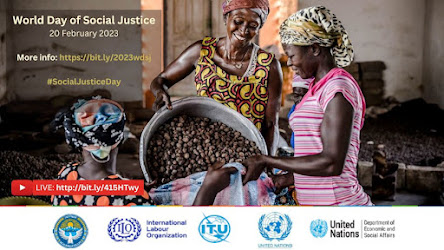
World Day of Social Justice 2023; February 20th.

FORUM: "How to deliver a sustained dose of social justice." World Day of Social Justice 2023.

The 2023 World Day of Social Justice provides an opportunity to foster dialogue on actions needed to achieve social justice by strengthening the social contract that has been fractured by rising inequalities, conflicts and weakened institutions that are meant to uphold and protect the rights of workers. Key Questions for Discussion: • What are the key bottlenecks and challenges to overcoming rising inequalities, decent work deficits, including lack of access to social protection, digital exclusion and disruption of trade? • What are the opportunities in the green and digital economy to reduce inequalities and promote social justice, in particular for youth? • What actions are needed by governments, the UN system, international financial institutions, employers’ and workers’ organisations, civil society and other stakeholders to increase investments for social justice?
The International Labour Organization (ILO) brings together leading figures from academia, politics and the world of work with the ILO Director-General to discuss how to advance social justice in the world. Follow the conversations with the hashtags: #20February, #SocialJusticeDay.


EVENTS: “Overcoming Barriers and Unleashing Opportunitiesfor Social Justice.” The World Day of Social Justice 2023 event aims to increase understanding of multiple global challenges and related social justice deficits and will propose concrete actions to achieve international development goals, including through a new global social contract.


Saturday, 19 February 2022

World Day of Social Justice 2022; February 20th.

 FORUM: Advancing a human-centred recovery through strengthened multilateral and tripartite cooperation. World Day of Social Justice 2022.

Since 2009, every 20 February has been the UN observance known as “World Day of Social Justice”. The purpose of the day is to focus on the plight of social injustice throughout the world and to press for improvements and solutions.


The Global Forum; this year, will open with scene-setting remarks from the business and trade union communities. It will feature remarks from the UN Secretary-General and a number of Heads of State or Government, and the ILO Director-General Guy Ryder.

Statement by ILO Director-General Guy Ryder. On the occasion of World Day of Social Justice 2022, February 20th.


ILO Director-General, Guy Ryder, highlights how formality is a necessary condition to reduce poverty and inequalities, advance decent work, increase productivity and sustainability of enterprises and expand government’s scope of action, notably in times of crisis.


Preliminary programme overview 
Introduction and overarching objectives
 In June 2021, the International Labour Conference adopted a Global Call to Action for a human-centred recovery from the COVID-19 crisis that is inclusive, sustainable and resilient. In it, Governments, workers’ and employers’ organizations from the ILO’s 187 Member States committed to pursue a “strong and coherent global response in support of Member States’ human-centred recovery strategies that are inclusive, sustainable and resilient, including through joint initiatives and enhanced institutional arrangements among international and regional organizations.” They directed the ILO to organize a major policy forum in cooperation with other multilateral organizations to advance this objective. The high-level Global Forum for a Human-Centred Recovery will be held from 22 to 24 February in a virtual format, bringing together Heads of State and Government, heads of international organizations and multilateral development banks, and employers’ and workers’ leaders from around the world. The sessions will provide an opportunity to discuss concrete actions that strengthen the international community’s response to the crisis and to the “great divergence” or widening inequality in crisis response and recovery among and within countries. The Forum also serves to advance a more networked, inclusive, and effective form of multilateralism that, in the words of the United Nations (UN) Secretary-General Guterres, “draws together existing institutional capacities, overcoming fragmentation to ensure all are working together towards a common goal.” In the current context, that goal must be to increase the level and coherence of the international response to the profound and profoundly unequal nature of the COVID-19 crisis’s impact on people, in particular regarding their employment opportunities and incomes; workers’ protection, capabilities, and just transitions; and social protections including with respect to health care. A key issue for discussion will be the Global Accelerator on Jobs and Social Protection for a Just Transition that the UN Secretary-General launched at the General Assembly in September 2021. The Forum will examine how to generate the investments and resources required to meet the ambition of creating at least 400 million new and decent jobs, including in the green, digital and care economy, while improving protections at work; extending social protection floors to the more than 50 per cent of global population without any access to social protection; improving protections at work; scaling up climate action for jobs to accelerate progress towards a carbon-neutral global economy; and pursuing a transformative agenda for gender equality. All participants of the Forum are invited to discuss how they will contribute to these global goals, particularly in the four mutually reinforcing areas of actions specified in the thematic sessions.


Provisional session descriptions

 Opening session – 22 February, 13h00 to 14h30 CET Advancing a human-centred recovery through strengthened multilateral and tripartite cooperation

 The Global Forum will open with scene-setting remarks from the business and trade union communities. It will feature remarks from the UN Secretary-General and a number of Heads of State or Government, and the ILO Director-General Guy Ryder. 

Thematic session 1 – 22 February, 14h45 to 16h15 CET Decent jobs and inclusive economic growth.
The session will begin with opening presentations by Heads of State or Government, followed by an interactive panel involving the leaders of a number of international organizations that are particularly engaged in this area, together with high-level representatives of the social partners. This session will present and discuss strengthened cooperative efforts and institutional arrangements to address the serious and ongoing impact of the COVID-19 crisis on employment, business continuity and livelihoods around the world, particularly with respect to disproportionately affected regions, sectors and hardest-hit groups such as youth, women, small businesses and informal and migrant workers. Globally, the labour market suffered unprecedented losses in working hours in 2020 and 2021 relative to prepandemic levels – the equivalent of 258 million and 125 million full-time jobs, respectively. Job recovery has been uneven, with much faster recovery in advanced economies than developing countries and uneven progress within countries, leaving already disadvantaged and hard-hit groups further behind and many enterprises struggling to survive. These deepened inequalities impede economic and social recovery, the prospects for which remain weak and uncertain in 2022 and beyond. The eventual outcome will be strongly influenced by policy choices and actions. Experience from past crises shows that achieving an inclusive, job-rich recovery requires placing decent jobs at the centre of recovery efforts with strong linkages to social protection; increasing investment in areas having particular potential for job creation (such as green, digital, and care economies); and supporting business resilience and recovery during and after the crisis. There is a high risk that without concerted international support, many developing countries will face significant challenges in implementing policies to attain, in line with UN Sustainable Development Goal 8, “sustained, inclusive and sustainable economic growth, full and productive employment and decent work for all”. 
• How can national and international solidarity and support be increased in sectors with particular potential to create decent jobs in sustainable ways, including the green, care and digital economies, as well as for micro, small and medium-sized enterprises (MSMEs); for workers’ skills and transitions; and for youth, women and other disproportionately affected groups.

Thematic session 2 – 23 February, 13h00 to 14h30 CET Universal social protection.

The session will begin with opening presentations by Heads of State or Government, followed by an interactive panel involving the leaders of a number of international organizations that are particularly engaged in this area, together with high-level representatives of the social partners. This session will present and discuss strengthened cooperative efforts and institutional arrangements to help countries address the significant gaps in social protection comprehensiveness, adequacy and sustainability, which are exacerbating the adverse human impacts of the current crisis. Less than half of the global population is effectively covered by at least one social protection benefit. To guarantee at least a basic level of social security through a nationally defined social protection floor, middle income countries would need to spend between 3.1 to 5.1 per cent of GDP. However, in low-income countries, the required amount of domestic resources amounts to an estimated 15.9 per cent of GDP, the equivalent of 45 per cent of current tax revenues. Closing the social protection floor financing gap in such countries through domestic resource mobilization alone is not realistic. Clearly, current levels of expenditure on social protection are insufficient to close persistent coverage gaps, despite large – yet unequal – resource mobilization during the COVID-19 pandemic. For countries with limited fiscal capacities or facing increased needs due to systemic crises, additional international financing in combination with technical assistance could complement national resources and support the creation of sufficient domestic fiscal space. Greater alignment among national policy makers, social partners and bilateral and multilateral development partners could help low- and lower-middle-income countries make stronger progress in this regard. A new international financing mechanism could help low-income countries increase levels of funding devoted to social protection over time. 
• How can national and international solidarity and support for the design, sustainable financing and administration of social protection systems in developing countries be expanded through increased technical assistance, institutional capacity building and catalytic financing that complements strengthened domestic resource mobilization? 

Thematic Session 3, February 23, 14h45 to 16h15 CET Protecting workers and sustaining enterprises. 

The session will begin with opening presentations by Heads of State or Government, followed by an interactive panel involving the leaders of a number of international organizations that are particularly engaged in this area, together with high-level representatives of the social partners. This session will present and discuss strengthened cooperative efforts and institutional arrangements to improve the implementation and ratification of international labour standards, notably with respect to occupational safety and health, working time and wages, gender and other forms of discrimination, and the other fundamental principles and rights at work, including through transitions to formality. It will also examine how to enhance international support for decent work opportunities through increased business continuity and productivity growth of MSMEs and other firms in sectors and geographies hit hardest by the pandemic or affected by ongoing shifts in technology, climate change or trade and investment as well as for universal global access to vaccines, as envisioned and enabled by the Access to COVID-19 Tools (ACT) Accelerator coordinated by the World Health Organization (WHO). The pandemic is posing new challenges with respect to safeguarding workplace safety and health, including in but not limited to frontline and other sectors critical to the functioning of economies and societies, and ensuring respect for workers’ rights more generally, including in digitally-enabled remote 4 work arrangements which have expanded substantially during the crisis. Effective implementation of labour standards enabled by properly resourced labour ministries underpins progress on all the other policy domains covered by the Forum, as does a transformative and measurable agenda for gender equality and non-discrimination and equal treatment more broadly. Social dialogue, including collective bargaining, plays a critical role in supporting the application of such standards and finding solutions to new challenges brought by changes in the world of work; however, the pandemic has placed employer and worker organizations under increased pressure. At the same time, sectors such as tourism and hospitality, culture, aviation, and some manufacturing and personal services continue to struggle, as do many smaller firms, resulting in many workers shifting from formal to informal and often insecure employment where labour protections, tax administration and social protection are considerably weaker.

 • How can national and international solidarity and support be increased for the capacity of countries to implement worker protections in such areas as occupational safety and health, gender and other forms of discrimination, adequate wages and working time and fundamental principles and rights at work; and how can international cooperation strengthen worker and employer organizations, the continuity and productivity of small businesses and other firms, and efforts to formalize jobs and enterprises?

Thematic session 4 – 24 February, 13h00 to 14h30 CET Just transition.

 The session will begin with opening presentations by Heads of State or Government, followed by an interactive panel involving the leaders of a number of international organizations that are particularly engaged in this area, together with high-level representatives of the social partners. This session will present and discuss strengthened cooperative efforts and institutional arrangements to support country strategies to achieve a just transition – a transition that maximizes economic and social gains from climate action, while minimizing risks of social disruption. The government, company and investment community net-zero commitments announced at the recent Glasgow Conference of theParties (COP26) imply an increasingly significant and potentially disruptive transformation of many industries and their workforces over the next decade and beyond, including in developing countries. At the same time, global warming is contributing to increasing levels of physical damage and social dislocation in countries, whether in terms of extreme weather and natural disasters, rising sea levels and water stress, or job loss and migration. There is compelling evidence that the ecological transition can be positive for the economy, with net gains in decent work and sustainable enterprise value creation which contribute to the advancement of social justice. The ILO estimates that a green transition through low-carbon and circular economies can generate some 100 million new jobs by 2030. However, 80 million jobs could be lost in the process. Most if not all countries are at an early stage of analyzing and planning for the implications of these shifts in public policy, corporate strategy, and environmental conditions. Many have limited resources to do so, let alone to finance the adaptations that will be required in industrial and infrastructure investment and public support for worker retraining, employment services and social protection. Policymakers will face geographical and temporal complexities and need to ensure distributive justice, give specific attention to the needs of young people, women, indigenous and tribal people, and persons with disabilities. Comprehensive policy frameworks, based on social dialogue and strong social consensus, will be indispensable to address all aspects of economic and social transformation. 
• How can national and international solidarity and support for the preparation and implementation of just transition strategies be expanded and accelerated, including withrespect to the transition of carbon-intensive industries and their workforces and communities; the expansion of job-intensive, low-carbon sectors such as nature-based services, regenerative agriculture, renewable energy, energy efficient buildings and industrial practices, etc.; and the reshaping of enabling environment incentives and requirements, for example with respect to carbon pricing and financial regulation? 

Closing session – 24 February, 14h45 to 16h15 CET Toward a human-centred recovery from the COVID-19 crisis that is inclusive, sustainable and resilient.
After closing messages, including from Heads of State or Government, a high-level tripartite conversation moderated by Director-General Guy Ryder will take place to reflect on the proceedings of the Forum, focusing on the action needed to sustain and increase momentum on multilateral cooperation around shared goals for human centred recovery.


Tuesday, 21 February 2012

“ A Society for All”

World Day of Social Justice 2012

FEBRUARY 20 - World Day of Social Justice To achieve “a society for all” governments made a commitment to the creation of a framework for action to promote social justice at national, regional and international levels. They also pledged to promote the equitable distribution of income and greater access to resources through equity and equality and opportunity for all. The governments recognized as well that economic growth should promote equity and social justice and that “a society for all” must be based on social justice and respect for all human rights and fundamental freedoms.