Showing posts with label International Labour Organization (ILO). Show all posts

Friday, 12 June 2026

World Day Against Child Labour 2026; June 12th.

FORUM "Red Card to Child Labour: From Marrakesh to action " World Day Against Child Labour 2026. This year's observance comes at a decisive moment, following the Sixth Global Conference on the Elimination of Child Labour in Marrakech, which reaffirmed the need to accelerate progress and turn commitments into concrete results. Under the slogan “Red card to child labour: Fair play for children, decent work for adults”, the campaign calls for stronger action on quality education, social protection, decent work, stronger laws and enforcement, and other measures that address the root causes of child labour. Despite progress, 138 million children remain in child labour worldwide, including nearly 54 million in hazardous work. On this World Day Against Child Labour, raise the Red card to child labour and help turn the Marrakech commitments into real change for children, families and communities everywhere. Follow the conversations with the hashtags: #WDACL, #SocialJustice, #WorldChildLabourDay; #Childlabourer, #12June, #EndChildLabour, #RedcardtoChildLabour.


Red Card to Child Labour - From Marrakesh to action


Statement of Mr. Gilbert F. Houngbo, Director-General of the International Labour Organization (ILO) on World Day Against Child Labour 2026; June 12th.


Today, nearly 138 million children remain in child labour, including 54 million in hazardous work.

This is unacceptable – we must accelerate action.

Marrakech Global Framework for Action against Child Labour gives us a roadmap grounded in decent work for parents, universal quality education, social protection and stronger laws and institutions.

For the first time, it includes clear indicators of progress and a built-in accountability mechanism to track implementation and to keep child labour high on the global agenda beyond 2030.

This year's theme – "Red Card to Child Labour: Fair play for children, decent work for adults" – reminds us that every child has the right to learn, to play and to grow up protected and safe.

Together, let us act with urgency and determination to end child labour.


EVENT: This event commemorates the 2026 World Day Against Child Labour. Opened by the ILO Director-General, this year's High-level event provides an opportunity for tripartite constituents to showcase country experiences and perspectives on follow up to the Marrakesh Global Framework for Action against Child Labour. This Framework, adopted at the 6th Global Conference on the Elimination of Child Labour, hosted by the Government of Morocco, provides a roadmap committing governments, employers and workers to accelerated, transformative action against child labour. The event celebrates the Red Card to Child Labour campaign, with attendees raising Red cards as a stand against child labour. Register to participate and Watch the livestream!

WORLD DAY AGAINST CHILD LABOUR 2026


Interpretation available: English, French, Spanish, Arabic, Chinese, German, Russian.

Opening remarks 

Gilbert F. Houngbo; Director-General, International Labour Organization (ILO)
Younes Sekkouri; Minister of Economic Inclusion, Small Business, Employment and Skills, Morocco

Panelists

Nomakhosazana Meth; Minister of Employment and Labour, South Africa
Jordania Ureña Lora; Deputy General Secretary, International Trade Union Confederation (ITUC)
Jacqueline Mugo; President, International Organisation of Employers (IOE)
Tomás Alejandro Flores Noriega; Vice-Minister of Labour and Promotion of Employment, Peru

Speakers

Fillemon Wise Immanuel; Minister of Justice and Labour Relations, Namibia
Marath Baruch Bolaños López; Secretary of Labour and Social Welfare, Mexico
Tanzila Narbaeva
Chairperson of the Senate of the Oliy Majlis of the Republic of Uzbekistan and Head of the National Commission on Combating Human Trafficking and Forced Labour, Uzbekistan
Mohammed Alobaidli; Director-General, Golf Cooperation Council Executive Bureau of Labour and Social Development Council
Wisdom
Child labour survivor and fashion designer from Ghana

Moderator

Sophy Fisher; Communications Consultant.


GET INVOLVED!

CAMPAIGN


Show your support for the global fight against child labour with the “Red card to child labour” campaign.

The red cards are available in more than 15 languages and can be freely browsed, downloaded, printed and used to help raise awareness and promote action everywhere. 

Explore the campaign resources and join the movement to help end child labour:

Learn more about the Red Card to Child Labour campaign

Explore the social media wall


Friday, 20 February 2026

World Day of Social Justice 2026, February 20th.

20 February


FORUM: "Renewed commitment to Social Development and Social Justice." World Day of Social Justice 2026. The celebration of this day is of particular relevance as it takes place in the aftermath of the Second World Summit for Social Development and the adoption of the Doha Political Declaration. Building on the 2025 theme of strengthening a just transition for a sustainable future, the 2026 commemoration seeks to build on the momentum generated by the World Social Summit and the 64th session of the Commission for Social Development (CSocD64) for advancing social development and social justice through effective policy coordination, equity and inclusion. In 2025, the ILO launched a new report on The State of Social Justice: A work in progress showing major gains in education, poverty reduction and productivity over the past three decades, while entrenched inequalities, fragile trust in institutions and slow progress in key areas continued to hold back social justice worldwide. Key achievements since the first World Social Summit in 1995 include halving the rate of child labour among 5- to 14-year-olds from 20 to 10 per cent, reducing extreme poverty from 39 to 10 per cent, raising primary school completion rates by 10 percentage points, and achieving social protection coverage for over half of the world’s population. At the same time, stark deficits remain. Informality has fallen by only two percentage points in two decades and still affects 58 per cent of workers; the gender labour force participation gap has narrowed by just three percentage points since 2005 and remains at 24 per cent; and trust in institutions has been declining worldwide since 1982. The report stresses the need to place social justice at the core of policymaking – from finance and industry to health and climate – and to strengthen cooperation among governments, international institutions and social partners to deliver coherent responses to global challenges. The findings of the United Nations World Social Report 2025 echoes this call asserting the need for a new global policy consensus to accelerate social progress, anchored in equity, economic security for all, and solidarity. At the Second World Summit for Social Development in Doha, Qatar, Member States of the United Nations demonstrated the political will to deliver social justice and advance social development as a shared global responsibility. The Doha Political Declaration, adopted at the Summit, reaffirms and renews the commitments made in the 1995 Copenhagen Declaration, centring poverty eradication, employment, and social inclusion, as the three critical and interrelated pillars of social development. At the same time, the Doha outcome acknowledges today’s global realities and their impact on social development, from the climate crisis and digital transformation to demographic change. The Doha Political Declaration asserts the need for macroeconomic policies that generate decent jobs and living wages, supported by stronger labour institutions and universal social protection for all, and underlines the need for fair and inclusive transitions in the digital and green economies, and greater investment in the care sector to create quality jobs to meet growing demand for care services. It urges stronger action to promote gender equality, expand opportunities for young people, and help workers and enterprises move from the informal to the formal economy. And, in reaffirming the global commitment to promote inclusive and sustainable economic growth, full and productive employment and decent work for all, it acknowledges the work of the Global Coalition for Social Justice.In outlining the process of follow-up, the Doha Political Declaration reaffirms the Commission for Social Development as the primary platform for and review of the implementation of the Copenhagen Declaration and Programme of Action and the outcome of the Doha Summit. In the first session of the Commission following the Summit, Member States considered the theme, “Advancing Social Development and Social Justice through Coordinated, Equitable and Inclusive Policies”, taking first steps to articulate the policy guidance needed for Doha implementation. Follow the conversations with the hashtags: #20February, #SocialJusticeDay.


High-level Panel discussions


EVENTS: At UNHQ New York; On February 20th, from 01:15 PM. -02:30 PM. (EST); Conference Room 6; The 2026 World Day of Social Justice, convened by the Permanent Mission of the Kyrgyz Republic to the United Nations and the International Labour Organization (ILO), in collaboration with the Division for Inclusive Social Development at the UN Department of Economic and Social Affairs (UN DESA), Within this context, this year’s World Day will focus on “Renewed Commitment to Social Development and Social Justice”. It aims to build on the momentum generated by the Second World Summit for Social Development and the first follow-up session of the Commission for Social Development to advance social justice for all. The event will provide an opportunity to examine how the renewed focus of the multilateral system on social development and social justice can be leveraged to strengthen the social dimension of sustainable development, accelerate the implementation of the Sustainable Development Goals, and promote social justice for all through concrete and actionable outcomes. Guided by the Doha Political Declaration and the deliberations and outcomes of CSocD64, the event will foster forward-looking dialogue on how progress in advancing social justice can be sustained and further strengthened, while addressing persistent and emerging challenges. Particular emphasis will be placed on multi-stakeholder collaboration in advancing shared goals and priorities, and how existing initiatives, such as the Global Coalition for Social Justice, Doha Solutions Platform, and other initiatives showcasing relevant policy and partnerships, can generate political commitments, mobilize investments and deliver concrete action. Register to participate, get the concept note and watch the livestream!


On February 20th 2026; From 15:00 - 16:00 GMT+1 at ILO Headquarters in Geneva, Switzerland, the event entitled ''From Doha commitment to action for social justice'' will advocate for sustained engagement by governments, social partners, and key stakeholders to advance the commitments outlined in the Political Declaration and through the implementation of the Coalition’s Key Interventions. Watch the event!

Agenda Programme

Opening session

Annalena Baerbock; President, 80th Session of the General Assembly, United Nations (UN).

Keynote intervention: Growth, innovation and social justice by Philippe Aghion; Nobel Laureate in Economics 2025.

Panel discussion: Operationalizing the Doha Declaration through collaboration and collective action

Colin Jordan; Minister of Labour, Social Security and the Third Sector, Barbados.
Christine Nkulikiyinka; Minister of Public Service and Labour, Rwanda.
Datuk Syed Hussain Syed Husman; President, Malaysian Employers Federation (MEF).
Luc Triangle; General Secretary, International Trade Union Confederation (ITUC).
Gilbert F. Houngbo; Chair of the Panel discussion and Director-General, International Labour Organization (ILO).

Closing remarks

Li Junhua; Secretary-General of the Second World Summit on Social Development and Under-Secretary-General for Economic and Social Affairs, United Nations (UN).


INITIATIVES: "Bridging Gaps and Building Alliances". A ground-breaking initiative will be launched to help intensifying collective efforts to urgently address social justice deficits and accelerate the implementation of the 2030 Agenda for Sustainable Development, the Sustainable Development Goals and the Decent Work Agenda. In support of the Global Coalition for Social Justice.


ILO Headquarters, Geneva, Switzerland


STATEMENTS
: Read the Statement of the United Nations Secretary-General on World Day of Social Justice 2026; February 20th and the Statement of the ILO Director General on World Day of Social Justice 2026; February 20th.

LIVESTREAM: At UNHQ; The celebration of the World Day of Social Justice20 February, is a global reminder of The urgent need to build fairer, inclusive, and sustainable societies. The 2026 observance is of particular significance as it follows the Second World Summit on Social Development, held in Doha in November 2025. In this context this 60-minute online event seeks to carry forward the momentum generated by the adoption of the Doha Political Declaration by reaffirming social justice as a shared global priority. The event will provide a timely opportunity to underscore the urgency of translating political commitments into meaningful action. Serving as a moment of reflection and a call to action, the event will advocate for sustained engagement by governments, social partners, and key stakeholders to advance the commitments outlined in the Political Declaration and through the implementation of the Coalition's Key InterventionsWatch rom Doha commitments to action for Social Justice!
International Labour Organization (ILO)


Agencies, Funds & Programmes

Sunday, 5 October 2025

World Teachers’ Day 2025; October 5th.

FORUM:“Recasting teaching as a collaborative profession.World Teachers’ Day 2025. Teachers play vital roles in education systems, driving learning, inclusion, and innovation in schools and societies. Yet many work without collaborative structures to support their pedagogy, agency, professionalism or well-being. In many systems, the profession remains marked by isolation, fragmented structures and limited opportunities to build networks with peers, mentors and school leaders, affecting both educational quality and teacher retention. This year celebrations will centre on the theme “Recasting teaching as a collaborative profession,” highlighting the transformative potential of collaboration for teachers, schools and education systems. Reframing teaching as inherently collaborative – supported by policies, practices, and environments that value mutual support, shared expertise, and joint responsibility – is essential to strengthen teaching, learning, and teachers’ professional fulfilment. Follow the conversations with the hashtags: #Teachers, #WorldTeachersDay, #5October, #valuingteachervoices, #teaching, #teachingasacollaborativeprofession, #teachthem.


EVENTS: 2025 celebrations.

A global celebration will take place in the framework of the Pan-African Conference on Teacher Education (PACTED) in Addis Ababa, Ethiopia. The programme will open with statements from high-level representatives of the co-convening partners – UNESCO, UNICEF, the International Labour Organization, and Education International – followed by a ministerial panel, moderated by the African Union, on the topic “From isolation to collective strength: Reenvisioning the teaching profession through the lens of collaboration.”Get more information on the Global event which was Organized on 3 October during the Pan-African Conference on Teacher Education in Addis Ababa, Ethiopia
   Read the concept note and Register to participate!


Other celebrations will take place around the world to support teachers.


Joint Message from Ms Audrey Azoulay, Director-General of UNESCO, Mr Gilbert F. Houngbo, Director-General, International Labour Organization, Ms Catherine Russell, Executive Director, UNICEF, Mr David Edwards, General Secretary, Education International on the occasion of World Teachers’ Day 2025.


Teachers are the backbone of quality education: they drive learning and inclusion in schools, and in doing so, strengthen the very social fabric of our societies. Yet, the profession is currently facing an unprecedented crisis – one requiring political mobilization at the highest level, as recently emphasized at the World Summit on Teachers, organized by UNESCO and the Government of Chile. The Global Report on Teachers warns that an additional 44 million teachers are needed worldwide if we are to achieve universal primary and secondary education by 2030. In just seven years, the number of teachers leaving the profession has doubled – further exacerbating the widespread shortage. This crisis is compounded by teachers’ working conditions. Teachers all too often experience professional isolation, with few opportunities for continued development, peer learning and the cooperation needed to ensure effective teaching practices. Reversing current trends in teacher attrition and recruitment demands not only increased investment, but also policies that foster collaborative working environments throughout teachers’ careers. This year’s World Teachers’ Day, held under the theme ‘Recasting teaching as a collaborative profession’, reminds us of the fundamentally collective and relational nature of education. It calls for teacher collaboration – in the classroom, in the digital sphere and in decision-making spaces – in order to strengthen motivation and resilience within this essential profession, and enhance the quality of education for millions of students. This mindset shift involves three key components. Firstly, rooting the profession in collaboration starts from the earliest days of a teacher’s career. Shaping a professional identity grounded in cooperation, rather than isolation, requires peer learning, co-teaching and mentoring to be placed at the heart of their initial and continued training. This is why UNESCO has supported the training of over 1.4 million teachers worldwide since 2018, providing them with opportunities to strengthen their skills alongside experts and peers. Secondly, while no technology can ever replace the humanity of teachers, collaborative digital tools are bringing opportunities for educators to work together across distances and disciplines like never before. Teachers must understand how to leverage technology to effectively enhance connection, dialogue and cooperation, with peers and students alike. Thirdly, we must also strengthen collaboration in educational decision-making, by recognizing the critical role of teachers when it comes to policy design and school leadership. Through social dialogue, teachers can meaningfully contribute to shaping reforms that reflect classroom realities. Meanwhile, their involvement in decision-making – from the policy to the school level – can improve school climate, trust and well-being for both staff and students. On this World Teachers’ Day, UNESCO, ILO, UNICEF and Education International call on governments, partners and the international community to make a collective commitment to ensuring that collaboration is recognized as a norm within the teaching profession – because it is only through effective cooperation at all levels that we can build truly inclusive, equitable and resilient education systems worldwide.

 Download the complete message: English - Français - Español - Русский - العربية - 中文


PUBLICATIONS2025 Factsheet.

Friday, 4 July 2025

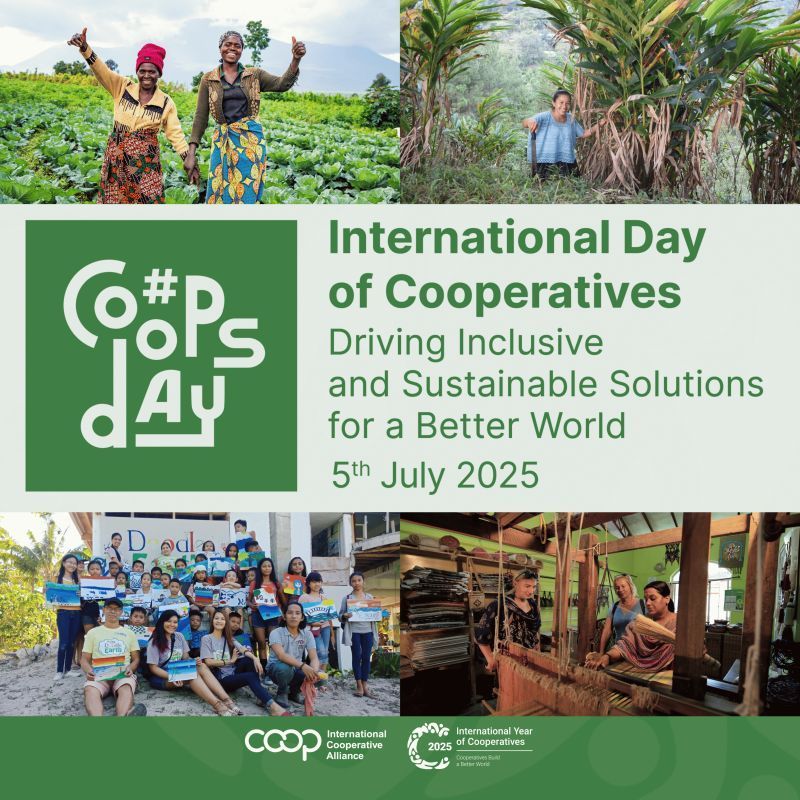
International Day of Cooperatives 2025; July 5th.

5 July


FORUM: "Cooperatives: Driving Inclusive and Sustainable Solutions for a Better." International Day of Cooperatives 2025. Cooperatives operate in every sector of the economy worldwide—agriculture, finance, housing, health and care, education, energy, retail, industry and services —and have consistently demonstrated their ability to advance social justice, economic democracy, and ecological sustainability while offering efficient, innovative and inclusive solutions to community needs.


International Day of Cooperatives 2025


Today the global cooperative movement will be celebrating the International Day of Cooperatives (CoopsDay) by highlighting what can be achieved through the power of cooperation. Themed “Driving inclusive and sustainable solutions for a better world”, CoopsDay is an opportunity to raise awareness about cooperatives’ role in delivering evidence-based, people-centred solutions. This year’s CoopsDay is a special celebration due to 2025 being the second United Nations International Year of Cooperatives. Cooperatives are active in every sector of the economy, including agriculture, finance, retail, housing, healthcare, education, energy, industry and services. They employ 10% of the world’s population, providing decent employment and advancing social justice, economic democracy, and ecological sustainability. Their track record of promoting the economic and social development of all people, including marginalised groups, was recognised in the 2023 UN Secretary-General Report on Cooperatives in Social Development. Follow the conversation with the hashtags: #coops4sdgs#CoopsDay#6july#Sustainability#Cooperatives.

EVENTS: In his message at the occasion of the International Year of Cooperatives 2025 launch, the Secretary-General António Guterres highlighted how “cooperatives are driving development across communities large and small, fighting poverty and social inclusion, strengthening food security, helping local entrepreneurs across international markets. Your united efforts are essential as our world confronts complex challenges and strives to achieve the sustainable development goals”.

ICA President Ariel Guarco says the day is one of the most important moments since the global movement began celebrating the International Day of Cooperatives over a century ago.

“Now is the time to strengthen that impact and expand the reach of our actions—actions rooted in the principles and values that unite us and guide our daily work toward the common good. Thanks to this identity, we remain strong around the world. And at the same time, we’re able to express cooperative principles in every region, culture, and country, adapting our values to each community's development strategy. In this way, we offer local solutions to global challenges—and we can truly live out our motto: that cooperatives build a better world,” he added.

The day also falls during the Festival of Co-operatives, which is currently being held in Manchester and Rochdale, UK, to celebrate the United Nations International Year of Cooperatives and the 130th anniversary of the ICA. The event, which includes the ICA General Assembly and the UK's national Co-op Congress, features a range of activities, including visits to FC United of Manchester, Hulme Community Garden Centre, Unicorn Grocery cooperative and the Rochdale Pioneers Museum, in the birthplace of the modern-day cooperative movement. The festival is hosted by The Co-operative Group and Co-operatives UK.


 The Committee for the Promotion and Advancement of Cooperatives (COPAC) is pleased to announce the official theme for the 2025 International Day of Cooperatives (CoopsDay): “Cooperatives: Driving Inclusive and Sustainable Solutions for a Better World.”. To be celebrated on Saturday, 5 July 2025, this year’s CoopsDay will serve as a flagship moment within the United Nations International Year of Cooperatives (IYC2025)—a once-in-a-decade opportunity to spotlight the critical role of cooperatives in building more inclusive, resilient, and sustainable communities. As the world confronts intensifying economic and climate-related crises, persistent inequality, and fragile social protection systems, the 2025 CoopsDay theme calls attention to the powerful role of cooperatives in delivering evidence-based, people-centered solutions.

CoopsDay 2025 aligns with two major global policy processes:

The United Nations High-Level Political Forum (HLPF), which will review progress on SDGs 3 (Good Health and Well-being), 5 (Gender Equality), 8 (Decent Work and Economic Growth), 14 (Life Below Water), and 17 (Partnerships for the Goals; and The Second World Summit for Social Development (WSSD2), which will focus on social inclusion, poverty eradication, and sustainable development.

In 2025, the celebration marks The 103rd International Cooperative Day, and The 31st UN International Day of Cooperatives. The theme is selected jointly by the International Cooperative Alliance (ICA) and COPAC, in consultation with UN partners and the cooperative movement.


For media inquiries, interviews, or contributions to CoopsDay 2025:
📧 Email: copac@copac.coop
🌐 Website: About CoopsDay 2025

Message from the ICA President Ariel Guarco for the 103rd International Day of Cooperatives.


Dear cooperative friends,

This is not just another day. On July 5, we will celebrate our Day in the International Year of Cooperatives.

I believe this is one of the most important moments since we first began celebrating the International Day of Cooperatives over a century ago.

We are gaining greater prominence on the global stage, as reflected in the recognition from the United Nations and other international organizations of our cooperative socio-business model.

That’s why we also have the responsibility to turn this global recognition into concrete, sustainable, and inclusive solutions in every place where we are present.

Surely, this is already happening in every community where there is a cooperative.

Now is the time to strengthen that impact and expand the reach of our actions—actions rooted in the principles and values that unite us and guide our daily work toward the common good.

Thanks to this identity, we remain strong around the world. And at the same time, we’re able to express cooperative principles in every geography, culture, and country, adapting our values to each community's development strategy.

In this way, we offer local solutions to global challenges—and we can truly live out our motto: that cooperatives build a better world.

We’re not doing it alone. We invite others—economic, social, political actors from both the public and private sectors—to join us in building a future that is prosperous, inclusive, and peaceful.

That’s why, this July 5, we open the doors of our cooperatives and celebrate together with our members, neighbors, and communities.

Together, we proudly say: Happy International Day of Cooperatives!

Let’s keep building inclusive and sustainable solutions for a better world!

Watch the full video here.


OTHER STATEMENTS

“This year’s theme speaks to both the identity and urgency of the cooperative model. In a time of global uncertainty, cooperatives are proving that development can be democratic, inclusive, and grounded in solidarity. CoopsDay 2025, celebrated during the International Year of Cooperatives, is a powerful opportunity to amplify that message to the world." (Wenyan Yang, COPAC Chair)

"Across the globe, cooperatives are demonstrating that a values-driven enterprise approach can deliver real and lasting solutions. International Day of Cooperatives 2025 is a moment to recognize this collective strength and reaffirm our dedication to an inclusive and sustainable path forward.” (Jeroen Douglas, Director General of the International Cooperative Alliance)


Get Involved!

As part of IYC2025, CoopsDay offers a platform for cooperatives to increase visibility, forge partnerships, and engage new audiences. A refreshed CoopsDay logo—aligned with the IYC visual identity—has been released for use in promotional materials.

Cooperatives and partners are encouraged to:

Visit the updated CoopsDay website:About CoopsDay 2025
Utilize the updated CoopsDay logo and Media Kit logo: International Day of Cooperatives 2025

Submit or view events on the IYC events platform:Events Portal – Events Portal

Share your cooperative story: Home.


About the United Nations International Year of Cooperatives 2025

On 19 June 2024, the United Nations General Assembly adopted a resolution proclaiming 2025 as the International Year of Cooperatives. The text recommends ways to celebrate and encourages all Member States, the United Nations, and relevant stakeholders to leverage this event to promote cooperatives’ contribution to social and economic development. Among others, Member States are also invited to consider establishing national committees to coordinate and prepare for all IYC 2025 activities.


About the International Day of Cooperatives

The International Day of Cooperatives has been celebrated globally by the International Cooperative Alliance since 1923 and was officially recognized by the United Nations in 1995. It is held every year on the first Saturday of July to increase awareness of cooperatives’ contributions to development and peace.


About The COPAC

The Committee for the Promotion and Advancement of Cooperatives (COPAC) is a multi-stakeholder partnership that promotes and supports people-centered and self-sustaining cooperative enterprises as key actors in sustainable development.

COPAC’s membership includes the United Nations Department of Economic and Social Affairs (UNDESA), the International Labour Organization (ILO), the Food and Agriculture Organization of the United Nations (FAO), the International Trade Centre (ITC), the United Nations Research Institute for Social Development (UNRISD), and the International Cooperative Alliance (ICA).

Together, COPAC works to ensure cooperatives are recognized in global policy processes and supported through enabling environments—particularly in advancing decent work, inclusive economies, gender equality, sustainable food systems, and the 2030 Agenda for Sustainable Development.


LIVESTREAM: International Day of Cooperatives 2025 Hybrid event entitled "Driving Inclusive and Sustainable Solutions for a Better World".

With less than five years to go to the 2030 deadline for reaching the sustainable development goals, the world is facing many challenges including persistent poverty, the climate emergency, economic shocks, conflict and growing insecurity. Progress towards achieving the Sustainable Development Goals is severely off-track. In a bid to resolve multiple global crises, United Nations Member States recently adopted the Pact for The Future, a commitment with ambitious and transformative actions to accelerate progress towards achieving the goals. Cooperatives operate in diverse sectors covering social, economic and environmental aspects of sustainable development. To mark the International Day of Cooperatives 2025, the Committee for the Promotion and Advancement of Cooperatives (COPAC); in collaboration with the United Nations Federal Credit Union and the New York City Department of Small Business Services; is holding an event to mark the International Day of Cooperatives  at the United Nations Headquarters in New York to highlight the role of Cooperatives.
Related Documents: Concept note.

Wednesday, 18 September 2024

International Equal Pay Day 2024; September 18th.


FORUM
: “Pay of the Future: Solutions to close the Gender Pay Gap.International Equal Pay Day 2024. The Gender Pay Gap remains critical, with women earning about 20% less than men globally. During the day, we will celebrate achievements and discuss the challenges on the way to achieving equal pay as well as provide an opportunity for you to make a new equal pay pledge. Across all regions, women are paid less than men, with the gender pay gap estimated at around 20% globally. Gender equality and the empowerment of women and girls continue to be held back owing to the persistence of historical and structural unequal power relations between women and men, poverty and inequalities and disadvantages in access to resources and opportunities that limit women’s and girls’ capabilities. Progress on narrowing that gap has been slow. While equal pay for men and women has been widely endorsed, applying it in practice has been difficult. The Sustainable Development Goals (SDGs) promote decent work and economic growth by seeking full and productive employment and decent work for all women and men, including for young people and persons with disabilities, and equal pay for work of equal value. Mainstreaming of a gender perspective is crucial in the implementation of the 2030 Agenda for Sustainable Development. Achieving equal pay is an important milestone for human rights and gender equality. It takes the effort of the entire world community and more work remains to be done. Follow the conversation with the hashtags #EqualPayDay, #GenerationEquality, #SDG5, #EqualPay and #18September.


EVENTS: You are invited attend a High-Level Pledging Event to mark International Equal Pay Day 2024 on September 18th, from 5:30 to 7:30 pm EDT organized by the Equal Pay International Coalition (EPIC), which is led by the International Labour Organization , the UN Women, and the Organization for Economic Cooperation and Development (OECD). The participants are invited to share lessons learned and good practices that can be adapted and applied to different contexts. The event will also highlight multi-stakeholder and whole-of-society approaches that are effecting change, in line with the reinvigoration of multilateralism seen at the Summit of the Future 2024. Register to participate!


INFOGRAPHICS: Eliminating the gender pay gap can provide incentives for more women to be economically active, which would advance gender equality and create a virtuous circle. 

What causes the gender pay gap?

Studies have linked increased labour participation rates of women with higher levels of GDP. The ILO estimates that reducing the gap in participation rates between men and women by 25 per cent by the year 2025, could raise global GDP by 3.9 per cent, or US$5.8 trillion.

High Income Countries - Mean gender pay gaps using monthly earnings, selected countries by income group.

High Income Countries - Mean gender pay gaps using monthly earnings, selected countries by income group


Upper-middle income - Mean gender pay gaps using monthly earnings, selected countries by income group.
Upper-middle income - Mean gender pay gaps using monthly earnings, selected countries by income group


Lower-middle income Countries - Mean gender pay gaps using monthly earnings, selected countries by income group.

Lower-middle income Countries - Mean gender pay gaps using monthly earnings, selected countries by income group
Low income Countries - Mean gender pay gaps using monthly earnings, selected countries by income group.

Low income Countries - Mean gender pay gaps using monthly earnings, selected countries by income group


The gender pay gap in management for selected countries, latest available year


Monday, 19 February 2024

World Day of Social Justice 2024; February 20th.

FORUM: "Global Coalition for Social Justice: Bridging Gaps, Building Alliances." World Day of Social Justice 2024. The theme this year provides an opportunity to foster dialogue on actions needed to achieve social justice by strengthening the social contract that has been fractured by rising inequalities, conflicts and weakened institutions that are meant to uphold and protect the rights of workers. As we have passed the half-way milestone towards the achievement of the 2030 Agenda, we must redouble our efforts to promote inclusive and sustainable economic growth, employment and decent work for all by focusing on the four interrelated and interdependent dimensions of social justice: universal human rights and capabilities include, which include among others, access to an adequate standard of living, education, healthcare and social security; equal access to opportunities for employment and productive activity that enable people to pursue their material well-being in conditions of economic security; fair distribution outcomes including a just share of the benefits of economic growth, with attention to the most disadvantaged or vulnerable in society; and just transitions on the significant transformations affect people’s well-being over time, which include transformations associated with globalization, technological, demographic, environmental and other transformations, and compounding crises.


By focusing on bridging gaps and building alliances in support of the Global Coalition for Social Justice, we can ensure the promise of enabling our societies and economies to function more cohesively and effectively; unlock the productive potential of countries and people; pave the way for sustained reductions in poverty and inequality – prerequisites for inclusive growth; and contribute to peace, stability and inter-generational solidarity.

Follow the conversations with the hashtags: #20February, #SocialJusticeDay.


EVENTS: On February 20th, from 1:30-2:30 PM. (EST) Room TBC at UNHQ. The International Labour Organization (ILO) brings together leading figures from academia, politics and the world of work with the ILO Director-General to discuss how to advance social justice in the world. The conference will be held by the Permanent Mission of the Kyrgyz Republic to the UN and the International Labour Organization (ILO), in partnership with the International Telecommunication Union (ITU) and the United Nations Conference on Trade and Development (UNCTAD) and the UN Department of Economic and Social Affairs (UN DESA).

PANEL DISCUSSION: "Global Coalition for Social Justice: Bridging Gaps, Building Alliances". In support of the Global Coalition for Social Justice, a ground-breaking initiative aimed at intensifying collective efforts to urgently address social justice deficits and accelerate the implementation of the 2030 Agenda for Sustainable Development, the Sustainable Development Goals and the Decent Work Agenda, the 2024 commemorative event will highlight the crucial role of international collaboration and solidarity in addressing social justice within the framework of multilateralism. Moreover, it will be a timely opportunity to emphasize the prioritization of social justice at key intergovernmental milestones of the United Nations this year. This includes the Fourth International Conference on Small Island Developing States, the Third United Nations Conference on Landlocked Developing Countries, the Summit of the Future, as well as preparations for the World Social Summit. Get the agenda Programme and Watch the Commemorative Event.

Thursday, 27 April 2023

World Day for Safety and Health at Work 2023; April 28th.


FORUM: "A safe and healthy working environment is a fundamental principle and right at work."World Day for Safety and Health at Work 2023.

Join the International Labour Organization global dialogue on how to implement a safe and healthy working environment as a fundamental principle and right at work. and why safety and health at work is essential for social justice. One of the main pillars of the Global Strategy is advocacy, the World Day for Safety and Health at Work is a significant tool to raise awareness of how to make work safe and healthy and of the need to raise the political profile of occupational safety and health. April 28th is also the International Commemoration Day for Dead and Injured Workers organized worldwide by the trade union movement since 1996. Follow the conversation wirh the hashtags: #WorldDayofSafetyandHealthatwork, #28April, #SafeWorkingEnvironment, #HealthyWorkingEnvironment. #Rightatwork.

EVENTS: On 28 April 2023, the ILO during the 2023 World Day for Safety and Health at work event will celebrate this decision, bringing together experts and constituents to discuss the implications it has for the world of work, as well as how to practically implement this right in the world of work. It will also serve to present the findings of research on the implementation status of various provisions of the fundamental Convention No. 155 and the Convention No. 187.


Stay tume to watch the Livestream on Friday, 28 April from 13:30 to 15:00 CEST; on How can we promote the fundamental right to a safe and healthy working environment?


STATEMENTS
Statement from ILO Director-General on World Day for Safety and Health at work 2023; April 28th.

10 years ago this month, more than eleven hundred workers died and thousands were injured when the Rana Plaza building collapsed.

I visited Bangladesh in the days after. I remember the shock and pain of the victims and families. Dealing not just with bereavement, but with the loss of bread-winners, their security, incomes and futures.

There could be no more brutal lesson about the importance of occupational safety and health.

We have an essential responsibility to ensure that people go to work and come home alive, uninjured, and healthy.

This year, on World Day for Safety and Health at Work, we can celebrate an important step towards this goal. The designation of a safe and healthy working environment as a fundamental principle and right at work.

All ILO Member States are now expected to respect, realize, and promote this principle, and the two fundamental conventions at its core.

It is the start of a long journey. But it is a step in the right direction, towards decent work and social justice for all.

ILO Director General, Mr.Gilbert H. Houngbo.


CAMPAIGN MATERIALS


PUBLICATION: Report on Implementing a safe and healthy working environment: Where are we now?

Thursday, 16 February 2023

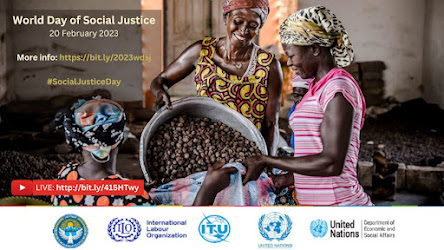
World Day of Social Justice 2023; February 20th.

FORUM: "How to deliver a sustained dose of social justice." World Day of Social Justice 2023.

The 2023 World Day of Social Justice provides an opportunity to foster dialogue on actions needed to achieve social justice by strengthening the social contract that has been fractured by rising inequalities, conflicts and weakened institutions that are meant to uphold and protect the rights of workers. Key Questions for Discussion: • What are the key bottlenecks and challenges to overcoming rising inequalities, decent work deficits, including lack of access to social protection, digital exclusion and disruption of trade? • What are the opportunities in the green and digital economy to reduce inequalities and promote social justice, in particular for youth? • What actions are needed by governments, the UN system, international financial institutions, employers’ and workers’ organisations, civil society and other stakeholders to increase investments for social justice?
The International Labour Organization (ILO) brings together leading figures from academia, politics and the world of work with the ILO Director-General to discuss how to advance social justice in the world. Follow the conversations with the hashtags: #20February, #SocialJusticeDay.


EVENTS: Overcoming Barriers and Unleashing Opportunitiesfor Social Justice.” The World Day of Social Justice 2023 event aims to increase understanding of multiple global challenges and related social justice deficits and will propose concrete actions to achieve international development goals, including through a new global social contract.