Showing posts with label International Day of the Victims of Enforced Disappearances. Show all posts

Saturday, 30 August 2025

International Day of the Victims of Enforced Disappearances 2025; August 30th.


FORUM: "Stand up for the rights of the disappeared." International Day of the Victims of Enforced Disappearances 2025. The United Nations and regional human rights experts urged all States to provide effective access to justice for victims of enforced disappearance, that include any individual who has suffered harm as the direct result of an enforced disappearance. Follow the conversations with the hashtags: #enforceddisappearances, #30August, #access2justice,#InternationalDayOfVictimsOfEnforcedDisappearances.

International Day of the Victims of Enforced Disappearances 2025


EVENTS: On August 30th; The International Day of the Victims of Enforced Disappearances 2025 will be held at the United Nations Palace in Geneva and at UNHQ in New York. The United Nations invites authorities to strengthen operational and technical capacities, including the provision of training in mass grave exhumations, crime scene management, and mortuary procedures; to provide guidance on effective operational planning, inter-agency cooperation, chain of custody, and the upgrade mortuary facilities. In the context of the 76th anniversary of the Universal Declaration of Human Rights, the Committee on Enforced Disappearances, the Working Group on Enforced or Involuntary Disappearances, the Inter-american Commission on Human Rights, the Chairperson of the Working Group on Death Penalty, Extrajudicial, Summary or Arbitrary Killings of the African Commission on Human and Peoples’ Rights and the Representatives of Indonesia and Malaysia to the ASEAN Intergovernmental Commission on Human Rights jointly called on all States to make pledges to promote justice for all victims of enforced disappearances without delay, and to ratify international and regional instruments on enforced disappearances. Register to participate!

On 15 and 16 January 2025 in Geneva, Switzerland. The forthcoming World Congress on Enforced Disappearances, which will take place, presents a crucial opportunity to bring States, victims and their representative organisations, national human rights institutions and experts together to find actionable solutions to eliminate and prevent enforced disappearances and promote the universal ratification of the International Convention for the Protection of all Persons against Enforced Disappearances. The World Congress will allow us to identify and adopt concrete actions to address these concerns and pledge to implement them under our respective mandates. We encourage all actors involved in the fight against enforced disappearances to make the most of this event and to commit to concrete action. On this International Day of the Victims of Enforced Disappearances, we reiterate our shared commitment to assisting victims worldwide and our call for collective action to end this scourge, once and for all.” The first World Congress on Enforced Disappearances provided a platform to share experiences, challenges, and best practices. This crucial step in shaping a collective path toward justice, truth, reparation, and the prevention of future disappearances, showed once again the urgency that all States ratify the Convention for the Protection of all Persons against Enforced Disappearances.


PUBLICATIONS: 2024 Report of the Working Group on Enforced or Involuntary Disappearances; This report reflects the activities of the WGEID, communications and cases that it processed during the reporting period. It also includes the main findings and observations on the thematic study on enforced disappearances and elections. Explore the Thematic report: Enforced disappearances and elections -A/HRC/57/54/Add.4 and the full report. A/HRC/57/54.

STATEMENTS: The United Nations and regional human rights experts issued a joint statement today, urging all actors to join forces immediately to support victims of enforced disappearance and ensure that their rights and obligations as codified in regional and international treaties and other legal instruments. Read the full Statement by Human Rights experts ahead of the International Day of the Victims of Enforced Disappearances 2025; August 30th.


Enforced disappearances entail a serious violation of multiple human rights, inflicting profound suffering, experienced not only by those who are forcibly disappeared, but also by their families, their communities, and by society as a whole. They are often practiced as a deliberate strategy of control through terror intended to cause suffering, instill fear, suppress dissent, and punish entire communities. Their commission involves varying degrees of participation, acquiescence, or omission by State agents.

Any act of enforced disappearance places the persons subjected thereto outside the protection of the law and at high risk of being subjected to serious human rights violations. It constitutes a violation of both international and domestic laws that guarantee, among others, the right to recognition as a person before the law, the right to liberty and security of the person and the right not to be subjected to torture and other cruel, inhuman or degrading treatment or punishment. It also constitutes a grave threat to the right to life.

The prolonged isolation and deprivation of communication with the outside world, to which forcibly disappeared persons are subjected, are harmful to their psychological integrity and that of their relatives, and constitute a violation of the prohibition of torture and/or other cruel, inhuman or degrading treatment.

Enforced disappearances prevent monitoring by national preventive mechanisms and other competent bodies, facilitating the commission of torture and/or other forms of cruel treatment. Decades of documentation of this heinous crime show how the practice has often served as a means to circumvent fundamental legal safeguards, including limitations to the duration of deprivation of liberty and the prohibition of violent interrogation methods.

Various international and regional human rights bodies, including the Inter-American Court of Human Rights, the Inter-American Commission on Human Rights, the African Commission on Human and Peoples? Rights, the Committee against Torture, the Human Rights Committee, and the European Court of Human Rights, have recognized enforced disappearances as a form of torture or other ill-treatment against the forcibly disappeared individuals and/or their families.

The Committee on Enforced Disappearances and the Working Group on Enforced or Involuntary Disappearances view with concern the continuous torture inflicted upon the relatives of the forcibly disappeared persons. The daily anguish of not knowing their fate and whereabouts, the fear of never seeing them again, as well as the silence, inaction, official indifference, and impunity that usually surround this crime, inflict on relatives unimaginable pain and despair. Scores of heart-breaking testimonies by family members refer to these experiences as a form of psychological torture or cruel treatment.

The psychological toll on family members is devastating and transgenerational, entailing lasting physical and mental health consequences such as depression, anxiety and profound trauma. Women, in particular, often bear a disproportionate burden, in most cases abruptly having to assume new roles as search organizers, advocates, on top of the additional caring or financial responsibilities they have to assume to their families.

Children grow up in the shadows of fear, doubt and anxiety created by the enforced disappearance, and the rupture of the family structure.

On this International Day of the Victims of Enforced Disappearances, we urgently call on all States to strengthen their policies to prevent and eradicate this crime and to guarantee the right of relatives of disappeared persons and society as a whole to know the truth about the fate and whereabouts of those forcibly disappeared, as well as access to justice and integral reparations. We acknowledge the shared aspiration that was recalled by all participants to the World Congress on Enforced Disappearance in January 2025 for truth, healing, and dignity, and reaffirm the value of constructive dialogue and cooperation in fostering a more humane and caring society.

Enforced disappearance is a wound that corrodes the fabric of society. It is a form of torture and/or other cruel, inhuman or degrading treatment or punishment that must be condemned unequivocally, prevented and eradicated through collective action, effective prevention, accountability, and sustained support for victims, including through the implementation of the pledges made at the World Congress on Enforced Disappearances.

We stand in solidarity with all those affected by enforced disappearances and reaffirm our commitment to truth, justice, rehabilitation, and reparations for all victims.

This is the occasion for the remaining States that have not yet ratified the International Convention for the Protection of all Persons against Enforced Disappearance and the Inter- American Convention on Forced Disappearance to do their part to eradicate this heinous crime, starting with committing today to ratify them.

OHCHR Experts Joint Statement.

The UN expert of the WGEID to review of 689 cases of Enforced disappearances from 41 countries at its 135th Session from 27 to 31 January 2025.


Thursday, 29 August 2024

International Day of the Victims of Enforced Disappearances 2024; August 30th.


FORUM: "Finding Actionable solutions to eliminate and prevent enforced disappearances." International Day of the Victims of Enforced Disappearances 2024. The United Nations and regional human rights experts urged all States to provide effective access to justice for victims of enforced disappearance, that include any individual who has suffered harm as the direct result of an enforced disappearance. Follow the conversations with the hashtags: #enforceddisappearances, #30August, #access2justice,#InternationalDayOfVictimsOfEnforcedDisappearances.

International Day of the Victims of Enforced Disappearances 2024


EVENTS: On August 30th; The International Day of the Victims of Enforced Disappearances 2024 will be held at the United Nations Palace in Geneva and at UNHQ in New York. The United Nations invites authorities to strengthen operational and technical capacities, including the provision of training in mass grave exhumations, crime scene management, and mortuary procedures; to provide guidance on effective operational planning, inter-agency cooperation, chain of custody, and the upgrade mortuary facilities. In the context of the 76th anniversary of the Universal Declaration of Human Rights, the Committee on Enforced Disappearances, the Working Group on Enforced or Involuntary Disappearances, the Inter-american Commission on Human Rights, the Chairperson of the Working Group on Death Penalty, Extrajudicial, Summary or Arbitrary Killings of the African Commission on Human and Peoples’ Rights and the Representatives of Indonesia and Malaysia to the ASEAN Intergovernmental Commission on Human Rights jointly called on all States to make pledges to promote justice for all victims of enforced disappearances without delay, and to ratify international and regional instruments on enforced disappearances.

On 15 and 16 January 2025 in Geneva, Switzerland. The forthcoming World Congress on Enforced Disappearances, which will take place, presents a crucial opportunity to bring States, victims and their representative organisations, national human rights institutions and experts together to find actionable solutions to eliminate and prevent enforced disappearances and promote the universal ratification of the International Convention for the Protection of all Persons against Enforced Disappearances. The World Congress will allow us to identify and adopt concrete actions to address these concerns and pledge to implement them under our respective mandates. We encourage all actors involved in the fight against enforced disappearances to make the most of this event and to commit to concrete action. On this International Day of the Victims of Enforced Disappearances, we reiterate our shared commitment to assisting victims worldwide and our call for collective action to end this scourge, once and for all.”

Statement by Human Rights experts ahead of the International Day of the Victims of Enforced Disappearances 2024; August 30th.
UN* and regional** human rights experts issued a joint statement today, urging all actors to join forces immediately to support victims of enforced disappearance and ensure that their rights and obligations as codified in regional and international treaties and other legal instruments, become a reality for all:

“Victims of enforced disappearance include any individual who has suffered harm as a direct result. They still face unbearable challenges, and impunity prevails. We renew our solidarity with victims of enforced disappearance, as well as organisations, human rights defenders and lawyers that support them.

Despite ongoing attempts to search for truth, justice and reparation, and even with the specialised national, regional and international frameworks in place, victims and those that support them are too often met with silence, or with the rejection of their allegations.

Clear commitments and action plans remain necessary.

Progress can be achieved when all concerned parties work together. The forthcoming World Congress on Enforced Disappearances, which will take place in Geneva, Switzerland, on 15 and 16 January 2025, presents a crucial opportunity to bring States, victims and their representative organisations, national human rights institutions and experts together to find actionable solutions to eliminate and prevent enforced disappearances and promote the universal ratification of the International Convention for the Protection of all Persons against Enforced Disappearances.

The World Congress will allow us to identify and adopt concrete actions to address these concerns and pledge to implement them under our respective mandates. We encourage all actors involved in the fight against enforced disappearances to make the most of this event and to commit to concrete action. On this International Day of the Victims of Enforced Disappearances, we reiterate our shared commitment to assisting victims worldwide and our call for collective action to end this scourge, once and for all.”


*UN experts: Ms. Aua Baldé (Chair-Rapporteur), Ms. Gabriella Citroni (Vice-Chair); Ms. Grażyna Baranowska, and Ms. Ana-Lorena Delgadillo Pérez, of the Working Group on Enforced or Involuntary Disappearances; Mr. Juan Pablo Albán Alencastro (Rapporteur), Mr. Mohammed Ayat, Mr. Matar Diop (Vice Chair), Mr. Olivier de Frouville (Chair), Ms. Suela Janina, Mr. Fidelis Kanyongolo, Ms. Milica Kolakovic-Bojovic (Vice Chair), Ms. Barbara Lochbihler, Mr. Horacio Ravenna (Vice Chair), and Ms. Carmen Rosa Villa Quintana, of the UN Committee on Enforced Disappearances. **Regional Human Rights Experts: Inter-American Commission on Human Rights; Hon. Idrissa Sow (Chairperson), Working Group on Death Penalty, Extrajudicial, Summary or Arbitrary Killings, African Commission on Human and Peoples’ Rights; Ms. Yuyun Wahyuningrum, Representative of Indonesia and Prof. Dr. Amara Pongsapich, Representative of Thailand of the ASEAN Intergovernmental Commission on Human Rights; and Mr. Michael O' Flaherty, Commissioner for Human Rights of the Council of Europe.

Tuesday, 29 August 2023

International Day of the Victims of Enforced Disappearances 2023; August 30th.

 FORUM:"Justice must be guaranteed without delay to allvictims." International Day of the Victimsof Enforced Disappearances 2023

United Nations and regional human rights experts urged all States to provide effective access to justice for victims of enforced disappearance, that include any individual who has suffered harm as the direct result of an enforced disappearanceFollow the conversations with the hashtags: #enforceddisappearances#30August#access2justice,#InternationalDayOfVictimsOfEnforcedDisappearances.


EVENTS: International Day of the Victims of Enforced Disappearances 2023. In the context of the 75th anniversary of the Universal Declaration of Human Rights, the Committee on Enforced Disappearances, the Working Group on Enforced or Involuntary Disappearances, the Interamerican Commission on Human Rights, the Chairperson of the Working Group on Death Penalty, Extrajudicial, Summary or Arbitrary Killings of the African Commission on Human and Peoples’ Rights and the Representatives of Indonesia and Malaysia to the ASEAN Intergovernmental Commission on Human Rights jointly called on all States to make pledges to promote justice for all victims of enforced disappearances without delay, and to ratify international and regional instruments on enforced disappearances.

Access to justice must not be merely theoretical, but guaranteed in practice through concrete measures that promote and fully value the genuine and meaningful participation of victims and their representatives throughout the process,” the experts said.


Statement by Human Right experts ahead of the International Day of the Victims of Enforced Disappearances 2023; August 30th.

Ahead of the International Day of the Victims of Enforced Disappearances, the Committee on Enforced Disappearances, the Working Group on Enforced or Involuntary Disappearances, the Interamerican Commission on Human Rights, the Chairperson of the Working Group on Death Penalty, Extrajudicial, Summary or Arbitrary Killings of the African Commission on Human and Peoples’ Rights and the Representatives of Indonesia and Malaysia to the ASEAN Intergovernmental Commission on Human Rights* urged all States to provide effective access to justice for victims of enforced disappearance, that include any individual who has suffered harm as the direct result of an enforced disappearance. “As we celebrate the 75th anniversary of the adoption of the Universal Declaration of Human Rights, we invite all States to reinvigorate access to justice at the national level and to finance and support Sustainable Development Goal 16 globally – the promotion of just, peaceful and inclusive societies. In this context, it is key to recall that the inextricable link between justice and truth is critical in cases of enforced disappearance. The right of victims to access justice entails taking all the necessary steps to seek out the truth. When a person disappears and then is located, justice requires the thorough investigation of the enforced disappearance, and its circumstances, as well as the identification, prosecution, and sanction of the perpetrators. When the fate or whereabouts of disappeared persons are unknown, justice also encompasses an obligation to search for them immediately. Ensuring adequate access to justice and, as a result, proper accountability for perpetrators at all levels of responsibility in the chain of command, is indispensable to convey that enforced disappearances are not permitted or tolerated. It also serves both as a preventive measure and as a guarantee of non-repetition, and is closely intertwined with reparation, emphasized the experts. Access to justice must not be merely theoretical, but guaranteed in practice through concrete measures that promote and fully value the genuine and meaningful participation of victims and their representatives throughout the process. States must guarantee the launch of the search and investigation without delay, as soon as authorities are informed of an alleged enforced disappearance, even in the absence of an official complaint. To have any chance of locating disappeared persons alive, time is of the essence. In the very few cases where justice is achieved, this too often occurs years after the enforced disappearance began, when some relatives have already passed away, after a life of anguish. ‘Justice delayed is justice denied’, even more so in the case of enforced disappearances. Likewise, access to justice must include both efforts to determine the truth and hold those responsible for the enforced disappearance accountable, as well as addressing the harm suffered by the victims. We urge States to guarantee victims’ effective access to justice and ensure that their right to redress is adequately upheld. Many relatives experience diverse and intersecting vulnerabilities which are intensified by the disappearance of their loved one, making it harder to claim their rights. Given that in cases of enforced disappearance most of those left behind are women, it is particularly important to incorporate a gender perspective into any measure aimed at providing search, truth, justice, reparation and redress to victims. Regarding the obstacles experienced by different actors, often victims face threats, intimidation, reprisals and stigmatisation in their struggle for truth and justice. The same applies to organizations and lawyers acting on their behalf. This must end, and victims must be given access to free legal aid to ensure that one’s finances are not a barrier to accessing justice. Given that in many cases enforced disappearance may be a transnational crime, cooperation and mutual legal assistance between States must be strengthened and systematized, as are measures to assist victims in ensuring their access to justice in other States. We renew our solidarity with victims of enforced disappearances, organisations that support them, human rights defenders and lawyers who, despite the often hostile and dangerous environment in which they operate, continue their struggle for truth, justice, memory and non-repetition. We call on all States to mark the 75th anniversary of the Universal Declaration of Human Rights to make pledges to promote justice without delay for all victims of enforced disappearances. Particularly, we call on States that have not yet done so to ratify the international and regional instruments on enforced disappearances.


CAMPAIGN: Ensuring adequate access to justice and proper accountability for perpetrators at all levels of the chain of command is critical.

The Committee on Enforced Disappearances is one of the United Nations Treaty Bodies. It gathers 10 independent experts in charge of monitoring the implementation of the Convention for the Protection of all Persons against enforced disappearances by States parties. These experts are persons of high moral character and recognized competence in the field of human rights, nominated by States parties to the Convention. They serve in their personal capacity and are independent and impartial. To date, the Convention has been ratified by 72 member States. 

The Working Groups are part of what is known as the Special Procedures of the Human Rights Council. Special Procedures, the largest body of independent experts in the UN Human Rights system, is the general name of the Council’s independent fact-finding and monitoring mechanisms that address either specific country situations or thematic issues in all parts of the world. Special Procedures’ experts work on a voluntary basis; they are not UN staff and do not receive a salary for their work. They are independent from any government or organization and serve in their individual capacity.

 ** Other human rights bodies: 

The Inter-American Commission on Human Rights (IACHR) - IACHR is a principal, autonomous body of the Organization of American States (OAS) deriving its mandate from the OAS Charter and the American Convention on Human Rights. The InterAmerican Commission has a mandate to promote respect for and to defend human rights in the region and acts as a consultative body to the OAS in this area. The Commission is composed of seven independent members who are elected in an individual capacity by the OAS General Assembly and who do not represent their countries of origin or residence. 

The African Commission on Human and Peoples’ Rights (ACHPR) - The African Charter established the African Commission on Human and Peoples’ Rights. The Commission was inaugurated on 2 November 1987 in Addis Ababa, Ethiopia. The Commission’s Secretariat has subsequently been located in Banjul, The Gambia. In addition to performing any other tasks, which may be entrusted to it by the Assembly of Heads of State and Government, the Commission is officially charged with three major functions: the protection of human and peoples' rights; the promotion of human and peoples' rights; the interpretation of the African Charter on Human and Peoples' Rights. 

ASEAN Intergovernmental Commission on Human Rights (AICHR) - AICHR was inaugurated by the ASEAN leaders on 23 October 2009, and was enhanced with the adoption of the ASEAN Human Rights Declaration (AHRD) in November 2012. The AICHR is designed as an overarching institution with overall responsibility for the promotion and protection of human rights in ASEAN. The AICHR members are called Representatives, who are nominated by their respective Governments. Decision-making of the AICHR is based on consultation and consensus.

Monday, 29 August 2022

International Day of Victims of Enforced Disappearances 2022; August 30th.


FORUM: Honouring the families of missing peopleInternational Day of Victims of Enforced Disappearances 2022.

On the occasion of the International Day of the Disappeared, we remind states that it is first and foremost their obligation to keep families informed about what has happened to their loved ones.


Established in 1983, the International Day of Victims of Enforced Disappearances has since grown to encompass all individuals who have gone missing as a result of armed conflict or natural disaster. That now includes the thousands of migrants who disappear every year.

On the 30th of August this year, we will pay hommage to the families of those who have gone missing. These families are left, in the words of the psychologist Pauline Boss, to cope with an "ambiguous loss." "Ambiguous loss is what happens when somebody goes missing and their presence or absence cannot be clearly established," she says. "If families have no official proof that their loved one is dead or alive, they are unable to move on." Along with the pain of not knowing that only grows as years go by without answers, these families often face numerous difficulties including psycho-social, administrative, legal and economic problems.

No trace of you: Thousands of migrants are missing on the roads to Europe.

According to the International Organization for Migration, nearly 3,300 migrants went missing or deceased along the migration routes into Europe in 2021. In reality, the number is far higher.


CAMPAIGN: #notraceofyou.

The #NoTraceOfYou campaign aims to raise the public's awareness of a tragedy that is unfurling at our doorsteps and the situation of the families who are suffering in silence, often alone. Many have seen pictures of rescue boats saving migrants on overcrowded, unseaworthy boats. But for the handful of people who are rescued, how many drown? Nobody knows.

Moreover, those who make it are often unable to tell their families they are well. Losing their mobile phone, spending time in a detention centre or their own families becoming displaced – these are just some of the reasons why people lose touch .


How to help families in their search for answers?

Families can be left waiting – often for decades – to hear from their loved ones. But what can be done? The ICRC, with more than 150 years of humanitarian action protecting and assisting those in need, knows this issue well. So do the Red Cross and Red Crescent National Societies who help families look for missing relatives through their Restoring Family Links services.

In 2013, the ICRC and European National Red Cross Societies created Trace the Face, a tool specifically designed to help families find loved ones who have gone missing along the migration routes into Europe. On average, thanks to this tool, one family finds a loved one every week. Sadly of course, sometimes the person has died. But according to an ICRC report, the bodies of only 13 per cent of those recorded as lost at sea between 2014 and 2019 by the International Organization for Migration have been found and buried in Italy, Spain or Greece. Many bodies have still not been identified, leaving families in the dark. Proper and dignified management of deceased persons is vital to enable their identification and give answers to the families.

So, at the ICRC, we use forensic expertise to help authorities identify the dead and / or to locate their families. We also work to reconstruct tragic events, such as shipwrecks, drawing on a wide variety of information and sources to give the families of missing people the answers they need. Whenever possible, the ICRC engages in dialogue with States to seek to prevent people from going missing, to put in place suitable search processes and to ensure dignified management of the dead including identification procedures.


More information on the #NoTraceOfYou campaign


Sunday, 23 October 2016

International Day of the Victims of Enforced Disappearances, August 30th.


30 August
 
The classic image of a victim of enforced disappearance is that of a person being deprived of liberty, taken to a secret place of detention, and being kept there without any further contact with the outside world. Yet victims of enforced disappearances are also the parents, children, partners or friends of those who have disappeared; anguished women and men desperately seeking any information, even if only a clue, that will lead them to their loved ones.
According to the International Convention for the Protection of All Persons from Enforced Disappearance, a victim is also “any individual who has suffered harm as the direct result of an enforced disappearance”. With the support of their communities, human rights defenders, and non-governmental organizations, these victims seek and demand adequate responses from the authorities. They have a right to know the truth regarding the circumstances of these disappearances, the progress and results of any investigations, and ultimately, the fate and whereabouts of their loved ones.
All States have an obligation to investigate, prosecute and punish enforced disappearances, as well as to provide redress to its victims. However, victims often face a lack of responsiveness or outright hostility from the authorities to which they reach out. The Committee on Enforced Disappearances and the Working Group on Enforced or Involuntary Disappearances, the two main United Nations expert mechanisms in this realm, have received accounts of reprisals such as arbitrary arrests, threats, and intimidation against relatives, or against the human rights defenders, lawyers, and non-governmental organizations that support them.
On this International Day, I call on States to acknowledge that family members and friends of the disappeared are also victims, and to guarantee their right to full protection from any form of reprisals. I also urge all Member States to sign, ratify or accede to the International Convention for the Protection of All Persons from Enforced Disappearance, which includes specific provisions against the ill-treatment or intimidation of witnesses, relatives, and persons participating in the investigation of enforced disappearances.
Let us all show solidarity with the victims and their relatives as they strive to realize their right for truth and justice.
 
Ban Ki-moon
 
FORUM: International Day of the Disappeared on August 30
Hundreds of thousands of people have vanished during conflicts or periods of repression in at least 85 countries around the world.


News :
 
“Every minute counts” – UN experts raise alarm over short-term enforced disappearances International Day of the Victims of Enforced Disappearances - Tuesday 30 August 2016
GENEVA (26 August 2016) – Two United Nations expert groups on enforced disappearances called on States worldwide to prevent and eradicate enforced disappearances, including short-term enforced disappearances, and to ensure that relatives of persons deprived of their liberty are informed accurately and promptly of their detention.
Speaking ahead of the International Day of the Victims of Enforced Disappearances, the Committee on Enforced Disappearances and the Working Group on Enforced or Involuntary Disappearances also expressed their concern at allegations of intimidation and reprisals against victims of enforced disappearances and those who report their cases.
“There is no time limit, no matter how short, for an enforced disappearance to occur. Every minute counts when a person is put outside the protection of the law. And when a person is disappeared, every anguished minute spent by his or her relatives without news of that person is a minute too long.
Reports and complaints have been received of people being briefly detained by State authorities, who then refuse to acknowledge their detention, nor allow them to make contact with their family members or their counsel, depriving them temporarily of any kind of legal protection.
Under these circumstances, and whatever their duration, these detentions amount to enforced disappearances, for which the States concerned bear international responsibility. 
States have the obligation to disclose the whereabouts of persons who are deprived of their liberty; to hold them in officially recognized places of detention; and to promptly provide accurate information on their detention to their family, their counsel, or other persons with a legitimate interest.
The relatives of persons who have disappeared have the right to know the truth regarding the fate and whereabouts of their loved ones. Unfortunately, their claim for truth and justice often gives rise to intimidation and reprisals. We have received worrying reports of acts of retaliation against relatives, witnesses and human rights defenders who report cases of enforced disappearances to the authorities, or who bring them to the attention of the Working Group or the Committee.
As we commemorate the International Day of the Victims of Enforced Disappearances, we encourage all victims and their relatives to continue engaging with the UN human rights mechanisms* and to make use of the avenues available against any form of intimidation and reprisal. These include the San José Guidelines against intimidation and reprisals adopted by the treaty bodies, and the framework for action on alleged acts of intimidation and reprisal, adopted by the Special Procedures mandate holders to strengthen their ability to provide a systematic and coordinated response to this phenomenon.
We also reiterate our call to all States to ratify or accede to the International Convention for the Protection of All Persons from Enforced Disappearance, as a fundamental first step towards the prevention, and the ultimate termination, of the inadmissible practice of enforced disappearances.”


(*) How to submit urgent actions:
To the Committee on Enforced Disappearances:
To the Working Group on Enforced or Involuntary Disappearances:
Guidelines against Intimidation or Reprisals (“San José Guidelines”)
Special Procedures framework on addressing reprisals on enforced disappearances :


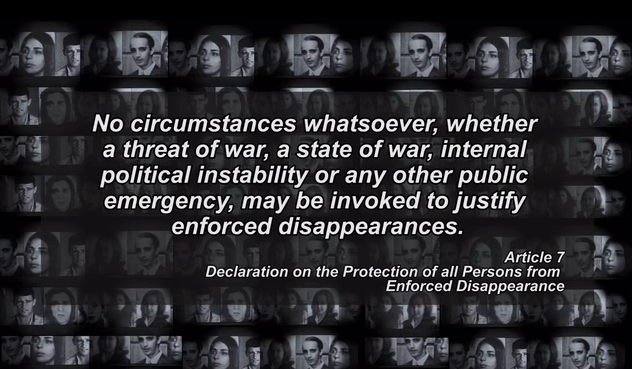
#ARTICLE7 on Enforced Disappearances