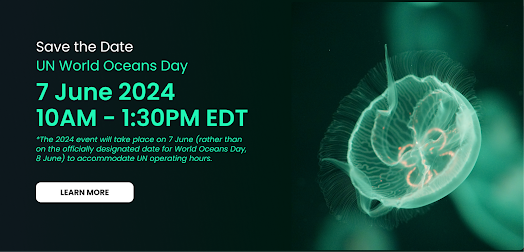
FORUM: "Awaken new depths." World Oceans Day 2024. This year theme acknowledges that while we know little of the ocean compared to its immense vastness, what we do know is that the consequences of our actions are evident throughout its waters – and that human activity is increasingly devastating the ocean as well as placing the survival of our entire blue planet at risk. Join the conversation with the hashtags: #WorldOceansDay, #8june, #OceanFirst.
EVENTS: At UNHQ, an hybrid -event hosted both virtually and in-person will be held on June 8th from 10:00 AM to 13:30 PM EDT to celebrate the United Nations World Oceans Day 2024. The event will take us on a journey of discovery through the ocean's vastness, tapping into the wisdom and expertise of global policy-makers, scientists, managers, thought leaders, and artists to awaken new depths of understanding, compassion, collaboration and commitment for the ocean and all it sustains. The celebration is hosted by the Division for Ocean Affairs and the Law of the Sea of the Office of Legal Affairs (DOALOS) in partnership with Oceanic Global.
Schedule: Depths of Commitment.
10:00 AM - Opening Remarks & Performance.
10:25 AM - Planetary Boundary Keynotes.
10:50 AM - Depths of Understanding: Science & Wisdom Fireside Chat.
11:15 AM - Depths of Compassion: New Depths Spotlights
PUBLICATION: Issued three times a year, the Bulletin provides cogent and timely information on issues related to the Convention on the Law of the Sea - ‘the constitution for the ocean’ - and contains the most recent legal materials relevant to the law of the sea. It includes national legislation, bilateral agreements and multilateral treaties as well as information on decisions of the International Court of Justice, arbitral tribunals and other dispute settlement procedures. Law of the Sea Bulletin - Current Issue.
SEMINARS, CONFERENCES AND WORKSHOPS
Advancing the united nations world ocean assessment - Supporting future ocean sustainability and informing decision making and oceans policy.
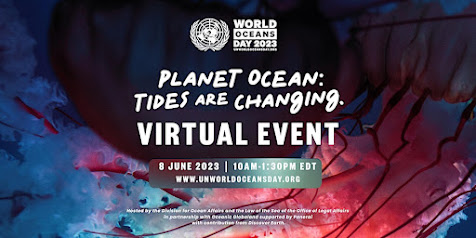
This year's theme is Planet Ocean: Tides are Changing. We need to conserve our wonderful marine resources for future generations. Our ocean needs protection. Our ocean covers 70% of the planet and supports life as we know it. Every second breath we take comes from the ocean; Our ocean feeds billions of people and hosts 80% of the world’s biodiversity. However, our oceans are in crisis.They are being threatened by pollution such as abandoned fishing nets, overfishing, bycatch, and the effects of climate change. We know the problems. We know the solutions. World Ocean Day is an opportunity to celebrate the people worldwide working hard to protect ocean ecosystems. Get involved in the conversation with the hashtags: #WorldOceansDay, #8june, #PlanetOcean, #Tidesarechanging, #BigBlueFuture, #OceanFirst.
The ocean is our planet's greatest reservoir of biodiversity.
Its resources sustain communities, prosperity and human health around the world.
Humanity counts on the ocean.
But can the ocean count on us?
We should be the ocean's best friend.
But right now, humanity is its worst enemy.
Human-induced climate change is heating our planet, disrupting weather patterns and ocean currents, and altering marine ecosystems and the species living there.
Marine biodiversity is under attack from overfishing, over-exploitation and ocean acidification.
Over one-third of fish stocks are being harvested at unsustainable levels.
And we are polluting our coastal waters with chemicals, plastics and human waste.
But this year's World Oceans Day reminds us that the tides are changing.
Last year, we adopted an ambitious global target to conserve and manage 30 per cent of land and marine and coastal areas by 2030, as well as a landmark agreement on fisheries subsidies.
At the UN Ocean Conference in Lisbon, the world agreed to push for more positive ocean action.
A global, legally binding agreement to end plastic pollution is under negotiation.
And in March, countries agreed to the historic High Seas Treaty on the conservation and sustainable use of marine biodiversity in areas beyond national jurisdiction.
Realizing the great promise of these initiatives requires collective commitment.
Sustainable Development Goal 14 — to conserve and sustainably use the ocean's resources — hangs in the balance.
This World Oceans Day, let's keep pushing for action.
Since its inception in 2008, the United Nations has celebrated World Oceans Day in recognition of the ocean’s importance as the sustainer of all life on earth. As the challenges to the ocean continue to grow, so does the need to understand them and to mobilize globally. Drawing in a global community through a series of in-person and virtual events and campaigns, the annual United Nations celebration has created an inclusive and dynamic platform, ignited a groundswell of awareness, and through multi stakeholder engagement, has yielded impactful action for the ocean and our blue planet.
To celebrate World Oceans Day 2023, the United Nations is joining forces with decision makers, scientists, private sector executives, civil society representatives, indigenous communities, celebrities and youth activists and more to put the ocean first. Through the World Oceans Day 2023 theme Planet Ocean: Tides are Changing, We will discover how Earth is more than it may seem, and generate a new wave of excitement towards cherishing and protecting the ocean and the entirety of our blue planet.
The celebration will include a mix of Keynotes, Panels, Spotlight Presentations, Art & Film Integrations and Performances, surrounding key themes including:
The Ocean As Earth’s Largest Ecosystem
Untapped Potential Opportunities for the Ocean
The Ocean x Climate Interface
Lesser Known Ecosystems & Underwater Terrains
Coastal Stewardship & Cultural Significance of The Ocean
In Australia and New Zealand - Even though World Oceans Day is a global day to celebrate our oceans, there's plenty that can be done locally to support ocean life around our coasts. Whether you live beside the Indian Ocean or South Pacific, near the Coral Sea, Tasman Sea, or by the Great Australian Bight – there's no denying we're island nations who depend on the sea for food, jobs in fishing and tourism, recreation and lifestyle.
ACTIVITIES
World Oceans Day is a day to take action and raise awareness about Oceans.
1 - Teach and learn about the ocean
Use the Australian and New Zealand curriculum-relevant teaching and learning resources to discover how we can help keep our oceans healthy for generations to come.
In Australia, our Saltwater Schools education program features ocean-themed education resources aligned with the Australian curriculum suitable for Stages 3-5. This includes lesson plans, videos, fact sheets, games, and activities. View World Ocean Day teaching resources for Australia.
These World Ocean Day activities are adaptable for learners (Year 7+) across science and social science, and include an activity encouraging learners to ‘Make a Deal with the Ocean’ that leads to action for ocean sustainability.
Let's Make a Deal with the Ocean: Take Action! Classroom activities for making a pledge to help our Ocean. Includes free downloadable banner for your classroom.
Lesson Plan / Teacher Outline: Download a teacher outline with lesson plans and activity outlines for teaching ocean sustainability. Adaptable for Years 7-13.
Ocean Sustainability PowerPoint Slides: Download our World Ocean Day PowerPoint slide set to accompany and support teaching World Ocean Day learning activities.
Kahoot Quiz - Cod Fishery Collapse: It’s good to remember how far we have come in our understanding and awareness about the issue of overfishing. Learn more about the collapse of the Northern Hemisphere Cod fishery and how this brought the issue of overfishing into the spot light
World Ocean Day Kahoot Quiz: Take our World Ocean Day Kahoot! People all over the world are taking this Kahoot – test your knowledge and see where you rank amongst other global ocean lovers.
The best way to understand the impact of MSC certified sustainable fisheries is to hear first-hand from those involved. Experience these immersive sustainable fishery stories about real-life communities whose livelihoods depend on fishing and hear from passionate people taking care of our ocean.
4 -Stay informed and inspired
Follow the MSC on Facebook, Instagram or Twitter, and we’ll keep you up to date on the latest ocean news, stories, reports, recipes and more. You can also sign up for one of our regular newsletters. Depending on your interests, there is a handful to choose from, including a monthly consumer newsletter featuring top stories and recipes and a weekly Fisheries Update on the latest certifications and assessments.
The concept of a dedicated day to honour the world's oceans was first proposed by the Canadian government during the Earth Summit held in Rio de Janeiro, Brazil, in 1992. The Canadian government suggested the idea of establishing an international day to celebrate the oceans and their significance in our daily lives.
The proposal gained support from various organisations and governments around the world, and in 2002, World Oceans Day was officially recognised by the United Nations General Assembly. The United Nations Division for Ocean Affairs and the Law of the Sea (DOALOS) was designated as the focal point for coordinating and promoting the observance of World Oceans Day.
Since its official recognition, World Oceans Day has been celebrated globally with a wide range of activities and events. These activities include educational programs, beach clean-ups, art contests, film screenings, public lectures, and other initiatives aimed at raising awareness about the vital role oceans play in sustaining life on Earth and the need to protect and conserve marine ecosystems.
World Oceans Day provides an opportunity for individuals, communities, and organisations to come together and emphasise the importance of ocean conservation and sustainable practices. It serves as a platform to highlight the various threats facing the oceans, such as pollution, overfishing, habitat destruction, and climate change while promoting solutions and encouraging collective action to address these challenges.
Through the years, World Oceans Day has grown into a global movement involving millions of people across the globe who are committed to protecting our oceans and ensuring their long-term health and vitality. The day serves as a reminder of the interconnectedness of all life on Earth and the need for sustainable practices to safeguard our oceans for future generations.
Help create a wave of support by encouraging your friends and family members to join the celebration. Download and print the A3 ocean literacy poster for your classroom.
Healthy oceans are critical to sustaining life on Earth. They regulate the
climate and provide a wide range of services, including natural resources,
nutritious food and jobs that benefit billions of people.
In order to protect the health of our oceans, it is crucial for us to know
their current state, and understand the impact that human activities and climate
change are having on them. This past December, the General Assembly welcomed
the First Global Integrated Marine Assessment, a truly global scientific
evaluation of the state of the world’s oceans. We now know that although the
oceans are seemingly endless, their capacity to withstand human activities is
limited, particularly as they also cope with the threats posed by climate
change. Urgent action on a global scale is needed to alleviate the world’s
oceans from the many pressures they face, and to protect them from future
dangers that may tip them beyond the limits of their carrying capacity.
Last year, in adopting the landmark 2030 Agenda for Sustainable Development,
Member States underscored that healthy and productive oceans will play a crucial
role in achieving the Sustainable Development Goals. Healthy oceans will also
play an essential role in climate change adaptation and mitigation, as we strive
to implement the Paris Agreement.
On this World Oceans Day, let us all commit to protecting our oceans and
using their gifts peacefully, equitably and sustainably for generations to come.
Healthy oceans are essential for a healthy planet and a healthy future for
all.
The official designation of World Oceans Day by the United Nations is an opportunity to raise global awareness of the benefits derived from the oceans and the current challenges faced by the international community in connection with the oceans. The day is intended to provide an opportunity for people to reflect and emphasize the benefits that the oceans can provide and our individual and collective duty to interact with oceans in a sustainable manner so as to meet current needs without compromising those of future générations.
Each year on the evening of World Oceans Day, the Empire State Building is lit in the World Oceans Day colours of white, blue and purple, representing the different layers of the ocean.
Location : United Nations Headquarters
The following activities are planned to celebrate World Oceans Day 2016 at the United Nations Headquarters:
As part of the celebrations, the Office of Legal Affairs, Division for Ocean Affairs and the Law of the Sea organizes several events and hosts a reception at United Nations Headquarters in New York City, where the Secretary-General’s Annual World Oceans Day Message is delivered and the winners of the Annual World Oceans Day Oceanic Photo Competition are announced.
Wednesday, 8 June 2016
10am to 1:30pm - ''He Lei Holo Puni Honua: Presentation of Declarations Ceremony & Sail of Friendship,” hosted by the Polynesian Voyaging Society (due to space limitations, this event is by invitation only).
This World Oceans Day, the traditional Polynesian voyaging canoe from the Pacific, Hōkūle‘a, will arrive at the United Nations for the first time in history. This is a rare moment to share how the oceans unite us and to hear first-hand stories of the state of the ocean and of coastal people shared by these courageous voyagers. A traditional Hawaiian ceremony will be held dockside and onboard during which the Secretary-General or his designate will be presented with a set of declarations gathered by the crew, which has been sailing across our oceans to support the global movement toward a more sustainable world. This will be followed by a sail of the Hōkūle‘a on the East River. For more information please visit: www.hokulea.com
Location: Gantry Park, Long Island City, Queens
3:30pm to 6pm - ''Voyaging to a Sustainable Planet: A Talk Story Uniting Leadership on Oceans” hosted by H.E. Tommy E. Remengesau Jr., President of Palau, in partnership with the Permanent Missions to the United Nations of Micronesia, Seychelles and Grenada. This event is open to all UN Missions and Agencies and by invitation to non-UN guests. Email proffice@palauun.org for more information.
Please join the President of Palau alongside Nainoa Thompson, Master Navigator of the Hōkūle‘a’s Mālama Honua Worldwide Voyage at this unique event. This event will share important perspectives on the intersect of the ocean agenda at the United Nations.
The arrival of the Worldwide Voyage at the United Nations is being coordinated with the support from:
Permanent Missions to the United Nations of Australia, Canada, Chile, Costa Rica, Cuba, France, Indonesia, Italy, Mozambique, Netherlands, New Zealand, Panama, Samoa, South Africa, Sweden, Tonga, United States as well as the Global Island Partnership, Polynesian Voyaging Society, The Pew Charitable Trusts, UN-DOALOS and UN-OHRLLS.
Location: United Nations Headquarters Conference Room 1, New York City
6pm to 9:30pm - Annual World Oceans Day Reception at UN Headquarters, hosted by the Division for Ocean Affairs and the Law of the Sea
As has become custom, at this year’s Annual World Oceans Day Reception the Secretary-General’s Annual World Oceans Day Message will be delivered and the winners of the Annual World Oceans Day Oceanic Photo Competition will be announced by the multiple time contest winner Ellen Cuylaerts. The evening will also feature musical performances.
Location: United Nations Headquarters Visitors Lobby (“Sputnik Lounge”)
This reception has been made possible thanks to the generous support of: Pew Charitable Trusts, Blancpain, and Hawaiian Airlines.
Our stand will include activities like Lurking Litter, Mysterious Muddy Marks, Fishing for Fishy Facts and a Marine Food Web Game. And the gang will be chatting about our #MarineMudness campaign to draw attention to the wonderful Irish Sea and all its wildlife. Only one day until World Oceans Day 2016! Come find us in the Liverpool World Museum 10am until close.
Learn more about what you can discover on our beaches, and in our oceans - all ages welcome!
Location : UNESCO Headquarters, Paris, France .
In honour of United Nations World Oceans Day, celebrated each year on 8 June,
the Intergovernmental Oceanographic Commission of UNESCO (IOC-UNESCO) will
organize a full
day dedicated to the Ocean. This year, under the theme of Healthy Oceans,
Healthy Planet, it is promoting the prevention of plastic pollution.
“Ocean Sustainability: Together let’s ensure oceans can sustain us into the future”
Why do we celebrate World Ocean Day?
To remind everyone of the major part the Ocean has in everyday life. They are the lungs of our planet, providing most of the oxygen we breathe.
To inform the public on the impact of the human actions on the Ocean.
To develop a worldwide movement of citizen, towards the Ocean.
To mobilize and unite the world’s population on a project for the sustainable management of the World Ocean. They are a major source of food and medicines and a critical part of the biosphere.
To celebrate together the beauty, the wealth and the promise of the Ocean.
Celebrate World Oceans Day :Thousands of organisations celebrated World Ocean Day over 70 countries. In 2016 you can hold your event on the theme “ Healthy Ocean, Healthy Planet”
This new Advisory Council will help expand the reach and impact of World Oceans Day, on June 8th, and year round. Advisory Council members will be instrumental in helping shape the development of World Oceans Day as it grows, providing new and unique perspectives, ideas, and recommendations. Together, with the Advisory Council and our growing global network of partners from all sectors and dozens of countries, we will also expand opportunities for ocean conservation throughout the year.
Publications :
Ocean Noise Strategy Roadmap DRAFT.
Ocean Noise Strategy Roadmap DRAFT
Screeming : Ocean Noise.
Take action and take a stand against Ocean noice.
Streamed live on 19 May 2016
Sonic Sea is a 60-minute documentary about the impact of industrial and military ocean noise on whales and other marine life. It tells the story of a former US Navy officer who solved a tragic mystery and changed forever the way we understand our impact on the ocean. The film is narrated by Rachel McAdams and features Sting, in addition to the renowned ocean experts Dr. Sylvia Earle, Dr. Paul Spong, Dr. Christopher Clark and Jean-Michel Cousteau. Sonic Sea was produced by the Natural Resources Defense Council (NRDC) and Imaginary Forces in association with the International Fund for Animal Welfare (IFAW) and Diamond Docs.
Join us for a live discussion with the following local experts who will share perspectives on the issue of ocean noise:
- Robert Lewis-Manning, President, Chamber of Shipping of British Columbia
- Kathy Heise, Research Associate, Vancouver Aquarium Marine Science Centre
- Orla Robinson, ECHO Program Manager, Vancouver Fraser Port Authority
Our event is made possible by the Vancouver Fraser Port Authority.
Oceans are an essential component of the Earth’s ecosystem, and
healthy oceans are critical to sustaining a healthy planet. Two out of
every five people live relatively close to a shore, and three out of
seven depend on marine and coastal resources to survive. Our oceans
regulate the climate and process nutrients through natural cycles while
providing a wide range of services, including natural resources, food
and jobs that benefit billions of people.
Given how critical oceans are to the health of our planet and the
prosperity of people, they are an essential element in our emerging
vision for sustainable development, including the new set of
sustainable development goals now being prepared to guide the global
fight against poverty for the next 15 years.
Climate change poses a great challenge for the health and
productivity of the oceans. The science is clear: humans have caused
changes to the climate system that are linked to the warming of oceans.
Sea-levels are rising, with devastating effects on vulnerable
communities, especially people living in small island developing
States.
Oceans absorb a large portion of greenhouse gas emissions and are
becoming more acidic as a result. Ocean ecosystems are degrading.
Corals, which sustain so much of marine life, are vulnerable to
bleaching and even death caused by warmer temperatures.
World Oceans Day is a chance to strengthen our resolve to appreciate, protect and restore our oceans and their resources.
This year, governments are seeking to adopt landmark agreements on
climate change and ending poverty. Success will demand that they look
at the essential role of world’s oceans.
The oceans are vast – but their capacity to withstand human damage
is limited. In this potentially pivotal year, we must commit to using
the gifts of the oceans peacefully, equitably and sustainably for
generations to come.
The United Nations will celebrate World Oceans
Day 2015 and recognize the winners of the Annual World Oceans Day
Oceanic Photo Competition at an event on 8 June 2015 at the United
Nations Headquarters. This year’s theme for World Oceans Day is
“Healthy Oceans, Healthy Planet.”
The celebration of World Oceans Day coincides
with the first day of the twenty-fifth meeting of the Meeting of States
Parties to the United Nations Convention on the Law of the Sea. This
year will also mark the twentieth anniversary of the adoption and
opening for signature of the Fish Stocks Agreement.
A reception will be held at the United Nations
Headquarters between 6 and 8pm, where the winners of the World Oceans Day 2015 photo contest
will be announced. The winning photos will be projected in large format.
A quartet of the United Nations Orchestra will perform at the
reception.
At sunset the Empire State Building will be
beautifully lit in the World Oceans Day colours of white, blue and
purple, representing the different layers of the ocean.
“Ocean Sustainability: Together let's ensure oceans can sustain us into the future"
The observance of World Oceans Day this year coincides with the
20th anniversary of the entry into force of the United Nations
Convention on the Law of the Sea. Known as the “Constitution for the
Oceans”, this instrument provides a comprehensive legal regime for all
ocean activities and is critical to the sustainable use of the world’s
seas and oceans.
We have to ensure that oceans continue to meet our needs without
compromising those of future generations. They regulate the planet’s
climate and are a significant source of nutrition. Their surface
provides essential passage for global trade, while their depths hold
current and future solutions to humanity’s energy needs.
On this World Oceans Day, let us reflect on the multiple
benefits of the oceans. Let us commit to keep them healthy and
productive and to use their resources peacefully, equitably and
sustainably for the benefit of current and future generations.
On World Oceans Day, I encourage people across the globe to honour our
oceans. Oceans are a major source of economic activity, food and are an essential part of our biosphere.
The United Nations General Assembly has recognized oceans and seas as
an important part of sustainable development, as envisioned by the
United Nations Millennium Declaration. Since 2009, the United Nations
family has come together each year to urge communities to ensure that
our oceans remain clean and healthy, and this year's theme underscores
the power of collaboration: "Together we have the power to protect the
ocean!"
As we look to implement a sustainable Post-2015
Development Agenda, I call on Member States and other stakeholders to
continue to take action to protect our oceans by reducing pollution, and
protecting marine life for present and future generations.
Billions of humans, plants and animals depend on our oceans each and
every day and together we must strive to protect them and create a
better, cleaner future for our planet.
The importance of the ocean for sustainable development was recognized at the 2012 International Conference on Sustainable Development, and it lies at the heart of negotiations within the United Nations Framework Convention on Climate Change. World Oceans Day is an opportunity to celebrate the importance of the ocean for life on earth and to stand up for its protection.At a time of rising threats,‘business as usual’ is no longer acceptable--we must change how we understand, manage and use ocean resources and coastal areas.
For this, we need to know more about the ocean and draw on stronger science to craft sustainable, ecosystem-based policies for the ocean and coasts. Through its Intergovernmental Oceanographic Commission, drawing on the 46 marines World Heritage sites and the implementation of the Convention on the Protection of the Underwater Cultural Heritage, UNESCO acts at the forefront of intergovernmental efforts to deepen ocean research and policy. UNESCO works to strengthen the evidence base for sharper decision-making on the ocean and to link science more tightly with policy and society. This includes strong partnerships with civil society. UNESCO is supporting a comprehensive platform of Non-Governmental Organizations to raise the profile of ocean issues in the run-up the Conferences of the Parties to the United Nations Framework Convention on Climate Change (COP),in Lima in 2014 and in Paris next year.
Simultaneously, the Intergovernmental Oceanographic Commission, the Oceanography Society and the Fundació Navegació Ocèanica Barcelona are bringing together ocean science experts to shape international collaboration in marine sciences and technology at the 2nd International Ocean Research Conference that will be held this November in Barcelona, Spain. In collaboration with a variety of UN and other institutional stakeholders, UNESCO is also actively engaged in the World Ocean Assessment and the Global Environment Facility’s Transboundary Waters Assessment Programme, to improve knowledge about the ocean and deliver science-based information to decision-makers.
All of these efforts are important for mitigating ocean hazards and the impact of climate change, essential in this International Year of Small Island Developing States. UNESCO is fully on-board to help prepare the 3rd International Conference on Small Island Developing States that will be held this September in Apia, Samoa, with an emphasis on engaging young people. The ocean is essential to our well-being and the future of our planet, and World Oceans Day is a moment for all Governments and all societies to join forces in ensuring its protection One Planet, One Ocean–Together,we have the power to protect them both. Irina Bokova
2014 Theme: Together, we have the power to protect the oceans
The celebration of World Oceans Day 2014 coincides with the
first day of the twenty-fourth meeting of the Meeting of States Parties
to the United Nations Convention on the Law of the Sea. This year, also marks the twentieth anniversary of the entry into force of the Convention.
The United Nations will celebrate World Oceans Day 2014 and recognize the winners of the Annual World Oceans Day Oceanic Photo Competition at an event on 9 June 2014 at United Nations Headquarters.
Why do we celebrate World Oceans Day?
To remind everyone of the major part the Ocean has in
everyday life. They are the lungs of our planet, providing most of
the oxygen we breathe.
To inform the public on the impact of the human actions on the Ocean.
To develop a worldwide movement of citizen, towards the Ocean.
To mobilize and unite the world’s pop ulation on a
project for the sustainable management of the World Ocean. They
are a major source of food and medicines and a critical part of
the biosphere.
To celebrate together the beauty, the wealth and the promise of the Ocean.
What we know abour the "Garbage Patches."
The Great Pacific Garbage Patch
Understanding marine debris
Land-based sources of marine debris
Boating and marine debris.
Fishing and marine debris.
The Great Barrier Reef is one of the natural wonders of the world.
But it is under threat from widespread, rapid and damaging set of industrial developments.
The Queensland Government is fast-tracking the dredging and dumping of
millions of tonnes of seabed and rock in the Reef’s waters, and a
near-doubling of bulk carriers cutting through the Reef.
The federal government is considering approval of these developments,
including the world’s biggest coal port at Abbot Point, 50 km from the
Whitsunday Islands.
With the planet’s oceans under stress, the United Nations is marking
World Oceans Day by appealing to the international community to keep
oceans healthy and productive and to use
their resources peacefully, equitably and sustainably for the benefit
of current and future generations.
World Oceans Day Events : 10 June 2014, UNESCO Headquarters, Paris, France.
- Press conference on ocean partnerships
Main stakeholders: UNESCO, Government of France, Tara Expedition, Océanopolis, Nausicaa. 9:00-10:00, room III.
Presentation of shared committments by the Intergovernmental
Oceanographic Commission (IOC-UNESCO) and civil society and of joint
projects in 2014-2015.
This press conference will provide an opportunity to launch the
“Océan & Climat” Civil Society Platform for the 2015 United
Nations Conference on Climate Change (COP 21) ; brief the press on the
milestone events of the COP 21 preparation process; and present joint
projects.
- Information Session for Permanent Delegations on the 2001
Convention on the Protection of the Underwater Cultural Heritage
10:00-13:00, Room II.
EVENTS FOR YOUTH - Exhibit by Deyrolle Pour l’Avenir on the ocean
All day, Espace Miro 3
Showcase of their newest collection of teaching materials on the
ocean, protected marine species, and the Mediterranean region.
- Hands-on science education workshop & tour of the Deyrolle exhibit
10:00-11:30, middle-school students, Espace Miro 3
Young students will carry out scientific experiments on water Ph and
Salinity, and discuss current ocean-related issues with experts, such
as ocean acidification or plastic pollution. The students will also
tour the exhibit on the ocean with Deyrolle president Louis Albert de
Broglie.
- Inaugural edition of the Campus OPEN UNESCO Jeunes
15:00-17:00, high school students, Room II
- UNESCO & the ocean: Illustration of UNESCO’s contribution to
the Aichi Targets for Ocean Conservation under the Convention on
Biological Diversity
17:30 – 19:00 UNESCO Cafeteria (to be confirmed)