Showing posts with label Peacekeepers. Show all posts

Friday, 29 May 2026

International Day of United Nations Peacekeepers 2026; May 29th.


FORUM: “The Future of Peacekeeping” International Day of United Nations Peacekeepers 2026.  this year’s International Day looks at the invaluable contributions military, police and civilian peacekeepers have made over the last nearly eight decades. It encapsulates the spirit of progress and collective action towards creating a more equal, just and sustainable world. Today, more than 68,000 civilians, military, and police personnel serve in 11 UN peacekeeping missions, confronting increasingly complex and interconnected challenges shaped by a shifting geopolitical landscape. Despite the challenges, peacekeepers remain steadfast in their pursuit of peace. Follow: #PKday, #BuildingBetterTogether, #Peacekeeping, #29May.

UNSMIL


EVENT: On Friday, May 29th, to mark the International Day of United Nations Peacekeepers 2026 under the theme “The Future of Peacekeeping", the United Nations will pay tribute to their unwavering service and sacrifice, as well as the resilience of the communities they support. It also solemnly honors the more than 4,400 peacekeepers who have lost their lives in the cause of peace, including 57 in 2024 alone. Watch the livestream!


Statement of the United Nations Secretary-General on the International Day of United Nations Peacekeepers 2026; May 29th.


The International Day of UN Peacekeepers, marked every year on 29 May, is an opportunity to honour peacekeepers for their service and sacrifice.

These women and men face real risks in the line of duty, and their safety and security remain a top priority. The UN continues to strengthen protective measures to mitigate threats and enable them to carry out their mandates safely.

Below is the message by António Guterres, Secretary-General of the United Nations, on the International Day of Peacekeepers.

"Right now, more than 50,000 UN peacekeepers are deployed across the globe protecting civilian lives.

Far from home, in some of the world’s most dangerous settings, they deescalate tensions between hostile parties, oversee aid delivery, support elections, and create space for political solutions to grow.

On this International Day, we honour peacekeepers past and present, and reaffirm our shared responsibility to respect and strengthen their work. We pay tribute to the nearly 4,500 peacekeepers who have lost their lives since 1948, including 59 last year.

No one should die serving the cause of peace. Attacks on peacekeepers are grave violations of international humanitarian law, and Member States must uphold their obligations to ensure the safety and security of UN personnel at all times.

In an era of rising tensions, peacekeeping is a proven and cost-effective way to restore stability and hope. But it requires steady political backing – and reliable financial support.

This year’s theme, Invest in Peace, calls for decisive action to ensure peacekeepers have the resources to carry out their vital mandates.

An investment in peacekeeping is an investment in a safer future.

Let us always support the people who help make peace possible.

Thank you."


United Nations Secretary-General.

WORLWIDE CELEBRATIONS:


In LEBANON: On Peacekeepers’ Day, UNIFIL reaffirms commitment and hope for stability.
On the occasion of the International Day of United Nations Peacekeepers, UNIFIL held a solemn ceremony at its Naqoura headquarters on the 29th of May. This year’s commemoration came against the backdrop of a significantly deteriorated security situation with intensified hostilities, repeated violations along the Blue Line, and an alarming risk of further escalation. The observance took place at a time of great challenges in south Lebanon. UNIFIL Head of Mission and Force Commander Major General Diodato Abagnara said: "I want just to remark that today is a very important day for us because the celebration of the United Nations Peacekeepers’ Day is one of the most important moments in the history of United Nations missions. This is another way to remark that we work for peace, for stability, and one of the most important things for UNIFIL as we are in a very particularly challenging environment. We continue to carry out the UNIFIL mission, not only to report, to monitor any kind of violations, but also to support civilians, to support humanitarian access during a particular time". A central moment of the ceremony was a tribute to fallen peacekeepers. In recent months, six UNIFIL peacekeepers lost their lives in the line of duty. Their sacrifice serves as a reminder of both the risks the peacekeepers face and the importance of the mission. I also want to remark that today is for all peacekeepers that lost their lives with dedication and professionalism for peace and stability, not only in Lebanon, but around the world. And this is the most important thing. For this reason, we will continue to work harder, day by day, in their memory and to create the best condition for peace and stability. Despite the difficult circumstances, UNIFIL has reaffirmed its enduring commitment to its mandate and to the people of south Lebanon.


In REPUBLIC DEMOCRATIC OF THE CONGO: Journée Internationale des Casques Bleus - 2026.

Servir la paix est un choix qui demande du courage et exige parfois le sacrifice ultime. À l’occasion de la Journée internationale des Casques bleus 2026, la MONUSCO honore la mémoire de ces héros venus de tous les horizons pour protéger les plus vulnérables.


Tuesday, 28 May 2024

International Day of UN Peacekeepers 2024; May 29th.

FORUM: "Fit for the future; building better together." International Day of UN Peacekeepers 2024.


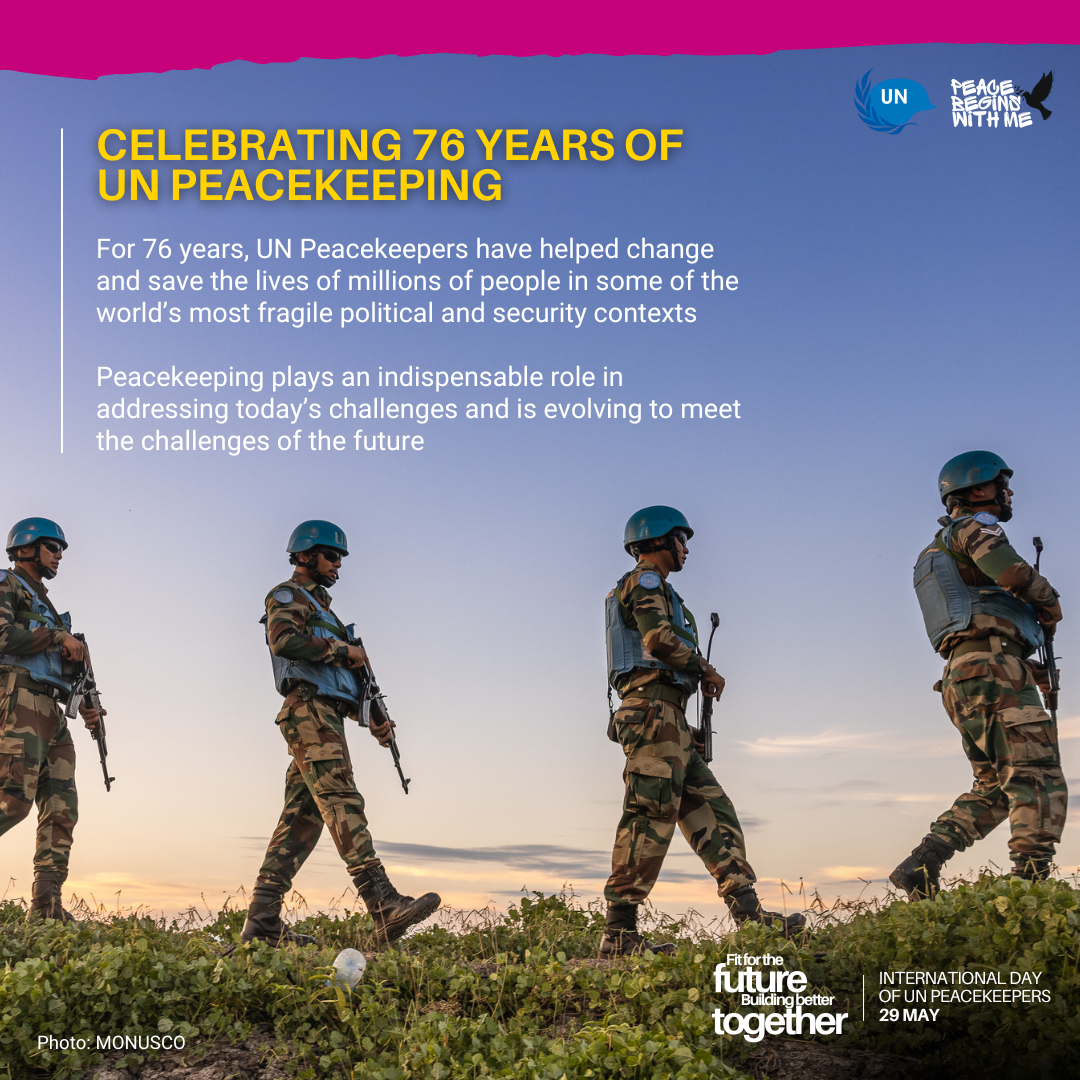
For 76 years, United Nations peacekeepers have worked to save and change lives in the world’s most fragile political and security situations. Since 1948, more than two million uniformed and civilian personnel have helped countries to transition from war to peace. Today, more than 70,000 peacekeepers serve in 11 missions deployed in hotspots around the world. Observed under the theme “Fit for the future, building better together,” this year’s International Day looks at the invaluable contributions military, police and civilian peacekeepers have made over the last seven decades. It encapsulates the spirit of progress and collective action towards creating a more equal, just and sustainable world. Over the years, peacekeeping has evolved to adapt to the changing political landscape and nature of conflicts which have become more complex and interconnected. With support from member countries, it continues to advance the path set forth in the United Nations Secretary-General’s New Agenda for Peace which calls for a more robust, holistic and collective response to the security threats of today and tomorrow. Despite the challenges, peacekeepers persevere, alongside many partners, in the collective pursuit of peace. The International Day pays tribute to the service and sacrifice of peacekeepers and the resilience of the communities that they serve. It honors the more than 4,000 peacekeepers who have lost their lives serving for peace. This campaign also calls on each of us to join the global movement for peace. Alone, we can never succeed. But, together, we can be a strong force for change. Follow the conversations with the hashtags: #PKday, #FitForTheFuture, #BuildingBetterTogether, #Peacekeeping, #29May, #Peacebegins, #WomenInPeacekeeping.

EVENTS: on May 29th, We observe a minute of silence for the fallen during the International Day of United Nations Peacekeepers 2024. On Thursday, May 30th 2024, starting at 9:45 a.m. ET, a Wreath Laying Ceremony will be held at the North Lawn building of the UNHQ with the United Nations Peacekeeping. the UN Secretary-General will lay a wreath at the Peacekeepers Memorial in honour of fallen peacekeepers. Following that, at 11 a.m. ET, he will preside over an in-person ceremony at which the Dag Hammarskjold Medal will be awarded posthumously to fallen peacekeepers. He will also present the UN Military Gender Advocate of the Year award. Follow the ceremony on UN Web TV. The Under-Secretary-General for Peace Operations, Jean-Pierre Lacroix, will be the guest at the noon briefing on 30 May. All events can be followed live on UN Web TV.

Medal recipients: At the meeting, by resolution 1121 (1997), the U.N. Security Council established the United Nations Dag Hammarskjöld Medal as a posthumous award to members of peacekeeping operations "as a tribute to the sacrifice of those who have lost their life as a result of service in peacekeeping operations under the operational control and authority of the United Nations".

Award: The United Nations Military Gender Advocate of the Year Award recognizes the dedication and effort of an individual peacekeeper in promoting the principles within the United Nations Security Council Resolution 1325. It was first given out in 2016. To mark the International Day at UN Headquarters, the UN Secretary-General will lay a wreath at the Peacekeepers Memorial in honor of fallen peacekeepers at 9:45 a.m. ET on Thursday, 30 May 2024.

List of Personnel to be Posthumously Awarded the Dag Hammarskjöld Medal on 30 May 2024

Follow the Dag Hammarskjöld Medal Awards Ceremony on UN Web TV (11:00 am, 30 May 2024)

Wreath Laying Ceremony: The commemorations are held at the U.N. Headquarters, United Nations offices and at different U.N. Peacekeeping missions Here is the List of Personnel to be Posthumously Awarded the Dag Hammarskjöld Medal.


Statement of the Secretary-general on the International Day of United Nations Peacekeepers 2024; May 29th.

For 76 years, United Nations peacekeepers have worked to save and change lives in the world’s most fragile political and security situations. Since 1948, more than two million uniformed and civilian personnel have helped countries to transition from war to peace. Today, more than 70,000 peacekeepers serve in 11 missions deployed in hotspots around the world. Observed under the theme “Fit for the future, building better together,” this year’s International Day looks at the invaluable contributions military, police and civilian peacekeepers have made over the last seven decades. It encapsulates the spirit of progress and collective action towards creating a more equal, just and sustainable world. Over the years, peacekeeping has evolved to adapt to the changing political landscape and nature of conflicts which have become more complex and interconnected. With support from UN member countries, it continues to advance the path set forth in the UN Secretary-General’s New Agenda for Peace which calls for a more robust, holistic and collective response to the security threats of today and tomorrow. Despite the challenges, peacekeepers persevere, alongside many partners, in the collective pursuit of peace. The International Day pays tribute to the service and sacrifice of peacekeepers and the resilience of the communities that they serve. It honors the more than 4,000 peacekeepers who have lost their lives serving for peace. This campaign also calls on each of us to join the global movement for peace. Alone, we can never succeed. But, together, we can be a strong force for change.

United Nations Secretary-general.


United Nations Secretary-General António Guterres to preside over Dag Hammarskjold medal and Military Gender Advocate of the Year ceremony in the Trusteeship Council chamber. For 76 years, United Nations peacekeepers have worked to save and change lives in the world's most fragile political and security situations. Since 1948, more than two million uniformed and civilian personnel have helped countries to transition from war to peace. Today, more than 70,000 peacekeepers serve in 11 missions deployed in hotspots around the world. Observed under the theme "Fit for the future, building better together," this year's International Day looks at the invaluable contributions military, police and civilian peacekeepers have made over the last seven decades. It encapsulates the spirit of progress and collective action towards creating a more equal, just and sustainable world.


STORY FROM THE FIELDS

By providing training to the National police, she helps build their skills and expertise on community policing activities.


Minute of silence


LIVESTREAM: Wreath Laying Ceremony at United Nations North Lawn Building.


Sunday, 29 May 2022

International Day of UN Peacekeepers 2022; May 29th.

 FORUM: People. Peace. Progress: The Power of Partnerships. International Day of UN Peacekeepers 2022.

Peacekeeping is just one of many tools used by the United Nations to help secure global peace and security. It is a collective enterprise. Standing alone, we can never succeed. But, together with partners, we are strong and changing lives for the better.


Statement by the U.N. Secretary-General on International Day of UN Peacekeepers 2022; May 29th.

Today, we honour the more than one million women and men who have served as United Nations peacekeepers since 1948.

We pay tribute to the nearly 4,200 heroes and heroines who sacrificed their lives in the cause of peace.

And we are reminded of an age-old truth: peace can never be taken for granted.

Peace is the prize.

We are deeply grateful to the 87,000 civilian, police and military personnel now serving under the UN flag who are helping to realize the prize of peace worldwide.

They face enormous challenges. Rising violence against peacekeepers has made their work even more dangerous. Restrictions due to the pandemic have made it more difficult. But United Nations peacekeepers continue to serve with distinction as partners for peace.

This year, we focus on the Power of Partnerships.

We know that peace is won when governments and societies join forces to resolve differences through dialogue, build a culture of nonviolence, and protect the most vulnerable.

Around the globe, UN peacekeepers work with Member States, civil society, humanitarians, the media, the communities they serve and many others, to foster peace, protect civilians, promote human rights and the rule of law and improve the lives of millions of people.

Today and every day, we salute their dedication in helping societies turn away from conflict, towards a more peaceful and prosperous future for all.

We are forever in their debt.


EVENTS

To mark the Day at the UN Headquarters in New York on 26 May, the Secretary-General will lay a wreath in honour of all peacekeepers who have lost their lives while serving under the UN flag over the past seven decades. And a virtual ceremony will be held at which the Dag Hammarskjold medal will be awarded posthumously to peacekeepers who lost their lives in 2021. The Military Gender Advocate of the Year award will also be presented at the virtual ceremony. Dag Hammarskjöld Medal Awards.


The Day is an opportunity to recognize the service and sacrifice of the more than one million personnel who have served under the blue flag since 1948. It is also a chance to honour the memory of the more than 4,000 peacekeepers who lost their lives in the cause of peace.


Series: 

Saturday, 29 May 2021

International Day of United Nations Peacekeepers 2021, May 29th


This year, the challenges and threats faced by our peacekeepers are even greater than ever as they, like people around the world, are having to cope not only with the COVID-19 pandemic but also the continued requirement to support and protect the people in the countries in which they are based.
The theme for this year’s Day is "The road to a lasting peace: Leveraging the power of youth for peace and security."
Today, tens of thousands of young peacekeepers (between the ages of 18 and 29 years) are deployed around the world and play a major role in helping the missions implement their mandated activities including the protection of civilians.  And UN peace operations -- in line with a series of Security Council resolutions (2250, 2419 and 2535) -- are increasing their collaboration with youth and youth groups to help build sustainable peace and implement their mandates on the ground.
Follow the conversations #ServingForPeace 🕊.


Are you interested in becoming a peacekeeper? Our peacekeepers come from the 193 U.N. Member States and are recruited with a broad range of backgrounds.

Statement by the U.N.Secretary-General on International Day of United Nations Peacekeepers 2021

The International Day of United Nations Peacekeepers honors the more than one million women and men who have served on the frontlines of conflict and the more than 4,000 who have lost their lives in the line of duty. Their service and sacrifices will never be forgotten.

I express my deep gratitude to the 85,000 civilian, police and military personnel currently deployed in some of the world’s most challenging hotspots to protect the vulnerable and help to build peace. Despite the restrictions imposed by the pandemic, as well as the risk of infection, these men and women have pursued their mission while also supporting local authorities in the fight against COVID-19. I offer sincere condolences to the families of peacekeepers who have fallen victim to this terrible disease.

This year’s observance focuses on the central question of youth, peace and security. In every country where our peacekeepers work, peace can only be achieved with the active participation of young people. The world needs to do far more to address their needs, amplify their voices and ensure their presence at decision-making tables.

Our Missions play an important role in protecting and supporting young people, in particular young women and girls, to reduce violence and sustain peace. In the Democratic Republic of Congo, MONUSCO is working with youth who are vulnerable to recruitment by armed groups, to provide viable and sustainable alternatives to violence. In South Sudan, the inclusion of youth groups in peace processes has helped strengthen relations between subnational and national actors. In the Central African Republic and in Mali, MINUSCA and MINUSMA have worked closely with youth representatives to increase voter turnout in recent elections.

One of our greatest strengths is our own young peacekeepers, in particular young women peacekeepers who contribute every day to debunking deeply entrenched gendered stereotypes and inspire young women and girls to seek non-traditional paths and opportunities.

United Nations peacekeeping helps nurture peace in some of the world’s most dangerous places. Today and every day, we salute the dedication and bravery of our peacekeepers in helping societies turn away from war and towards a safer, more stable future.

Dag Hammarskjöld Medal Awards


Wednesday, 24 March 2021

International Day of Solidarity with Detained and Missing Staff Members 2021; March 25


On the International Day of Solidarity with Detained and Missing Staff Members, we recognize the extreme dangers encountered by so many colleagues as they carry out the vital work of the United Nations.

The threats vary -- from deliberate and deadly ambushes to kidnappings, intimidation and unlawful detention.  But the thread is the same: these are unacceptable obstacles to fulfilling our mandates and advancing peace, sustainable development, human rights and humanitarian assistance around the globe.  National staff are often at particular risk.

As of 15 March of this year, 20 United Nations personnel are in detention, including six arrested this year, five in 2020 and the rest before that.

Meanwhile, peacekeeping operations continue to be targeted; at least 10 of our personnel have lost their lives this year to malicious attacks.

I urge all countries to support the 1994 Convention on the Safety of United Nations and Associated Personnel as well as its 2005 Optional Protocol.  To date, only 95 countries are party to the Convention, and only 33 to the Protocol.

The United Nations will continue its efforts to protect our personnel, and to pursue justice for the perpetrators of attacks.  I thank the Standing Committee on the Security and Independence of the International Civil Service of the United Nations Staff Union for its advocacy and vigilance.

Together, we must do everything we can to ensure that those who undertake lifesaving work around the world have the protection and conditions they need to fulfil their vital mission.

*****
À l’occasion de la Journée internationale de solidarité avec les membres du personnel détenus ou portés disparus, nous mesurons les dangers extrêmes auxquels tant de nos collègues sont exposés dans le travail essentiel qu’ils accomplissent au nom de l’Organisation.

Les menaces sont diverses – embuscades mortelles, enlèvements, actes d’intimidation et détention illégale – mais toutes font obstacle de manière inacceptable à l’accomplissement de nos mandats et à la promotion de la paix, du développement durable, des droits humains et de l’aide humanitaire dans le monde entier. Le personnel recruté sur le plan national est souvent le plus exposé.

Au 15 mars de cette année, 20 membres du personnel des Nations Unies sont en détention, dont 6 arrêtés cette année, 5 en 2020 et le reste avant cela.

Parallèlement, les opérations de maintien de la paix continuent d’être prises pour cibles ; au moins 10 membres du personnel ont perdu la vie cette année dans des attaques malveillantes.

J’engage tous les pays à soutenir la Convention sur la sécurité du personnel des Nations Unies et du personnel associé de 1994 et son Protocole facultatif de 2005. À ce jour, seuls 95 pays sont parties à la Convention et 33 pays au Protocole.

L’ONU poursuivra ses efforts pour protéger les membres de son personnel et faire en sorte que les auteurs d’attaques soient traduits en justice. Je remercie le Comité permanent sur la sécurité et l’indépendance de la fonction publique internationale du Syndicat du personnel de l’Organisation des Nations Unies de ses activités de sensibilisation et de sa vigilance.

Ensemble, nous devons tout faire pour garantir que les personnes qui accomplissent des activités vitales dans le monde entier bénéficient de la protection dont elles ont besoin pour remplir leur mission essentielle dans des conditions appropriées.


Thursday, 29 May 2014

International Day of United Nations Peacekeepers 2014, May 29

Theme 2014: “UN Peacekeeping: A Force for Peace. A Force for Change. A Force for the Future.


 On 29 May, UN offices, alongside Member States and non-governmental organizations, hold events to honour fallen peacekeepers. Since the first UN peacekeeping mission was established in 1948, more than 3,200 military, police and civilian personnel have lost their lives in the service of peace as a result of acts of violence, accidents and disease.


FEATURE: New challenges spur UN peacekeeping to become ‘a force for the future’.

Hervé Ladsous, Under-Secretary-General for Peacekeeping Operation, greets a MONUSCO FIB contingent in Pinga, DR Congo. UN Photo/Sylvain Liechti


29 May 2014 – From deploying new technologies such as drones and robots to boosting the number of women in its ranks, United Nations peacekeeping is striving to confront new challenges and offer best value for funding as it serves communities around the world.

“The United Nations is improving logistics and administrative practices, strengthening infrastructure and taking other steps to harness the power of our personnel,” said Secretary-General Ban Ki-moon. “Our goal is to ensure that peacekeeping is a cost effective, valuable investment that brings enormous benefits and, above all, saves lives.”
Today, more than 116,000 UN military, police and civilian personnel from more than 120 countries serve in 16 peacekeeping operations, often at great personal risk. They perform a variety of tasks, from stabilizing communities torn apart by conflict and protecting civilians to promoting the rule of law and advancing human rights.
To assist them in carrying out such critical duties, UN peacekeeping is on a mission of its own: to modernize and innovate to ensure it can tackle tomorrow’s peace and security challenges, and to be “a force for peace, a force for change, and a force for the future,” according to the Department of Peacekeeping Operations.
“We’re operating in the 21st century and we cannot continue just using tools of 50 or 100 years ago. We have to be current with all the developments in the world,” Under-Secretary-General for Peacekeeping Operations told the UN News Centre.
“We need to deliver better services, possibly for less. I think that using technology is one way to address that very legitimate concern of our Member States.”
For this reason, the International Day of UN Peacekeepers, observed annually on 29 May, kicks off a six-month campaign designed to raise political support and highlight the fact that UN peacekeeping is ‘good value’.
An example of the use of new technology is the introduction of unmanned aerial vehicles (UAVs), which are unarmed and used solely for surveillance purposes, in the vast Democratic Republic of the Congo – a technological first for the UN and one which is now being considered for other peacekeeping operations.
One of the ways that UAVs have made an impact on the ground was earlier this month during a ferry accident in Lake Kivu. After a UAV spotted a boat in distress, the UN peacekeeping mission in the country immediately sent its speedboats and helicopters to the scene and was able to rescue 15 people.
“From the second it spotted the sinking ship, the UAV stayed at the scene searching for survivors and providing situational awareness,” said Ameerah Haq, Under-Secretary-General for Field Support.
“This illustrates the flexibility and the ability of UAVs to greatly enhance situational awareness and aid life-saving operations by the provision of real-time imagery to support reaction to incidents,” she added.
Also in eastern Democratic Republic of the Congo, where communities are under threat from armed militias, the UN deployed a specially equipped ‘Force Intervention Brigade’ to support the national army. In November, the brigade successfully supported the military defeat of the M23 armed group, liberating areas under its control and removing the threat posed to civilians.
The UN has also enhanced its use of thermal imaging, closed-circuit television, night vision abilities and GIS [geographic information systems] data to improve situation awareness to provide better for the safety and security of its peacekeepers.
As part of the ongoing effort by the Departments of Peacekeeping Operations (DPKO) and of Field Support (DFS) to take advantage of emerging technologies and innovations, a group of five experts is being tasked with advising on how best to use these capabilities.
The group, led by seasoned peace and security expert Jane Holl Lute, will examine how these technologies can be leveraged to enable peacekeepers to respond more effectively to an increasing number of complex, multidimensional tasks in challenging field environments.
It will also look at how technological innovations can improve operational effectiveness, multiply impact and enhance safety and security of both peacekeepers and host communities.
As part of its modernization endeavour, the UN is boosting the representation of women among its ranks, with the belief that female peacekeepers serve as role models in local communities, inspiring women and girls in often male-dominated societies.
In an historic move earlier this month, the Organization appointed its first-ever female force commander. Major General Kristin Lund of Norway will take over military command of the UN mission in Cyprus, whose top leadership post is held by another woman, Lisa Buttenheim.
“I think it’s very important that the UN took this step to appoint a female force commander and I hope that I can be a role model for other female officers that see that it’s possible,” Major General Lund told the UN News Centre at the time of her appointment.
UN blue helmets are also aiming to ‘go green’ through the responsible use of limited resources, in a bid to leave mission areas in better shape than when they arrived. Among other steps, GIS data is being used to help find water sources for missions so as not to compete with the local water supply.
Missions are also including waste water treatment plants designed to drastically reduce the need for water and generation of disposable waste, as well as exploring alternative sources of energy such as solar panels.
Another way the UN is looking to innovate is by strengthening partnerships with Member States and regional and sub-regional organizations as well as pursuing cooperation between missions. In Mali and the Central African Republic, it has worked closely with the African Union and other sub-regional groups.
“Looking forward, we will need to develop those partnerships more and more,” said Assistant Secretary-General for Peacekeeping Operations Edmond Mulet, who noted that regional and sub-regional organizations are often the “first respondents” when conflict breaks out, especially on the African continent.
“The world is changing. The threats are changing. The levels of conflict are changing in many places in the world,” he added. “So we have to adapt and we have to evolve and we have to learn how to deal with these new challenges.”

UN honours ‘blue helmets,’ seeks to build modern, adaptive peacekeeping force


Wreath laid in honour of the 106 peacekeepers who lost their lives the previous year while serving under the UN flag. UN Photo/Devra Berkowitz

List of Fallen in 2013 (Peacekeepers) 
UN Peacekeeping : The Fallen by Country nationality, Rank, Names, Date of Incident, Missions, Appointment Type, Gender. Peacekeepers lost in 2013.


Hailing the “long and proud” history of United Nations peacekeeping – with over one million “blue helmets” having served in more than 70 operations on four continents since 1948 – Secretary-General Ban Ki-moon led the Organization today in honouring those men and women who lost their lives in the past year, while looking to the future, envisioning a modern, global force that can effectively tackle emerging peace and security challenges.

On this International Day of United Nations Peacekeepers, observed annually on 29 May, the world body honoured the 106 peacekeepers who died last year while serving under the UN flag, bringing the total number of lives lost in the history of peacekeeping to more than 3,200.

“We mourn the passing of every one of these courageous individuals. We grieve with their friends and families and we recommit ourselves to ensure that their contributions to the cause of peace will never be forgotten,” declared the Secretary-General in his message for the Day.

He noted that today, more than 116,000 UN personnel from more than 120 countries serve in 16 peacekeeping operations. “At great personal risk, these military, police and civilian personnel help stabilize communities, protect civilians, promote the rule of law and advance human rights.”

The annual wreath-laying ceremony took place for the first time at a newly-created site on the north end of the UN’s New York Headquarters complex.

Opening that solemn ceremony, Mr. Ban said 2013 was the sixth year in a row that more than 100 peacekeepers died. Some were killed when their convoys came under attack in Darfur and South Sudan.
Others had lost their lives to explosions in Mali. Still others were taken by floodwaters in Darfur. “In the Democratic Republic of the Congo (DRC) and elsewhere, our peacekeepers were shot while protecting civilians.” He said, adding that in the Middle East, Haiti and beyond, many succumbed to deadly diseases and other dangers that are part of their life-saving work.

“The threats continue this year. The insecurity in South Sudan, the Central African Republic, Mali and Darfur has tested us to the limits of our capacities,” the Secretary-General said, underscoring that the Organization is doing everything possible to protect its personnel in the field. “Despite our best efforts, we can never reduce the risks entirely,” he added sombrely.

“That is why today, we applaud the courage, dedication and professionalism of the 120,000 peacekeepers who are now deployed in some of the most dangerous places on earth. I pay them my highest tribute,” said the UN chief.

In his remarks at the Dag Hammarskjöld Medal Awards Ceremony, Hervé Ladsous, Under-Secretary-General for UN Peacekeeping Operations said those blue helmets that had lost their lives had not perished merely for an ideal: “Our peacekeepers have made a practical difference on the ground, and this perhaps what matters most.”

As for current on-the-ground operations, he said UN peacekeeping is providing a dynamic response in some of the planet’s most complicated and difficult places. “Our peacekeepers continue to be in high demand and for UN peacekeeping to be relevant and effective, we must not just keep up with this changing environment, we must be a step ahead of it.”

Echoing the theme of the day, Mr. Ladsous said peacekeepers are working tirelessly so that UN Peacekeeping can be “A Force for Peace, A Force for Change, A Force for the Future.” By introducing unarmed, unmanned aerial vehicles (UUAVs) in the DR Congo, UN peacekeeping has shown “that we are able to be modern and use latest technologies to monitor movements of armed groups and allow us to better protect vulnerable populations.”

“By rapidly erecting protection of civilian sites for 90,000 civilians fleeing war in South Sudan – sometimes from an empty plot of land – we have shown that we are able to adapt under tough circumstances to respond to developing crisis,” said Mr. Ladsous, adding that by going after armed groups in the foothills of North Kivu with ferocity and vigour, UN peacekeeping has shown that it “will not back down” when confronted by those who would threaten the most vulnerable.

“Of course, none of this would happen without the support of our partners. Today, I would like especially to commend the Member States, who provide troops and police, resources and funding, training and equipment – our contributing States. I thank you all for your hard work on our behalf,” he said.

Under-Secretary-General for Field Support, Ms. Ameerah Haq said that 22 civilians had been among those who lost their lives while serving in UN peacekeeping missions, including in Liberia, Darfur, and South Sudan. On behalf of the Secretary-General and the Departments of Peacekeeping Operations and Field Support, she extended deepest condolences to the families and loved ones of the deceased.

“Our civilian colleagues in the field toil day-in, day-out on the frontlines of today’s conflicts,” she said noting that whether mediating inter-tribal conflicts, documenting human rights violations, or reporting on the state of fragile ceasefire agreements, they carry out their work at great personal risk and sacrifice.

“We can pay no greater tribute to those who have lost their lives than to ensure that their aspirations are pursued and ultimately realized.”

Mr. Ban said earlier that UN peacekeeping is modernizing to ensure that it can tackle tomorrow's peace and security challenges. It is deploying new technologies such as refining its practices to better protect civilians, and boosting the representation of women among its ranks while strengthening its partnerships with regional organizations.

“The United Nations is improving logistics and administrative practices, strengthening infrastructure and taking other steps to harness the power of our personnel,” he said, adding: “Our goal is to ensure that peacekeeping is a cost effective, valuable investment that brings enormous benefits and, above all, saves lives.”

He noted that over the past year, the Security Council established two peacekeeping operations – in Mali and in the Central African Republic – again highlighting its trust in UN peacekeepers to take on tough challenges.

In addition, the UN mission in the DRC, known as MONUSCO, helped the Government defeat the M23 rebels that had preyed on civilians in the country's east, he said, while also highlighting another first: “In an historic breakthrough, a woman was named the first female Force Commander of a UN peacekeeping operation.”

Earlier this month, the Security Council established the "Captain Mbaye Diagne Medal," named after an unarmed Senegalese peacekeeper who lost his own life after saving as many as a thousand people during the 1994 genocide in Rwanda.

“This medal will honour UN personnel who demonstrate exceptional courage. Let us all commit to following the selfless example of Mbaye Diagne and other fallen heroes, as we work together to help our blue helmets be a force for peace, a force for change, and a force for the future,” declared the Secretary-General.
In his message for the Day, John Ashe, President of the General Assembly, encouraged Member States, civil society and other stakeholders to support this year's theme: “UN Peacekeeping: A Force for Peace. A Force for Change. A Force for the Future.”

“We must ensure that security challenges are addressed in the countries where peacekeepers work so that we can create a more sustainable future for all members of the international community,” he said.
As the UN and the international community continue the global effort to set the stage for the creation of a post-2015 development agenda, innovation and technology, especially the transfer of new and emerging technologies will greatly contribute to strengthening global security. “We must continue to create new ways of using these technologies to protect those at greatest risk in conflict and war-torn countries,” said Mr. Ashe.


News Tracker: past stories on this issue


On International Day, Secretary-General Applauds Courage of 120,000 Peacekeepers Now Deployed in Most Dangerous Places on Earth

International Day of United Nations Peacekeepers to Be Observed at New York Headquarters, Offices Worldwide, 29 May