Showing posts with label United Nations Peacekeeping. Show all posts

Friday, 29 May 2026

International Day of United Nations Peacekeepers 2026; May 29th.


FORUM: “The Future of Peacekeeping International Day of United Nations Peacekeepers 2026.  this year’s International Day looks at the invaluable contributions military, police and civilian peacekeepers have made over the last nearly eight decades. It encapsulates the spirit of progress and collective action towards creating a more equal, just and sustainable world. Today, more than 68,000 civilians, military, and police personnel serve in 11 UN peacekeeping missions, confronting increasingly complex and interconnected challenges shaped by a shifting geopolitical landscape. Despite the challenges, peacekeepers remain steadfast in their pursuit of peace. Follow: #PKday, #BuildingBetterTogether, #Peacekeeping, #29May.

UNSMIL


EVENT: On Friday, May 29th, to mark the International Day of United Nations Peacekeepers 2026 under the theme “The Future of Peacekeeping", the United Nations will pay tribute to their unwavering service and sacrifice, as well as the resilience of the communities they support. It also solemnly honors the more than 4,400 peacekeepers who have lost their lives in the cause of peace, including 57 in 2024 alone. Watch the livestream!


Statement of the United Nations Secretary-General on the International Day of United Nations Peacekeepers 2026; May 29th.


The International Day of UN Peacekeepers, marked every year on 29 May, is an opportunity to honour peacekeepers for their service and sacrifice.

These women and men face real risks in the line of duty, and their safety and security remain a top priority. The UN continues to strengthen protective measures to mitigate threats and enable them to carry out their mandates safely.

Below is the message by António Guterres, Secretary-General of the United Nations, on the International Day of Peacekeepers.

"Right now, more than 50,000 UN peacekeepers are deployed across the globe protecting civilian lives.

Far from home, in some of the world’s most dangerous settings, they deescalate tensions between hostile parties, oversee aid delivery, support elections, and create space for political solutions to grow.

On this International Day, we honour peacekeepers past and present, and reaffirm our shared responsibility to respect and strengthen their work. We pay tribute to the nearly 4,500 peacekeepers who have lost their lives since 1948, including 59 last year.

No one should die serving the cause of peace. Attacks on peacekeepers are grave violations of international humanitarian law, and Member States must uphold their obligations to ensure the safety and security of UN personnel at all times.

In an era of rising tensions, peacekeeping is a proven and cost-effective way to restore stability and hope. But it requires steady political backing – and reliable financial support.

This year’s theme, Invest in Peace, calls for decisive action to ensure peacekeepers have the resources to carry out their vital mandates.

An investment in peacekeeping is an investment in a safer future.

Let us always support the people who help make peace possible.

Thank you."


United Nations Secretary-General.

WORLWIDE CELEBRATIONS:


In LEBANON: On Peacekeepers’ Day, UNIFIL reaffirms commitment and hope for stability.
On the occasion of the International Day of United Nations Peacekeepers, UNIFIL held a solemn ceremony at its Naqoura headquarters on the 29th of May. This year’s commemoration came against the backdrop of a significantly deteriorated security situation with intensified hostilities, repeated violations along the Blue Line, and an alarming risk of further escalation. The observance took place at a time of great challenges in south Lebanon. UNIFIL Head of Mission and Force Commander Major General Diodato Abagnara said: "I want just to remark that today is a very important day for us because the celebration of the United Nations Peacekeepers’ Day is one of the most important moments in the history of United Nations missions. This is another way to remark that we work for peace, for stability, and one of the most important things for UNIFIL as we are in a very particularly challenging environment. We continue to carry out the UNIFIL mission, not only to report, to monitor any kind of violations, but also to support civilians, to support humanitarian access during a particular time". A central moment of the ceremony was a tribute to fallen peacekeepers. In recent months, six UNIFIL peacekeepers lost their lives in the line of duty. Their sacrifice serves as a reminder of both the risks the peacekeepers face and the importance of the mission. I also want to remark that today is for all peacekeepers that lost their lives with dedication and professionalism for peace and stability, not only in Lebanon, but around the world. And this is the most important thing. For this reason, we will continue to work harder, day by day, in their memory and to create the best condition for peace and stability. Despite the difficult circumstances, UNIFIL has reaffirmed its enduring commitment to its mandate and to the people of south Lebanon.


In REPUBLIC DEMOCRATIC OF THE CONGO: Journée Internationale des Casques Bleus - 2026.

Servir la paix est un choix qui demande du courage et exige parfois le sacrifice ultime. À l’occasion de la Journée internationale des Casques bleus 2026, la MONUSCO honore la mémoire de ces héros venus de tous les horizons pour protéger les plus vulnérables.


Thursday, 29 May 2025

International Day of UN Peacekeepers 2025; May 29th.


FORUM: “The future of peacekeeping.” International Day of the United Nations Peacekeepers 2025. Of the 26 peacekeepers who lost their lives in 2024, five were killed in hostile incidents. We mourn their loss, alongside their families and colleagues. The sacrifice of all 4,430 peacekeepers who have given their lives across the decades will never be forgotten. Their legacy inspires us to continue all efforts in the pursuit of peace and progress for all peoples. Despite these challenges, peacekeepers persevere, performing a wide range of taskings, including ensuring the safe delivery of humanitarian aid, deterring violence, supporting locally-led conflict resolution, political settlements, elections, and restoring state authority.In the next decade the world could be transformed by climate-related crises, lethal and disruptive technologies, political discord and polarization, and new non-state armed groups. Civil strife could emerge in states currently regarded as stable.Conflicts could spread across borders, and wars may be fought in virtual space without the firing of a single bullet. The Future of Peacekeeping Operations (FOPO) project attempts to imagine what the missions of the future might look like. Begun in 2020, FOPO has drawn on broad and inclusive consultations with UN and non-UN stakeholders, including interviews with representatives of Member States, academia, civil society, regional organizations and current and former peacekeeping practitioners. In addition, a series of think piece papers were commissioned. Themes explored in the project centered around four broad areas: a) the geostrategic environment and political processes, b) the changing conflict environment, c) the international responses to conflict and d) Peacekeeping policy approaches. The Project interlocutors also identified some key trends affecting conflict such as: The competition versus cooperation; The protracted, internationalized armed conflicts; The blurred lines between war and peace; The weakening of universalist norms; The climate change; and the socio-economic inequality. While geopolitical polarisation will likely make it difficult to achieve consensus around new peacekeeping missions, the UN’s peace and security pillar may still be asked to respond through new forms of flexible and adaptative deployments, as well as enhanced advisory and thematic support functions. Moreover, in response to erosion of normative consensus, the Secretariat may need to step up efforts to build support for unified and principled approaches to peace, and to affirm the UN’s norms and values to which all Member States have committed. Socioeconomic exclusion and inequality are likely to remain drivers of civil instability and potential conflict The strengths of peacekeeping operations may need to be more closely integrated into efforts that support the 2030 Agenda and Sustainable Development Goals. Follow the conversations with the hashtags: #PKday, #FitForTheFuture, #BuildingBetterTogether, #Peacekeeping, #29May, #Peacebegins, #WomenInPeacekeeping.

29 May
The Future of Peacekeeping.


EVENTS: on May 29th, We observe a minute of silence for the fallen during the International Day of United Nations Peacekeepers 2025. On Thursday, May 29th 2025, starting at 9:45 a.m. ET, a Wreath Laying Ceremony will be held at the North Lawn building of the UNHQ with the United Nations Peacekeeping. the UN Secretary-General will lay a wreath at the Peacekeepers Memorial in honour of fallen peacekeepers. Following that, at 11 a.m. ET, he will preside over an in-person ceremony at which the Dag Hammarskjold Medal will be awarded posthumously to fallen peacekeepers. He will also present the UN Military Gender Advocate of the Year award. Follow the ceremony on UN Web TV. The Under-Secretary-General for Peace Operations, Jean-Pierre Lacroix, will be the guest at the noon briefing. Register to participate; All events can be followed live on UN Web TV.

Medal recipients: At the meeting, by resolution 1121 (1997), the U.N. Security Council established the United Nations Dag Hammarskjöld Medal as a posthumous award to members of peacekeeping operations "as a tribute to the sacrifice of those who have lost their life as a result of service in peacekeeping operations under the operational control and authority of the United Nations".

Award: The United Nations Military Gender Advocate of the Year Award recognizes the dedication and effort of an individual peacekeeper in promoting the principles within the United Nations Security Council Resolution 1325. It was first given out in 2016. To mark the International Day at UN Headquarters, the UN Secretary-General will lay a wreath at the Peacekeepers Memorial in honor of fallen peacekeepers at 9:45 a.m. ET on Thursday, 29 May 2025.

List of Personnel to be Posthumously Awarded the Dag Hammarskjöld Medal on 29 May 2025

Wreath Laying Ceremony: The commemorations are held at the U.N. Headquarters, United Nations offices and at different U.N. Peacekeeping missions.
Follow the Dag Hammarskjöld Medal Awards Ceremony on UN Web TV (11:00 am, 29 May 2025)

Here is the List of Personnel to be Posthumously Awarded the Dag Hammarskjöld Medal.

On May 27, 2025; The General Assembly have organized an Informal meeting of the 79th plenary session to hear a briefing on the review on the future of all forms of United Nations peace operations; Briefing by Jean-Pierre Lacroix, Under-Secretary-General for Peace Operations and Rosemary A. DiCarlo, Under-Secretary-General for Political and Peacebuilding Affairs. Reac Concept note and Watch the informal meeting of the plenary to hear a briefing on the review on the future of all forms of United Nations peace operations - General Assembly, 79th session!

Held from 13 to 14 May 2025, the UN Peacekeeping Ministerial served as a high-level political forum to discuss the future of peacekeeping and for Member States to express and demonstrate their political support. It provided a platform for delegations to announce substantial pledges in support of closing capability gaps and adapting peace operations to better respond to existing challenges and new realities, in line with the pledging guide. The UN Peacekeeping Ministerial 2025 contributed to increased safety and security for peacekeepers deployed, and fostering overall mission effectiveness. For their pledges, member states were encouraged to arrange partnerships where appropriate, for instance in training and capacity-building. The Co-chairs of the Peacekeeping Ministerial process were Bangladesh, Canada, Ethiopia, Ghana, Germany, Indonesia, Japan, the Netherlands, Pakistan, Republic of Korea, Rwanda, Uruguay, United Kingdom, United States and the United Nations Secretariat. Watch the livestream of the Day 1 (High Level Session 1 - High Level Session 2 - High Level Session 3) and the Livestream of the Day 2 - Opening and Pledging Session 1 - Pledging Session 2).

Three key events were held in the lead up to the 2025 Berlin UN Peacekeeping Ministerial.

10-11 December 2024 – Preparatory meeting on Capacity-building, Partnerships and the Future of Peacekeeping, co-hosted by Japan, the UK and Uruguay in Montevideo.
Concept note, agenda, logistics note and summary of the meeting.


4-5 February 2025 – Preparatory meeting on the Future of Peacekeeping, New Models and Related Capabilities, co-hosted by Bangladesh, Indonesia, the Netherlands and USA in Jakarta.
Concept note, agenda and logistics note.


15-16 April 2025 – Preparatory meeting, titled Towards a Safer and More Effective Peacekeeping: Use of Technology and Integrated Approach, co-hosted by Pakistan and the Republic of Korea in Islamabad.
Concept note, agenda, logistics note and summary of the meeting.

PUBLICATIONS: Study on the future of peacekeeping, new models and related capabilities.

At the request of Germany and the other co-chairs of the UN Peacekeeping Ministerial process, DPO commissioned the study on “The Future of Peacekeeping, New Models, and Related Capabilities”. Launched in the C34 on 1 November 2024, the study was intended to serve as food for thought leading into the 2025 Ministerial. The study’s vision for UN peacekeeping was a politically focused, people-centered, modular tool that can unite the Security Council around effective multilateral responses to a broad range of threats and challenges. The study offered 30 plausible models to inform thinking related to future UN missions.

Policy Papers: Peacekeeping is one of the most effective tools available to the United Nations in the promotion and maintenance of international peace and security.


STATEMENTS:
Statement of the United Nations Secretary-General on the International Day of UN Peacekeepers 2025; May 29th.

With unwavering courage, United Nations peacekeepers step into danger – to help protect those who need protection, preserve peace, and restore hope in some of the world’s most challenging contexts.

Today, we honour their service.

We draw inspiration from their resilience, dedication and courage.

And we remember all the brave women and men who made the ultimate sacrifice for peace.

More than 4,400 peacekeepers have died in service – 57 last year alone.

We will never forget them – and we will carry their work forward.

The focus of this year’s International Day of Peacekeepers is on “the future of peacekeeping”.

Today, peacekeepers face increasingly complex situations in an increasingly complex world:

Growing polarization and division around the globe …

Operations made even more dangerous from a multiplicity of threats such as terrorism…

Targeting of peacekeepers through deadly misinformation…

And challenges that transcend borders – from the climate crisis to transnational crime.

As we look ahead, it is essential that peacekeepers have what they need to do their jobs.

This is the shared responsibility of the United Nations and Member States.

The Pact for the Future – adopted last year at the United Nations – includes a commitment to adapt peacekeeping to our changing world.

This challenge is also an opportunity:

To analyse what makes peacekeeping operations successful…

To better understand what hinders them…

And to help design new future-focused models that are anchored in political solutions, adequately resourced, and have mandates that are achievable, with clear exit strategies.

The first step – reviewing our peace operations – is underway.

And together, we will keep pushing this vital effort forward.

Now more than ever, the world needs the United Nations -- and the United Nations needs peacekeeping that is fully equipped for today’s realities and tomorrow’s challenges.


António Guterres;


 “UN peacekeepers bring stability to chaos. It's an investment in ending violence.” Read the UN Secretary-General - Remarks to the Ministerial Meeting on the Future of Peacekeeping and the Remarks by Nicholas Haysom, Special Representative of the Secretary-General.


LIVESTREAM: High-Level Event to mark the International Day of UN Peacekeepers 2025.


United Nations Secretary-General António Guterres to preside over a wreath laying ceremony at the Peacekeepers' Memorial site in the North Lawn.


For nearly 80 years, United Nations peacekeepers have delivered tangible change to communities worldwide. From Liberia and Namibia to Cambodia, Sierra Leone and Timor-Leste, their presence has been life-saving and transformative in some of the most volatile political and security contexts, guiding countries from conflict towards lasting peace.

Observed under the theme "The Future of Peacekeeping" this year's International Day looks at the invaluable contributions military, police and civilian peacekeepers have made over the last nearly eight decades. It encapsulates the spirit of progress and collective action towards creating a more equal, just and sustainable world.
 
 The United Nations Secretary-General António Guterres to preside over Dag Hammarskjold medal, UN Woman Police Officer and UN Military Gender Advocates of the Year ceremony.

To mark the International Day of UN Peacekeepers at UN Headquarters, the UN Secretary-General will preside over an in-person ceremony at which the Dag Hammarskjold Medal will be awarded posthumously to fallen peacekeepers. He will also present the UN Military Gender Advocate of the Year award and the UN Woman Police Officer of the Year awards.

For 77 years, United Nations peacekeepers have worked to protect people, preserve peace, and provide hope in the world's most fragile political and security situations. Since 1948, more than two million uniformed and civilian personnel have helped countries to transition from war to peace. Today, more than 68,000 peacekeepers serve in 11 missions deployed in hotspots around the world.

Observed under the theme "The Future of Peacekeeping" this year's International Day looks at the invaluable contributions military, police and civilian peacekeepers have made over the last seven decades and our commitment to adapt peacekeeping to our changing world.

Friday, 4 April 2025

International Day for Mine awareness and Assistance in Mine Action 2025; April 4th.


FORUM: ”Safe Futures Start HereInternational Day for Mine Awareness and Assistance in Mine Action 2025. Mines, explosive remnants of war, and improvised explosive devices continue to cause death and injury, especially in situations of armed conflict. On average, one person is killed or injured by such explosive device every hour. Many children are among the victims. The use of improvised explosive devices has expanded, terrorizing civilians and threatening humanitarian actors and United Nations missions and personnel. The United Nations mine action community will commemorate the annual International Day for Mine Awareness and Assistance in Mine Action under the theme “Safe Futures Start Here”. The UN mine action community will bring attention to the progress made over the last year and the challenges that remain in countries around the world. Building on the Pact of the Future, considering the condemnation of the devastating impact of armed conflict on all persons including persons with disabilities (Action 14) and seizing “on opportunities provided by new and emerging technologies to empower and advance equity for persons with disabilities, including through promoting the availability of assistive technologies” (Action 29), events and campaigns will focus on raising awareness about the needs of people around the world. The United Nations is calling for a greater responsiveness to the needs and rights of all people with disabilities in conflict and peacebuilding settings. The 2025 campaign will also bring attention to the anniversary of Security Council resolution 2475, which calls upon Member States, and specifically Security Council members, to consider and protect persons with disabilities; to ensure they have access to assistance, and to include them in conflict prevention and peacebuilding. Follow the conversation with the hashtags: #IMAD2025, #safefuturesstarthere, #MineAwareness; #landmines; #4april; #Mineaction.

4 april


EVENTS: On April 3rd, 2025; The Assistant Secretary-General for Rule of Law and Security Institutions, Mr. Alexandre Zouev, and two other UN officials will be guests at the Noon Briefing of the Spokesperson of the Secretary-General. Watch the press briefing!

On April 4th; To commemorate the International Day for Mine Awareness and Assistance in Mine Action 2025; The Permanent Mission of the Republic of Azerbaijan to the United Nations will hold a roundtable discussion entitled “Saving Lives through Humanitarian Mine Action in Azerbaijan”. The briefing will be held in cooperation with the Center of Analysis of International Relations (AIR Center). Details to follow.


Events Around the World:

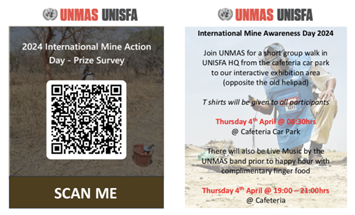
Abyei - On 4 April in Abyei, UNISFA set up an interactive exhibition area about the “Prize Survey” and invited the staff to the “Show and Tell” event. They will be presenting a skit on explosive ordnance risk education to raise awareness about the dangers of explosive ordnance. Additionally, there will be live music and an award ceremony to recognize the most meaningful answers to the “Prize Survey”.

Afghanistan - The IMAD commemorations in Afghanistan will be led by the Directorate for Mine Action Coordination (DMAC) and the mine action implementing partners on 4 April in Kabul. UNMAS Afghanistan and other key stakeholders will participate in the event. On the day around 100 deminers along with their technical equipment including (metal detectors, visors, and armor jackets) will be displayed/ paraded. There will also be an exhibition area for demining equipment, risk education and victim assistance. See how Sharafuddin, Team Leader at Halo Trust is working to demine Afghanistan for a safer tomorrow.

Colombia - On 3 April, UNMAS Colombia a panel discussion will be held from, 10am - 12pm at the Auditorio Marino Troncoso, Pontificia Universidad Javeriana, Bogotá; Join us for a conversation on 'Humanitarian Demining and Territorial Transformation: Contributing to the Construction of Peace from the Territories' organised by the High Commissioner for Peace. Get the flyer (in Spanish) and Register for the event.

Somalia; On April 6th, 2025, from 10am to 12pm at theTukul, UN Compound, Mogadishu. We invite you to join us in this important commemoration with remarks from key UN and Somali officials and presentations on the ongoing efforts to strengthen Somali-led mine action capabilities. You will have an opportunity to meet our wonderful explosive detection dogs and watch them go through their paces, as well as to familiarize yourself with the equipment and engage with technical experts to discuss all aspects of mine action in Somalia. Personnel from SNA and SPF will be present to participate in the interactive session for the EDD response Demo.
Ethiopia - On 4 April, the United Nations in Ethiopia would like to stress the need for enhancing support to victims affected by Explosive Ordnance with a commemorative event in Addis Ababa, bringing together the United Nations, donors and members of the Mine Action community. Keynote speaker will be the director of the Ethiopian Mine Action Office, with further contributions by the UN Resident and Humanitarian Coordinator, the UNICEF Ethiopia Head and a representative of a local NGO involved in Mine Action in the country.

Democratic Republic of the Congo - On 4 April, UNMAS RDC partner with the Korean International Cooperation Agency (KOICA) and the Congolese Mine Action Coordination Center (CCLAM) to organize an event in Kinshasa, in recognition of mine action day. The event brought together important people and organizations, including donors, embassies, national authorities, and others to raise awareness about the dangers of landmines and explosive remnants of war.

South Sudan - On 4 April, from 09:00 to 11:30 CAT, UNMAS South Sudan will lead a commemoration with a focus on youth. Highlights will also include speeches by Honourable Angelina Teny, Minister of Interior Affairs; UNMISS, National Mine Action Authorities (NMMA), and mine action partners; as well as the launch of the National Mine Action Authority Law.

Syria - The ​​UNMAS team in Syria invited heads of agencies in Syria for a field visit to Yarmouk on Thursday 14th March (Yarmouk is a Palestinian refugee camp and was heavily affected by the crisis). The joint visit by UNMAS ,UNRWA and Norwegian People’s Aid (NPA) survey and clearance teams took place then.The event has been arranged to mark Mine Action Day. In cooperation with agencies including UNHCR, UNFPA, UNICEF, UNRWA, WHO, OSE, and OCHA, a series of joint media posts will be published to mark the day and raise awareness of affected populations. Furthermore, a joint initiative with UNICEF was organized to promote mine awareness through painting activity in two schools located in Rural Damascus. There was also an SMS awareness campaign to all mobile phone subscribers in the country, and a Facebook campaign to ensure the messages and visual contents reach beneficiaries. Additionally, official ceremony will be held on 16 April, an open-door afternoon at the UNMAS office in Damascus allowing visitors to learn about the organization’s demining operations in the country.

EXHIBITS: In the Washington D.C., United States, on April 7th 2025, from 6pm - 8pm at the Rayburn House Office Building; an Exhibition and Reception will be held to mark the day. You are cordially invited to join the bipartisan Congressional Unexploded Ordnance/Demining Caucus for an exhibition and reception to celebrate International Mine Awareness Day, and to acknowledge the United States' historical commitment to Conventional Weapons Destruction. Join us for an evening with refreshments, interactive exhibits from leading demining organizations, cutting edge technology from the Department of Defense (including Spot the robot dog), and demonstrations from live demining dogs and rats. Hear from Members of Congress (including Caucus Co-Chairs Reps. Chrissy Houlahan and David Valadao, and HFAC Chairman Brian Mast), Administration representatives, and Ambassadors about the modern field of humanitarian demining and how the United States is saving lives and strengthening security around the world. Get the flyer and Register to participate!

ACTIVITIES: Over the next week we will bring you more stories from the occupied Palestinian territories, Rwanda, Syria, Ukraine and elsewhere. “Leave no one behind”, the goal of the 2030 Agenda, and as disability rights activists have stated for decades, “Nothing about us, without us”.

STATEMENTS: Read the statement from the United Nations Secretary-General António Guterres’ on the International Day for Mine Awareness and Assistance in Mine Action 2025; April 4th.


Tuesday, 28 May 2024

International Day of UN Peacekeepers 2024; May 29th.

FORUM: "Fit for the future; building better together." International Day of UN Peacekeepers 2024.


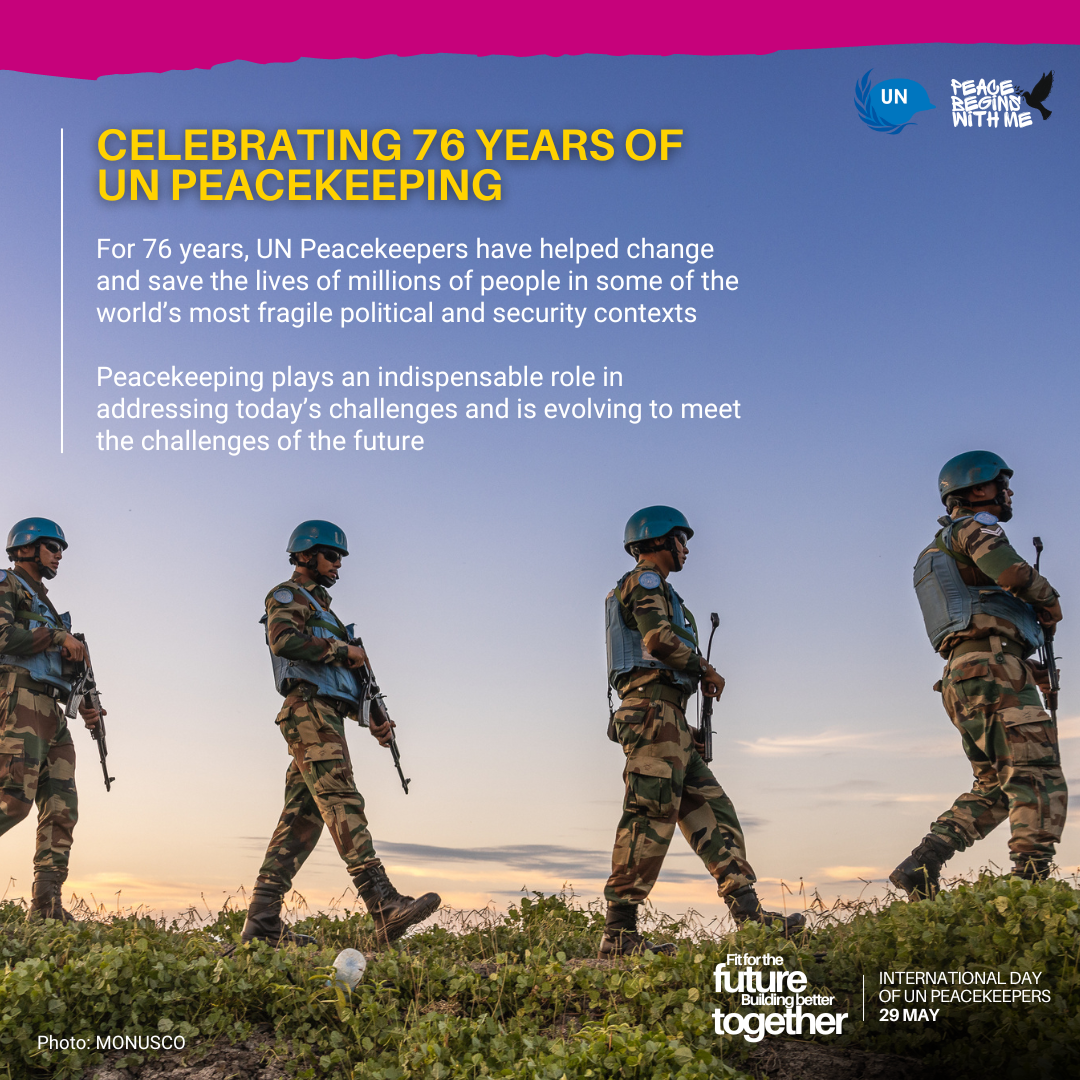
For 76 years, United Nations peacekeepers have worked to save and change lives in the world’s most fragile political and security situations. Since 1948, more than two million uniformed and civilian personnel have helped countries to transition from war to peace. Today, more than 70,000 peacekeepers serve in 11 missions deployed in hotspots around the world. Observed under the theme “Fit for the future, building better together,” this year’s International Day looks at the invaluable contributions military, police and civilian peacekeepers have made over the last seven decades. It encapsulates the spirit of progress and collective action towards creating a more equal, just and sustainable world. Over the years, peacekeeping has evolved to adapt to the changing political landscape and nature of conflicts which have become more complex and interconnected. With support from member countries, it continues to advance the path set forth in the United Nations Secretary-General’s New Agenda for Peace which calls for a more robust, holistic and collective response to the security threats of today and tomorrow. Despite the challenges, peacekeepers persevere, alongside many partners, in the collective pursuit of peace. The International Day pays tribute to the service and sacrifice of peacekeepers and the resilience of the communities that they serve. It honors the more than 4,000 peacekeepers who have lost their lives serving for peace. This campaign also calls on each of us to join the global movement for peace. Alone, we can never succeed. But, together, we can be a strong force for change. Follow the conversations with the hashtags: #PKday, #FitForTheFuture, #BuildingBetterTogether, #Peacekeeping, #29May, #Peacebegins, #WomenInPeacekeeping.

EVENTS: on May 29th, We observe a minute of silence for the fallen during the International Day of United Nations Peacekeepers 2024. On Thursday, May 30th 2024, starting at 9:45 a.m. ET, a Wreath Laying Ceremony will be held at the North Lawn building of the UNHQ with the United Nations Peacekeeping. the UN Secretary-General will lay a wreath at the Peacekeepers Memorial in honour of fallen peacekeepers. Following that, at 11 a.m. ET, he will preside over an in-person ceremony at which the Dag Hammarskjold Medal will be awarded posthumously to fallen peacekeepers. He will also present the UN Military Gender Advocate of the Year award. Follow the ceremony on UN Web TV. The Under-Secretary-General for Peace Operations, Jean-Pierre Lacroix, will be the guest at the noon briefing on 30 May. All events can be followed live on UN Web TV.

Medal recipients: At the meeting, by resolution 1121 (1997), the U.N. Security Council established the United Nations Dag Hammarskjöld Medal as a posthumous award to members of peacekeeping operations "as a tribute to the sacrifice of those who have lost their life as a result of service in peacekeeping operations under the operational control and authority of the United Nations".

Award: The United Nations Military Gender Advocate of the Year Award recognizes the dedication and effort of an individual peacekeeper in promoting the principles within the United Nations Security Council Resolution 1325. It was first given out in 2016. To mark the International Day at UN Headquarters, the UN Secretary-General will lay a wreath at the Peacekeepers Memorial in honor of fallen peacekeepers at 9:45 a.m. ET on Thursday, 30 May 2024.

List of Personnel to be Posthumously Awarded the Dag Hammarskjöld Medal on 30 May 2024

Follow the Dag Hammarskjöld Medal Awards Ceremony on UN Web TV (11:00 am, 30 May 2024)

Wreath Laying Ceremony: The commemorations are held at the U.N. Headquarters, United Nations offices and at different U.N. Peacekeeping missions Here is the List of Personnel to be Posthumously Awarded the Dag Hammarskjöld Medal.


Statement of the Secretary-general on the International Day of United Nations Peacekeepers 2024; May 29th.

For 76 years, United Nations peacekeepers have worked to save and change lives in the world’s most fragile political and security situations. Since 1948, more than two million uniformed and civilian personnel have helped countries to transition from war to peace. Today, more than 70,000 peacekeepers serve in 11 missions deployed in hotspots around the world. Observed under the theme “Fit for the future, building better together,” this year’s International Day looks at the invaluable contributions military, police and civilian peacekeepers have made over the last seven decades. It encapsulates the spirit of progress and collective action towards creating a more equal, just and sustainable world. Over the years, peacekeeping has evolved to adapt to the changing political landscape and nature of conflicts which have become more complex and interconnected. With support from UN member countries, it continues to advance the path set forth in the UN Secretary-General’s New Agenda for Peace which calls for a more robust, holistic and collective response to the security threats of today and tomorrow. Despite the challenges, peacekeepers persevere, alongside many partners, in the collective pursuit of peace. The International Day pays tribute to the service and sacrifice of peacekeepers and the resilience of the communities that they serve. It honors the more than 4,000 peacekeepers who have lost their lives serving for peace. This campaign also calls on each of us to join the global movement for peace. Alone, we can never succeed. But, together, we can be a strong force for change.

United Nations Secretary-general.


United Nations Secretary-General António Guterres to preside over Dag Hammarskjold medal and Military Gender Advocate of the Year ceremony in the Trusteeship Council chamber. For 76 years, United Nations peacekeepers have worked to save and change lives in the world's most fragile political and security situations. Since 1948, more than two million uniformed and civilian personnel have helped countries to transition from war to peace. Today, more than 70,000 peacekeepers serve in 11 missions deployed in hotspots around the world. Observed under the theme "Fit for the future, building better together," this year's International Day looks at the invaluable contributions military, police and civilian peacekeepers have made over the last seven decades. It encapsulates the spirit of progress and collective action towards creating a more equal, just and sustainable world.


STORY FROM THE FIELDS

By providing training to the National police, she helps build their skills and expertise on community policing activities.


Minute of silence


LIVESTREAM: Wreath Laying Ceremony at United Nations North Lawn Building.


Thursday, 16 May 2024

International Day of Living Together in Peace 2024; May 16th.


FORUM: “Moving towards a peaceful coexistence. International Day of Living Together in Peace 2024. Heritage, education, culture, social reconstruction and scientific cooperation are truly invaluable cornerstones of peace; a step forward in any one of these areas helps to bring people a step closer together. Collective commitment and solidarity are indispensable in this effort to bring together humanity. Dialogue paves the way for reconciliation, to moving from a divided past towards a shared future. We need a globalization of solidarity and compassion instead the normalization of division and hatred. We need a new narrative to address the current global context. One that is people-centered focusing on the vulnerable. We need to rebuild trust and restore solidarity. On May 16th, participate in discussions to find the ways to promote reconciliation to ensure peace and sustainable development; To recognize, respect and appreciate each others’ cultures and diversities and to transform relations among communities affected by conflict. Follow the conversation with the hashtags #LivingTogetherinPeaceDay; #16May.


Why living in peace in worth the fight?


As salaam alaikum.

I was born in Lisbon — a city that for centuries was part of Al-Andalus. This was at a time when Cordoba was the centre of culture and civilization of the Iberian Peninsula, just as Baghdad was the centre of culture and civilization of the world — reaching out from the Chinese border to the Atlantic coast. History moved on. And a number of transformations — cultural, economic, technological and military — changed the world to the detriment of the Arab people.

The majority of Arab countries were colonized. It took decades of struggle for liberation — sometimes bloody wars — often with long periods of exploitation — and a legacy of lines arbitrarily drawn in the sand.

But, today, once again, the world is changing and I see enormous potential in the Arab region. You have the resources. You have the culture. You have the people. But there is one core condition for success in today’s world: unity.

Time and again, history has shown that divisions allow outsiders to intervene — promoting conflicts, stoking sectarian tensions and inadvertently fueling terrorism. These are obstacles to peaceful development and the well-being of your peoples.

Overcoming those obstacles requires breaking the vicious circle of division and foreign manipulation — and moving forward together to build a more peaceful and prosperous future for the people of the Arab world and beyond.

We gather as hearts are breaking for Palestinians in Gaza. The war in Gaza is an open wound that threatens to infect the entire region. In its speed and scale, it is the deadliest conflict in my time as Secretary-General — for civilians, aid workers, journalists and our own UN colleagues.

Of course, nothing can justify the abhorrent 7 October terror attacks by Hamas. I reiterate my call for the immediate and unconditional release of all hostages. And nothing can justify the collective punishment of the Palestinian people. Yet the toll on civilians continues to escalate.

Entire families wiped out. Children traumatized and injured for life. People denied access to the very basics for human survival. A looming famine.

Any assault on Rafah is unacceptable. It would inflict another surge of pain and misery when we need a surge in life-saving aid. It is time for an immediate humanitarian ceasefire and unimpeded access for humanitarian assistance throughout Gaza.

The United Nations Relief and Works Agency for Palestine Refugees in the Near East (UNRWA) remains the backbone of our operations in Gaza and a lifeline for Palestine refugees across the region. It needs full support and funding.

I am also deeply troubled by tensions in the occupied West Bank including East Jerusalem, with a spike in illegal Israeli settlements, settler violence, excessive use of force by Israeli Defense Forces, demolitions and evictions.

The only permanent way to end the cycle of violence and instability is through a two-State solution, Israel and Palestine living side-by-side in peace and security, with Jerusalem as the capital of both States. The demographic and historical character of Jerusalem must be preserved, and the status quo at the holy sites must be upheld, in line with the special role of the Hashemite Kingdom of Jordan.

Turning to Sudan, a devastating war has thrown half the country’s population into a humanitarian freefall. One year on, thousands have been killed, and 18 million people are staring down the terrifying threat of famine.

I urge the international community to intensify its push for peace and call on the warring parties to agree on a lasting ceasefire. This should be followed by a political process that includes women’s and youth groups. I pledge the full support of the United Nations.

We must also protect the fragile political processes in Libya and Yemen.

As High Commissioner for Refugees, I witnessed the enormous generosity of the Syrian people. I am pained to see Syria now, with so much suffering and with parts of its territory occupied with several external actors involved. I call on all Syrians to come together in a spirit of reconciliation, honouring the diversity of the Syrian people and respecting the human rights of all.

We face other serious global crises. The climate emergency; rising inequalities, poverty and hunger; crushing debt; and new technology — including artificial intelligence — that is running ahead of governance and guardrails. We need deep reforms to the global multilateral system — from the Security Council to the international financial architecture — so they are truly universal and representative of today’s realities.

The upcoming Summit of the Future is a pivotal opportunity to create momentum for a more networked and inclusive multilateralism. I look forward to welcoming you to the Summit in New York in September.

There is no better moment for the Arab region to come together. Unity and solidarity throughout the Arab world would amplify the vital voice of the region and further boost your influence on the global stage. It can help this region find peace, make the most of its enormous potential and further contribute to the global good. In all this work, you can count on the United Nations, and on me personally, for our support and partnership.

UN Secretary‑General António Guterres.


EVENTS: On May 16th to mark the United Nations International Day of Living Together in Peace 2024; the United Nations General Assembly president invites all Member States, organizations of the United Nations system and other international and regional organizations, as well as civil society, including non-governmental organizations and individuals to reflect on the ways to Live Together in Peace. For the 6th World Forum on Intercultural Dialogue entitled “Dialogue for Peace and Global Security: Cooperation and Interconnectivity”. The UNAOC have led 3 sessions: 1) An inter-generational Dialogue with 20 of UNAOC youth alumni. 2) a plenary on the interfaith dialogue as a confidence building measure 3) the launch of the Young Peacebuilders in Central Asia and the Caucuses, which is supported by the Government of Azerbaijan to advance the Peace4Culture initiative.


2024 Path To Peace Gala


STATEMENTS: Read the UNAOC High Representative’s Remarks at the 6th World Forum on Intercultural Dialogue.

CAMPAIGN: Working Together towards More Peaceful Future.


Friday, 2 June 2023

World bicycle Day 2023; June 3rd.

FORUM: "Celebrate the bicycle and highlight its role in creating more sustainable, healthy and inclusive societies." World Bicycle Day 2023.

Every year on 3 June, the United Nations’ World Bicycle Day invites all to acknowledge “the uniqueness, longevity and versatility of the bicycle”.The UN-declared World Bicycle Day is a key occasion to celebrate the bicycle and highlight its role in creating more sustainable, healthy and inclusive societies. Follow the conversations with the hashtags #3june, #WorldbicycleDay#bicycle, #cycling.

EVENT: 2023 "Bike Month"NYC".

Did you Know that a joint United Nations Department of Political and Peacebuilding Affairs and United Nations Peacekeeping team participated in the 2023 "Bike Month"NYC" challenge hosted by the United Nations Staff Mission, the United Nations Department of Management Strategy policy and compliance (DMPSC), the United Nations Department of Safety and Security.

Collectively, DPPA-DPO staff logged over 3,600 miles - equivalent to New York to Paris!


ACTIONS