Showing posts with label Special Rapporteur on freedom of religion or belief. Show all posts

Friday, 22 August 2025

International Day Commemorating the Victims of Acts of Violence Based on Religion or Belief 2025; August 22nd.


FORUM: "Building a world where religious diversity is celebrated and where everyone can live in safety and dignity.” International Day Commemorating the Victims of Acts of Violence Based on Religion or Belief 2025. Around the world, individuals and communities face violence based on religion or beliefs. We must urgently combat this scourge. It is crucial to avoid generalizations about entire religions or religious groups based on the actions of a few individuals or extremist groups. It is also important to understand the specific context and motivations behind acts of violence for addressing the root causes and preventing future incidents. Promoting interfaith dialogue, tolerance, and respect for religious diversity is crucial for fostering peaceful coexistence. Governments must protect all people and places of worship, implement comprehensive anti-discrimination laws, and invest in education initiatives that foster inclusion and equal rights. Digital platforms must enforce content moderation policies that align with international human rights standards. Political and religious leaders must unequivocally condemn hate speech, advance dialogue, and make clear that violence can never be an answer. We must work together to stem the tide of hatred and promote tolerance, mutual understanding and respect.This year’s offers the opportunity to make visible the multiple, daily and egregious violence that takes place based on religion or belief, and to seek to respond to its root causes, urgently and with far greater determination. Follow the conversation with the hashtags: #22August, #Religiousviolence, #CounterViolentExtremism, #ForSafeWorship, #AgainstReligiousViolence.

August 22nd


EVENTS: On August 22nd; A webinar to mark the International Day Commemorating the Victims of Acts of Violence Based on Religion or Belief 2025 will be held at UNHQ in New york. Religious or other ideologies and beliefs can never be evoked to justify attacks against life, human dignity and rights, and in no circumstances should be used for suppressing critical and dissenting opinions and views, and undermining rule of law, peace and the democratic principles, as has been reiterated by the United Nations experts. The topics of the panel discussion will focus on Freedom of religion or belief and gender equality; the Religion and freedom of religion or belief literacy and the Antisemitism. Register to participate!

Message of the United Nations Secretary-General, Mr. António Guterres on the International Day to commemorate victims of acts of violence based on religion or belief 2025.

Across the globe, people continue to be harassed, attacked – and even killed – simply for what they believe.

Places of worship are desecrated. Communities are terrorized. Online platforms are flooded with hate.

These acts are not only abhorrent – they are a threat to our shared humanity.

When people are targeted for their faith, when hate speech goes unchecked, when impunity prevails – everyone is at risk.

We must confront this threat head-on.

Governments must adopt and enforce strong anti-discrimination laws – and invest in education that fosters respect, inclusion and human rights for all.

Political, religious and community leaders must reject divisive tactics and champion dialogue within and across communities.

And digital platforms must step up and incorporate safeguards to avoid becoming megaphones of hate.

On this International Day, we remember the victims and recommit to action.

Let us stand together to build a world where diversity is celebrated and everyone can live in safety and dignity.

António Guterres.


Monday, 21 August 2023

International Day Commemorating the Victims of Acts of Violence Based on Religion or Belief 2023; August 22nd.


FORUM: "Provide to victims of acts of violence based on religion or belief and members of their families appropriate support and assistance in accordance with applicable law." International Day Commemorating the Victims of Acts of Violence Based on Religion or Belief 2023.

This year’s international day to Commemorate the Victims of Acts of Violence based on Religion or Belief offers the opportunity to make visible the multiple, daily and egregious violence that takes place based on religion or belief, and to seek to respond to its root causes, urgently and with far greater determination. Follow the conversation with the hashtags: #22August, #Religiousviolence #CounterViolentExtremism.


Joint statement by a group of UN experts on the occasion of the International Day to commemorate victims of acts of violence based on religion or belief 2023.

“In 2019, 22 August was designated by the United Nations General Assembly as the International Day Commemorating the Victims of Acts of Violence Based on Religion or Belief, deploring the widespread violations suffered by individuals – including migrants, refugees, asylum seekers and persons belonging to minorities – who are targeted on the basis of religion or belief.

Back in 1981, it had taken some two decades for the international community to finally adopt the UN Declaration on the Elimination of All Forms of Intolerance and of Discrimination Based on Religion or Belief. That Declaration acknowledged the great suffering brought about by the disregard and infringement of human rights including of freedom of religion or belief. It noted that for those that profess religion or belief, this constitutes one of the fundamental elements of their conception of life and therefore also of their freedoms.

On this, the 75th anniversary year of the Universal Declaration of Human Rights (UDHR), there is a particular resonance with the 1981 Declaration’s emphasis that the use of religion or belief for ends inconsistent with the UN Charter, the UDHR and other instruments is inadmissible and condemnable (Article 3).

The international community resolved to adopt all necessary measures to speedily eliminate and combat intolerance and discrimination on the grounds of religion or belief, observing that this can stem from any actor whether a State, business, institution, group of persons, or person. Intolerance and discrimination based on religion or belief is defined as: “Any distinction, exclusion, restriction or preference based on religion or belief and having as its purpose or as its effect nullification or impairment of the recognition, enjoyment or exercise of human rights and fundamental freedoms on an equal basis” (Article 2.2).

Regrettably, such impairments and violations continue to plague us from every direction in every corner of the world. 42 years on from the 1981 Declaration, this year’s international day to Commemorate the Victims of Acts of Violence based on Religion or Belief offers the opportunity to make visible the multiple, daily and egregious violence that takes place based on religion or belief, and to seek to respond to its root causes, urgently and with far greater determination.”

ENDS

The experts: Ms. Nazila Ghanea, Special Rapporteur on freedom of religion or belief; Ms. Alice Jill Edwards, Special Rapporteur on Torture and other Cruel, Inhuman or Degrading Treatment or Punishment; Mr. Fernand de Varennes, Special Rapporteur on Minority issues; Mr. Balakrishnan Rajagopal, Special Rapporteur on the right to adequate housing; Ms. Alexandra Xanthaki, Special Rapporteur in the field of cultural rights; Mr. Felipe González Morales,Special Rapporteur on the human rights of migrants;Mr. Tom Andrews, Special Rapporteur on the situation of human rights in Myanmar; Mr. Vitit Muntarbhorn, Special Rapporteur on the situation of human rights in Cambodia; Mr. Michael Fakhri, Special Rapporteur on the right to food; Ms. Farida Shaheed, Special Rapporteur on the right to education; Mr. Tomoya Obokata, Special Rapporteur on contemporary forms of slavery, including its causes and consequences; Mr. Alioune Tine, Independent Expert on the situation of human rights in Mali; Mr. Mohamed Abdelsalam Babiker, Special Rapporteur on the Situation of Human Rights in Eritrea ; Mr. Javaid Rehman, Special Rapporteur on the situation of human rights in the Islamic Republic of Iran | OHCHR ; Mr. Gerard Quinn, Special Rapporteur on the rights of persons with disabilities; Mr. Morris Tidball-Binz, Special Rapporteur on extrajudicial, summary or arbitrary executions; Ms. Dorothy Estrada Tanck (Chair), Ms. Ivana Radačić (Vice-Chair), Ms. Elizabeth Broderick, Ms. Meskerem Geset Techane and Ms. Melissa Upreti - Working Group on discrimination against women and girls; Ms. Paula Gaviria Betancur, Special Rapporteur on the human rights of internally displaced persons; Mr. Surya Deva, Special Rapporteur on the right to development; Claudia Mahler, Independent Expert on the enjoyment of all human rights by older persons; Ms. Siobhán Mullally, Special Rapporteur on trafficking in persons, especially women and children; Ms. Ashwini. K.P. Special Rapporteur on contemporary forms of racism, racial discrimination, xenophobia and related intolerance ; Ms. Reem Alsalem, Special Rapporteur on violence against women and girls ; Ms. Margaret Satterthwaite, Special Rapporteur on the independence of judges and lawyers; Mr. Damilola Olawuyi (Chair), Mr. Robert McCorquodale (Vice-Chair), Ms. Fernanda Hopenhaym, Ms. Elżbieta Karska, and Ms. Pichamon Yeophantong -Working Group on Business and Human Rights; Muluka-Anne Miti-Drummond Independent Expert on the enjoyment of human rights by persons with albinism; Mr. Victor Madrigal-Borloz, Independent Expert on protection against violence and discrimination based on sexual orientation and gender identity; Ms. Priya Gopalan (Chair-Rapporteur), Mr. Matthew Gillett (Vice-Chair on Communications), Ms. Ganna Yudkivska (Vice-Chair on Follow-Up), Ms. Miriam Estrada-Castillo, and Mr. Mumba Malila, Working Group on arbitrary detention; Ms. Isha Dyfan, Independent Expert on the situation of human rights in Somalia; Ms. Irene Khan, Special Rapporteur on the Protection and Promotion of Freedom of Opinion and Expression; Ms. Fionnuala Ní Aoláin, Special Rapporteur on the promotion and protection of human rights and fundamental freedoms while countering terrorism.

The Special Rapporteurs, Independent Experts and Working Groups are part of what is known as the Special Procedures of the Human Rights Council. Special Procedures, the largest body of independent experts in the UN Human Rights system, is the general name of the Council’s independent fact-finding and monitoring mechanisms that address either specific country situations or thematic issues in all parts of the world. Special Procedures’ experts work on a voluntary basis; they are not UN staff and do not receive a salary for their work. They are independent from any government or organization and serve in their individual capacity.

Sunday, 21 August 2022

International day to commemorate victims of acts of violence based on religion or belief 2022; August 22nd.

FORUM:"Redoubling efforts to provide redress to victims of acts of violence based on religion or belief." International day to commemorate victims of acts of violence based on religion or belief 2022.


U.N. Secretary-General's Statement on the International Day Commemorating the Victims of Acts of Violence Based on Religion or Belief 2022; August 22nd.

On this day, we honour those who have lost their lives or who have otherwise suffered for simply seeking to exercise their fundamental rights to freedom of thought, conscience, and religion or belief. I reiterate my firm solidarity with these victims.

Despite the concern of the United Nations General Assembly, which instituted this observance in 2019, persons and communities worldwide continue to face intolerance and violence based on religion or belief.

Hate speech, online or offline, continues to fuel violence against vulnerable members of society, including ethnic and religious minorities. We must do more to support victims and examine the conditions that drive intolerance and hate. Initiatives like my Call to Action for Human Rights and the UN Strategy and Plan of Action on Hate Speech are tools that can be used to address these complex and pressing issues.

States have the responsibility to prevent and address discrimination and violence inflicted in the name of religion or belief through comprehensive policies that promote inclusion, diversity, tolerance and interfaith and intercultural dialogue. Human rights violations perpetrated in the name of religion or belief must be investigated and punished, and effective reparations need to be provided to victims, in compliance with international human rights law.

It is essential that all States, faith leaders and other influential actors condemn all incitement to hatred and violence based on religion or belief. Only a collective, inclusive, and society-wide effort can result in safe co-existence for all and end this blight on our societies.


António Guterres


The cynical abuse of religion or belief as a tool of discrimination, hostility and violence should be condemned by all actors at every level of society, UN experts and senior UN officials* said today. Ahead of the International day to commemorate victims of acts of violence based on religion or belief, they issue the following joint statement:


“The United Nations General Assembly designated 22 August as the International Day Commemorating the Victims of Acts of Violence Based on Religion or Belief, deploring the widespread violations suffered by individuals, and persons belonging to minorities, who are targeted on the basis of their religion or belief.

Today we honour these victims and recognise their inherent dignity and equal and inalienable rights as members of the human family, as upheld in the Universal Declaration of Human Rights. Freedom of thought, conscience, religion and belief is protected in all human rights instruments. In the 1981 UN Declaration on the Elimination of All Forms of Intolerance and of Discrimination Based on Religion or Belief, the international community committed to ensuring that no one be subject to discrimination by any State, institution, group of persons, or person on grounds of religion.

Regrettably, we see these standards flouted with impunity in every corner of the world through an alarming number and severity of violations, many targeting persons belonging to religious or belief minorities. Considering that States have the primary responsibility to promote and protect human rights, these violations are particularly abhorrent when directed by State authorities themselves and where they reveal consistent patterns of gross violations of human rights. In other instances, the State is unable or unwilling to protect victims of all ages from violence or, worse still, funds and supports these acts which target individuals and communities belonging to religious or belief minorities, especially those with multiple marginalized identities. Violence too often contributes to further marginalising populations who are already discriminated against.

On this international day, we also condemn the targeting of individuals, in the name of religion or belief. This cynical abuse of religion or belief as a tool of discrimination, hostility and violence should be condemned by all actors at every level of society. Last year, the General Assembly adopted its resolution 75/309 of 21 July, in which it reaffirmed the obligation of Member States to prohibit discrimination and violence on the basis of religion or belief and to implement measures to ensure the equal and effective protection of all by the law. International law rejects any attempt to call on either religion or belief, or freedom of religion or belief, as justification for the destruction of the rights and freedoms of others. Online and offline hate speech that take the form of expressions of intolerance, discrimination and violence against individuals on the basis of religion or belief should be addressed and countered.

In commemorating this significant UN day, we urge States to redouble efforts to provide redress to victims of acts of violence based on religion or belief. We seek to prevent such violations by taking constructive steps that hollow out the efforts of State or non-state actors who carry out acts of intolerance and violence based on religion or belief or in the name of religion or belief.

Our efforts require us to work together in the promotion of tolerance and respect for religious or belief diversity and human rights, as States, United Nations entities, regional organisations, national human rights institutions, non-governmental organisations, religious or belief bodies and leaders, the business sector, the media and civil society. We stress the importance of working together in recognition of the potential role that inspiration and volition drawing from religion and belief can play in advancing respect for the human rights of each and all, and dialogue, understanding and peace.”
*The experts: Nazila Ghanea, Special Rapporteur on freedom of religion or belief; Alice Wairimu Nderitu, Under-Secretary-General Special Advisor on the Prevention of Genocide; Fernand de Varennes, Special Rapporteur on Minorities Issues; Alexandra Xanthaki, Special Rapporteur in the field of cultural rights; Gerard Quinn, Special Rapporteur on the rights of persons with disabilities; Javaid Rehman, Special Rapporteur on the situation of human rights in the Islamic Republic of Iran; Livingstone Sewanyana,Independent Expert on the promotion of a democratic and equitable international order;Tom Andrews, Special Rapporteur on the situation of human rights in Myanmar; Morris Tidball-Binz, Special Rapporteur on extrajudicial, summary or arbitrary executions; Fionnuala Ní Aoláin, Special Rapporteur on the promotion and protection of human rights while countering terrorism; Richard Bennett, Special Rapporteur on the situation of human rights in Afghanistan; Vitit Muntarbhorn,Special Rapporteur on the situation of human rights in Cambodia;Cecilia Jimenez-Damary, Special Rapporteur on the human rights of internally displaced persons; Alioune Tine, Independent Expert on the situation of human rights in Mali; E. Tendayi Achiume, Special Rapporteur on contemporary forms of racism, racial discrimination, xenophobia and related intolerance; Ms. Sorcha MacLeod (Chair-Rapporteur), Ms. Jelena Aparac, Mr. Ravindran Daniel, Mr. Chris Kwaja, Mr Carlos Salazar, Working Group on the use of mercenaries; Michael Fakhri, Special Rapporteur on the right to food; Siobhán Mullally, Special Rapporteur on trafficking in persons, especially women and children; Luciano Hazan (Chair-Rapporteur), Aua Baldé (Vice-Chair), Gabriella Citroni, Angkhana Neelapaijit, Grazyna Baranowska. Working Group on Enforced or Involuntary Disappearances; Miriam Estrada-Castillo (Chair-Rapporteur), Mumba Malila (Vice-chairperson), Elina Steinerte, Priya Gopalan, Matthew Gillett, Working Group on arbitrary detention; Isha Dyfan, Independent Expert on the Situation of Human Rights in Somalia; Balakrishnan Rajagopal, Special Rapporteur on the right to adequate housing; Reem Alsalem, Special Rapporteur on violence against women and girls, its causes and consequences; Melissa Upreti (Chair), Dorothy Estrada Tanck (Vice-Chair), Elizabeth Broderick, Ivana Radačić, and Meskerem Geset Techane, Working Group on discrimination against women and girls; Claudia Mahler, Independent Expert on the enjoyment of all human rights by olderpersons; Attiya Waris, Independent Expert on the effects of foreign debt and other related international financial obligations of States on the full enjoyment of all human rights, particularly economic, social and cultural rights; Farida Shaheed, Special Rapporteur on the right to education; Clément Nyaletsossi Voule, Special Rapporteur on the rights to freedom of peaceful assembly and of association; Mr. Tomoya Obokata, Special Rapporteur on contemporary forms of slavery, including its causes and consequences; Catherine S. Namakula, current Chair-Rapporteur; Barbara G. Reynolds, Vice-Chairperson, Dominique Day, Sushil Raj and Miriam Ekiudoko, Working Group of Experts on People of African Descent; Pedro Arrojo-Agudo, Special Rapporteur on the human rights to safe drinking water and sanitation; Fernanda Hopenhaym (Chair-Rapporteur), Pichamon Yeophantong (Vice Chairperson), Elżbieta Karska, Robert McCorquodale and Damilola Olawuyi, Working Group on Business and Human Rights; Obiora Okafor, Independent Expert on human rights and international solidarity

The Special Rapporteurs, Independent Experts and Working Groups are part of what is known as the Special Procedures of the Human Rights Council. Special Procedures, the largest body of independent experts in the UN Human Rights system, is the general name of the Council’s independent fact-finding and monitoring mechanisms that address either specific country situations or thematic issues in all parts of the world. Special Procedures’ experts work on a voluntary basis; they are not UN staff and do not receive a salary for their work. They are independent from any government or organization and serve in their individual capacity.


Friday, 17 June 2022

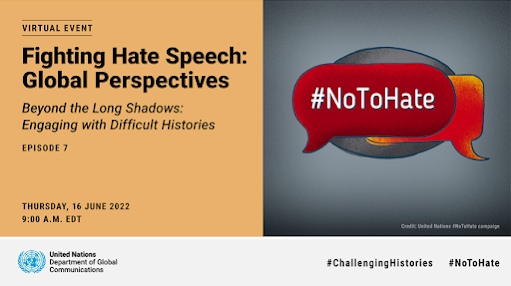
International Day for Countering Hate Speech 2022; June 18th.

FORUM: "FIGHTING HATE SPEECH: GLOBAL PERSPECTIVES". International Day on Countering Hate Speech 2022


In May 2019, the United Nations Strategy and Plan of Action on Hate Speech was launched highlighting that a disturbing groundswell of xenophobia, racism and intolerance is being observed around the world. Social media and other forms of communication are being exploited as platforms for bigotry. Public discourse is being weaponized for political gain with incendiary rhetoric that stigmatizes and dehumanizes minorities, migrants, refugees, women and any so-called “other”.

Hate speech is a menace to democratic values, social stability and peace. As a matter of principle, hate speech must be confronted at every turn and be tackled in order to prevent armed conflict, atrocity crimes and terrorism, end violence against women and other serious violations of human rights, and promote peaceful, inclusive and just societies.

The Special Rapporteur on freedom of religion or belief addressed increasing limitations on freedom of expression related to religion or belief that take the form of anti hate speech laws, read the 2019 report (A/HRC/40/58).


Hate speech and incitement to hatred or violence. Special Rapporteur on freedom of religion or belief


Violence in “the name of religion” is often manifested through targeted attacks on individuals or communities, acts of extremism or terrorism, communal violence, State repression, discriminative policies or legislation and other types of embedded structural violence. Incidents involving hate speech, negative stereotyping, and advocacy of religious or national hatred have resulted in killings of innocent people, attacks on places of worship and calls for reprisals. Such violence also disproportionately targets religious dissidents, members of religious minorities, converts or non-believers.

The UN Rabat Plan of Action stresses the collective responsibility of public officials, religious and community leaders, the media and individuals, and the need to nurture social consciousness, tolerance, mutual respect, and intercultural dialogue to prevent incitement to hatred.

Read the Special Rapporteur’s reports on violence committed “in the name of religion” (A/HRC/28/66) and on the need to tackle manifestations of collective religious hatred (A/HRC/25/58).