Showing posts with label young people. Show all posts

Saturday, 24 January 2026

International Day of Education 2026; January 24th.

International Day of Education 2026


FORUM: ‘‘The power of youth in co-creating education.’’ International Day of Education 2026. Youth under 30 constitute more than half of the global population. They are a driving force for sustainable development, innovation and social transformation, yet they remain disproportionately affected by poverty, inequality and limited access to quality education and decent work opportunities.When it comes to shaping the future of education, youth have a special role to play: they are the beneficiaries of education programmes and their future depends on it. For this reason, meaningfully engaging students and youth in co-creating the education they want is essential to meet their aspirations and ambitions. This is particularly true at a time of radical transformation induced by the technological revolution, which calls for rethinking the purpose and modalities of teaching and learning.This commitment aligns with the 2030 Agenda for Sustainable Development, which recognizes the role of youth as agents of change in achieving inclusive and equitable quality education and building peaceful, just and inclusive societies. Although progress has been made in involving young people and students in global decision making in education – including by securing them a permanent seat alongside global leaders in the SDG 4 High-Level Steering Committee – more needs to be done to ensure they are co-creators of education systems at all levels: at school, at country level, in international development cooperation programmes and so. The Youth Declaration on Transforming Education is a tangible result of youth’s willingness and capacity to contribute to strategic dialogues in education. Their initiatives at grassroots level, where young people play an instrumental role in supporting their peers with the provision of education – especiallyin crisis situations – are instrumental to take informed decisions: they need to be better brought to light, mainstreamed and considered. This year’s International Day of Education will celebrate the power of youth as co-creators of education. This will be done by: 1. Taking stock of national efforts to involve youth in educational decision-making, through anew report by the UNESCO Global Education Monitoring Report team, in partnership with the UN Youth Office, which measures student and youth participation in education laws and policy-making. R equested by the SDG4 High-Level Steering Committee in 2022, this new measurementholds countries accountable for the ir commitments to meaningfully engage youth made at the United Nations’ Transforming Education Summit and in the Pact for the Future. 2. Showcasing how UNESCO is leading the way by giving youth a voice in decision-making bodies such as the SDG 4 High -Level Steering Committee, placing them at the centre of global consultations for the post -2030 education agenda and amplifying their voices through UNESCO networks such as ASP net, SDG4 Youth & Student Network, the Global Youth Community, and the Youth Climate Action Network. On the ground, UNESCO empowers youth as leaders and changemakers, notably in crisis-affected contexts. 3. Introducing tools to ensure meaningful youth engagement in education at school and beyond, which were developed by the SDG4 Youth & Student Network and the UNESCO Associated Schools Network. 4. Highlighting youth-led initiatives in crisis-affected contexts that help safeguard the right to education for all, particularly for the most marginalized. As we shape the 2026 GEM Report consultationwe would love your input. What should be prioritized?, Follow the conversations with the hashtags: #EndLearningPoverty, #Education2030, #DayofEducation, #24January, #EducationforPeace, #Learningforpeace, #education, SDG4.

Foro realizado en México con motivo del Día Internacional de la Educación y su tema del 2026: "El poder de la juventud en la cocreación de la educación". Un foro realizado por las UNESCO en México en colaboración con la Secretaría de Educación del Gobierno de México y la Asociación Nacional de Universidades e Instituciones de Educación Superior (ANUIES).


EVENTS: On Saturday, January 24th, The UNESCO and its member states will mark the International Day of Education 2026 under the theme “The power of youth in co-creating education.” On Friday, January 23rd; From 10:00 a.m. to 17:00 p.m at UNESCO HQ Paris, Room I and Room VII; The global celebration will highlight how young people are shaping the future of learning and how everyone can help amplify their leadership. Youth under 30 make up more than half the world’s population, yet they remain underrepresented in education decision-making. By participating you help build a global movement advocating for inclusive, relevant and youth-centered education systems. The Observance of the International Day of Education 2026 will be marked through youth-led and participatory celebrations:

• A global event convening youth and students alongside international decision-makers will be hosted at UNESCO Headquarters in Paris on 23 January 2026 from 10 am to 1 pm (Paris time).

• An online youth-led event will feature young people’s stories and their role in advancing quality education in conflict-affected contexts on 23 January 2026 from 3 to 5 pm (Paris time). The event will be organized by the SDG 4 Youth & Student Network in cooperation with other UNESCO networks and partners, notably the UNESCO Associated Schools Network (ASPnet).

• An online action for youth and students to participate in the celebrations around International Day for Education will accompany other activities to drive visibility and engagement.

• The issuing of a call for good practices on meaningful youth engagement in education, which will be featured in the SDG 4 Knowledge Hub.

Register to participate (via indico), get the agenda programme and watch the livestream!


STATEMENTS: Read the Statement by the United Nations Secretary-General on International Day of Education 2026; January 24th.


Education is a human right, and a springboard to greater opportunity, dignity and peace.

Yet around the world, 272 million children and young people lack access to education because of poverty, discrimination, conflict, displacement and disasters.

On this International Day of Education, I call on all governments, partners and donors to prioritize education in their policies, budgets and recovery efforts. We must close the persistent gaps in financing, access and quality that lock young people out of the future they seek and deserve.

As this year’s theme reminds us, we particularly need to listen to the voices of young people themselves, and act on their pleas for qualified teachers, relevant skills and competencies training for a changing world, and equitable access to technology.

Together, let’s build inclusive, resilient and innovative education systems for all people.

António Guterres, Secretary-General.

On this International Day of Education, UNESCO is putting young people in the spotlight. It is our collective responsibility to offer younger generations, through education, better prospects for the future than those of the generations that came before. It is with this in mind that UNESCO helps its Member States to ensure that access to quality education is a reality for all, and not a privilege of the few. Around the world, UNESCO implements major educational programmes to unlock the potential of the millions of young people who need it most. This is the “UNESCO for the people” that we are striving to build. UNESCO runs large-scale education programmes using funds from the Global Partnership for Education. This is the case in places such as Côte d’Ivoire, Cambodia, Ukraine and Chad, where nearly 100,000 out-of-school young people have been able to return to school. We also work in the most challenging contexts, amid crises. In Haiti, for instance, we are supporting community schools in the most vulnerable neighbourhoods. In Afghanistan, we have established literacy programmes for young women. In Gaza, we are helping to maintain learning continuity and providing young people with vital psychological assistance. We also act in the aftermath of crises, as is the case in Iraq, where we have renovated more than 400 classrooms in the province of Nineveh. However, access to education is not enough. At a time when climate challenges and technological changes are affecting traditional teaching methods on a large scale, education can no longer be conceived of without young people’s input; it can no longer ignore the voices of those it is intended to benefit. Young people must be included in the construction of education. Yet according to a new UNESCO study, while four out of five countries report having consulted young people on educational laws and policies in the last three years, only one out of five youth and student organizations feels that students and youth are genuinely working hand-in-hand with their governments. Because education systems are more effective when designed in collaboration with the people they are intended to serve, UNESCO calls for greater involvement of young people in the development of the education policies and decision-making processes which affect them. It is this conviction that drives UNESCO’s work. Today we are presenting a new study under the Global Education Monitoring (GEM) Report, developed in collaboration with the Office of the Assistant Secretary-General for Youth Affairs. This edition of the GEMReport includes, for the first time, an international indicator for measuring young people’s  actual participation in the development of education policies, thereby responding to a request made in 2022 by young people themselves at the Transforming Education Summit. In the same spirit, we are launching a new cohort of the SDG4 Youth & Student Network: 110 young people from 80 countries, involved in consultations on the future of education and the post-2030 global agenda. On this International Day of Education, we are reaffirming a simple yet powerful belief: the belief that young people have a rightful place at the decision-making table – not only as beneficiaries, but also as full-fledged partners. 

Mr Khaled El-Enany, Director-General of UNESCO.


PUBLICATION2026 Global Education Monitoring Report, Countdown to 2030: Access and equity,


The 2026 GEM Report aims to address the following questions:
  • Among countries that started from similar levels of education development, which countries have improved much faster than others or stagnated in terms of early childhood education participation, out-of-school rates, completion rates and tertiary participation? 
  • Have they managed to reduce disparity?
  • Among countries that have improved fast (or stagnated), what are the 2-3 key reasons that help explain the observed trends?
  • What policies does research identify as having played a key role for improving education participation and reducing disparity in the long term – and how do they relate to factors put forward in country analyses? 
  • What is the role of financing policies to promote equity?
  • What are the implications of the statistical, country case study and policy analyses for a forward looking education agenda? 
The recommendations would cover a range of issues, including: scope for improvement in approaches to monitoring participation at different education levels; lessons from past progress records on feasible but ambitious targets for an agenda post-2030 and a reflection on the implication for the right to education; mechanisms for setting targets; policy principles that have served countries that have expanded faster; and scope for improvement in approaches to monitoring policies. As the 2030 deadline draws nearer, there is a clear demand to take comprehensive stock of the progress achieved since the start of SDG 4. In this context, following a recommendation of the independent external evaluation of the GEM Report, its Advisory Board has recommended bringing education statistics to the forefront and introducing changes to the next three report cycles in the form of a Countdown to 2030 series.

The first report in the series will look at four indicators: 
  1. Early childhood participation (SDG global indicator 4.2.2)
  2. Out-of-school rate (SDG thematic indicator 4.1.4
  3. Completion rate (SDG global indicator 4.1.2
  4. Tertiary education gross enrolment ratio (SDG thematic indicator 4.3.2)

Equity measures will be examined as part of the country case studies. In addition, some countries will also be selected directly based on analysis of progress in inequality measures.

For each one of the indicators and for a broad set of equity measures, five countries of fast progress and two countries of stagnation will be analysed – a total of 35 countries – to provide a representative set of examples. The aim is not to pick the ‘best’ performing countries in the world but a regionally balanced set of countries that moved fast, given their initial conditions and contexts.

CONCEPT NOTE


Save the date: 2026 GEM Report launch on 25 March 2026.


The 2026 Global Education Monitoring Report, Countdown to 2030: Access and equity, will be launched on 25th March, 2026. The full-day event will follow the 23-24th March meeting of the Global Education Coalition, both taking place in UNESCO HQ in Paris, France. The report is the first in a three-part series of Countdown to 2030 reports, the next of which will cover learning and quality (2027) and relevance (2028/9). The 2026 GEM Report will provide the latest data and analysis on key global education indicators: the out-of-school rate, completion rate, early childhood participation, and higher education enrolment, including case studies of countries that have improved much faster than their peers over the past two decades. It will contain the analysis of a new series of GEM PEER country profiles on equitable finance mechanisms.

For additional information about the global launch on 25 March, visit this page.

UNESCO HQ; PARIS


Monday, 11 August 2025

International Youth Day 2025; August 12th.

August 12th.


FORUM: “Local Youth Actions for the SDGs and Beyond." International Youth Day 2025. The theme places a strong emphasis on the transformative role of young people in the localization of the SDGs, translating the global Sustainable Development Goals (SDGs) into local realities. This theme recognizes that young people are not merely beneficiaries of development, but are active agents of change, innovation, and leadership. It acknowledges the need for youth inclusion in local governance processes, as their creativity, energy, and community knowledge are essential for addressing the complex and interconnected challenges of our time. Over the past decade, global institutions have increasingly acknowledged that the achievement of the SDGs by 2030 depends on how effectively they are localized—translated into concrete actions at the community level. Recent reports by UN-Habitat and the United Nations Department of Economic and Social Affairs (DESA) revealed that at least 65 per cent of SDG targets relate directly to the mandates of local and regional governments (LRGs). Consequently, there is a growing imperative to empower youth as partners in SDG localization processes, as they are often deeply embedded in their communities and possess unique insights into local development needs. Localizing the SDGs refers to the process of adapting and implementing the global goals within specific local contexts, aligning them with community needs while maintaining consistency with national and international commitments. This approach is vital to ensure that development is inclusive, participatory, and sustainable. When young people are empowered to engage in this process, they become catalysts for innovation and resilience in their communities. The theme of 2025 IYD is deeply aligned with the World Programme of Action for Youth (WPAY), which sets a policy framework and practical guidelines for national action and international support to improve the situation of young people. As the WPAY approaches its 30th anniversary, the 2025 IYD theme offers a timely opportunity to renew commitment to its principles, particularly those emphasizing youth agency, youth engagement in decision-making, and sustainable development. Indeed, the WPAY provides a vital framework for guiding and advancing youth contributions to development processes. By aligning SDG localization efforts with the objectives of the WPAY, countries can promote their role as key partners in sustainable development, and ensure their inclusion in designing, implementing and evaluating policies that directly affect their communities. SDG localization supports the WPAY by enabling young people to take ownership of the development agenda, turning the global goals into localized actions that reflect their unique challenges and aspirations.

Building on this foundation, 2025 IYD connects with new global commitments such as the Pact for the Future and the Declaration on Future Generations, which emphasize the importance of youth in shaping a fairer, more equitable and sustainable world. The Pact calls for “meaningful youth engagement, recognizing young people as agents of change and essential partners in achieving sustainable development”. Similarly, the Declaration affirms “the duty to ensure that the interests and needs of future generations, including today’s children and youth, are reflected in public policy and decision-making at all levels”. Localizing the SDGs through youth-led efforts ground the goals of the Pact and Declaration—making them real in the places young people live and lead. The upcoming Second World Summit on Social Development (Doha, Qatar, November 2025) also presents a key opportunity to spotlight youth-led actions on social development and strengthen their role in shaping inclusive social policies. Local youth actions are not isolated activities; they are integral to broader efforts to achieve national development plans and the SDGs. By highlighting and supporting these initiatives, the international community can help bridge the gap between top-down policy frameworks and bottom-up implementation, thus ensuring that no one is left behind.

The 2025 IYD will serve as a strategic platform to: 1. Recognize youth as key local development partners: • Elevate the visibility of youth-led initiatives and their impact on SDG implementation. • Raise awareness about the WPAY and its role in recognizing the youth as local development partners. • Celebrate young people as innovators, leaders, and mobilizers within their local contexts. 2. Promote policy coherence and institutional support for local youth initiatives: • Encourage governments to integrate youth-led initiatives into local development frameworks and decision-making processes. • Promote the integration of youth development goals within local development strategies, drawing from the WPAY’s framework and the Pact for the Future and the Declaration on Future Generations • Advocate for inclusive policy environments that facilitate youth participation in governance. 3. Encourage multi-stakeholder collaboration: • Foster partnerships between youth and youth-led organizations, local governments, civil society, the private sector, academia, and UN agencies. • Promote knowledge sharing and joint problem-solving to enhance the effectiveness of local SDG implementation. • Leverage technology and innovation to connect youth across regions and facilitate collaboration. 4. Showcase youth stories and solutions: • Provide platforms for youth to share their personal experiences, insights, and innovations. • Use storytelling as a tool to amplify youth voices and promote peer learning. • Document and disseminate lessons learned from youth-led localization projects.

Follow the conversation with the hashtags: #12August, #InternationalYouthDay, #Youthday, #Greenskills.


International Youth Day 2025;


EVENTS: On August 12th at 9:00 (EST), The global observance of the International Youth Day 2025 will take place in Nairobi, Kenya, hosted in collaboration with UN-Habitat, a key partner of DESA and a leading advocate for sustainable urban development and SDG localization. The event will bring together youth leaders, policymakers, municipal officials, academics, development practitioners, and UN representatives to explore strategies for enhancing youth engagement in local development. Planned activities include: • Interactive Dialogue: The event will feature an interactive dialogue between youth and other decision-makers. Topics will cover urban planning, climate resilience, social inclusion, innovation, and digital transformation, all through a youth lens. • Youth Innovation Showcase: Youth organizations and social enterprises will have the opportunity to exhibit their work both in the community and at the UN compound. • Commemoration of 2025 IYD which will include youth, UN and government represenatives. The commemoration will be held in person on the UN compound and virtually, ensuring global participation of youth and youth partners. Knowledge products developed include: • Infographics: Visual tools that present data and analysis on the contributions of youth to SDG localization. Designed to inform policy discussions and advocate for greater youth involvement. • Youth storytelling series: A multimedia collection featuring short films, podcasts, and blog posts. These stories will reflect diverse youth experiences in implementing the SDGs at the local level. • Social media engagement package: A ready-to-use digital toolkit that includes infographics, video messages (e.g., from the UN Secretary-General or DESA’s USG), and sample content. Designed for dissemination by youth networks, Member States, and UN agencies to increase outreach and engagement. The Youth Unit Programme encourages youth around the world to organize activities to raise awareness about the situation of youth in their country. Read the concept note and Register to participate!

On August 12th, to mark International Youth Day and as part of the Women and Youth Democratic Engagement Initiative (WYDE), the Inter-Parliamentary Union (IPU) is hosting an empowerment briefing for Young MPs to access peer-to-peer support, empowerment networks and initiatives. Despite increased acknowledgement from parliaments of the importance of youth participation in political decision-making, the number of sitting Young MPs remains unrepresentative. This webinar entitled ''Youth Political empowerment'' will showcase youth platforms, exchange country-level experiences of youth networks and identify better opportunities for youth to be heard in the political community. Register to attend!

On August 8th 2025, the UNITAR High-level panel discussion to mark the International Youth Day 2025 entitled "Youth Advancing Multilateral Cooperation Through Technology and Partnerships," will highlight the vital role young people play in redefining multilateral diplomacy. This year's observance, organized in collaboration with UNITAR and AFS Intercultural Programs and the Permanent Mission of Malta to the UN, provides a dynamic platform for young leaders, policymakers, diplomats, innovators, and civil society actors to engage in meaningful conversations on how technology and partnerships can strengthen global cooperation. Open to all through public registration, the event will encourage diverse participation, ensuring that voices from various backgrounds contribute to shaping a more connected and collaborative world. In today’s rapidly evolving global landscape, youth are emerging as key drivers of change, harnessing the power of technology and strategic partnerships to address pressing international challenges. By 2030, the youth population is projected to comprise 57 percent of the global demographic, underscoring the urgent need to empower young people with meaningful roles indecision-making and global governance. This demographic shift positions youth not only as beneficiaries of multilateral policies but as essential partners in shaping them. The theme for International Youth Day 2025, "Youth Advancing Multilateral Cooperation Through Technology and Partnerships," highlights the vital role young people play in redefining multilateral diplomacy. By leveraging digital tools and fostering cross-sector collaborations, youth are not only amplifying their voices but also facilitating inclusive, impactful dialogue across nations, cultures, and institutions. Digital platforms empower young people to transcend national boundaries, enabling real-time collaboration on global challenges such as climate change, health crises, and economic disparity. Through initiatives like virtual hackathons, open-source development, and cross-border social media campaigns, youth are not only raising awareness but also co-creating innovative solutions with youth across continents. Their digital fluency allows them to participate in global dialogues previously limited to diplomats and policymakers, positioning them as active stakeholders in shaping multilateral agendas. Youth-run digital platforms are being used to mediate conflict and promote intercultural understanding in regions of unrest. By embedding technology into the fabric of multilateral cooperation, and by forming dynamic alliances across sectors, the youth are not just participants, they are architects of a more collaborative and innovative global order.

Objectives 1. Highlight and empower the role of youth as active participants and leaders in international decision-making processes. 2. Explore how digital innovation enables youth to transcend geographical boundaries and foster effective diplomatic relations. 3. Encourage collaboration between youth, governments, international organizations, civil society, and the private sector to address global challenges. 4. Create a space where diverse perspectives are shared, promoting equity, mutual understanding, and cooperative action. 5. Motivate participants to develop initiatives and partnerships that continue beyond the event, contributing to long-term global cooperation.

Expected Outcomes 1. Enhanced understanding of how youth-led technological initiatives and partnerships can influence multilateral diplomacy. 2. New connections formed among youth, institutions, and stakeholders, fostering future joint efforts. 3. Encouragement of young participants to take active roles in diplomatic and global governance spaces. 4. Compilation of key discussion points and recommendations to be shared with relevant organizations and participants for continued engagement.

SPEAKERS ● 3:30 - 3:35 pm - Welcome: Yumna Khan, Director of the Youth Assembly and Strategic Youth Initiatives, AFS ● 3:35 - 3:40 pm - Introduction: Daniel Obst, President and CEO, AFS ● 3:40 - 3:50 - Remarks: H.E. Mr. Philemon Yang, President of the 79th Session of the United Nations General Assembly (pending) ● 3:50 - 3:55 pm - Remarks: Mr. Felipe Paullier, Assistant Secretary General for Youth Affairs, UN Youth Office (video) ● 3:55 - 4:05 pm - Remarks: Permanent Mission of Malta to the UN ● 4:05 - 4:15 pm - Remarks: Mr. Samim Hamidy, UNITAR ● 4:15 - 4:25 pm - Mr. Eliot Minchenberg, Director, New York Office & Representative to the United Nations, UNESCO (invited) ● 4:25 - 4:30 pm - Youth Remarks: Ms. Daphne Frias, Youth Advocate, Box The Ballot, Forbes 30 under 30 ● 4:30 - 4:35 pm - Remarks: Ms. Azza Karam, Founding President and CEO of Lead Integrity ● 4:35 - 4:45 pm - Remarks: Ms. Jennie Magiera, Global Head of Education Impact at Google YOUTH PANEL SPEAKERS 4:45 - 5:55 pm ● Moderator: Ali Mustafa, AFS Intercultural Programs ● Daphne Frias, Youth Advocate, Box The Ballot, Forbes 30 under 30 ● Shah Chowdhury, Co-Founder and President, Footsteps Bangladesh ● Ilan Enverga, Youth Representative on the UNESCO SDG4 High-Level Steering Committee and Founder & CEO of Global Changemaker Schools ● Dana Al Anzy, Qatar Youth Ambassador, AFS International Board of Trustees Member ● Yugratna Shirawastwa, Co-Chair Major Group of Children and Youth. Read the Concept note and Watch the celebration of the International Youth Day 2025!


STATEMENTS:

Statement by the United Nations Secretary-General Antonio Guterres on International Youth Day 2025; August 12th.

On International Youth Day, we celebrate the determination, creativity and leadership of young people everywhere.
This year's theme – Local Youth Action for the SDGs and Beyond – reminds us that global progress begins in communities. And in every corner of the world young people are leading the way.

They are driving sustainable development, building more inclusive communities, forging peace, and demanding a fairer, greener and more just future.

Young people are bold innovators, resilient organizers, and essential partners in achieving the Sustainable Development Goals.

This year also marks a renewed commitment to the World Programme of Action for Youth – a recognition that when young people lead, societies thrive.

To every young person: your voice, ideas and leadership matter.

Let us work together to support youth-led solutions and build a more just, peaceful, and sustainable world, from the ground up.


António Guterres,United Nations Secretary-General.

Dear friends, today on International Youth Day, we celebrate young people who are driving change in their communities and advancing sustainable development goals.

This year's the same local youth actions for the SDGs and beyond reminds us that meaningful change starts in our local communities. Over the 65% of the SDG targets are linked to the policies and services delivered by the local and regional governments. Empowering youth where they live is not just beneficial, it is essential. Young people process an intimate understanding of their community's needs and are uniquely equipped to design the solutions that resonate. By empowering young people, we unlocked a powerful and effective force for sustainable development, shifting towards a more inclusive and participatory processes, amplifying diverse voices, building trust and delivering lasting solutions.


Young people are already leading the way, tackling local challenges and demonstrating sustainable development in practice. Young people are also actively engaged in the key UN platforms to advance sustainable development.

At the annual ECOSOC youth forum, the UN's largest intergovernmental gathering with young people, leaders from around the world shared invaluable ground level experiences and shaped global policies.
At the internet governance forum, youth voices have been instrumental in promoting an open and inclusive digital space highlighting the role of a digital technology in achieving sustainable development. Young people also played a critical role at the recent conferences supported by UN DESA including the third UN ocean conference and the fourth international conference on financing for development showing their impact across a wide range of sustainable development issues.

At the UN, we are very much looking forward to having impactful contributions in the process leading up to the second world summit for social development to be held in Doha later this year.
As we mark the 30th anniversary of the world programme of the action for youth, we have a pivotal opportunity to deepen our commitment to ensuring young people are fully included as equal partners, particularly at the local level.
By championing young change makers, let us build a more inclusive, resilient, and sustainable future for all.
Happy International Youth Day.


Mr. Li Junhua, Under-Secretary-General, UN DESA.


OTHER STATEMENTS:

Poster


PUBLICATION: The Youth2030 Phase 2 (2025–2030) presents a comprehensive Strategic Priorities and Results Framework, charting a bold path forward to intensify impact and drive transformative change with and for young people worldwide. Launched in 2018 by the UN Secretary-General, Youth2030 — the UN Youth Strategy — is the umbrella framework guiding the UN system’s work with and for youth. Now, over six years into its implementation, acceleration is needed at all levels to meet the strategy’s goals. The report focuses on accelerating the implementation of Youth2030 at the global, regional, and national levels. Read the full Youth2030 Phase 2 (2025–2030) report!

Publication


LIVESTREAM: High-level Event organized bty the UNITAR to mark the International Youth Day 2025; The theme for International Youth Day 2025, "Youth Advancing Multilateral Cooperation Through Technology and Partnerships," highlights the vital role young people play in redefining multilateral diplomacy.This year's observance, organized in collaboration with UNITAR and AFS Intercultural Programs, provides a dynamic platform for young leaders, policymakers, diplomats, innovators, and civil society actors to engage in meaningful conversations on how technology and partnerships can strengthen global cooperation. Open to all through public registration, the event will encourage diverse participation, ensuring that voices from various backgrounds contribute to shaping a more connected and collaborative world. Get the Concept note!


Thursday, 31 October 2024

World Cities Day 2024. October 31st.


FORUM: “Youth climate changemakers: Catalysing local action for urban sustainability.” World Cities Day 2024. With urban areas projected to accommodate 70% of the global population by 2050, cities face unprecedented challenges, particularly in the context of climate change. In cities worldwide, youth represent a significant demographic, with their voices and actions pivotal in shaping urban futures. It has been estimated that 60% of the world’s population will live in cities by 2030 and that as many as 60% of urban dwellers will be under the age of 18. Despite progress towards the Sustainable Development Goals, urban areas continue to grapple with poverty, inequality, and environmental degradation, necessitating urgent and transformative actions. In the Global South, these challenges are often more pronounced due to rapid urbanization, limited infrastructure, and insufficient resources. Cities in these regions frequently face severe housing shortages, inadequate access to clean water and sanitation, and higher vulnerability to climate-related disasters. Youth in these areas are particularly affected, experiencing high levels of unemployment and limited educational opportunities. Therefore, addressing the unique needs and leveraging the potential of young people in the Global South is crucial for achieving sustainable urban development and mitigating the impacts of climate change. Engaging youth meaningfully in urban decision-making processes is essential for fostering inclusive and resilient cities. By empowering and enabling young people to participate actively, cities can tap into their creativity, innovation, and commitment to drive sustainable development. Moreover, involving youth in policymaking ensures that urban strategies reflect their aspirations and concerns, leading to more effective and equitable future. Through the Pact for the Future and the Declaration on Future Generations, the imperative is to establish frameworks that prioritize the voices of youth and future generations, ensuring their active participation in shaping sustainable urban landscapes. The Pact for the Future aims to strengthen the multilateral system to address current and future challenges, explicitly recognizing the crucial role of youth and future generations. This commitment is reflected in the Declaration on Future Generations, which seeks to safeguard the rights and interests of those yet to be born by promoting long-term, responsible decision-making. As we prepare for the Summit of the Future, these frameworks will be critical in shaping the discussions and outcomes. The Summit of the Future is an opportunity to integrate youth perspectives into global policy, ensuring that the multilateral system is responsive to the needs and aspirations of the younger generation. By adopting these frameworks at the Summit, we commit to creating pathways for young people to influence urban policies and strategies actively. This includes establishing youth councils, integrating youth representatives into local government bodies, and ensuring continuous dialogue between young people and policymakers. These actions will help build cities that are not only sustainable and resilient but also reflective of the diverse voices and needs of all their inhabitants, present and future. The 2024 World Cities Day (WCD) will be held right before the World Urban Forum 12 (WUF 12) in Cairo. This event will energize youth to engage actively in WUF 12. As part of the agenda, the Youth Forum will tackle many of these pressing challenges. The discussions and outcomes from the Youth Forum will feed directly into the declaration and outcome document of WUF 12, shaping the future cities forum and ensuring that youth perspectives are integral to urban planning and policy decisions. The objectives of this year’s observance is to Recognize the leadership of local governments and potential of youth in advancing climate and local action for cities; Facilitate dialogue and collaboration among stakeholders to accelerate climate action and sustainable urban developmen; Celebrate successful city projects and youth-led initiatives and contributions to urban sustainability. and to Highlight the importance of integrating youth perspectives in urban planning, policymaking, and implementation processes. As cities around the world continue to grow, they are increasingly home to a new wave of young leaders committed to addressing the pressing issues of climate change. Youth are at the forefront of local action and innovation, playing a catalytic role in shaping sustainable urban futures. This year’s celebration is a call to action for youth and local governments to work hand-in-hand to address the climate crisis. With climate change intensifying urban challenges, particularly in rapidly growing cities, this year’s observance will emphasize the power of youth to lead in urban adaptation and climate resilience. By taking the lead, today’s youth can shape their cities to be inclusive, equitable, and environmentally sustainable for generations to come. Follow the conversation with the hashtags: #WorldCitiesDay, #31October, #UrbanOctober, #sustainableurbanfuture, #Cities.


EVENTS: On October 31st, from 08:30 AM-16:00 PM (UTC+03) at the Bibliotheca Alexandrina, Alexandria, Egypt, the UN-Habitat invites everyone committed to urban resilience and climate action to join the Global Observance of World Cities Day, under the theme “Youth climate changemakers: Catalysing local action for urban sustainability.” This year’sevent is taking place in the historic city of Alexandria, Egypt and will highlight the leadership of young people in driving bold, transformative actions that contribute to building more sustainable and climate-resilient cities. The celebration will bring together leaders of sovereign wealth funds, development finance institutions, private sector and governments to focus on the World Cities Day 2024 theme. During the Global Observance, participants will engage in high-level discussions, youth panels, and dialogues that explore innovative solutions for building resilient urban spaces. The event will also feature the prestigious Shanghai Award presentation, recognizing outstanding urban initiatives that support sustainable development. Watch the livestream!


Agenda Programme:

10:00 – 10:45: Welcome Notes of World Cities Day 2024 Youth climate changemakers

10:50 – 12:00: High-level Ministerial Panel for Youth Climate Change Makers: Different Perspectives

12:00 – 12:30: Shanghai Award and Shanghai Manual presentation

13:30 – 14:30: Youth panel discussion on climate and cities (Youth on the Front Lines: Leading Climate Change in Cities)

14:30 – 15:30: Public-Private Sectors Dialogue (Public-private dialogue: Sustainable Investments for Climate Resilience)

15:30 – 15:50: A joint presentation and closing remarks for the day - World Cities Day 2024

To Participate Get the concept note, the Information for the participants; Register to attend the Global Observance at events.unhabitat.orgDownload the programme. Please feel free to contact us on our email address: unhabitat-wcd@un.org.


Statement of the United Nations Secretary-General on World Cities Day 2024; October 31st.

On this World Cities Day, we recognize the role of young people in driving climate action and shaping urban futures. With more than half of the world’s population and 70 per cent of global greenhouse gas emissions, cities are at the forefront of the climate crisis. And they need the energy and vision of youth leading the charge for change.

From grassroots movements to innovation labs, young people are pushing for ambitious climate action. They are championing renewable energy integration, green jobs, clean public transportation, and climate adaptation measures – contributing to shape sustainable cities where everyone can thrive.

We must amplify their voices, invest in their ideas, and promote their meaningful participation in urban decision-making. By empowering young people, we can accelerate climate action and drive global progress for the Sustainable Development Goals.

As we mark World Cities Day, let us celebrate the power of youth to build green, resilient and inclusive cities that meet the needs and aspirations of future generations.

António Guterres

Message of the UN-Habitat Executive Director on World Cities Day 2024; October 31st.

Youth climate changemakers: Catalysing local action
for urban sustainability
Our house is on fire, and inaction is making it worse for both people and the planet.
Young people like Greta Thunberg and other activists worldwide are mobilizing in
communities across the globe. They are proving that age is no barrier to making a lasting
impact. The young generation is determined to do everything in their power to create a
better future for all.
This World Cities Day, we are celebrating you – the young leaders, bold advocates, and
changemakers driving the climate action we urgently need. You are the face and energy
of our cities and towns.
World Cities Day was established to reflect on the state of our cities. Today, however, the
youth are calling for action, not just reflection.
This year’s theme, “Youth climate changemakers: Catalysing local action for urban
sustainability”, invites young people to lead the charge.
By 2050, cities are expected to house 70 per cent of the global population, and youth
represent a significant share of the urban population. That’s why your voices and actions
have never been more critical. From housing and clean water to renewable energy and
disaster resilience, local climate action must become a reality.
In the Global South, where the impacts of climate change are often most severe, young people are already leading. These are real stories of hope and transformation, driven by
youth.
On this World Cities Day, we invite you to lead, share your ideas, and take bold action.
Together, we can create cities that are not just liveable but resilient, equitable, and
sustainable.
The time is now. Let’s shape the cities we want to live in – together.


Statement by the Executive Director of UN-Habitat.

LIVESTREAM

Welcome Notes of World Cities Day 2024 Youth climate changemakers


High-level Ministerial Panel for Youth Climate Change Makers: Different Perspectives


Shanghai Award and Shanghai Manual presentation


Youth panel discussion on climate and cities (Youth on the Front Lines: Leading Climate Change in Cities)


Public-Private Sectors Dialogue (Public-private dialogue: Sustainable Investments for Climate Resilience)


A joint presentation and closing remarks for the day - World Cities Day 2024.

Thursday, 14 September 2023

International Day of Democracy 2023; September 15th.

FORUM: "Empowering the next generation." International Day of Democracy 2023.

This year’s theme will focus on young people’s essential role in advancing democracy and ensuring that their voices are included in the decisions that have a profound impact on their world.


Young people are the current and future custodians of democracy

An engaged, well-educated electorate is at the heart of strong democratic societies. Creating an environment in which young people feel their voice counts is crucial. Young people must navigate a world in which democracies are under threat from factors ranging from the proliferation of online mis- and disinformation, to rising populism, and the destabilizing effects of the climate crisis. It is important everyone is able to meaningfully participate in the decisions that affect their lives now, and in years to come.

Climate justice and democracy

The effects of the climate crisis on the physical environment are today impossible to ignore, and it is becoming increasingly apparent that it is a challenge to democracy: growing food insecurity, migration, water scarcity, and extreme weather events are driving conflict and weighing on the minds of voters. Young people around the world have shown that they are extremely concerned about the climate crisis; in recent years hundreds of thousands of school age children, frustrated by the pace of negotiations to cut fossil fuel emissions, have taken part in large-scale marches, strikes, and protests. Calls for climate justice have also been a feature of these demonstrations: young people realize that they are likely to suffer the consequences of an increasingly unstable climate, caused by the activities of earlier generations. The United Nations recognizes the importance of empowering young people to take leadership roles on issues of international importance; the Office of the Secretary-General’s Envoy on Youth convenes the Young Leaders for the Sustainable Development Goals, a group of 17 changemakers whose leadership is catalyzing the achievement of the SDGs, and the Youth Advisory Group on Climate Change ensures that the Secretary-General hears directly from young climate activists, who can share strategies for advancing climate action. The United Nations Democracy Fund (UNDEF) finances projects that empower civil society, promote human rights, and encourage the participation of all groups in democratic processes, including youth.

Follow the conversations with the hashtags: #InternationalDayofDemocracy, #15September, #DemocracyDay


Statement from the United Nations Secretary General on the occasion of the International Day of Democracy 2023; September 15th.

Democracy, the rule of law, and respect for human rights are bedrocks of resilient, inclusive, and peaceful societies.

They underwrite freedom, advance sustainable development, and protect the dignity and rights of every person.

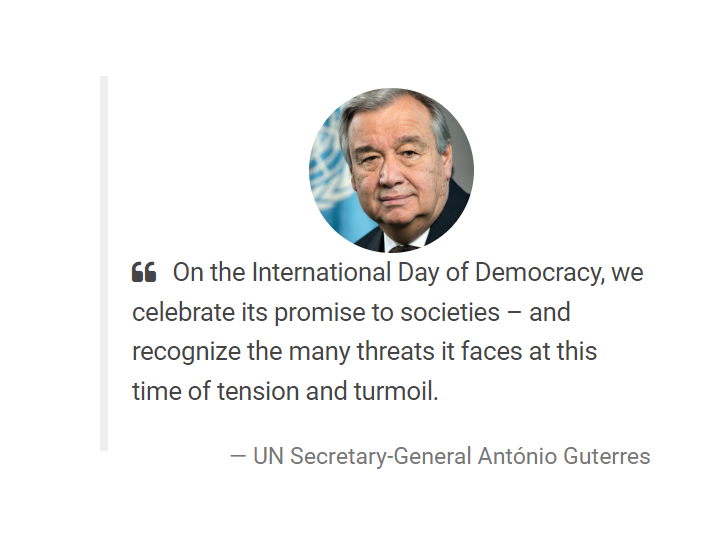
On the International Day of Democracy, we celebrate its promise to societies – and recognize the many threats it faces at this time of tension and turmoil.

The walls are closing in on civic spaces.

Mis- and disinformation is poisoning public discourse, polarizing communities, and eroding trust in institutions.

This year’s theme – “Empowering the Next Generation” – focuses on the essential role of children and young people in safeguarding democracy today and in the future.

It is not enough to listen to children and young people.

We must support them with massive investments in education, skills-building, and lifelong learning.

We must protect human rights and advance gender equality.

And we must expand the meaningful participation of young people in decision-making processes at every level.

On this important day, let us join hands across generations and work as one to build a more just world for all.

António Guterres.


 EVENTS
Empowering the next generation: Democracy for climate justice.

15 September 14:00-15:00 EST
SDG Pavilion, North Lawn UNHQ, New York

Watch the event live or on demand

The event, organized by the UN Democracy Fund within the UN Office for Partnerships, brings together civil society representatives, UN officials, and climate activists, to highlights the role of youth in advancing civic space and recognizes their leadership in moving climate action forward.

IDEA: Inclusive Democracy for Sustainable Development.

15 September 10:00-13:00 EST
Conference room 3, UNHQ, New YorkREGISTER

This event, organized by the intergovernmental organization International IDEA in partnership with the Global Democracy Coalition and the Permanent Mission of Costa Rica to the United Nations, will seek to deepen the understanding between inclusive democracy, the 2030 Agenda for Sustainable Development, and the forthcoming SDG Summit.


A special event marking the International Day of Democracy.
SDG Pavilion - Empowering the next generation: Democracy for climate justice.