Saturday, 9 December 2023

International Day of Commemoration and Dignity of the Victims of the Crime of Genocide and of the Prevention of this Crime 2023; December 9th.

FORUM: "A Living Force in World Society: The Legacy of the 1948 Convention on the Prevention and Punishment of the Crime of Genocide." International Day of Commemoration and Dignity of the Victims of the Crime of Genocide and of the Prevention of this Crime 2023. This year's event to mark the 75th anniversary of the Genocide Convention will seek to highlight achievements that emanate from the Convention, to showcase its legacy, and also reflect on the challenges that remain for its effective implementation. Around the world, populations remain at risk of this crime. The need to invest in prevention as envisaged by the Convention drafters 75 years ago remains as relevant as ever. The event, therefore, will also seek to showcase the work of champions of prevention and their tireless efforts to protect populations from the scourge of genocide. Follow the conversation with the hashtags: #GenocidePreventionDay, #9december, #genocide, #VictimsofGenocide, #PreventGenocide.

75 years of the genocide convention

EVENT: On Friday, December 8th, from 11:00 to 10:00 PM (EST) at the United Nations Trusteeship Chamber UNHQ, We will mark the International Day of Commemoration and Dignity of the Victims of the Crime of Genocide and of the Prevention of this Crime 2023, as well as the 75rd anniversary of the 1948 Convention on the Prevention and Punishment of the Crime of Genocide (the “Genocide Convention”), the first human rights treaty adopted by the General Assembly. The event will build upon a series of expert consultations and meetings convened by the Office of the Special Adviser on the Prevention of Genocide in the lead up to the December 9th event, as well as an info-campaign from the United Nations archives, which seek to explore in detail the impact of the Convention in the fields of accountability, protection and prevention. The Global event will feature opening remarks by United Nations Secretary-General, the President of the 77th session of the General Assembly and the Special Adviser on the Prevention of Genocide, followed by an interactive dialogue; Remarks will also be made by member states, representing regional groups.
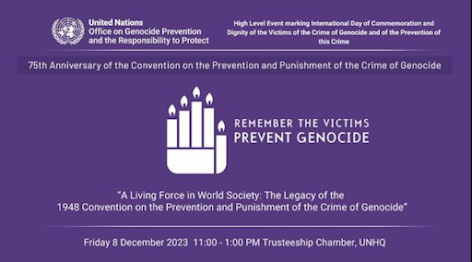

A Living Force in World Society: The Legacy of the 1948 Convention on the Prevention and Punishment of the Crime of Genocide.

Every year, the United Nations Special Adviser on the Prevention of Genocide organizes events to mark this International Day, honoring the victims of genocide and the anniversary of the adoption of the Convention. The 1948 Genocide Convention codified for the first time the crime of genocide in international law. Its preamble recognizes that “at all periods of history genocide has inflicted great losses on humanity” and that international cooperation is required to “liberate humankind from such an odious scourge”. To date, 153 States have ratified the Convention. Achieving universal ratification of the Convention remains an important step in advancing genocide prevention. The Genocide Convention includes the obligation not only to punish the crime of genocide but, crucially, to prevent it. In the 75 years since its adoption, the Genocide Convention has played an important role in the development of international criminal law, in holding perpetrators of this crime accountability and in giving a voice to its many victims. The principles set out in the Convention have been utilized by international criminal tribunals to prosecute perpetrators, and the crime of genocide, as set out in the Convention, today forms part of the core crimes for which the International Criminal Court has jurisdiction. The Convention has also supported national jurisdictions to ensure accountability for this crime. At the same time, the prevention obligation of the Convention has provided a framework for promoting early warning and it has spurred national, regional and international mechanisms for prevention. This year’s event to mark the 75th anniversary of the Genocide Convention will seek to highlight some of the achievements that emanate from the Convention, showcasing its lasting legacy. The event will also reflect on the challenges that remain. Genocide is still a threat in the world today. Around the world, populations remain at risk of this crime. The need to invest in prevention as envisaged by the Convention drafters 75 years ago remains as relevant as ever. The event, therefore, will also seek to showcase the work of champions of prevention and their tireless efforts to protect populations from the scourge of genocide. The event will build on a series of expert meetings to be convened by the UnitedNations Special Adviser on the Prevention of Genocide in the lead up to the December 9th event, which will seek to explore in detail the impact of the Convention in the areas of accountability, protection and prevention.

OBJECTIVE
I) Showcasing its legacy and impact at the international, regional and national levels. 
II) Demonstrating its continued relevance as a tool for prevention and punishment of the crime of genocide and showcasing positive examples of champions of prevention working in the fields of prevention, protection and accountability for genocide.

 III. PARTICIPANTS 
The event will be open to Member States, UN staff, civil society, media and the public. Permanent Representatives of Member States in regional groups will be invited to speak.
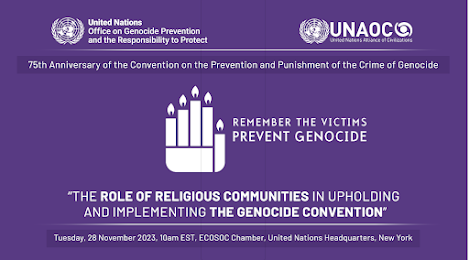

SIDE EVENT: The role of religious communities in upholding and implementing the genocide convention.

The Role of Religious Communities in Upholding and Implementing the Genocide Convention


Remarks of the UNAOC High Representative on “The Role of Religious Communities in Upholding and Implementing the Genocide Convention”.


Your Excellency, Ms. Alice Wairimu Nderitu, Under-Secretary-General, Special Adviser of the United Nations Secretary-General on the Prevention of Genocide;

Ms. Sadhvi Bhagawati Saraswati, Secretary-General of the Global Interfaith WASH Alliance;

Rabbi Burton L. Visotzky, Appleman Professor of Midrash and Interreligious Studies Emeritus at the Jewish Theological Seminary of America;

Dr. Mohamed Elsanousi, Executive Director of the Network for Religious and Traditional Peacemakers;

Ms. Debra Boudreaux, Chief Executive Officer of the Buddhist Tzu Chi Foundation;

Mr. Rudelmar Bueno de Faria, General Secretary at ACT Alliance;

Excellencies and distinguished guests,

The 75th anniversary of the Convention on the Prevention and Punishment of the Crimes of Genocide is an apt time to commemorate the victims of the crime of genocide, to recall the robust commitment to multilateralism that was required for the global community to codify the crime of genocide into international law, and to take stock of efforts to prevent it.

Over the past two months, the plea for Humanity has been revibrating in speeches and comments made by political leaders, faith actors and ordinary people.

Humanity is the exact opposite of atrocities perpetrated by state or non-state actors.

Genocide is a testament that the perpetrators are stripped of their of their humanity. They have no moral compass.

It is an unfortunate truism that the Genocide Convention remains highly relevant seven-and-a-half decades after it was unanimously adopted by the UN General Assembly.

Indeed, the 75th Anniversary of the Convention on the Prevention and Punishment of the Crime of Genocide is approaching at an especially somber and tumultuous juncture in human history.

An alarming wave of antisemitic, anti-Muslim hatred and anti-Arab bigotry and hate has been unleashed around the world since the eruption of the situation in the Middle East.

These incidents included hate speech, harassment, intimidation, damage to personal property, the desecration of places of worship, death threats, and, most tragically, the murder of innocent people on the sheer account of their origin or faith.

All these manifestations are utterly rejected and cannot and should not be justified.

During this most recent spike in religious intolerance, some have falsely and maliciously invoked religion to aggravate misconceptions, fuel divisions, and sow fear and hatred.

This unacceptable upsurge in hate is an affront to the premises and spirit that led to the Genocide Convention and the principles and values on which the United Nations and organizations such as UNAOC are founded.

Distinguished delegates,

Seventy-five years ago, the nations of the world united in an unprecedented, at the time, demonstration of resolute and inspired multilateral action to support the first human rights treaty to be adopted by the United Nations — the Genocide Convention.

The Genocide Convention signified the international community’s resolve that the atrocities committed during the Second World War would never happen again.

This was without a doubt a remarkable and noble achievement and one worthy of commemoration. But we must not take for granted that the Genocide Convention and its principles will be promoted, protected, and implemented in the absence of the unwavering and active commitment of all of us.

In fact, we must remain as steadfast as ever in our efforts to ensure —individually and collectively as one humanity — that the Genocide Convention is upheld. That is because, sadly, both collective and individual vigilance is still required to, as stated in the preamble to the international treaty, “liberate humankind from such an odious scourge”.

Following the unimaginable horror that unfolded in Germany in the 1930s and 1940s, the world has let antisemitic, anti-Muslim, anti-Arab and Islamophobic discrimination and other forms of hatred based on religion, race, ethnicity or nationality go unaddressed on too many occasions.

The tragic consequences of failing to confront this hatred in a meaningful and holistic way were on full display in Cambodia, Rwanda and Srebrenica in the former Yugoslavia.

Sadly, in the 75 years since the landmark Genocide Convention became general customary international law, we have seen just how catastrophic and disastrous it can be to allow dehumanizing language and other acts of dehumanization go unfettered.

We know dehumanizing acts can beget even worse acts, including genocide and other atrocity crimes.

At the same, we must exercise our diligence about how we use the term genocide because the term has frequently been misused of late in popular discourse. The legal definition of genocide is precise and the determination about whether or not genocide has occurred can only be made by competent international and/or national courts of law with the jurisdiction to try such cases following a rigorous investigation that meets appropriate international standards for due process.

That being said, it is incumbent on all of us to do everything in our power to prevent an escalation in the scale and intensity of violence against those targeted by hate, which means pushing back against every single attempt to target people because of their nationality, ethnicity, religion or race, or any other form of identity.

Not only must we counter intolerance, discrimination and hate to avert tragedy, we must at the same time do everything at our disposal to promote tolerance, dialogue and mutual understanding, which enable peaceful coexistence and harmony among all people.

Distinguished guests,

Promoting interfaith dialogue and partnerships, as well as countering hate crimes, are keys to UNAOC’s work to foster mutual respect and strengthen intercultural and interreligious understanding.

UNAOC is proud of providing a recognized global platform for interreligious and intercultural dialogue with the aim of bridging the cultural divides and building cohesive, inclusive and peaceful societies.

We have long recognized the crucial role played by religious leaders in calling out prejudices and hate speech targeting individuals or communities based on their religion or belief, ethnicity.

They have a role in promoting mutual respect, empathy and human dignity for all.

Let me emphasize that protection should be given to both believers and non-believers.

In this context, We have collaborated on the introduction and management of tools that actively encourage tolerance based on mutual respect, and promote intercultural and interreligious dialogue.

The UN Plan of Action to Safeguard Religious Sites was developed by UNAOC and launched by the UN Secretary-General in 2019.

The Plan is rooted in the Universal Declaration of Human Rights, which was adopted by the UN one day after the Genocide Convention and sets out the fundamental human rights to be universally protected.

The Plan advocates the sanctity of religious sites and safety of worshippers. It stresses the right of all believers to access holy sites and to practice their religious rituals and traditions freely, peacefully, and safely without fear or intimidation.

Attacks on places of worship and the perpetuation of hate against the faithful at their places of worship strike at the very core of a community’s sense of identity and belonging.

Equally important, is the UN Strategy and Plan of Action on Hate Speech developed by The office of the Special Advisor for Genocide Prevention . The Strategy and the Plan of Action to Safeguard Religious Sites complement each other. And I am very pleased with the collaboration of our 2 offices and my personal engagement with the Special Advisor. .

I look forward to sharing the stage with religious leaders and faith actors who are here today, virtually and in person, to provide their own insights about how religious communities are upholding the legacy of the Genocide Convention.

In the meantime, I am reminded that the Torah encourages interreligious dialogue and cooperation by teaching us to accept others without prejudice or bias: “You shall not hate your kinsfolk in your heart. Reprove your kinsman, but incur no guilt because of him. You shall not take vengeance or bear a grudge against your countrymen. Love your fellow as yourself.” (Leviticus 19:17-18)

According to the Holy Qur’an, God created nations and tribes “so that we might know one another. “O mankind, indeed We have created you from male and female and made you peoples and tribes that you may know one another. Indeed, the most noble of you in the sight of Allah is the most righteous of you. Indeed, Allah is Knowing and Acquainted.” (Qur’an, 49:13)

Let us take inspiration from these and other examples from religious communities that remind us of our capacity to stand together as one human family — one humanity — rich in cultural and religious diversity, equal in dignity and rights, united in solidarity.

I thank you.

International Anti-Corruption Day 2023; December 9th.


FORUM: “UNCAC at 20: Uniting the World Against Corruption. International Anti-Corruption Day 2023. We intend to celebrate not only this significant milestone in global anti-corruption endeavours but also the improvements brought about by the collective efforts supported by the Convention. The observance seeks to highlight the crucial link between anti-corruption and peace, security, and development. At its core is the notion that tackling this crime is the right and responsibility of everyone, and that only through cooperation and the involvement of each and every person and institution can we overcome the negative impact of this crime. Follow the conversation with the hashtags: #9December, #UnitedAgainstCorruption, #IACD2023 .The hashtag #UNCAC20 is used to mark the UNCAC 20th anniversary.

20th anniversary of the United Nations Convention against corruption


EVENTS: The IACD 2023 campaign will take place 4-9 December and will also serve as countdown to the 10th session of the 11-15 December 2023.

On December 9th, the UNODC Corruption and Economic Crime Branch and UNDP Global Anti-Corruption Programme will held a webinar to mark the International Anti-Corruption Day 2023. Equally crucial is our examination of the remaining gaps that need addressing to ensure that this mechanism continues to grow stronger in the years ahead. States, government officials, civil servants, law enforcement officers, media representatives, the private sector, civil society, academia, the public and youth alike all have a role to play in this.

UNCAC at 20 anniversary: The UNODC will mark the 20th anniversary of the United Nations Convention against Corruption; A dedicated social media package is available to UNCAC20 | Trello.

CoSP10: The 10th session of the Conference of States Parties to the UN Convention against Corruption will take place from 15-19 December 2023 in Atlanta, USA. A dedicated social media package is available for COSP10 | Trello.

Join us on this day and beyond as we continue to build a world United Against Corruption. Watch the webinars on UN WEBTV.

2023 International Anti-Corruption Day (IACD)


STATEMENTS: “As we mark the 20th Anniversary of the United Nations Convention Against Corruption , this crime continues to rock our ability to achieve the SDGs. By being United Against Corruption, we can ensure our ladder to a better world is unshakeable.” Statement from the UNDP Administrator on International Anti-Corruption Day 2023; December 9th. Read the Statement from the UNODC Executive Director on International Anti-corruption Day 2023; December 9th. and the Statement from the United Nations Information Office in South Africa 2023 International Anti-Corruption day. and the United States Department of State on “Honoring Global Anti-Corruption Champions”.


CAMPAIGN: Stand united against corruption for people, planet and prosperity.

Wednesday, 6 December 2023

International Civil Aviation Day 2023; December 7th.

FORUM: “Advancing Innovation for Global Aviation Development. International Civil Aviation Day 2023. During the 40th Session of the Assembly, Member States adopted Resolution A40-27 related to Innovation in Aviation which recognizes that innovations carry significant potential in improving aviation safety, efficiency, security, facilitation, environmental sustainability, and economic development of air transport. Innovations can also lead to more efficient and streamlined aviation regulatory processes. As the United Nations and world nations have now adopted Agenda 2030, and embarked on a new era in global sustainable development, the focus on the importance of aviation as an engine of global connectivity has never been more relevant to the Chicago Convention’s objectives to look to international flight as a fundamental enabler of global peace and prosperity. Follow the conservations with the hashtags: #CivilAviationDay, #7December, #AviationDevelopment, #AdvancingInnovation.

Advancing Innovation for Global Aviation Development.


EVENTS: On December 7th to celebrate the International Civil Aviation Day 2023, the Council has decided that the theme will be “Advancing Innovation for Global Aviation Development.”. The International Civil Aviation Organization will held a series of workshops, seminars and events accessible online on ICAO TV. As part of the ICAO consultative process, the ICAO Global Aviation Dialogues (GLADs) on LTAG will be held in a series of five regional events. To take part registrate to the Upcoming events!


- From 3 to 7 December 2023 in Riyadh, Saudi Arabia, The ICAO Air Services Negotiation Event (ICAN2023) will discuss current industry trends and issues, and exchange experiences, in addition to the negotiation of agreements; The event is hosted by the General Authority of Civil Aviation of the Kingdom of Saudi Arabia.
- From 5 to 7 December 2023, Montréal, CANADA will be held the DRONE ENABLE 2023 symposium entitled ''Innovation and infrastructure developments supporting the future of unmanned aviation.' Register to participate Drone enable 2023 symposium.
- From 6 to 8 December 2023 in Almaty, KAZAKHSTAN will be held the ICAO TRIP Regional Symposium entitled ''Building future Resilience:The role of seamsless and contactless travel.'' Registration are closed.
- From 12 to 14 March 2024 in Montréal , CANADA will be held the 2024 ICAO Innovation Fair entitled “Digital Aviation: the Future is Now.”. Register to participate to the ICAO Innovation fair 2024.
- From 30 April – 2 May 2024 at the Barceló Bávaro Convention Center, will held the ICAO Global Implementation Support Symposium 2024, you can view the draft ICAO/GISS 2024 Symposium Detailed programme, and Register to Participate to the ICAO Implementation support Symposium.
- From 9- 12 September 2024 at ICAO HQ, Montréal, Canada will be held the First Advanced Air Mobility Symposium (AAM 2024) entitled “Advanced air mobility (AAM) global harmonization and interoperability: Challenges and opportunities?“.Register to participate to the 1st ICAO Advanced Air mobility Symposium.


WEBCASTS: Aviation professionals keeping our industry safe and secure are our greatest asset. Stream the latest videos from ICAO and civil aviation partners.Watch events, expert webinars, training content and much more on thematic of the International Civil Aviation Day 2023 is “Advancing Innovation for Global Aviation Development.” on ICAO TV.

ICAO TV


The ICAO Assembly adopted a long-term global aspirational goal (LTAG) for international aviation of net-zero carbon emissions by 2050, in support of the UNFCCC Paris Agreement‘s temperature goal. This is a historic agreement that reinforces the leadership of ICAO on issues relating to international aviation and climate change. Read the adopted Resolution A41-21.


HISTORY OF THE DAY
The International Civil Aviation Organization (ICAO) is a specialized agency of the United Nations and was created with the signing in Chicago, on 7 December 1944, of the Convention on International Civil Aviation. ICAO is the permanent body charged with the administration of the principles laid out in the Convention. It sets the standards for aviation safety, security, efficiency and regularity, as well as for aviation environmental protection. ICAO’s membership comprises 193 Member States. Its headquarters are in Montréal and it has regional offices in Bangkok, Cairo, Dakar, Lima, Mexico City, Nairobi and Paris. The aims and objectives of ICAO, as contained in Article 44 of the Chicago Convention, are to develop the principles and techniques of international air navigation and to foster the planning and development of international air transport so as to: Ensure the safe and orderly growth of international civil aviation throughout the world;Encourage the arts of aircraft design and operation for peaceful purposes; Encourage the development of airways, airports and air navigation facilities for international civil aviation; Meet the needs of the peoples of the world for safe, regular, efficient and economical air transport; Prevent economic waste caused by unreasonable competition; Ensure that the rights of Member States are fully respected and that every Member State has a fair opportunity to operate international airlines; Avoid discrimination between Member States; Promote safety of flight in international air navigation; andPromote generally the development of all aspects of international civil aeronautics. The constitution of ICAO is the Convention on International Civil Aviation to which each ICAO Member State is a party. The Organization has a sovereign body, the Assembly, and a governing body, the Council. The chief officers are the President of the Council and the Secretary General.
The Assembly, composed of representatives from all Member States, meets every three years, reviewing in detail the complete work of the Organization and setting policy for the coming years. It also decides on a triennial budget. The Council, composed of representatives from 36 States, is elected by the Assembly for a three-year term and provides continuing direction to the work of ICAO. One of the major duties of the Council is to adopt International Standards and Recommended Practices (SARPs) and to incorporate these into the Annexes to the Convention on International Civil Aviation. The ICAO Council is assisted by its subsidiary bodies (the Air Transport Committee, the Committee on Joint Support of Air Navigation Services, the Finance Committee, the Committee on Unlawful Interference, the Human Resources Committee and the Technical Cooperation Committee) and by the Air Navigation Commission. The Secretariat, headed by the Secretary General, has five main divisions: the Air Navigation Bureau, the Air Transport Bureau, the Technical Cooperation Bureau, the Legal Affairs and External Relations Bureau, and the Bureau of Administration and Services. The ICAO works in close collaboration with other specialized agencies of the United Nations such as the International Maritime Organization (IMO), the International Telecommunication Union (ITU), and the World Meteorological Organization (WMO). The International Air Transport Association, the Airports Council International (ACI), the International Federation of Air Line Pilots’ Associations, and other international organizations participate in many ICAO meeting and to celebrate the International Civil Aviation Day on December 7th.

International Civil Aviation Day 2023


Monday, 4 December 2023

World Soil Day 2023; December 5th.

FORUM:“Soil and Water: a source of life.World Soil Day 2023. The campaign aim to raise awareness on the importance and relationship between soil and water in achieving sustainable and resilient agriood systems. WSD is a unique global platform that not only celebrates soils but also an occasion to empower and engage citizens around the world to improve soil health. Our planet’s survival depends on the precious link between soil and water. Over 95% of our food originates from these two fundamental resources. Soil and water are vital for nutrient absorption by plants, binds our ecosystems together. This symbiotic relationship is the foundation of our agricultural systems. However, in the face of climate change and human activity, our soils are being degraded, putting excessive pressure on our water resources. Erosion disrupts the natural balance, reducing water infiltration and availability for all forms of life. Sustainable soil management practices, such as minimum tillage, crop rotation, organic matter addition, and cover cropping, improve soil health, reduce erosion and pollution, and enhance water infiltration and storage. These practices also preserve soil biodiversity, improve fertility, and contribute to carbon sequestration, playing a crucial role in the fight against climate change. Follow the conversations with the hashags: #worldSoilDay, #5December, #soilandwater, #soil.


EVENTS: On December 5th, from 12:30 – 14:00 CET at the Sheikh Zayed Center will be held a symposium to mark the Observance of World Soil Day 2023. Together, let’s pave the way for a future where soil and water are sustainably managed to continue to be the steadfast guardians of our environment and climate. Register to Participate and Get the Agenda Programe of the World Soil Day 2023 Ceremony. The Center for International Forestry Research (CIFOR), during the COP28 in Dubai, Emirates Arab States will held a workshop entitled “Forests, Food, Carbon and Climate’’. Soil, often overlooked, is a strategic tool to improve climate resilience, food security, carbon capture and storage, and a highly biodiverse asset for all who walk upon it. Watch the FAO World Soil Day 2023 Live ceremony event!


STATEMENTS: Key messages World Soil Day 2023 (5 December) – Soil and water, a source of life.


Get the communication materials!

Sustainable agricultural management is of crucial importance for terrestrial ecosystem functioning in the face of changing climate. Small or big, we encourage you mark your agenda, alert your audience, contact your local, regional and global advocates and make use of the free campaign toolkit.

International Volunteer Day 2023; December 5th.


FORUM: "If everyone did..." International Volunteer Day 2023. The theme of this year's IVD will center on the power of everyone - collective action - if everyone did. If everyone volunteered the world would be a better place. Imagine more than eight billion of us volunteering. Limitless possibilities for sustainable development - food and education for everyone, clean environment and good health, inclusive and peaceful societies, and more. As the world garners support to deal with mounting challenges, it's the volunteers who are the first ones to help. Volunteers are at the fore in crises and emergencies, often in very testing and dire situations. Follow the conversations with the hashtags: #5December, #InternationalVolunteerDay, #IVD2023, #Ifeveryonedid.

International Volunteer Day 2023


Statement of the United Nations Secretary-General on the International Volunteer Day for Economic and Social Development 2023; December 5th.

This year’s theme — “If everyone did…” — underscores the importance of collective action, cooperation, and people-led solutions to global challenges like poverty, inequalities, conflict, the climate crisis, food insecurity and more. In every community on the planet, volunteers are taking action to support the most vulnerable people, including in the midst of conflict and other humanitarian emergencies. Young volunteers are joining the fight for climate action, pressing governments, businesses and policymakers to take the decisions needed to end this planetary emergency. Our own UN Volunteers hail from more than 160 countries, and are helping to spur peace and sustainable development, and the realization of human rights, for people around the world. On this important day, let’s re-commit to ensuring that all people can lend their energies to shaping a better future for all people and the planet we share. Let’s stand with volunteers, everywhere. 

United Nations Secretary-General.

OTHERS STATEMENTS:
"As International Volunteer Day 2023 is marked on 5 December, I thanks the 1 billion volunteers worldwide serving their communities every day." Watch the video Statement of the UNDP Administrator on International Volunteer Day for Peace and Development 2023; December 5th.

"Volunteers are the unsung heroes working tirelessly to rescue those trapped under rubble. They step in when there is no mechanism to reach the front line. This is the reality of volunteers who, despite everything, just don't give up." Watch the video Statement of the United Nations Deputy Secretary-General on the occasion of the International Volunteer Day 2023.

"Today I say to all volunteers around the globe: Thank you. For choosing to improve the world. For finding inspiration to act. For creating solutions. For keeping our hopes alive." Watch the Message of the UNV Executive coordinator on the occasion of the International Volunteer Day 2023; December 5th.


If everyone did...


EVENTS: More than a billion volunteer around the world act for solidarity and humanity for people and planet. IVD is a day to pay tribute to volunteers worldwide and to recognize the value of volunteerism in peace and development.The International Volunteer Day 2023 activities are taking place around the world including seven high-level events co-hosted by Governments in Azerbaijan, Bolivia, Iraq, Ireland, Tanzania, Thailand, and Togo. From the national caravan of volunteering in Togo to the climate-conscious activities of tree planting in Azerbaijan to the wheelchair journey of volunteers with disabilities in Thailand - each event will amplify the diversity of volunteering around the globe. Countries and volunteer groups will mark the spirit of volunteerism together with communities, academia, volunteer-involving organizations, and UN agencies. United Nations Volunteer Staff at Headquarters in Bonn will also participate in a volunteering activity to mark IVD and demonstrate the spirit of volunteerism among local residents.


CAMPAIGN: Join us in recognizing volunteers all over the world through the International Volunteer Day 2023 campaign "If Everyone Did." View the IVD 2023 Trello Board for resources.

If Everyone Did.


Sunday, 3 December 2023

International Day of Banks 2023; December 4th.

FORUM :”Improving payment systems as well as financial inclusion.International Day of Banks 2023.

Central Bank Digital Currency Development enters the next phase. Many of the world’s monetary authorities are seeking more guidance on how best to pursue digital forms of central bank money. Central bank digital currencies can improve payment systems as well as financial inclusion—if they are appropriately designed. If not, they could pose risks. While not all countries may see an immediate case to deploy a CBDC, many countries are exploring Central Bank Digital Currencies so they will have the option to introduce one in the future if it becomes pertinent for them. Benefits are more likely to come in time, following the policies pursued by countries and the private sector’s response, as well as the evolution of technology. In most cases, it would be useful for countries to continue exploring CBDC, carefully and systematically, as IMF Managing Director Kristalina Georgieva noted in her recent speech at the Singapore Fintech Festival. The Bahamas, Jamaica, and Nigeria have already introduced CBDCs. And more than 100 countries are in the exploration stage. Central bankers in Brazil, China, the euro area, India, and the United Kingdom are at the forefront. Follow the conversations with the hashtags: #multilateralBanks, #Developmentbanks #4December, #InternationalDayofBanks, #bankingsystems, #digitalbanking on social medias.

Improving payment systems as well as financial inclusion.

EVENTS: On December 4th, a webinar will be held to mark the International Day of Banks 2023.

The United Nations General Assembly have invited all Member States, the organizations of the United Nations system and non-governmental organizations to observe the International Day of Banks 2023, in a manner consistent with national priorities, in order to highlight the role of banks in contributing to achieving sustainable development; The UNGA have also Invited the Department of Economic and Social Affairs of the Secretariat,the United Nations Development Programme, the United Nations Conference on Trade and Development and other relevant United Nations entities to facilitate the observance of the International Day of Banks in collaboration with other relevant organizations.


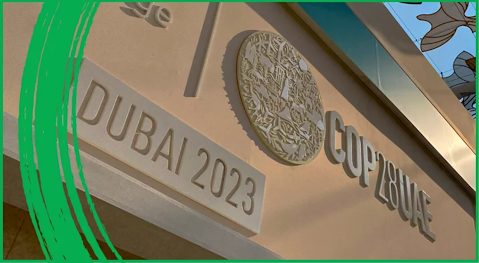
World Bank Live at COP28.

Join our live-streamed conversations and announcements from COP28, covering climate action, climate and development priorities, water, infrastructure, and more.Watch All live Events

World Bank Live at COP28


PAST EVENTS

Aligning to the Global Biodiversity Framework: Principles for Responsible Banking Nature Guidance Launch.

22 November 2023 – WEBINAR

UNEP FI is thrilled to introduce its new Principles for Responsible Banking Guidance on Nature Target Setting. Developed in collaboration…

Empowering Climate Resilience Through Banking: Principles for Responsible Banking Adaptation Guidance Launch.

28 November 2023 -WEBINAR

UNEP FI is delighted to unveil its latest milestone report, the Principles for Responsible Banking Guidance on Climate Adaptation Target Setting

Exploring human rights and environmental due diligence regulations for banks.

25 September 2023 – ONLINE

UNEP FI is partnering with ECOFACT to host a series of webinars on key thematic issues in emerging sustainable finance

Financing the future with Christos Megalou, CEO of Pireaus Bank.

29 September 2023 – PODCAST

As the Principles for Responsible Banking celebrate their 4th anniversary, we speak to Pireaus Bank CEO Christos Megalou about how…

The road to banking decarbonisation: The case of MENA.

29 August 2023 -ONLINE

This webinar will discuss key climate challenges in the MENA region and the role banks can play in mitigating those…

UNEP FI at Climate Week NYC 2023.

17-24 September 2023 NEW YORK CITY, NY & ONLINE

Find out more about UNEP FI’s presence at the world’s largest climate-focused event.

Financing the future with Christine Bergeron, CEO of Vancity.

26 May 2023 PODCAST

As the world faces growing environmental and social challenges, financial organisations are transforming to incorporate ESG concerns into their…

Is your bank gender conscious? Why and how to invest in gender equality?

6 July 2023 ONLINE

Setting clear and specific targets for the advancement of gender equality will enable banks to make substantial contributions to the…

Cómo los bancos de América Latina y Caribe se adaptan al cambio climático.

12 January 2023 HYBRID

UNEP FI y la CAF –Banco de Desarrollo de América Latina–, en colaboración con la Federación Latinoamericana de Bancos (FELABAN),


Kunming-Montreal Global Biodiversity Framework: from the drawing board to action.

9 February 2023 -WEBINAR

The UNEP Finance Initiative & the B4B+ Club decided to collaborate and co-organize a webinar destinated to their respective members…


PUBLICATIONS: The IMF’s Central Bank Digital Currency (CBDC) Virtual Handbook

The IMF recently launched a virtual CBDC Virtual Handbook to collect and share knowledge with policymakers around the world, and to serve as a basis for the IMF’s engagement with country authorities. We intend this to be a living document that will be updated and expanded as our body of knowledge and analysis grows, and as new lessons and insights emerge from countries.

Central Banl Digital Currency Virtual Handbook

The chapters published so far cover process and policy topics:How Should Central Banks Explore Central Bank Digital Currency? Countries that decide to pursue CBDCs will take different paths, depending on the degree of digitalization of the economy, the legal and regulatory frameworks, and the central bank’s capacity. We propose a dynamic decision-making process in which central banks can proceed despite uncertainty, and adjust the pace, scale, and scope of their initiatives in response to changes in domestic and international conditions.

A Guide to Central Bank Digital Currency Product Development. To help guide central banks in exploring and developing CBDC, we’ve established a step-by-step guide to address the complex requirements and risks associated with CBDCs. We call it the 5P methodology: preparation, proof-of-concept, prototypes, pilots, and production.

Implications of Central Bank Digital Currencies for Monetary Policy Transmission. We analyze how CBDCs would likely affect monetary policy. In general, policy transmission is not expected to be affected much under normal circumstances, but the effects can be more significant in an environment with low interest rates or financial market stress.

Implementing capital flow management measures with CBDC. We explain how CBDCs could be designed to facilitate cross-border payments while still managing capital flows. With new digital technologies that can make payment infrastructure programmable, some of the capital-flow management measures could be implemented more efficiently and effectively with a CBDC compared to the traditional approach.

Central Bank Digital Currency’s Role in Promoting Financial Inclusion. As a risk-free and widely acceptable form of digital money, with potentially lower costs and greater accessibility, CBDCs can increase financial inclusion. If properly designed to replicate some of the properties of cash, CBDCs could gain acceptance as a payment mechanism for financially excluded populations—and be an entry point to the broader formal financial system.

Looking ahead, our engagement with central banks will continue as they pursue new technologies. We will keep assessing the potential effects of CBDCs on areas from financial stability to cybersecurity and cross-border payments and build on these first five chapters with new publications planned for next year. And we’ll continue our collaboration with other global bodies, including the Group of Twenty. The IMF will continue assisting countries exploring CBDCs, along with efforts by other global bodies like the Bank for International Settlements.


Saturday, 2 December 2023

International Day of Persons with Disabilities 2023; December 3rd.

FORUM: “United in action to rescue and achieve the SDGs for, with and by persons with disabilities.” International Day of Persons with Disabilities 2023. Given the multiple crises of today’s world, achievement of the SDGs is in peril. At the mid-point of the implementation period for the 2030 Agenda, the world is not on track to reach numerous SDGs targets by 2030. For many, progress has either stalled or regressed below the 2015 baseline. Unfortunately, the world’s poorest and most vulnerable are often the hardest hit in times of crisis. Preliminary findings from the forthcoming United Nations Disability and Development Report 2023 indicate that the world is even more off track in meeting several SDGs for persons with disabilities. Our efforts to rescue the SDGs for, with and by persons with disabilities need to be intensified and accelerated, given that persons with disabilities have historically been marginalized and have often been among those left furthest behind. A fundamental shift in commitment, solidarity, financing and action is critical. Integral to this is the inclusion of the voices, needs and priorities of the global community of persons with disabilities in all their diversity. Encouragingly, with the adoption of the Political Declaration of the SDG Summit 2023, world leaders have recommitted themselves to achieving sustainable development and shared prosperity for all, by focusing on policies and actions that target the poorest and most vulnerable, including persons with disabilities. This calls for re-energized efforts by Member States, the United Nations system, civil society and the global community of persons with disabilities, through enhanced actions and international cooperation, to make the SDGs a reality for, with and by persons with disabilities. Follow the conversations with the hashtags: #EveryoneIncluded, #3December, #DisabilityInclusionStrategy, #DisabilityDay, #IDPD on social medias.


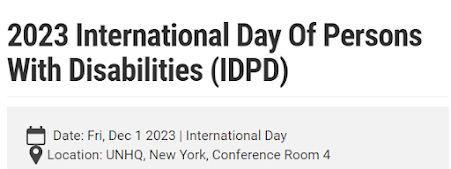
EVENTS: The United Nations will commemorate the International Day of Persons with Disabilities 2023 at the United Nations Conference room 4 in New York on December 1st, from 10am to 1pm (EDT) a hyvrid event will be held. The 2023 overarching theme of the commemoration is “United in action to rescue and achieve the SDGs for, with and by persons with disabilities.” The panel discussions will be structured around five pillars of sustainable development – People, Planet, Prosperity, Peace, and Partnerships – with a special focus on the priority areas identified in the SDG Progress Report of 2023, in the outcome document of the recent SDG Summit, in policy briefs prepared for the Summit for the Future 2024 and in the forthcoming United Nations Disability and Development Report 2023. For purposes of this discussion, the priority areas can be identified as gender equality (People), climate action (Planet), financing for development (Prosperity), a new agenda for peace (Peace) and strengthening multilateralism (Partnerships).

People: Women and girls with disabilities are acutely vulnerable to being left behind due to the intersection of gender and disability, which compounds the challenges and barriers they encounter. An intersectional lens is crucial for fulfilling the pledge that no one will be left behind.

Planet: Persons with disabilities are disproportionately affected by the impacts of climate change, owing to their greater likelihood of living in poverty, which was exacerbated by the COVID-19 pandemic . Moreover, stigma and discrimination are additional factors that increase the vulnerability of persons with disabilities to the effects of climate change .

Prosperity
: Ensuring that adequate financial resources are allocated towards disability-inclusive development must be a priority going forward, as well as the effective mainstreaming of disability in all aspects of development, including its financing. It is imperative that persons with disabilities, in all their diversity and throughout the world, actively participate in and shape these policies and processes.

Peace: Persons with disabilities are disproportionately affected by conflict in several ways, yet their needs and priorities are rarely addressed in situations of conflict. Furthermore, their role as peacemakers and peacekeepers is often ignored . Recent attempts to remedy this situation include the adoption of Security Council resolution 2475, which stipulates that respect for the human rights of persons with disabilities must be enshrined in international humanitarian law. Nevertheless, more needs to be done in this regard.

Partnerships: Despite recent setbacks, the 2030 Agenda and the SDGs remain the essential roadmap out of the multiple crises that the world is facing. A renewal of the pledge that no one will be left behind is fundamental. Success will require that all Member States, the United Nations system, civil society and the global community of persons with disabilities work together to strengthen international solidarity, and that they join in coordinated, targeted actions designed to reach the furthest behind first.

International Day for Persons with Disabilities 2023

The 2023 observance of the International Day for Persons with Disabilities (IDPD) aims to promote an understanding of disability issues and to mobilize support for the dignity, rights and well-being of persons with disabilities

Opening (10 - 10.30 a.m. EST): featuring messages from high-level representatives from the United Nations, Member States and civil society, to be held in person; Online panel discussion (10.40 a.m. - 1 p.m. EST): a moderated panel discussion to address major gaps in the realization of inclusive and sustainable development for, with and by persons with disabilities and to call for enhanced actions and greater international cooperation. The Event organised by UN DESA with the support of the UN Youth Office, the Department of Global Communications, the Permanent Missions of Tunisia and New Zealand, the Civil Society Coordination Mechanism and the World Institute on Disability. The commemorative event will take place in a hybrid mode. In-person attendance will be open only to those who have a valid ground pass. The deadline to register for joining us online is on November 28, 2023, by midnight (New York time). Read the 2023 IDPD concept note and Register to participate!