Sunday, 16 November 2025
World Day of Remembrance for Road Traffic Victims 2025; November 16th.
International Day for Tolerance 2025; November 16th.
FORUM: "Reflecting on Tolerance" International Day for Tolerance 2025. The "principle of tolerance" can refer to several concepts, most commonly: the social and ethical idea of accepting and respecting diverse beliefs, behaviors, and identities, even if one disagrees with them; and the logical principle that two instances are similar enough to be treated as the same for a given purpose. Socially, tolerance is a cornerstone of peaceful coexistence, allowing individuals to live freely without imposing their views on others. In logic and philosophy, it relates to the choice of language and systems, as with the "principle of tolerance" proposed by Rudolf Carnap for creating new logical systems. The acceptance of different beliefs, actions, and cultures, acknowledging that people have the right to live their own lives, even if their views differ from your own. olerance equires respect and appreciation for human diversity, not indifference or weakness. It means that one's own views should not be imposed on others. The Principle of Tolerance is consistent with human rights and encourages peaceful coexistence by ensuring everyone can live in peace and dignity. The concept of Tolerance, highlighted by philosophers like Karl Popper, questions whether a society should tolerate those who are intolerant. Some argue that a tolerant society must preserve itself and therefore has the right to suppress intolerant ideologies that would undermine its own liberties and freedoms. Follow the conversations with the hashtags: #tolerance, #16November, #InternationalDayforTolerance, #ToleranceDay.
EVENTS: Commemoration of the 30th anniversary of the 1995 Declaration of Principles on Tolerance UNESCO,
On November 16th; The UNESCO, the UNAOC, the UN ACADEMIC IMPACT and the OHCHR will organize a webinar to mark the International Tolerance Day 2025 to generate public awareness of the dangers of intolerance and to teach the values of peace, responsible citizenship, equality, and tolerance in all circumstances. The United Nations General Assembly recommends that interested intergovernmental and non-governmentalorganizations and specialized agencies exert efforts in their respective fields to contribute to the celebration, and to consider what further contributions they can make toimplement and disseminate the standards affirmed in the Declaration of Principles. Register to participate!
ACTIONS: Inform and mobilize public opinion, as well as the United Nations system to the Principles of Tolerance. The General Assemebly Requests the United Nations Educational, Scientific and CulturalOrganization to continue to coordinate actions in support of tolerance promotion and education in partnership with other United Nations agencies and regional, intergovernmental and non-governmental organizations
PUBLICATION: Read the 1995 Declaration of Principles on Tolerance established by the UNESCO
Saturday, 16 November 2024
International Day of Tolerance 2024; November 16th.
EVENTS: On November 16th; The UNESCO, the UNAOC, the UN ACADEMIC IMPACT and the OHCHR will organize a webinar to mark the International Tolerance Day 2023 to generate public awareness of the dangers of intolerance and to teach the values of peace, responsible citizenship, equality, and tolerance in all circumstances.
PRIZE: UNESCO-Madanjeet Singh Prize for the Promotion of Tolerance and Non-Violence. In 1995, to mark the United Nations Year for Tolerance and the 125th anniversary of the birth of Mahatma Gandhi, UNESCO created a prize for the promotion of tolerance and non-violence: the UNESCO-Madanjeet Singh Prize. This Prize rewards significant activities in the scientific, artistic, cultural or communication fields aimed at the promotion of a spirit of tolerance and non-violence. The creation of the Prize has been inspired by the ideals of UNESCO’s Constitution that proclaims that "peace, if it is not to fail, must be founded on the intellectual and moral solidarity of mankind".
CAMPAIGN: Diversity is a strength, not a threat.
On Saturday's Tolerance Day & every day, let’s embrace tolerance, respect for diversity, and understanding —values that unite us and make us stronger.
Wednesday, 15 November 2023
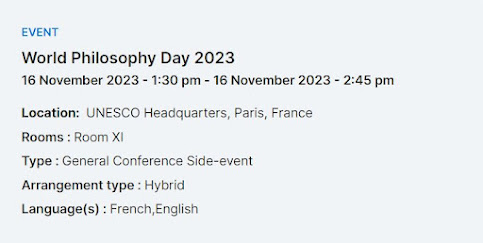
World Philosophy Day 2023; November 16th.
FORUM: “Artificial intelligence, a tool for mental health care?.” World Philosophy Day 2023. If AI has great potential for a better understanding and treatment of mental illnesses and is likely to improve access to care, what potential pitfalls and ethical implications does it hold? In other words, can AI be a dynamic factor for the improvement of mental healthcare?; In the context of the Management of Social Transformations (MOST) programme, UNESCO’s work on philosophy aims to promote humanist thinking as a response to social transformations and encourage its use for impact on political dialogue. Philosophy allows to think collectively about the future of humanity - and to design a better world. Follow the conversation with the hashtags: #WorldPhilosophyDay, #philosophy, #16November, #Philosophicaldebates, #PhilosophyDay.
EVENTS: On November 16th; The UNESCO will organize a panel discussion on “Artificial intelligence, a tool for mental health care?" with the French National Commission for UNESCO and Paris Saclay University, to mark World Philosophy Day 2023 during the 42nd General Conference from 1.30 to 2.45pm at UNESCO Paris, Room XI). The round-table will reflect on potential contributions of AI to a human-centered approach of mental health and examine ethical repercussions and moral concerns.
Tuesday, 15 November 2022
International Day for Tolerance 2022, Novembe 16th.
FORUM: ‘‘Redefine Tolerance'.’’ International Day for Tolerance 2022. Tolerance is much more than passively accepting the other. It brings obligations to act, and must be taught, nurtured and defended. Tolerance requires investment by States in people, and in the fulfilment of their full potential through education, inclusion and opportunities. This means building societies founded on respect for human rights, where fear, distrust and marginalization are supplanted by pluralism, participation and respect for differences. Follow the conversation with the hastags: #tolerance, #16November, #InternationalDayforTolerance, #ToleranceDay.
EVENTS: 2022 UNESCO-Madanjeet Singh Prize for the Promotion of Tolerance and Non-Violence. In 1995, to mark the United Nations Year for Tolerance and the 125th anniversary of the birth of Mahatma Gandhi, UNESCO created a prize for the promotion of tolerance and non-violence: the UNESCO-Madanjeet Singh Prize. This Prize rewards significant activities in the scientific, artistic, cultural or communication fields aimed at the promotion of a spirit of tolerance and non-violence. The creation of the Prize has been inspired by the ideals of UNESCO’s Constitution that proclaims that "peace, if it is not to fail, must be founded on the intellectual and moral solidarity of mankind".
History of the Day
In 1996, the United Nations General Assembly (by resolution 51/95) invited UN Member States to observe the International Day for Tolerance on November 16th, with activities directed towards both educational establishments and the wider public.
Monday, 16 November 2015
World Day of Remembrance for Road Traffic Victims 2015, November 16th
![]() |
"It's time to Remember - Say NO to Road Crime! |
The World Day of Remembrance for Road Traffic Victims is a time to reflect on the needless tragedies that occur each day on the world’s roads.
Despite improvements in road safety, we still face some shocking injury and fatality figures.
Road traffic accidents kill an estimated 1.25 million people each year -- 90 per cent of them in middle- and low-income countries.
Such accidents are the leading cause of death among young people aged between 15 and 29. Almost half of all road traffic deaths are among pedestrians, cyclists and motorcyclists.
I call on governments to tighten enforcement of laws on speeding, drinking and driving, and to mandate and enforce the use of seat-belts, motorcycle helmets and child restraints -- all of which have been shown to save lives.
The Second Global High-Level Conference on Road Safety, hosted by the Government of Brazil and supported by the World Health Organization, is being convened this week. Some 1500 delegates from more than 100 countries -- including ministers of transport, health and interior -- will meet to find ways to halve road traffic deaths and injuries by 2020 -- the target set forth in the new Sustainable Development Goals agreed by Member States in September.
On this solemn day, let us re-commit to making our roads safe for all.
Ban Ki-moon
![]() |
| Advocating for Road Safety and Road Traffic Injury Victims - A guide for Nongovernmental organizations. |
The Day has become an important tool in global efforts to reduce road casualties. It offers an opportunity for
drawing attention to the scale of emotional and economic devastation caused by road crashes and for giving recognition to the suffering of road crash victims and the work of support and rescue services. In 2008, remembrance services and other related events were held in such countries as Argentina, Australia, Brazil, Brunei Darussalam, Canada, India, Japan, Mexico, Nigeria, the Philippines, South Africa, Uganda and the United States, and almost every country in Europe.
A dedicated website was also launched to make the Day more widely known and to link countries through sharing common objectives and the remembrance of people killed and injured in crashes.
Resources :
Saturday, 15 November 2014
International Day for Tolerance 2014, November 16th.
Día Internacional para la Tolerancia, 16 de noviembre.
We live in an era of rising and violent extremism, radicalism and widening conflicts that are characterized by a fundamental disregard for human life. There are more people displaced by fighting today than at any period since the end of the Second World War. Innocent lives are being lost in senseless clashes around the world. The youngest victims are robbed of their childhoods, conscripted and abused, or even kidnapped simply for wanting an education.
Democratic and peaceful societies are not immune from prejudice and violence. There is growing hostility and discrimination towards people crossing borders in search of asylum or opportunities denied to them at home. Hate crimes and other forms of intolerance mar too many communities, often stoked by irresponsible leaders seeking political gain.
I have strongly urged world leaders to protect people from persecution and to encourage tolerance for all regardless of nationality, religion, language, race, sexuality or any other distinction that obscures our common humanity.
The International Day of Tolerance is an opportunity to reaffirm our commitment to work for the recognition and protection of universal human rights and fundamental freedoms that is so essential to lasting peace.
The United Nations is committed to strengthening tolerance by fostering mutual understanding among cultures and peoples. This imperative lies at the core of the United Nations Charter as well as the Universal Declaration of Human Rights. Promoting tolerance is also a key objective of the International Decade for the Rapprochement of Cultures being observed through 2022. And the United Nations Alliance of Civilizations is paving the path to greater cross-cultural understanding.
On this International Day of Tolerance, I call on all people and governments to actively combat fear, hatred and extremism with dialogue, understanding and mutual respect. Let us advance against the forces of division and unite for our shared future.
Ban Ki-moon
![]() |
| Winners of our 2014 prize for tolerance & non-violence inspire us all in the quest for peace |
Tolerance is a fundamental principle of life in society, stemming naturally from respect for human rights and human dignity. It is a principle that is more relevant now than ever and it is under serious threat. Cultural diversity is being targeted by extremist groups seeking to impose their sectarian vision on the world, and minorities are being persecuted, falling victim to attempts at “cultural cleansing”. Within societies, economic and social crises are sometimes used as a pretext for
blaming and rejecting others. In tackling these challenges, we must reaffirm with determination the need for tolerance by recalling that every culture is worthy of respect and that no belief deserves the hatred or scorn of others.
This message is central to all of UNESCO’s action, guided by the conviction that lasting peace must be constructed in the minds of men and women, by nurturing the principles of tolerance and mutual respect through education, the dialogue among cultures and intellectual cooperation. In a globalizing world, it is no longer enough to live side by side, in passive indifference – tolerance requires active vigilance, renewed each day, against xenophobia, discrimination and hatred. We
learn through tolerance to reconcile the universal rights that bind us together with the diversity that gives us so much, and to see that we need others, in all their diversity, so that we can be fully ourselves.
More than words, tolerance is behaviour that is also learnt in the classroom. It takes the form of openness to the diversity of cultures and beliefs and respect for freedom of expression and opinion, rooted in attachment to human rights. This is the spirit of the International Decade for the Rapprochement of Cultures (2013-2022), for which UNESCO is lead agency in the United Nations system. It is also the objective of the UNESCO-Madanjeet Singh Prize for the Promotion of Tolerance and Non-Violence, awarded this year to two human rights activists – Mr Ibrahim Ag Idbaltanat (Mali) and M. Francisco Javier Estévez Valencia (Chile).
UNESCO is committed to promoting tolerance through its educational and cultural programmes, through the International Coalition of Cities against Racism and through the mobilization of young people and global citizenship education. On the occasion of this international day, I call on all of UNESCO’s Member States and partners to reassert the transformational power of tolerance as a force for dialogue and peace.
Irina Bokova
- Symposium on "Repentance and forgiveness in the public space", UNESCO Paris, France, 12 November 2014
- Tolerance, Understanding and Coexistence: Oman’s message of Islam, Lalitpur, Nepal, 12-17 November 2014
- Celebration of International Day of Tolerance in Iran to highlight UNESCO's work towards a culture of peace, Tehran, Iran, 16 November 2014
- The UNESCO-Madanjeet Singh Prize for the Promotion of Tolerance and Non-Violence rewards significant activities in the scientific, artistic, cultural or communication fields aimed at the promotion of a spirit of tolerance and non-violence.
- Declaration of Principles onTolerance, UNESCO
- Interviews and messages for the International Day for Tolerance 2014
- Integrated Strategy to Combat Racism, Discrimination, Xenophobia and Intolerance
- Intercultural Dialogue
- Interreligious Dialogue
- Routes of Dialogue
- Practical measures to promote a culture of tolerance
- Tolerance and reconciliation are key to a just and equitable society
- Committee on the Elimination of Racial Discrimination
- Special Rapporteur on contemporary forms of racism, racial discrimination, xenophobia and related intolerance
- Special Rapporteur on freedom of religion or belief
- Special Rapporteur on the promotion and protection of the right to freedom of opinion and expression