Showing posts with label 21 May. Show all posts

Thursday, 21 May 2026

International Tea Day 2026; May 21st.

FORUM:"Tea for Wellness" International Tea Day 2026. This year's theme highlights the holistic benefits of tea—from its antioxidant and health-promoting properties to its role in fostering mindfulness, relaxation, and community connection. Across cultures, tea has long been associated with balance, hospitality, and moments of pause in otherwise busy lives. Tea is one of the most widely consumed beverages in the world and holds deep cultural, economic, and social significance across continents. The United Nations General Assembly recognizes its role in rural development, poverty alleviation, and sustainable livelihoods. Beyond its economic importance, tea is increasingly appreciated for its contribution to physical, mental, and social well-being. Tea cultures across regions reflect diverse approaches to wellness and well-being. In India, the ubiquitous ‘masala chai’ is well known but tea drinking culture is also linked with traditional systems such as Ayurveda, where herbal infusions and spiced teas are valued for their preventive and restorative health benefits. In Japan, green tea traditions, including the tea ceremony, emphasize mindfulness, balance, and mental clarity. In South East Asia, tea is integral to daily life, with green and herbal infusions valued for digestion, longevity, and social connection. In Africa, tea production is complemented by traditional herbal infusions rooted in indigenous knowledge systems promoting holistic health. In Europe, a culture of herbal infusions, or tisanes, highlights relaxation and digestive wellness. In South America, yerba mate and herbal beverages play a central role in fostering energy, community bonding, and overall well-being. This global diversity underscores tea’s unique role at the intersection of health, culture, and sustainable livelihoods. Guiding Questions 1. How can tea and tea-based traditions contribute to promoting physical, mental, and social well-being in contemporary societies? 2. What role can sustainable tea production play in advancing the 2030 Agenda, particularly in supporting livelihoods and empowering smallholder farmers and women? 3. How can traditional knowledge systems associated with tea be preserved and integrated with modern wellness practices? 4. What opportunities exist for enhancing international cooperation in promoting wellness-oriented tea products and value chains? 5. How can tea serve as a medium for fostering cultural exchange, dialogue, and community connection in an increasingly fast-paced world? Follow the conversations with the hashtags: #TeaforWellness,  #InternationalTeaDay#tea, #21May, #tealovers, #teaconsumers, #teadrinkers, #Farmedwithcare.

International Tea Day 2026


EVENT: On May 21st,  2026,  from3:00 p.m. – 4:30 p.m., in the Conference Room 8 at the United Nations Headquarters will be held a high-level event to mark the International Tea Day 2026. The event seeks to provide a platform for exchanging perspectives on the role of tea in advancing holistic well-being, while also highlighting its contribution to sustainable development, cultural heritage, and inclusive economic growth. It aims to foster a cross-regional dialogue among Member States on how traditional knowledge systems and contemporary approaches can be leveraged to promote wellness through tea. The observance will bring together Member States, UN officials, experts, and stakeholders for a moderated discussion on tea’s role in promoting well-being. The event will also provide an opportunity for informal exchange and cultural appreciation of diverse tea traditions.


High-level Events
Agenda Programme


From Rome to Réunion Island, from livestreamed tea tastings in Canada to diplomatic programs at the United Nations in New York, International Tea Day 2026 reflects tea’s growing importance as both a cultural and economic force. Below is a recap of the major announced and anticipated International Tea Day activities taking place May 19–28, 2026. The FAO’s annual flagship observance remains the anchor event for International Tea Day worldwide. Policymakers, tea boards, researchers, development agencies, exporters, and sustainability advocates are expected to gather in Rome to discuss tea’s role in rural livelihoods, biodiversity preservation, ethical sourcing, and the UN Sustainable Development Goals. The FAO’s companion “Farmed With Care” campaign continues throughout the week, highlighting tea producers and sustainability initiatives through digital storytelling and social media outreach, emphasizing environmental stewardship and producer welfare.

Time: Expected 9:30 AM–4:00 PM CEST
URL: FAO International Tea Day
United Nations International Tea Day Programs
Thursday, May 21, 2026
Location: New York, USA
Venue: United Nations Headquarters
Organizer: United Nations member missions and tea-producing countries

Tea-producing nations continue using International Tea Day as a platform for diplomatic and cultural engagement at the United Nations. India’s Permanent Mission to the United Nations is expected to once again play a leading role with programming centered on tea’s contribution to livelihoods, women’s employment, sustainable agriculture, and international trade. The annual UN observances increasingly position tea as both an agricultural commodity and an instrument of cultural diplomacy and economic development.

Format: In-person and webcast programming
URL: United Nations International Tea Day

Réunion is a territory in the heart of the Indian Ocean, a volcanic island with varied altitudes
and diverse climates, located between Africa, Asia, Europe, and South America. It is a land shaped by the history of plants and the host of the International Tea Symposium 2026. A coherent place to bring together the great nations carrying cultural and agricultural traditions linked to tea.

International Tea Symposium — Réunion Island
May 19–21, 2026

Location: Réunion Island, France
Format: Multi-day symposium with livestream elements
Official Program | Speakers

One of the most ambitious observances this year is the International Tea Symposium on Réunion Island, held under the High Patronage of Emmanuel Macron, President of France — an indication that tea diplomacy and tea tourism are gaining higher-level political visibility. .8The symposium brings together tea historians, tourism officials, researchers, producers, cultural organizations, and tea professionals from across the Indian Ocean region and beyond. Discussions are expected to focus on tea heritage, sustainable tourism, island agriculture, cultural preservation, and regional economic development tied to tea. The gathering reflects growing international interest in tea as a driver of experiential tourism and cultural exchange. The Symposium forms part of a broader commitment to the recognition and promotion of living cultural heritage related to tea and the territories in which it is cultivated.

Venue: Regional conference and cultural facilities across Réunion Island
Format: In-person and livestreamed sessions

Website: https://www.internationalteasymposium.org/
Travel Virtually Around the Globe With Tea Event Post


Sofa Summit 2026 — Global Tea Livestream
Thursday, May 21, 2026

Location: Online
Host: Shabnam Weber
Organizer: Tea and Herbal Association of Canada

One of the tea industry’s most accessible annual gatherings returns online with the Sofa Summit, hosted by Shabnam Weber, president of the Tea and Herbal Association of Canada. The livestreamed event connects tea professionals and consumers worldwide through interviews, tea tastings, discussions on wellness and sustainability, and conversations with tea experts across multiple tea origins. The digital-first format enables global participation and reflects how online tea communities continue to expand beyond traditional trade boundaries.

Format: Livestream
Expected Time: 8 am-7 pm EST | Full-day rolling sessions
URL: Tea and Herbal Association of Canada


Tea for Better Lives Programs
May 18-24, 2026
Location: Multiple tea-producing countries
Organizer: National tea boards, producer associations, NGOs, tourism agencies

Throughout International Tea Day week, producing countries across Asia and Africa are expected to organize tea tastings, sustainability seminars, factory tours, tea garden visits, school programs, retailer activations, and public awareness campaigns under themes such as “Tea for Better Lives.” Participating countries traditionally include India, China, Sri Lanka, Kenya, Japan, Indonesia, Nepal, Bangladesh, Vietnam, and Uganda. These observances increasingly emphasize: regenerative agriculture, biodiversity, ethical sourcing tea tourism, cultural heritage, premium tea education, producer livelihoods. The events reflect how governments and tea boards are increasingly viewing tea culture as a strategic tool for market development.

Format: Regional and country-wide programming
URL: FAO International Tea Day

UNESCO-Linked Tea Heritage Activities
May 18-24, 2026
Location: Global cultural institutions and tea centers

Museums, universities, tea schools, tea houses, and cultural institutions are expected to align this year’s observance with UNESCO-recognized tea traditions, including Chinese tea processing techniques and the Japanese tea ceremony. Programs include: tea ceremonies, heritage exhibitions, lectures and demonstrations, tea tourism initiatives, intergenerational tea education, cultural preservation activities. These observances continue positioning tea not simply as a beverage but as an intangible cultural heritage worthy of preservation and international recognition.

URL: UNESCO Tea Heritage Activities.
Intangible Cultural Heritage: Tea.
GIAHS: Fuding White Tea.


World Tea Retail and Tea House Celebrations.
May 18-24, 2026
Location: Global retail and hospitality venues

Independent tea houses, specialty tea retailers, cafés, tea schools, and hospitality venues worldwide are expected to host:guided tastings; matcha workshops; gongfu tea sessions; afternoon tea events; tea-and-food pairings; tea wellness programs; community tea gatherings. Post-pandemic demand for experiential gatherings continues fueling participation in tea-centered cultural events, particularly among younger consumers seeking authenticity, wellness, and meaningful social experiences. Together, these events reflect how International Tea Day is evolving beyond symbolic recognition into a coordinated week of consumer engagement, sustainability messaging, and origin storytelling. Increasingly, governments, trade groups, and tea brands view the observance as an opportunity to expand tea’s cultural relevance and premium positioning in the market. As producing countries compete for tourism, premiumization, and consumer mindshare, International Tea Day is increasingly functioning as a soft-power and market-development platform for the global tea sector. Tea Biz Blog | Podcast will continue tracking International Tea Day activities throughout the week ahead, including livestreams, symposiums, tea tourism initiatives, sustainability campaigns, and regional celebrations across the global tea industry. Let us know if you would like us to include any regional or national activities we may have missed. Write dan.bolton@teajourney.pub

Visit Tea Biz Blog | Podcast for schedules, venues, livestreams, and links to participate.
Listen: Tea Biz Podcast.
Follow: Tea Biz Blog | Podcast (LinkedIn)
Sign up for free: Need-to-Know Newsletter.
Sharing is Caring: Please forward this post to a friend in tea.


COMMUNUCATION MATERIALS: Visit the Trello: Global Tea Campaign board.

Wednesday, 21 May 2025

World Day for Cultural Diversity for Dialogue and Development 2025; May 21st.


FORUM:"Bridging the gap between cultures is urgent and necessary for peace, stability and development." World Day for Cultural Diversity for Dialogue and Development 2025Cultural diversity is a driving force of development, not only with respect to economic growth, but also as a means of leading a more fulfilling intellectual, emotional, moral and spiritual life. This is captured in the culture conventions, which provide a solid basis for the promotion of cultural diversity. Cultural diversity is thus an asset that is indispensable for poverty reduction and the achievement of sustainable development. At the same time, acceptance and recognition of cultural diversity – in particular through innovative use of media and Information and Communications Technologies (ICTs) – are conducive to dialogue among civilizations and cultures, respect and mutual understanding. The delegations from 150 States unanimously adopted the historic Declaration for Culture affirming culture as a “global public good” and calling for it to be integrated “as a specific goal in its own right” in the development agenda beyond 2030. The text defines a set of cultural rights that need to be taken into account in public policies. These range from the social and economic rights of artists to artistic freedom, the right of indigenous communities to safeguard their ancestral knowledge, and the protection and promotion of cultural and natural heritage. It also calls for substantial regulation of the digital sector, notably of the major platforms, for the benefit of online cultural diversity, artists’ intellectual property rights and fair access to content for all.

May 21st


EVENTS: On May 21st, 2025, we will mark the 20th anniversary of the entry in force of the UNESCO Convention on the Protection and Promotion of the Diversity of Cultural Expressions at UNESCO HQ and its regional offices worldwide. The observance of day will provide an opportunity to deepen our understanding of the values of cultural diversity and to advance the 4 goals of the UNESCO Convention adopted on 20 October 2005 which call to Support sustainable systems of governance for culture, to Achieve a balanced flow of cultural goods and services and increase mobility of artists and cultural professionals, to Integrate culture in sustainable development frameworks, to Promote human rights and fundamental freedoms.


MONDIACULT 2025 Associated Event


From 29 September to 1 October 2025 at the Centre de Convencions Internacional de Barcelona (CCIB), Spain, the MONDIACULT 2025 is UNESCO’s flagship World Conference on Cultural Policies and Sustainable Development, scheduled to take place. Hosted by the Government of Spain, the conference aims to shape the global cultural agenda and advocate for the recognition of culture as a standalone goal in the post-2030 United Nations development framework.

The conference will focus on six key themes:
  1. Cultural rights: Ensuring equitable access to culture and safeguarding the rights of all individuals to participate in cultural life.
  2. Digital technologies in the culture sector: Exploring the impact of digital transformation on cultural expressions, heritage preservation, and the creative industries.
  3. Culture and education: Integrating cultural education into curricula to foster creativity, critical thinking, and intercultural understanding.
  4. Economy of culture: Recognizing culture’s contribution to economic development, job creation, and innovation.
  5. Culture and climate action: Addressing the role of culture in promoting environmental sustainability and resilience to climate change.
  6. Culture, heritage, and crisis: Understanding how cultural heritage can be protected and leveraged in times of crisis, including conflicts and natural disasters.

In addition to the main themes, MONDIACULT 2025 will emphasize two critical focus areas:
  1. Culture for peace: Highlighting culture’s role in conflict prevention, reconciliation, and the promotion of peaceful societies.
  2. Artificial intelligence and culture: Examining the ethical implications of AI on cultural creation, dissemination, and preservation.

The follow-up Conference, MONDIACULT 2025 (Barcelona, 29 September-1 October 2025), provides an opportunity to review achievements at the national, regional and international-level achievements following the adoption of the MONDIACULT Declaration, which established a set of cultural rights that must be guaranteed. There has been evident momentum, as culture has been included on the agendas of the G20, G7, G77+China and other regional and international forums. The conference aims to enhance global collaboration on cultural issues, assess the implementation of the MONDIACULT Declaration's priority areas, encourage inclusive dialogues on cultural policies involving diverse stakeholders, establish priorities for a dedicated cultural goal in the post-2030 development agenda, and assist UNESCO Member States in strengthening cultural information systems for better public policies.


International Tea Day 2025; May 21st.

FORUM: “Tea for Better Lives.International Tea Day 2025. The origins of tea stretch back more than 5 000 years, but its contributions to health, culture and socioeconomic development are still as relevant today. Tea is currently grown in very localized areas, and supports over 13 million people, including smallholder farmers and their households, who depend on the tea sector for their livelihoods.The observance aims to raise awareness of the key role, the sector plays in reducing extreme poverty (SDG1), fighting hunger (SDG2), empowering women (SDG5), supporting the sustainable use of the terrestrial ecosystem (SDG15), and in contributing to the achievement of the 2030 Agenda for Sustainable Development. Follow the conversations with the hashtags: #InternationalTeaDay; #tea, #21May, #tealovers, #teaconsumers, #teadrinkers, #Farmedwithcare.


EVENTS: On Wednesday, 21 May 2025 from 9.30 to 16.00 (CEST); Join us virtually to mark the World Bee Day and International Tea Day at FAO headquarters (Atrium). Under the theme ‘‘Tea for Better Lives.’’; The Food and Agriculture Organization of the United Nations (FAO) has the pleasure to inform Members that the celebration of the International Tea Day 2025 will be held through a joint observance with World Bee Day, which is officially celebrated on Tuesday, 20 May. The event will be inaugurated by the FAO Director-General, Mr QU Dongyu, and will highlight tea’s significant contributions to livelihoods, sustainability, and well-being. The inauguration will be followed by an exclusive tea tasting experience,. as well as a special edition of Markets and Trade Talks—a series of short, speaker’s corner-style sessions where participants will share insights about their tea heritage, culture, and tradition. Watch the livestream Part I and Part II!


On May 21st, 2025 from 3.30 to 5pm EST, hosted by the Permanent Mission of India to the United Nations and Tea Board of India will held a high-level event entitled “Tea for Livelihoods, Tea for SDGs” ‘in the Conference Room 08, at the UNHQ, This event will highlight how the global tea industry supports the Sustainable Development Goals (SDGs), particularly in promoting economic and livelihood opportunities, fostering sustainable agriculture, and ensuring environmental sustainability. The event will bring together relevant stakeholders of this sector for discussions aimed at : Highlighting the role of the tea industry in eradicating poverty (SDG 1) and ensuring decent work and economic growth (SDG 8) by providing employment and income to millions, especially women and small-scale farmers. Promoting sustainable agricultural practices contributing to zero hunger (SDG 2) and responsible consumption and production (SDG 12). Showcasing the tea sector’s role in climate action (SDG 13) through sustainable farming practices that mitigate environmental impact. Emphasizing gender inclusivity and empowerment in tea-producing regions, advancing gender equality (SDG 5). Strengthening global partnerships (SDG 17) to promote fair trade and sustainable tea production. Panel discussions will be followed by a curated Tea tasting Experience. Read the concept note and Watch the livestream!


EXHIBITS: An exhibition will be held in the Atrium, accompanied by tasting events for tea and coffee.

INITIATIVES: Tea cultivation is attractive to smallholders in many low-income countries because it creates jobs and income throughout the year and requires relatively little investment. They are responsible for 60% of global tea production. Learn about the FAO´s Globally Important Agricultural Heritage Systems (GIAHS) programme. For further informations, send a email to International-Tea-Day@fao.org.

Tuesday, 21 May 2024

International Tea Day 2024, May 21st.

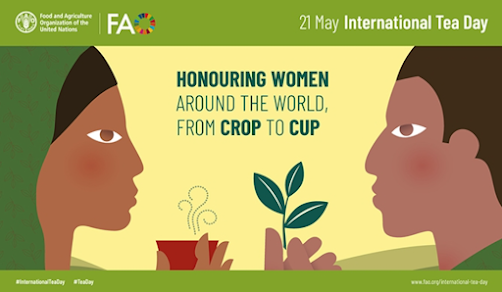
FORUM: “Honoring women around the world, from crop to cup. International Tea Day 2024. The observance aims to raise awareness of the key role, the sector plays in reducing extreme poverty (SDG1), fighting hunger (SDG2), empowering women (SDG5), supporting the sustainable use of the terrestrial ecosystem (SDG15), and in contributing to the achievement of the 2030 Agenda for Sustainable Development. Follow the conversations with the hashtags: #InternationalTeaDay; #tea, #21May.

Honoring women around the world, from crop to cup

The World Tea Day is celebrated annually on May 21st to promote and raise awareness about the importance of tea and its cultural, historical and health significance around the world. According to archaeological and historical records, China is considered the birthplace of tea. The earliest documented use of tea dates back to the Zhou Dynasty (c.11th century-771 BC), while tea as a beverage became popular during the Han Dynasty (206 BC-AD 220). With trade along the Silk Road, tea spread from China to various parts of the world, profoundly influencing global tea culture. China boasts the most diverse range of teas globally, including green tea, black tea, oolong tea, white tea, yellow tea and dark tea, each with its unique production method and flavor.

EVENT: On May 21th, 2024 starting at 10:00 (GMT) a virtual event will be held to celebrate the International Tea Day 2024 by the FAO from Sheikh Zayed Centre. The event will provide an opportunity to promote international cooperation in tea industry in order to contribute to global green development and to achieve the Global goals. This year, we will highlight women and their role in the tea sector. Following the inauguration, there will be a dialogue featuring the participation of the FAO Director-General Mr. QU Dongyu and women representatives from the tea and coffee sectors. Watch the livestream!


EXHIBITS: An exhibition will be held in the Atrium, accompanied by tasting events for tea and coffee.


INITIATIVES: Tea cultivation is attractive to smallholders in many low-income countries because it creates jobs and income throughout the year and requires relatively little investment. They are responsible for 60% of global tea production. Learn about the FAO´s Globally Important Agricultural Heritage Systems (GIAHS) programme. For further informations, send a email to International-Tea-Day@fao.org.


Monday, 20 May 2024

World Day of Cultural Diversity for Dialogue and Development 2024; May 21st.


FORUM: "Preserving Cultural Diversity is preserving what makes us human.'' World Day of Cultural Diversity for Dialogue and Development 2024.
Whether we speak different languages or come from different places, one thing is certain: preserving Cultural Diversity is preserving what makes us human! Follow the conversations with the hashtags: #culturaldiversity; #May21, #culturalheritage, #culturalsites.


The fifteenth call for applications opens on 15 April 2024 and closes on 14 June 2024, noon Paris time. For any inquiries, please contact the Secretariat of the 2005 Convention (convention2005.ifcd@unesco.org). Learn more about IFCD funded projects.


WEBINARS


Sunday, 21 May 2023

World Day for Cultural Diversity for Peace and Development 2023; May 21st.

FORUM: "Preserving the values of cultural diversity, dialogue and development across our globe." World Day for Cultural Diversity for Peace and Development 2023. Culture is who we are and what shapes our identity. No development can be sustainable without including culture. The World Day for Cultural Diversity for Dialogue and Development is an occasion to promote culture and highlight the significance of its diversity as an agent of inclusion and positive change. It represents an opportunity to celebrate culture’s manifold forms, from the tangible and intangible, to creative industries, to the diversity of cultural expressions, and to reflect on how these contribute to dialogue, mutual understanding, and the social, environmental and economic vectors of sustainable development.Today, as we mark the World Day for Cultural Diversity for Dialogue and Development, the UNAOC celebrates cultural diversity as a driving force for achieving sustainable peace and development. Follow the conversation with the hashtags:#OneHumanity, #WorldDiversityDay, #WorldDayforculturalDiversity, #21May, #CulturalHeritage.


Press Statement Attributable to the Spokesperson of the High Representative for UNAOC on the Occasion of the World Day for Cultural Diversity for Dialogue and Development 2023; May 21st. 

Today, as the international community marks the World Day for Cultural Diversity for Dialogue and Development (A/RES/57/249), the United Nations Alliance of Civilizations (UNAOC) celebrates cultural diversity as a driving force for achieving sustainable peace and development.

More than ever, amid escalating conflicts and volatile identity-based tensions, UNAOC underscores that diversity is the reality that enriches human life. Recognizing the pluralism of civilizations, UNAOC upholds its motto “Many Cultures, One Humanity” by building bridges of dialogue between multiple cultures and faiths.

Indeed, the World Day for Cultural Diversity for Dialogue and Development is a special day for UNAOC. Since its inception in 2005, UNAOC has fostered intercultural dialogue by promoting the humanistic values of respect, understanding, social inclusion, and living together in solidarity as #OneHumanity.

Despite our efforts, radicalization, racism, and xenophobia have continued to persist, driving a wedge between cultures and making sustainable peace an unattainable goal. However, cultural diversity should be viewed not as a source of division, but rather as the connective tissue that binds our increasingly multicultural, multi-ethnic and multi-lingual world. Bridging the gap between cultures is urgent and imperative to achieve peace and stability.

On this day and every day, UNAOC reaffirms its commitment to strengthening the bonds between cultures, faiths, and communities, and deepening humanity’s understanding of the value of cultural diversity as a richness rather than a threat.

 Spokesperson of the High Representative for UNAOC.

EVENTS: The World Day for Cultural Diversity for Peace and Development 2023 will be held on May 21st at UNESCO Headquaters in Paris. All are invited to join in, and promote the values of cultural diversity, dialogue and development across our globe. On May 25, 2023, a Cultural performance representing the General History of Africa : Global Launch of the "Mansa World Project". On May 26, 2023, a Colloquium on the challenges of the restoration of the Notre-Dame de Paris Cathedral on the 4th anniversary of the fire will be held at UNESCO.

EXHIBITS: From 15 March 2023 - 15 July 2023 ,a Photo Exhibition entitled 'Silk Roads: Routes of dialogue, exchange, and creativity' will be open for the public at UNESCO Headquarters.


Saturday, 21 May 2022

World Day for Cultural Diversity for Dialogue and Development 2022, May 21st

FORUM: "The time to invest in creativity is now!"  World Day for Cultural Diversity for Dialogue and Development 2022.

The COVID-19 pandemic has hit the cultural and creative industries hard, with many artists, culture professionals and venues finding themselves out of business, sometimes permanently. Rapid digitalization has further exacerbated inequalities within the global marketplace of arts and culture, leaving many artists and culture professionals struggling to gain decent work and fair pay.

Today we are presented with a challenge:

  1. how can we build back better?
  2. How can we ensure that everybody can create, produce, disseminate, and enjoy a diversity of cultural expressions?
  3. How can we ensure that artists and culture professionals everywhere benefit from the opportunities of digital technology, and that none are left behind?


Statement by the Director-General of UNESCO, on the occasion of World Day for Cultural Diversity for Dialogue and Development, 21 May 2022


In the words of former United Nations Secretary-General Mr Boutros Boutros-Ghali, “cultures need to assemble, but not to resemble one another”. These words encapsulate the fundamental aim of World Day for Cultural Diversity for Dialogue and Development and the UNESCO culture conventions alike – to remind us that diversity is just as essential for the cultural world as it is for the living world.In the midst of crises, from the coronavirus disease (COVID-19) pandemic to wars and conflict, we can recognize more than ever both the importance and the urgency of defending cultural diversity and tangible and intangible heritage. Indeed, culture is our most powerful ally for crisis management and recovery. It is a means by which each and every one of us can cultivate and enrich our inner life; it allows us to come together, to remember the past and to think about the future. It allows us to understand that our differences provide the opportunity to celebrate the richness of the human mind, to expand our horizons and to achieve unity in diversity.Yet, cultural diversity continues to be weakened, be it by COVID-19, conflict or climate change. The closure of cultural sites and the cancellation of festivals, concerts and ceremonies owing to the COVID-19 pandemic have affected the sharing of culture and impacted professionals, in particular independent creators.Although the rapid advancement of the digital world has broadened access to culture and inspired creativity, it also exacerbates inequality and can be a vector of cultural homogenization. This is the reason behind UNESCO’s intention to devise new, strong, public policies for culture based on the opinions of those involved in the field; these have been collected over the course of the 355 UNESCO ResiliArt debates held across 115 countries. These reflections informed the UNESCO report Re|shaping policies for creativity, which was published this year. The report sets out clear recommendations: to implement a more protective status for artists, to reduce inequality, both of gender and between regions and to ensure a fair income distribution between digital platforms and creators.UNESCO will ensure that these issues will be at the heart of Mondiacult 2022, the next World Conference on Cultural Policies and Sustainable Development, which will be held in September in Mexico City – a key event for the world of culture and for its future.On this Day, UNESCO would like to call upon everyone to celebrate cultural diversity, through which we will be able to build the intellectual and moral solidarity of humankind.

Audrey Azoulay, UNESCO Director-General.


EVENTS

- Launch of the “Strengthening Digital Literacy Skills and Competencies and Promoting Gender Equality in Cultural and Creative Sectors in Central Asia
From May 20, 2022, 10:00 AM.to May 20, 2022, 1:00 PM.

- In celebration of the World Day for Cultural Diversity for Dialogue and Development, UNESCO organizes a special event on the International Fund for Cultural Diversity (IFCD):The time to invest in creativity is now. From May 20, 2022, 2:00 PM To May 20, 2022, 4:00 PM.

This special event will feature keynote speeches and discussions with actors from the cultural and creative industries and private sector donors on the importance of investing in the creative economy now. The event will also feature exclusive performances from IFCD projects, and offer participants the chance to ask questions directly to IFCD project managers from across the globe.The IFCD is one of the few United Nations funds that provides financial support to arts and cultural bodies, public institutions, and NGOs in the Global South to strengthen the cultural and creative industries in their countries, bolstering inclusive and sustainable development. Over the past 12 years, UNESCO, through the IFCD, has invested more than US$ 9.4 million in 129 cultural projects across 65 Member States.


- Through the World Conference on Cultural Policies and Sustainable Development – MONDIACULT 2022, UNESCO is reinvesting in the global policy dialogue in the field of culture, building on its mandate and expertise to foster multilateral cooperation and policy dialogue as a follow-up to its landmark conferences on cultural policies. The Conference will be convened by UNESCO forty years after the first MONDIACULT World Conference on Cultural Policies held in Mexico City (Mexico) in 1982, and 24 years after the UNESCO World Conference on Cultural Policies for Development held in Stockholm (Sweden) in 1998. 
From 28 to 30 September 2022 in Mexico City.


Launch of the Korean edition of the Global Report - Re|Shaping Policies for Creativity.
FromMay 24, 2022, 2:00 PM To May 24, 2022, 4:00 PM.

The Republic of Korea has been strongly committed to pursuing its active partnership with UNESCO to promote the value of the 2005 Convention on the Protection and Promotion of the Diversity of Cultural Expressions. Since 2008 the Korea-UNESCO Funds-In-Trusts has supported more than 25 projects in developing countries to build an enabling environment for Cultural and Creative Industries and the Minister of Culture, Sports and Tourism of the Republic of Korea chaired the 14th session of the Intergovernmental Committee on the 2005 Convention, which was held exceptionally online due to the pandemic. The Republic of Korea has launched the previous two editions of the Global Report and organized the forums to inform the policy dialogue on the latest policy developments to support arts and creativity. The Republic of Korea’s launch event is co-hosted by the UNESCO Secretariat of the 2005 Convention and the Ministry of Culture, Sports and Tourism of the Republic of Korea, and organized in cooperation with the Arts Council Korea and Korea Culture and Tourism Institute. UNESCO Assistant-Director General for Culture Ernesto Ottone R. will participate in the national launch of the Global Report in Seoul and the public presentation will include the participation of Magdalena Moreno Mújica, one of the authors of the Global Report and Executive Director of IFACCA, Geon-Soo Han, Professor of Gangwon National University and Yoonhyung Jeon from the Korean Film Council and a member of the EU-UNESCO Expert Facility. The International Forum and the launch event would be a valuable occasion to explore new opportunities and shed light on current and future challenges in areas such as digital environment, media diversity, status of artists and artistic freedom.


LIVESTREAM 
The Time to Invest in Creativity is Now!


Friday, 20 May 2022

International Tea Day 2022; May 21st.

FORUM: ''Celebrating Tea around the world, from field to Cup.'' International Tea Day 2022.

The International Tea Day is an opportunity to celebrate the cultural heritage, health benefits and economic importance of tea, while working to make its production sustainable “from field to cup” ensuring its benefits for people, cultures and the environment continue for generations. Follow the conversation with the hastags #InternationalTeaDay; #TeaDay; #21May


Key messages
  • Tea production and processing represent a source of livelihoods for millions of families, including millions in least developed countries.
  • Tea export earnings help to finance food import bills, supporting the economies of major tea-producing countries.
  • The specific agro-ecological conditions where tea thrives occur in areas which are highly vulnerable to climate change.
  • Global trade in 2020 was affected by logistics issues and measures imposed to contain COVID-19.
  • Trade recovered in 2021 as shipments from major exporters resumed
  • During the COVID-19 pandemic tea sales remarkably increased spurred by purchases for in-home consumption, as tea brought comfort to millions around the world
  • Increasing in-home consumption of tea more than offset declining out-of-home consumption in many instances.
  • In order to ensure benefits for both people and the environment, the tea value chain must be sustainable at all stages, from field to cup.


EVENTS: Celebrate International Tea Day with us!

The event, to be opened by FAO Director-General, QU Dongyu, will highlight the vital role the tea sector plays for Members as well as its broader economic and social impacts around the world. 


The event will be an occasion focus on the contribution of tea to the food systems transformation that is needed to ensure better production, better nutrition, a better environment, and a better life, leaving no one behind.

The opening ceremony will be followed by a panel discussion that will complement the celebration and touch on issues affecting the tea sector.

High-level segment
12:00-13:00 hours CEST

Panel discussion
13:30-14:30 hours CEST


Friday, 21 May 2021

World Day of Cultural Diversity for Dialogue and Development 2021; May 21st


 Throughout lockdowns all over the world, artists and cultural professionals were essential workers - for our well-being. Online concerts, music, film, books, art classes, and dance gave us the strength and the resilience we needed to face an uncertain tomorrow. And despite all of this, we are experiencing a cultural emergency, today, with millions of creative workers and artist unemployed or underemployed.

CAMPAIGN: Add your #Voices4Culture and join us [LIVE NOW] at the High-level event on #Culture4Development.


Thursday, 20 May 2021

International Tea Day 2021, May 21st

 FORUMTea: Resilient; Sustainable; Healthy, From Field to CupInternational Tea Day 2021.

Re-emphasizing the call from the Intergovernmental Group on Tea to direct greater efforts towards expanding demand, particularly in tea-producing countries, where per capita consumption is relatively low, and supporting efforts to address the declining per capita consumption in traditional importing countries. Join the conversation on twitter by using the hashtags  #Tea or  #InternationalTeaDay.


CAMPAIGN


Key messages

  • Tea production and processing represent a source of livelihoods for millions of families, including millions in least developed countries.
  • Tea export earnings help to finance food import bills, supporting the economies of major tea-producing countries.
  • The specific agro-ecological conditions where tea thrives occur in areas which are highly vulnerable to climate change.
  • Global trade in 2020 was affected by logistics issues and measures imposed to contain COVID-19.

  • Increasing in-home consumption of tea more than offset declining out-of-home consumption in many instances.
  • During the first weeks of lockdown, in home tea sales surged, increasing by 75 percent in some consuming countries.
  • In order to ensure benefits for both people and the environment, the tea value chain must be sustainable at all stages, from field to cup.


Tea has been with us for a long time. There is evidence that tea was consumed in China 5,000 years ago.Throughout the years, the aroma of their millenary tea varieties has made its way into the hearts and minds of many tea drinkers around the world, one leaf at a time.


Tea per capita consumption increased by 2.8 percent per year over the last decade.


Tea consumption can bring health benefits and wellness due to the beverage's anti-inflammatory, antioxidant and weight loss effects. It also has cultural significance in many societies.


Tea production and trade contribute to livelohoods; export earnings food security and incomes 


Moreover, there is an urgent need to raise public awareness of the importance of tea for rural development and sustainable livelihoods and to improve the tea value chain to contribute to the 2030 Agenda for Sustainable Development.


Tea thrives in bery specific agro-ecological conditions and in certain environments which today are often impacted by climate change.


Changes in temperature and rainfall patterns, with more floods and droughts, are already affecting yields, tea product quality and prices, lowering incomes and threatening rural livelihoods. These climate changes are expected to intensify, calling for urgent adaptation measures. In parallel, there is a growing recognition of the need to contribute to climate change mitigation, by reducing carbon emissions from tea production and processing.


The FAO Intergovernmental group on tea leads multilateral efforts to support the world tea economy.


The United Nations General Assembly decided to designate 21 May as International Tea Day in order to promote and foster collective actions in favour of the sustainable production and consumption of tea.