עולם פליטי היום, 20 ביוני.
世界難民日,6月20日。
World Refugee Day, 20 June.
Всемирный день беженцев, 20 июня.
Día Mundial de los Refugiados, 20 de junio.
Journée mondiale des réfugiés, le 20 Juin.
اليوم العالمي للاجئين 20 يونيو.
2016年主題:難民。
Тема 2016: с беженцами.
Tema 2016: Con los Refugiados.
Thème 2016: Avec les réfugiés
2016 فريق: مع اللاجئين.
Forced displacement has reached unprecedented levels, with more than 65 million people uprooted from their homes globally. New and recurring conflicts, and ever-more disturbing forms of violence and persecution, are driving people to flee in search of safety within their own countries, or to cross international borders as asylum seekers or refugees. Others are living in long-term exile, as solutions to protracted conflicts remain elusive. At the end of 2015, there were 21.3 million refugees, 3.2 million people in the process of seeking asylum, and 40.8 million people internally displaced within their own countries.
World Refugee Day is a moment for taking stock of the devastating impact of war and persecution on the lives of those forced to flee, and honouring their courage and resilience. It is also a moment for paying tribute to the communities and States that receive and host them, often in remote border regions affected by poverty, instability and underdevelopment, and beyond the gaze of international attention. Nine out of ten refugees are today living in poor and middle income countries close to situations of conflict.
Last year, more than 1 million refugees and migrants arrived in Europe across the Mediterranean, in unseaworthy dinghies and flimsy boats. Thousands did not make it -- tragic testimony to our collective failure to properly address their plight. Meanwhile, divisive political rhetoric on asylum and migration issues, rising xenophobia, and restrictions on access to asylum have become increasingly visible in certain regions, and the spirit of shared responsibility has been replaced by a hate-filled narrative of intolerance. We see a worrisome increase in the use of detention and in the construction of fences and other barriers.
With anti-refugee rhetoric so loud, it is sometimes difficult to hear the voices of welcome. But these do exist, all around the world. In the past year, in many countries and regions, we have witnessed an extraordinary outpouring of compassion and solidarity, as ordinary people and communities have opened their homes and their hearts to refugees, and States have welcomed new arrivals even while already hosting large numbers of refugees.
There is an urgent need to build on and amplify these positive examples. Our responses to refugees must be grounded in our shared values of responsibility sharing, non-discrimination, and human rights and in international refugee law, including the principle of non-refoulement. On 19 September, the UN High-Level Plenary of the General Assembly on Addressing Large Movements of Refugees and Migrants will offer a historic opportunity to agree a global compact, with a commitment towards collective action and greater shared responsibility for refugees at its core.
We must stand together with the millions of men, women and children who flee their homes each year, to ensure that their rights and dignity are protected wherever they are, and that solidarity and compassion are at the heart of our collective response.
Press Statement by John Kerry, Secretary of State on U.N. World Refugee Day 2016, June 20th.
Today, we honor refugees’ resilience and courage. We also recognize the tremendous contributions made by local and international non-governmental organizations on the front lines of delivering life-saving assistance. This year’s commemoration comes at a time when brutal conflicts are forcing record numbers of innocent people to flee, and challenging the world to find better ways to protect them. The war in Syria alone has displaced more than 11 million people – half of that nation’s pre-war population. Millions more have fled Daesh’s atrocities in Iraq, civil wars in Yemen and South Sudan, political violence in Burundi, and Boko Haram’s rampages through Nigeria, Cameroon, Niger, and Chad.
The number of forcibly displaced people is the largest ever recorded. Sixty-five million people are refugees, internally displaced or seeking asylum, five million more than a year ago.
World War II, another era of mass displacement, taught us indelible lessons about our collective duty to aid victims of conflict and persecution. The global humanitarian system our leaders assembled in the aftermath of that war has saved millions of lives. Throughout that time, the United States government has funded and continues to galvanize support for humanitarian operations. Last year alone, U.S. humanitarian aid exceeded $6 billion.
But this good work and the resources we and other donors provide are not keeping pace with today’s unprecedented needs – because there are so many refugees, because they are staying in exile longer, and because countries hosting them are overwhelmed. More than eight in ten who flee across borders take refuge in poor or middle income countries, often in countries struggling to provide even their own citizens with basic necessities like health care, education, and clean water.
The United States is determined to find solutions. That is why, on September 20, at the UN General Assembly in New York, President Obama will host a Leaders’ Summit on Refugees asking nations to make concrete commitments toward expanding the humanitarian safety net and creating more long-term, durable opportunities for refugees. In the meantime, we will remain committed to providing humanitarian assistance across the globe, while also expanding our own refugee resettlement program – from nearly 70,000 admitted last year to 85,000 from across the world in 2016.
The refugees we welcome to the United States will join previous generations who have come to this country to escape violence and persecution – threats to human life and dignity that remain all too real today. History celebrates such moments when we have overcome bias and fear, and opened our doors. Those who have walked through them have made immeasurable contributions to our community of citizens and enriched our lives. Their achievements are a testament to the potential all humans have to heal, to overcome loss, to start over, and to the obligation we share, to give future generations that chance.
U.S. Department of State Recognizes World Refugee Day
In a world where violence forces hundreds of families to flee each day, the UN Refugee Agency believes now is the time to show world leaders that the global public stands with refugees, and it will launch its #WithRefugees petition on June 20th to send a message to governments that they must work together and do their fair share for refugees.
The #WithRefugees petition aims to gather public support for the growing number of families forced to flee conflict and persecution worldwide, who currently face heightened anti-refugee rhetoric coupled with greater restrictions to asylum, according to the Office of the UN High Commissioner for Refugees (UNHCR).
“We are in a period of deepening conflict and turmoil in the world, which is causing many more people to flee their homes than before,” said Filippo Grandi, UN High Commissioner for Refugees. “It affects and involves us all, and what it needs is understanding, compassion and political will to come together and find real answers for the refugee plight. This has become a defining challenge of our times,” he said.
In 2015, millions of people were newly displaced, adding again to the global refugee and internal displacement totals. Overwhelmingly, it was countries of the developing world that were most affected, but Europe too witnessed dramatic scenes, as hundreds of thousands of people crossed the Mediterranean in search of safety and refuge. Thousands died along the way, according to the agency chief.
“At the same time, there was an extraordinary outpouring of empathy and solidarity, as ordinary people and communities opened their homes and their hearts to refugees, and some countries have welcomed new arrivals even while already hosting large numbers of refugees,” he explained and added: “The #WithRefugees campaign and petition aims to amplify those voices of welcome and show that the world stands with refugees.”
The petition calls on Governments to ensure that every refugee child gets an education, every refugee family has somewhere safe to live, and every refugee can work or learn new skills to make a positive contribution to their community.
Among those celebrities are UNHCR Goodwill Ambassador Cate Blanchett, best-selling author Khaled Hosseini and supermodel and former refugee Alek Wek.
Others lending support include faith leaders Archbishop Desmond Tutu and Venerable V. Vajiramedhi, as well as actors Benedict Cumberbatch, Chiwetel Ejiofor, Margot Robbie, Ben Stiller and Dame Helen Mirren and singers Juanes, Mika, Maher Zain and Babaa Maal.
“We are in the middle of a catastrophic displacement crisis that has already uprooted millions of innocent families, and seen too many lose their lives trying to reach safety,” said Ms. Blanchett.
“The ultimate solution is political – we need peace and stability. But whilst we wait for that, we – as people with a voice – can and must play our part,” she stressed, urging all countries to take a shared responsibility for ensuring refugees have protection, shelter and the chance to live a productive life. “If enough of us stand together, we will be heard.”
“Refugees are mothers, fathers, sisters, brothers, children, with the same hopes and ambitions as us; except that a twist of fate has bound their lives to a global refugee crisis on an unprecedented scale,” said Mr. Hosseini.
The petition will be delivered to the UN Headquarters in New York, ahead of September’s High-Level Meeting of the General Assembly on addressing large movements of refugees and migrants.
Forum : The terms refugee and migrant are often used interchangeably but do you know the difference?
The #WithRefugees petition will be delivered to UN headquarters in New York ahead of the UN General Assembly meeting on September 19. The petition asks governments to:

Events :
Ahead of the World Refugee Day on 20 June, more than 60 film, TV and music stars have joined refugees, faith leaders and the United Nations refugee agency staff to back a petition highlighting the plight of forcibly displaced people.
Find out about the UN General Assembly high-level Summit to be held on 19 September,2016 on Refugees and Migrants .
Angelina Jolie Pitt, the UN refugee agency's special envoy, has warned that the international humanitarian system for refugees is breaking down. Ms Jolie Pitt has been speaking as part of the BBC's World on the Move day of coverage of global migration issues. She warned against a "fear of migration" and a "race to the bottom" as countries competed to be the toughest to protect themselves.
Photos : We are the UN Refugee Agency. Join us as we provide vital aid and protection to the forcibly displaced. Stand #WithRefugees.
世界難民日,6月20日。
World Refugee Day, 20 June.
Всемирный день беженцев, 20 июня.
Día Mundial de los Refugiados, 20 de junio.
Journée mondiale des réfugiés, le 20 Juin.
اليوم العالمي للاجئين 20 يونيو.
 |
| The terms refugee and migrant are often used interchangeably but do you know the difference? |
Theme 2016 : With Refugees.
Theme 2016: בפליטים.2016年主題:難民。
Тема 2016: с беженцами.
Tema 2016: Con los Refugiados.
Thème 2016: Avec les réfugiés
2016 فريق: مع اللاجئين.
Forced displacement has reached unprecedented levels, with more than 65 million people uprooted from their homes globally. New and recurring conflicts, and ever-more disturbing forms of violence and persecution, are driving people to flee in search of safety within their own countries, or to cross international borders as asylum seekers or refugees. Others are living in long-term exile, as solutions to protracted conflicts remain elusive. At the end of 2015, there were 21.3 million refugees, 3.2 million people in the process of seeking asylum, and 40.8 million people internally displaced within their own countries.
World Refugee Day is a moment for taking stock of the devastating impact of war and persecution on the lives of those forced to flee, and honouring their courage and resilience. It is also a moment for paying tribute to the communities and States that receive and host them, often in remote border regions affected by poverty, instability and underdevelopment, and beyond the gaze of international attention. Nine out of ten refugees are today living in poor and middle income countries close to situations of conflict.
Last year, more than 1 million refugees and migrants arrived in Europe across the Mediterranean, in unseaworthy dinghies and flimsy boats. Thousands did not make it -- tragic testimony to our collective failure to properly address their plight. Meanwhile, divisive political rhetoric on asylum and migration issues, rising xenophobia, and restrictions on access to asylum have become increasingly visible in certain regions, and the spirit of shared responsibility has been replaced by a hate-filled narrative of intolerance. We see a worrisome increase in the use of detention and in the construction of fences and other barriers.
With anti-refugee rhetoric so loud, it is sometimes difficult to hear the voices of welcome. But these do exist, all around the world. In the past year, in many countries and regions, we have witnessed an extraordinary outpouring of compassion and solidarity, as ordinary people and communities have opened their homes and their hearts to refugees, and States have welcomed new arrivals even while already hosting large numbers of refugees.
There is an urgent need to build on and amplify these positive examples. Our responses to refugees must be grounded in our shared values of responsibility sharing, non-discrimination, and human rights and in international refugee law, including the principle of non-refoulement. On 19 September, the UN High-Level Plenary of the General Assembly on Addressing Large Movements of Refugees and Migrants will offer a historic opportunity to agree a global compact, with a commitment towards collective action and greater shared responsibility for refugees at its core.
We must stand together with the millions of men, women and children who flee their homes each year, to ensure that their rights and dignity are protected wherever they are, and that solidarity and compassion are at the heart of our collective response.
United Nations, Secreary General
The Secretary-General issued his report 'In Safety and Dignity: Addressing Large Movements of Refugees and Migrants' on 9 May 2016.
The report focuses on three interdependent pillars. It calls for a new comprehensive framework and makes recommendations to address issues of common concern, including the causes of such movements, protecting those who are compelled to undertake such journeys and preventing discrimination and xenophobia frequently encountered.
Statement by the President Barack Obama on World Refugee Day (2016) - The White House
Today, on World Refugee Day, we recognize the challenges and hardships that refugees face, honor their courage and resilience in the face of overwhelming obstacles, and celebrate their many valuable contributions to our Nation.
This year’s commemoration comes as the UN High Commissioner for Refugees reports that more people are displaced by rising violence, insecurity, and persecution than at any time on record. More than 65 million people around the world – more than the population of France, or California and Texas combined – have been driven from their homes. More than half are children. The scale of this human suffering is almost unimaginable; the need for the world to respond is beyond question.
Every day, members of the international community, humanitarian organizations, civil society, and individual citizens work to assist these vulnerable populations. For our part, the United States provides more humanitarian assistance to refugees than any other nation and maintains the world’s largest refugee resettlement program. We support programs that provide food, water, shelter, and medical care to refugees, and fight for their rights to safety, dignity and long-term livelihood opportunities.
But responding to today’s unprecedented challenge requires all of us to do more. In September, when world leaders meet for the UN General Assembly, I will convene a Leaders’ Summit on Refugees. In advance of that Summit, the United States is urging other governments to contribute more funding for humanitarian aid operations, to grant more refugees the chance to work and attend school, and to provide more resettlement opportunities for refugees who cannot safely go home or remain where they are. We are urging our non-governmental partners, including the private sector, to do more as well.
Even as our aid supports refugees thousands of miles from here, each day, countless Americans do their part to welcome and support refugees as they start life anew in the United States. The millions of refugees who have resettled here through the years have brought similar dreams of a better tomorrow. Each has enriched the diverse mosaic that is America. Their lives and their many accomplishments stand as a clear rebuke to the bigotry and brutality they fled, and serve as a powerful example of the human will to endure, hope, and achieve.
Today, we commemorate the spirit and strength of refugees worldwide and the dedication of those who help them on and after their journeys. Protecting and assisting refugees is a part of our history as a Nation, and we will continue to alleviate the suffering of refugees abroad, and to welcome them here at home, because doing so reflects our American values and our noblest traditions as a Nation, enriches our society, and strengthens our collective security.
Barack Obama
44th President of the United States.
Press Statement by John Kerry, Secretary of State on U.N. World Refugee Day 2016, June 20th.
Today, we honor refugees’ resilience and courage. We also recognize the tremendous contributions made by local and international non-governmental organizations on the front lines of delivering life-saving assistance. This year’s commemoration comes at a time when brutal conflicts are forcing record numbers of innocent people to flee, and challenging the world to find better ways to protect them. The war in Syria alone has displaced more than 11 million people – half of that nation’s pre-war population. Millions more have fled Daesh’s atrocities in Iraq, civil wars in Yemen and South Sudan, political violence in Burundi, and Boko Haram’s rampages through Nigeria, Cameroon, Niger, and Chad.
The number of forcibly displaced people is the largest ever recorded. Sixty-five million people are refugees, internally displaced or seeking asylum, five million more than a year ago.
World War II, another era of mass displacement, taught us indelible lessons about our collective duty to aid victims of conflict and persecution. The global humanitarian system our leaders assembled in the aftermath of that war has saved millions of lives. Throughout that time, the United States government has funded and continues to galvanize support for humanitarian operations. Last year alone, U.S. humanitarian aid exceeded $6 billion.
But this good work and the resources we and other donors provide are not keeping pace with today’s unprecedented needs – because there are so many refugees, because they are staying in exile longer, and because countries hosting them are overwhelmed. More than eight in ten who flee across borders take refuge in poor or middle income countries, often in countries struggling to provide even their own citizens with basic necessities like health care, education, and clean water.
The United States is determined to find solutions. That is why, on September 20, at the UN General Assembly in New York, President Obama will host a Leaders’ Summit on Refugees asking nations to make concrete commitments toward expanding the humanitarian safety net and creating more long-term, durable opportunities for refugees. In the meantime, we will remain committed to providing humanitarian assistance across the globe, while also expanding our own refugee resettlement program – from nearly 70,000 admitted last year to 85,000 from across the world in 2016.
The refugees we welcome to the United States will join previous generations who have come to this country to escape violence and persecution – threats to human life and dignity that remain all too real today. History celebrates such moments when we have overcome bias and fear, and opened our doors. Those who have walked through them have made immeasurable contributions to our community of citizens and enriched our lives. Their achievements are a testament to the potential all humans have to heal, to overcome loss, to start over, and to the obligation we share, to give future generations that chance.
John Kerry
U.S. Department of State
U.S. Department of State
U.S. Department of State Recognizes World Refugee Day
In honor of World Refugee Day on June 20, officials from the U.S. Department of State are participating in a variety of outreach activities in Baltimore, Washington, D.C., New York City, and New Jersey to honor the contributions of refugees making new lives in communities across the U.S.
U.S. Secretary of State John Kerry will be attending an interfaith Iftar reception this evening at the All Dulles Area Muslim Society center in Sterling, Virginia, where he is looking forward to meeting with refugee families and the communities that have so generously welcomed them to the United States. He will be joined in making remarks and meeting with community leaders by United Nations High Commissioner for Refugees Special Envoy Angelina Jolie Pitt, a tireless advocate on behalf of refugees.
This afternoon, the Secretary and Special Envoy Jolie Pitt will meet with a group of State Department employees who are former refugees or the sons and daughters of refugees. Following that roundtable, the Secretary and Special Envoy will hold a bilateral meeting to discuss refugee and other issues. The Secretary will also speak with a group of college students who are visiting the Department to participate in the U.S. Diplomacy Center’s diplomatic simulation on refugees and forced displacement. He will have the opportunity to see young Americans engaged in learning how to resolve a simulated humanitarian crisis through diplomacy.
Ambassador Samantha Power will represent the United States Mission to the United Nations later tonight at a photo exhibit organized jointly with the United Nations High Commissioner for Refugees (UNHCR) at the New York Public Library.
Recognizing refugees’ contributions to American society, U.S. Deputy Secretary of State Antony Blinken will represent the Department at a naturalization ceremony being held today at the Holocaust Museum in Washington, D.C. He will deliver remarks, and welcome some of America’s newest citizens to a nation founded on the perseverance and dedication of immigrants. Deputy Secretary Blinken will also attend a small, informal training session for community leaders from across the United States who came to America as refugees and are dedicated to helping arriving refugees to integrate successfully.
U.S. Deputy Secretary for Management and Resources Heather Higginbottom will participate in a public service announcement sponsored by the Ad Council. Through this campaign, Deputy Secretary Higginbottom will explain the strength and importance of the U.S. Refugee Admissions Program, and will highlight the positive impact that refugees have on their communities.
This past weekend, U.S. Assistant Secretary of State for Population, Refugees, and Migration Anne C. Richard spoke with refugees in Baltimore at a World Refugee Day event sponsored by representatives of the local community. Joined by the Mayor of Baltimore Stephanie Rawlings-Blake, Assistant Secretary Richard conveyed her deep, heartfelt appreciation for the Baltimore community’s outstanding support for refugees, and her admiration for those who are leading successful lives in their new homes. Today, Assistant Secretary Richard, U.S. Assistant Secretary of State Anne Patterson, and U.S. Assistant Secretary of State Linda Thomas-Greenfield will discuss the refugee crisis and other foreign policy issues at a luncheon held today by the Women’s Foreign Policy Group.
Special Representative for Religion and Global Affairs Shaun Casey will travel to New Jersey later this week to attend a World Refugee Day event hosted by a local resettlement agency, highlight the role of religious communities in welcoming refugees, and thank local volunteers for their contributions. Special Representative to Muslim Communities Shaarik Zafar and Assistant Secretary Richard will join the Secretary at the interfaith dinner tonight at the All Dulles Area Muslim Society in Sterling, Virginia.
Special Representative for Business and Commercial Affairs Ziad Haidar is meeting today with business owners and refugees to discuss how refugees can and do fill roles much in demand in today’s economy – from healthcare to education to technology.
These efforts demonstrate the Department’s commitments to leading the global response to refugee crises, through the provision of humanitarian assistance and in marshaling our diplomatic resources to ask every individual and every nation to do more.
Building on this commitment, President Obama will co-host the Leaders’ Summit on Refugees in New York on September 20. The goal of the President’s summit is to expand the humanitarian safety net and create more long-term, durable opportunities for refugees.
The United States remains committed to finding safe, new lives for the world’s most vulnerable people as they flee conflict, terrorism, and persecution.
In a world where violence forces hundreds of families to flee each day, the UN Refugee Agency believes now is the time to show world leaders that the global public stands with refugees, and it will launch its #WithRefugees petition on June 20th to send a message to governments that they must work together and do their fair share for refugees.
“We are in a period of deepening conflict and turmoil in the world, which is causing many more people to flee their homes than before,” said Filippo Grandi, UN High Commissioner for Refugees. “It affects and involves us all, and what it needs is understanding, compassion and political will to come together and find real answers for the refugee plight. This has become a defining challenge of our times,” he said.
In 2015, millions of people were newly displaced, adding again to the global refugee and internal displacement totals. Overwhelmingly, it was countries of the developing world that were most affected, but Europe too witnessed dramatic scenes, as hundreds of thousands of people crossed the Mediterranean in search of safety and refuge. Thousands died along the way, according to the agency chief.
“At the same time, there was an extraordinary outpouring of empathy and solidarity, as ordinary people and communities opened their homes and their hearts to refugees, and some countries have welcomed new arrivals even while already hosting large numbers of refugees,” he explained and added: “The #WithRefugees campaign and petition aims to amplify those voices of welcome and show that the world stands with refugees.”
The petition calls on Governments to ensure that every refugee child gets an education, every refugee family has somewhere safe to live, and every refugee can work or learn new skills to make a positive contribution to their community.
Among those celebrities are UNHCR Goodwill Ambassador Cate Blanchett, best-selling author Khaled Hosseini and supermodel and former refugee Alek Wek.
Others lending support include faith leaders Archbishop Desmond Tutu and Venerable V. Vajiramedhi, as well as actors Benedict Cumberbatch, Chiwetel Ejiofor, Margot Robbie, Ben Stiller and Dame Helen Mirren and singers Juanes, Mika, Maher Zain and Babaa Maal.
“We are in the middle of a catastrophic displacement crisis that has already uprooted millions of innocent families, and seen too many lose their lives trying to reach safety,” said Ms. Blanchett.
“The ultimate solution is political – we need peace and stability. But whilst we wait for that, we – as people with a voice – can and must play our part,” she stressed, urging all countries to take a shared responsibility for ensuring refugees have protection, shelter and the chance to live a productive life. “If enough of us stand together, we will be heard.”
“Refugees are mothers, fathers, sisters, brothers, children, with the same hopes and ambitions as us; except that a twist of fate has bound their lives to a global refugee crisis on an unprecedented scale,” said Mr. Hosseini.
The petition will be delivered to the UN Headquarters in New York, ahead of September’s High-Level Meeting of the General Assembly on addressing large movements of refugees and migrants.
Forum : The terms refugee and migrant are often used interchangeably but do you know the difference?
The #WithRefugees petition will be delivered to UN headquarters in New York ahead of the UN General Assembly meeting on September 19. The petition asks governments to:
- Ensure every refugee child gets an education.
- Ensure every refugee family has somewhere safe to live.
- Ensure every refugee can work or learn new skills to make a positive contribution to their community
 |
| Mediterranean sea arrivals |
Events :
Ahead of the World Refugee Day on 20 June, more than 60 film, TV and music stars have joined refugees, faith leaders and the United Nations refugee agency staff to back a petition highlighting the plight of forcibly displaced people.
Find out about the UN General Assembly high-level Summit to be held on 19 September,2016 on Refugees and Migrants .
Angelina Jolie Pitt, the UN refugee agency's special envoy, has warned that the international humanitarian system for refugees is breaking down. Ms Jolie Pitt has been speaking as part of the BBC's World on the Move day of coverage of global migration issues. She warned against a "fear of migration" and a "race to the bottom" as countries competed to be the toughest to protect themselves.

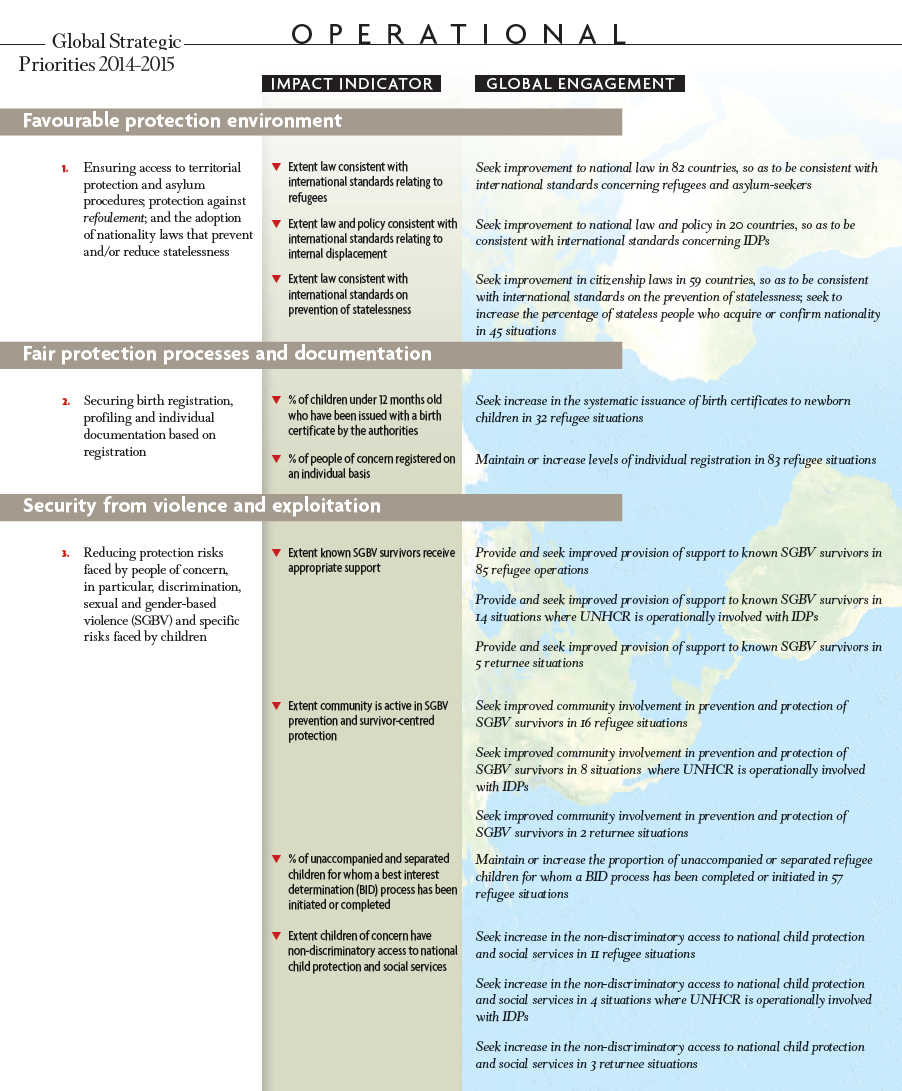
 |
| Ensuring access to territorial protection and asylum procedures; protection against refoulement; and the adoption of nationality laws that prevent andor reduce statelessness |
 |
| Securing birth registration, profiling and individual documentation based on registration |
 |
| Reducing protection risks faced by people of concern, in particular, discrimination, sexual and gender-based violence and specific risks faced by children |
 |
| Reducing mortality, morbidity and malnutrition through multi-sectoral interventions |
 |
| Meeting international standards in relation to shelter, domestic energy, water, sanitation and hygiene |
Audio/Video :
Watch the media launch by the Deputy Secretary-General, Jan Eliasson, and the Special Adviser, Karen AbuZayd.
 |
| Promoting active participation in decision making of people of concern and building coexistence with hosting communities |
 |
| Promoting Human potential through increased opportunities for quality education and livelihoods support |
 |
| Expanding opportunities for durable solutions for people of concern... |
Audio/Video :
Watch the media launch by the Deputy Secretary-General, Jan Eliasson, and the Special Adviser, Karen AbuZayd.
#WithRefugees | Lim Bol is a refugee of knowledge
#WithRefugees | Tinalbarka dreams of becoming a lawyer
#WithRefugees | Solaf loves sports and dreams of living in America
#WithRefugees | Mojtaba dreams of finding a cure for cancer
#WithRefugees | Carmen hopes to inspire other women through her work
#WithRefugees | Baw Meh dreams of a better future for her grandchildren
#WithRefugees | Irene dreams of empowering women at her training centre
Publications :
The UNHCR WASH Manual is a comprehensive and authoritative reference document for WASH interventions in refugee settings, built upon the experience of UNHCR and WASH organisations.

 |
| +United Nations High Commissioner for Refugees (UNHCR) 2016, Top 10 government donors |
Interviews :
Photos : We are the UN Refugee Agency. Join us as we provide vital aid and protection to the forcibly displaced. Stand #WithRefugees.
News :
- Adressing large movements of Refugees and Migrants, #UN4RefugeesMigrants
- The Global Trends 2015, UN Refugee Agency.