Showing posts with label Promoting multilingualism and multilingual education. Show all posts

Monday, 5 June 2023

Russian Language Day 2023; June 6th.

FORUM: "Celebrate the beauty of the Russian Language." Russian Language Day 2023.

Russian is one of the world (global) languages. This status was given to the language in the 20th century. The spread of the Russian language was largely a consequence of the activities of the Russian Empire, then the USSR and modern Russia. The status of the Russian language was enshrined in the UN, where Russian is one of the six official international languages. 

To express your interest for the celebration of the Russian Language Day and to promote the langue. Follow the conversations with the hashtags: #RussianlanguageDay, #RussianLanguage, #6june#interpretation. #Деньрусскогоязыка, #Русскийязык, #6июня, #Многоязычие.


At the beginning of the 20th century, approximately 150 million people spoke Russian, mostly subjects of the Russian Empire. Over the next 90 years, the number of those who knew Russian increased to about 350 million people, of which 286 million lived in the USSR, where Russian was the state language and for most of its inhabitants was the native language, and more than 70 million people (mainly in the allied republics of the USSR, Eastern European, Balkan countries and a number of Asian countries) also knew the Russian language to one degree or another.

By 2004, the number of people who spoke Russian to varying degrees had dropped to 278 million, including 140 million in Russia itself. According to 2006 estimates, Russian is the native language for 130 million citizens of the Russian Federation, for 26.4 million inhabitants of other countries on the territory of the former USSR and for almost 7.4 million inhabitants of other countries (primarily Germany and other European countries, the USA and Israel). ), that is, for a total of 163.8 million people. More than 114 million people (data for 2006) speak Russian as a second language (mainly in post-Soviet countries) or know it as a foreign language.

In terms of prevalence (the total number of people who speak a language), Russian in 2022 ranked eighth in the world (258.2 million) after English (1.5 billion speakers), Mandarin Chinese (1.1 billion), Hindi (602.2 million ), Spanish (548.3 million), French (274.1 million), Standard Arabic (274.0 million) and Bengali (272.7 million). Among the native languages of their speakers, Russian in 2022 ranked seventh in the world (154 million) after Mandarin Chinese, Spanish, English, Hindi, Bengali and Portuguese. According to a W3Techs study, in March 2013, Russian was the second most used language on the Internet.


EVENTS: On June 6th to mark the Russian Language Day 2023, the United Nations Security Council, the United Nations General Assembly, the Permanent Mission of Russia to the United Nations, the UN DGACM, the Permanent Delegation of Russia to the UNESCO, the United Nations Information Centre, the United Nations Multimedia and all the other United Nations entities will hold a series of virtual events in New York, Geneva and Vienna, including a poetry reading, a literature recital, theatrical performances and panel discussions about the Russian language.


The United Nations delegates and staff will celebrate Russian Language Day 2023 at an event at the United Nations HQ, featuring a documentary on simultaneous interpretation. The DGACM USG Movses Abelian paid tribute to our linguists and their invaluable contribution to the UN’s global mission .


2023 День русского языка - "Русский язык в мире."

В рамках празднования Дня русского языка (6 июня) структуры Организации Объединенных Наций провели в Нью-Йорке, Женеве и Вене ряд виртуальных мероприятий, включая поэтические чтения, литературный концерт, театральные представления и дискуссии о русском языке.
Русский язык — один из мировых (глобальных) языков. Такой статус язык получил в XX веке. Распространение русского языка было во многом следствием деятельности Российской империи, затем СССР и современной России. Статус русского языка был закреплён в ООН, где русский является одним из шести официальных международных языков.
В начале XX века русским языком владели примерно 150 миллионов человек — в основном подданные Российской империи. На протяжении последующих 90 лет число знающих русский язык увеличилось примерно до 350 миллионов человек, причём 286 миллионов из них проживали в СССР, где русский был государственным языком и для большей части её жителей являлся родным языком, а ещё свыше 70 миллионов человек (преимущественно в союзных республиках СССР, восточноевропейских, балканских странах и ряде азиатских стран) также в той или иной мере знали русский язык.

К 2004 году число владеющих в различной степени русским языком сократилось до 278 миллионов человек, в том числе в самой России — до 140 миллионов человек. По оценкам 2006 года, русский язык является родным для 130 миллионов граждан Российской Федерации, для 26,4 миллионов жителей других стран на территории бывшего СССР и для почти 7,4 миллионов жителей остальных стран (прежде всего Германии и других стран Европы, США и Израиля), то есть в общей сложности для 163,8 миллионов человек. Ещё свыше 114 миллионов человек (данные на 2006 год) владеют русским как вторым языком (преимущественно в постсоветских странах) или знают его как иностранный.

По степени распространённости (общему количеству владеющих языком людей) русский в 2022 году занимал восьмое место в мире (258,2 млн) после английского (1,5 млрд носителей), мандаринского китайского (1,1 млрд), хинди (602,2 млн), испанского (548,3 млн), французского (274,1 млн), стандартного арабского (274,0 млн) и бенгальского (272,7 млн) языков. Среди языков, являющихся для их носителей родными, русский в 2022 году занимал седьмое место в мире (154 млн) после мандаринского китайского, испанского, английского, хинди, бенгальского и португальского языков.

По данным исследования W3Techs, в марте 2013 русский язык вышел на второе место по использованию в Интернете.

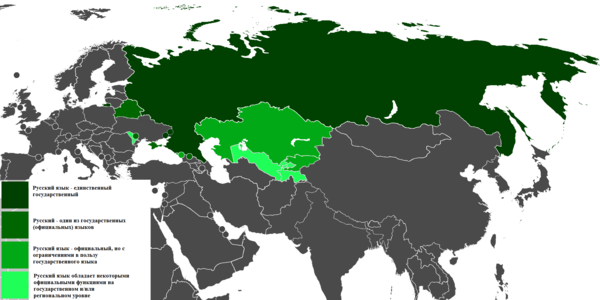
Map of Russian language - Юридический статус русского языка в мире.


Monday, 20 February 2023

International Mother Language Day 2023; February 21st.

 FORUM: " Multilingual education - a necessity to transform education." International Mother Language Day 2023.

This year edition will explore the theme ‘multilingual education - a necessity to transform education.’ It will explore and debate the potential of multilingualism totransform education from a lifelong learning perspective and in different contexts. It is shaped around the following three inter-connected themes:

 • Enhancing multilingual education as a necessity to transform education in multilingual contexts from early childhood education and well beyond; 

• Supporting learning through multilingual education and multilingualism in our fast-changing global contexts and in crisis situations including emergencies contexts; 

• Revitalizing languages that are disappearing or are threatened with extinction. 


Objectives: The overall aim of the International Mother Language Day (IMLD) 2023 is to contribute to the achievement of Sustainable Development Goal 4 by recognizing the role of actors in education and in related fields in promoting multilingualism and multilingual education, and in fostering quality, inclusive and equitable learning. 

More specifically, IMLD 2023 aims to:

 • Further sensitize actors in education, teachers, education policy-makers of the transformative power of multilingualism and multilingual education;

 • Support actors in education, teachers, education policy-makers in the strengthening of multilingualism and multilingual education by highlighting and sharing promising and innovative policies and practices.


Statement from Ms Audrey Azoulay, Director-General of UNESCO, on the occasion of International Mother Language Day 2023, February 21st.


While mother-tongue-based education is essential to the full development of individuals and to the transmission of linguistic heritage, 40% of the world's students do not have access to education in the language they speak or understand best. Such a situation severely undermines learning, cultural expression and the building of social relations, and significantly weakens the linguistic heritage of humanity. It is therefore crucial that this language issue be taken into account in the necessary exercise of transforming education, which UNESCO was supporting throughout 2022, culminating in the Transforming Education Summit, convened last September by the Secretary-General of the United Nations, António Guterres. This imperative first requires a better collection of data, which will make it possible to carry out specific and customized actions. Above all, however, it requires a more general awareness of the irreplaceable but fragile value of the world's linguistic and cultural diversity. Each of the more than 7,000 languages spoken by humanity carries within it a unique view of the world, of things and of beings, a way of thinking and feeling – so much so that each disappearance of a language constitutes an irretrievable loss. In this context, the International Decade of Indigenous Languages (2022–2032), for which UNESCO is the leading agency, is an important opportunity for the international community to mobilize in order to safeguard a major part of the world's cultural diversity. This is also the aim of this International Day: celebrating these ways of expressing the world in its multiplicity, committing to the preservation of the diversity of languages as a common heritage, and working for quality education – in mother tongues – for all.

Director-General of UNESCO.


EVENTS: The event will take place in Room (TBC), UNESCO House (Fontenoy). Interpretations will be available in English, French, Spanish. 

Morning session: Official opening and two panels on 

1) Multilingual education as a vector for transforming education and promoting gender equality and 

2) Revitalizing local languages to promotemultilingual education and transform education.

 Afternoon session: Two panels on

 1) Multilingual Education in Small Island Developing States: Challenges and Opportunities for Transformative Education and

 2) Multilingual education - a factor of change - in crisis and emergency situations. 


Target audiences 

• Key stakeholders in education, education policy-makers, teachers. 

• Non-governmental organizations, foundations and other bodies supporting multilingualism.