Showing posts with label Mother Tongue. Show all posts

Saturday, 21 February 2026

International Mother Language Day 2026; February 21st.


FORUM: "Youth voices on multilingual education." International Mother Language Day 2026. Young people are not only inheritors of linguistic diversity: they are key actors in its future. Ensuring that youth can access education, information and digital spaces in their own languages is essential for inclusion, equity and sustainable development. The theme emphasizes that language is more than a means of communication: it is central to identity, learning, well-being and participation in society. The celebration underscores the importance of education systems that recognize and value every learner’s language to support inclusion and learning outcomes.The 2026 edition will also highlight the growing digital dimension of multilingualism. Online content remains heavily concentrated in a limited number of languages, while AI systems rely primarily on dominant-language data. UNESCO continues to advance multilingualism in cyberspace through global policy frameworks, partnerships and initiatives supporting Indigenous and underrepresented languages. In February, UNESCO will celebrate the 26th anniversary of International Mother Language Day, reaffirming the importance of linguistic diversity and multilingualism in fostering dignity, peace, and understanding. This milestone highlights decades of efforts to preserve mother tongues, safeguard cultural heritage, and improve education. Follow the conversation with the hashtags: #IMLD2026, #MotherLanguageDay, #mothertongue; #21February, #Multilingualeducation, #LanguagesMatter.

February 21st


EVENT: On February 21st; The symposium to mark the 26th edition and the International Mother Language Day 2026 will take place from 17:00 pm to 18:30 pm in Room I at UNESCO House (Fontenoy). This year’s edition will highlight the vital role of youth in shaping multilingual education. Language is more than a communication tool. It is key to identity, learning, well-being and social participation and reaffirms the need for education systems that value every learner’s language to foster inclusion and improve outcomes. UNESCO places youth at the heart of this global conversation under the theme “Youth voices on multilingual education.”. The program of the 2026 celebration, organised by the Permanent Delegation of Bangladesh, will feature a high-level panel discussion with opening remarks by H.E. Khondker M. Talha, President of the General Conference, Ambassador, Permanent Delegate of Bangladesh to UNESCO, and H.E. Nasser Hamad Hinzab, President of the Executive Board, Ambassador, Permanent Delegate of Qatar to UNESCO, followed by an address by UNESCO Director-General Prof. Khaled El-Enany. A keynote address by Prof. Damián Blasi on “The future of mother languages in the AI era” will explore how artificial intelligence can either reinforce linguistic inequalities or help revitalize underrepresented languages. A ministerial panel discussion moderated by UNESCO Assistant Director-General for Education Stefania Giannini will examine the role of language in peacebuilding and sustainable development. The evening will conclude with cultural performances (from 7pm to 8:30pm) organized by the Permanent Delegation of Bangladesh, featuring contributions from Member States and celebrating the richness of the world’s linguistic heritage while reaffirming the value of every language. The event is by invitation only. Register to participate!

International Mother Language Day 2026


ACTIVITIES: On February 13th; Ahead of International Mother Language Day, the UNESCO is organizing an online Campus event. Students aged 13–18 can participate, engage via chat, and exchange with international experts and peers from all regions. The activity offers a space for young people to share experiences and identify concrete actions to promote linguistic diversity in their schools and communities. The celebration of the International Decade on Indigenous Languages (2022 – 2032) is emphasizing the role of languages in achieving global development goals.


Young people are the main guardians of the world’s linguistic diversity. They are the inheritors of nearly 7,000 spoken or signed languages – and of the responsibility to keep them alive and pass them on. Still, young people need to be introduced to linguistic diversity, and this begins at an early age, through education. This is why UNESCO’s theme for the celebration of this year’s International Mother Language Day, initiated by Bangladesh, is youth voices on multilingual education. The research on the subject is clear. As indicated in our recent report Languages Matter: Global Guidance on Multilingual Education, learning in one’s mother tongue promotes academic success, builds self-confidence and strengthens the predisposition to learning new languages. Yet 40% of the world’s children learn in a language which is not the one they speak at home. In light of this observation, UNESCO is pleased to be collaborating with Cameroon on the integration of more than 200 local languages into school and literacy programmes as international languages are also gradually being introduced. Likewise, within the framework of our collaboration with Mozambique, one in four schools now offers multilingual education, thanks to teacher training. Beyond its proven cognitive benefits, linguistic diversity is also a cultural and ecological matter, since each language carries with it a way of thinking, communicating and being in the world. Our Representative List of the Intangible Cultural Heritage of Humanity thus ensures the preservation of several types of oral expression on every continent: from the pasillo of Ecuador to the Mongolian Tuuli and to the Xeer Ciise in Ethiopia, Djibouti and Somalia. That is also why, as the lead agency for the International Decade of Indigenous Languages (2022–2032), UNESCO provides more than 30 countries with support in this field: from the preservation of Mayan languages in Latin America to the preservation of the languages of the Hadzabe in the United Republic of Tanzania and the preservation of the languages of the Ju/’hoansi San in Namibia. Preserving linguistic diversity is ultimately also a digital issue. With most of online content produced in a dozen or so languages, linguistic exclusion becomes a form of digital exclusion. However, digital technology can also become a tool for transmission, and UNESCO is taking action in this area. For example, with Malaysia, it has helped young people to enrich Wiktionary by adding nearly 3,000 words from 25 endangered Indigenous languages. It has also launched the English–Kiswahili AI Dictionary in order to make artificial intelligence more accessible by providing clear definitions in Kiswahili of key terms related to AI. Finally, the UNESCO World Atlas of Languages enables greater knowledge of all endangered languages. On this International Mother Language Day, UNESCO is calling for investment in language transmission by placing young people at the heart of the solutions involved. Because linguistic diversity is a pillar of peace, dignity and inclusion. And no voice should be missing from the story of our humanity.

 Mr Khaled El-Enany, Director-General of UNESCO.


Friday, 21 February 2025

International Mother Language Day 2025; February 21st.


FORUM: The year 2025 marks the 25th anniversary of the International Mother Language Day, first proclaimed by UNESCO and later adopted by the United Nations General Assembly. Celebrated annually on February 21st, this milestone will highlight a quarter-century of dedicated efforts to preserve linguistic diversity and promote the use of mother tongues. Languages are essential for both education and sustainable development, shaping the way people learn, communicate, and engage with society. The world is increasingly aware of its rich cultural, linguistic and biological diversity and their interlinkages. There is growing recognition of the need to protect and preserve this diversity in the face of its gradual decline. The UNESCO estimates that there are 8,324 languages, spoken or signed. Out of these, around 7,000 languages are still in use. However, linguistic diversity is under threat, with many languages disappearing at an accelerated pace in our rapidly changing world.Language is the primary medium through which knowledge is transferred. Education plays a key role in sharing and maintaining the world’s diversity, where languages, cultures and environments mutually and sustainably support one another. There is still much to be done to ensure that all learners have the right to education in the language they best speak and understand

EVENTS: Silver Jubilee celebration of International Mother Language Day.


*


AGENDA PROGRAMME


The UNESCO will celebrate the Silver Jubilee of the International Mother Language Day (IMLD) in line with the UNESCO Executive Board decision 219 EX/38 which aims to reaffirm the importance of linguistic diversity and multilingualism in promoting human dignity, peaceful co-existence and mutual understanding. The celebration of the 25th anniversary of the International Mother Language Day serves as a significant opportunity to reflect on achievements, renew commitments, and emphasize the critical role of language preservation in safeguarding cultural heritage, improving education outcomes and creating more peaceful, sustainable societies. As we approach 2030, the Silver Jubilee will highlight the urgency of accelerating progress on linguistic diversity and multilingualism to achieve a more sustainable, equitable and inclusive world by 2030. It will also contribute to the International Decade of Indigenous Languages (2022–2032) for which UNESCO is leading global efforts. The Silver Jubilee will also underline the crucial role of languages in implementing the SDGs and shaping the post-SDG agenda. Languages are essential for communication, inclusion, education, and empowerment – all key for achieving the SDGs.

Throughout 2025 and beyond, UNESCO will harness its convening power and leadership in education to advocate for multilingual educational policies and practices. Register to participate and watch the livestream!


Goal and objectives
The event seeks to renew commitment towards supporting linguistic diversity and multilingualism as a key contribution to the attainment of all SDGs. Specifically, it aims to:
  • Review progress in policies and practices for developing multilingual societies and educational
  • systems.
  • Showcase educational policies and practices that have improved access to quality multilingual education.
  • Further advocate for inclusive language policies and practices that respect language communities.

Expected outcomes
The following expected outcomes reflect the key objectives of the celebration and the broader vision to promote multilingualism as a foundation for a more inclusive and equitable future:
  1. Fostered dialogue and cooperation on language diversity and multilingual education.
  2. Enhanced awareness of the potential of multilingual education in a globalized and digitalized world.
  3. Renewed commitment towards linguistic diversity and multilingualism, with specific attention to the preservation, teaching and transmission of Indigenous languages

Participants
Around 500 participants are expected to attend the event including: Ministers of Education and other government officials; Ambassadors and representatives of the Permanent Delegations to UNESCO;
education practitioners and educators; researchers and experts; bilateral, multilateral and other development partners; private sector stakeholders; representatives of youth organizations; representatives of intergovernmental and non-governmental organizations supporting multilingual
education, cultural and linguistic diversity and inclusion in education.

Format
The event will provide a platform for debate and sharing of experiences and innovative policies and programmes and will consist of one day for technical dialogues (20 February) and a High-Level event (21 February). An exhibition ‘Languages matter!’ will illustrate the richness of languages across the globe, and a cultural event will close the Silver Jubilee celebration. Interpretation will be provided in English, French and Spanish for the technical dialogues on 20 February and in the six UN official languages for the High-level event on 21 February. Sessions will be streamed for online viewing in English, French and Spanish.

Get the list of Panelists!


Contacts: UNESCO’s Section of Education for Inclusion and Gender Equality, Division for Education 2030, Education Sector: inclusion@unesco.org

Tuesday, 20 February 2024

International Mother Language Day 2024; February 21st.

FORUM: ”Multilingual education – a pillar of intergenational learning.” International Mother Language Day 2024. Today, 40% of the world’s population does not have access to education in a language they speak or understand. In some countries this figure rises to over 90%. Yet research shows that the use of learners’ own language(s) in schools provides a solid foundation for learning, boosts self-esteem and critical thinking skills, and opens the door for inter-generational learning, language revitalization, and the preservation of culture and intangible heritage.


Learning in one’s first language facilitates understanding and interaction, and further develops critical thinking. It strengthens self-confidence and self-esteem and stimulates active participation. In addition to boosting learning, multilingual education contributes to opening the doors to inter-generational learning, the preservation of culture and intangible heritage, and the revitalization of languages. It enriches multilingualism on the web and is essential for digital literacy. Multilingual education also helps in acquiring life skills, especially in the context of emergencies, crises and natural disasters. Thus, refugees, internally or internationally displaced people and those excluded or marginalized from quality education, such as Indigenous peoples, are not left behind. Follow the conversation with the hashtags: #IntergenerationalLearning, #IMLD2024, #MotherLanguageDay, #mothertongue; #21February, #Multilingualeducation.


EVENT

AT UNESCO HQ ; On February 21st; The symposium to mark the 25 th edition of International Mother Language Day and the International Mother Language Day 2024 will take place from 10:00 am to 13:00 pm in Room X at UNESCO House (Fontenoy). the celebration will highlight the importance of implementing multilingual education policies and practices as a pillar to the achievement of Sustainable Development Goal 4 which calls for inclusive, quality education and lifelong learning for all as well as to the objectives of the International Decade on Indigenous Languages (2022 – 2032)

Join the experts in early childhood education, literacy, informal learning and indigenous languages as they discuss how multilingual education policies and practices can be implemented to ensure inclusive, quality learning for all that enhances not only learning outcomes but the transmission of inter-generational knowledge, languages, culture and intangible heritage. This year's event at UNESCO HQ will include two panel discussions on multilingual education. 

The Panel sessions will be webcast. Interpretations will be available in English, French, Spanish. Targeted audiences include Key stakeholders in education, education policy-makers, teachers; Non-governmental organizations, foundations and other bodies supporting multilingualism. Register to participate!

AGENDA PROGRAMME


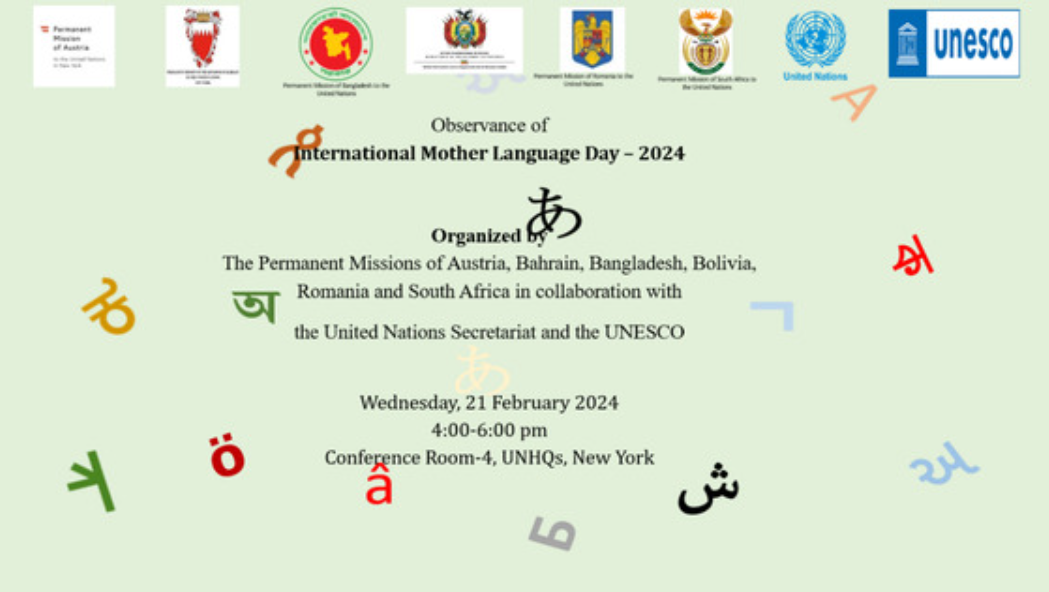
AT UNHQ -  Observance of the International Mother Language Day (IMLD) 2024.

Language serves as a powerful and unifying tool to connect people irrespective of their socio-economic and cultural differences. It transcends geographical barriers and brings people together to work for the greater cause of humanity. Thus, the power of language is universal.


- IMLD Theme Song by Sri Chinmoy Group [Amar Bhaiyer Rokte; Rangano Ekushe February]
- Welcome Remarks by H.E. Mr. Muhammad Abdul Muhith, Representative of Bangladesh Permanent Mission to the United Nations, New York
- Special Remarks by H.E. Mr. Dennis Francis,President of the United Nations General Assembly
- #musicalPerformance by the UN Chamber Music Society of the United Nations Staff Recreation Council
Panel Discussion Segment - 16:40-17:30 hrs,
- Remarks by H.E. Mr. Jamal Fares Alrowaiei, Permanent Representative of the United Nations Bahrainmission.
- Remarks by H.E. Mr. Cornel Feruță, Representative of the Permanent Mission of Romania to the United Nations
- Remarks by H.E. Mr. Diego Pary Rodríguez, Representativo de la Misión Permanente de Bolivia ante las Naciones Unidas - Oficial
- Remarks by H.E. Ms. Mathu Joyini, Permanent Representative of Permanent Mission of South Africa to United Nations
- Remarks by Mr. Stefan Pretterhofer, Deputy Permanent Representative of Permanent Mission of Austria to the UN - Vienna
- Remarks by H.E. Mr. Movses Abelian, Under-Secretary-General for
United Nations Department for General Assembly & Conference Management and UN Coordinator for Multilingualism
- Remarks by the Representative of the Secretary-General of the United Nations (TBC)
- Remarks by Eliot Minchenberg, Director, UNESCO, New York
- Remarks by the Representative of the Group of Friends of Spanish Language
- Remarks by the representatives of interested member states (based on requests made before the event)
- Remarks by CSO representative (NGO Committee on Language and Languages)
- Message from the NYC Mayor's Office

Multilingual Cultural Performance Segment, 17:30-18:00 hrs
- Performance by Sneh Art
- Poetry recitation by Sri Chinmoy Group
- Folk songs by Bangladeshi singers

Closing of the event.

WEBCAST:


Monday, 20 February 2023

International Mother Language Day 2023; February 21st.

 FORUM: " Multilingual education - a necessity to transform education." International Mother Language Day 2023.

This year edition will explore the theme ‘multilingual education - a necessity to transform education.’ It will explore and debate the potential of multilingualism totransform education from a lifelong learning perspective and in different contexts. It is shaped around the following three inter-connected themes:

 • Enhancing multilingual education as a necessity to transform education in multilingual contexts from early childhood education and well beyond; 

• Supporting learning through multilingual education and multilingualism in our fast-changing global contexts and in crisis situations including emergencies contexts; 

• Revitalizing languages that are disappearing or are threatened with extinction. 


Objectives: The overall aim of the International Mother Language Day (IMLD) 2023 is to contribute to the achievement of Sustainable Development Goal 4 by recognizing the role of actors in education and in related fields in promoting multilingualism and multilingual education, and in fostering quality, inclusive and equitable learning. 

More specifically, IMLD 2023 aims to:

 • Further sensitize actors in education, teachers, education policy-makers of the transformative power of multilingualism and multilingual education;

 • Support actors in education, teachers, education policy-makers in the strengthening of multilingualism and multilingual education by highlighting and sharing promising and innovative policies and practices.


Statement from Ms Audrey Azoulay, Director-General of UNESCO, on the occasion of International Mother Language Day 2023, February 21st.


While mother-tongue-based education is essential to the full development of individuals and to the transmission of linguistic heritage, 40% of the world's students do not have access to education in the language they speak or understand best. Such a situation severely undermines learning, cultural expression and the building of social relations, and significantly weakens the linguistic heritage of humanity. It is therefore crucial that this language issue be taken into account in the necessary exercise of transforming education, which UNESCO was supporting throughout 2022, culminating in the Transforming Education Summit, convened last September by the Secretary-General of the United Nations, António Guterres. This imperative first requires a better collection of data, which will make it possible to carry out specific and customized actions. Above all, however, it requires a more general awareness of the irreplaceable but fragile value of the world's linguistic and cultural diversity. Each of the more than 7,000 languages spoken by humanity carries within it a unique view of the world, of things and of beings, a way of thinking and feeling – so much so that each disappearance of a language constitutes an irretrievable loss. In this context, the International Decade of Indigenous Languages (2022–2032), for which UNESCO is the leading agency, is an important opportunity for the international community to mobilize in order to safeguard a major part of the world's cultural diversity. This is also the aim of this International Day: celebrating these ways of expressing the world in its multiplicity, committing to the preservation of the diversity of languages as a common heritage, and working for quality education – in mother tongues – for all.

Director-General of UNESCO.


EVENTS: The event will take place in Room (TBC), UNESCO House (Fontenoy). Interpretations will be available in English, French, Spanish. 

Morning session: Official opening and two panels on 

1) Multilingual education as a vector for transforming education and promoting gender equality and 

2) Revitalizing local languages to promotemultilingual education and transform education.

 Afternoon session: Two panels on

 1) Multilingual Education in Small Island Developing States: Challenges and Opportunities for Transformative Education and

 2) Multilingual education - a factor of change - in crisis and emergency situations. 


Target audiences 

• Key stakeholders in education, education policy-makers, teachers. 

• Non-governmental organizations, foundations and other bodies supporting multilingualism.