Showing posts with label multilingualism. Show all posts

Tuesday, 20 February 2024

International Mother Language Day 2024; February 21st.

FORUM: ”Multilingual education – a pillar of intergenational learning.” International Mother Language Day 2024. Today, 40% of the world’s population does not have access to education in a language they speak or understand. In some countries this figure rises to over 90%. Yet research shows that the use of learners’ own language(s) in schools provides a solid foundation for learning, boosts self-esteem and critical thinking skills, and opens the door for inter-generational learning, language revitalization, and the preservation of culture and intangible heritage.


Learning in one’s first language facilitates understanding and interaction, and further develops critical thinking. It strengthens self-confidence and self-esteem and stimulates active participation. In addition to boosting learning, multilingual education contributes to opening the doors to inter-generational learning, the preservation of culture and intangible heritage, and the revitalization of languages. It enriches multilingualism on the web and is essential for digital literacy. Multilingual education also helps in acquiring life skills, especially in the context of emergencies, crises and natural disasters. Thus, refugees, internally or internationally displaced people and those excluded or marginalized from quality education, such as Indigenous peoples, are not left behind. Follow the conversation with the hashtags: #IntergenerationalLearning, #IMLD2024, #MotherLanguageDay, #mothertongue; #21February, #Multilingualeducation.


EVENT

AT UNESCO HQ ; On February 21st; The symposium to mark the 25 th edition of International Mother Language Day and the International Mother Language Day 2024 will take place from 10:00 am to 13:00 pm in Room X at UNESCO House (Fontenoy). the celebration will highlight the importance of implementing multilingual education policies and practices as a pillar to the achievement of Sustainable Development Goal 4 which calls for inclusive, quality education and lifelong learning for all as well as to the objectives of the International Decade on Indigenous Languages (2022 – 2032)

Join the experts in early childhood education, literacy, informal learning and indigenous languages as they discuss how multilingual education policies and practices can be implemented to ensure inclusive, quality learning for all that enhances not only learning outcomes but the transmission of inter-generational knowledge, languages, culture and intangible heritage. This year's event at UNESCO HQ will include two panel discussions on multilingual education. 

The Panel sessions will be webcast. Interpretations will be available in English, French, Spanish. Targeted audiences include Key stakeholders in education, education policy-makers, teachers; Non-governmental organizations, foundations and other bodies supporting multilingualism. Register to participate!

AGENDA PROGRAMME


AT UNHQ -  Observance of the International Mother Language Day (IMLD) 2024.

Language serves as a powerful and unifying tool to connect people irrespective of their socio-economic and cultural differences. It transcends geographical barriers and brings people together to work for the greater cause of humanity. Thus, the power of language is universal.
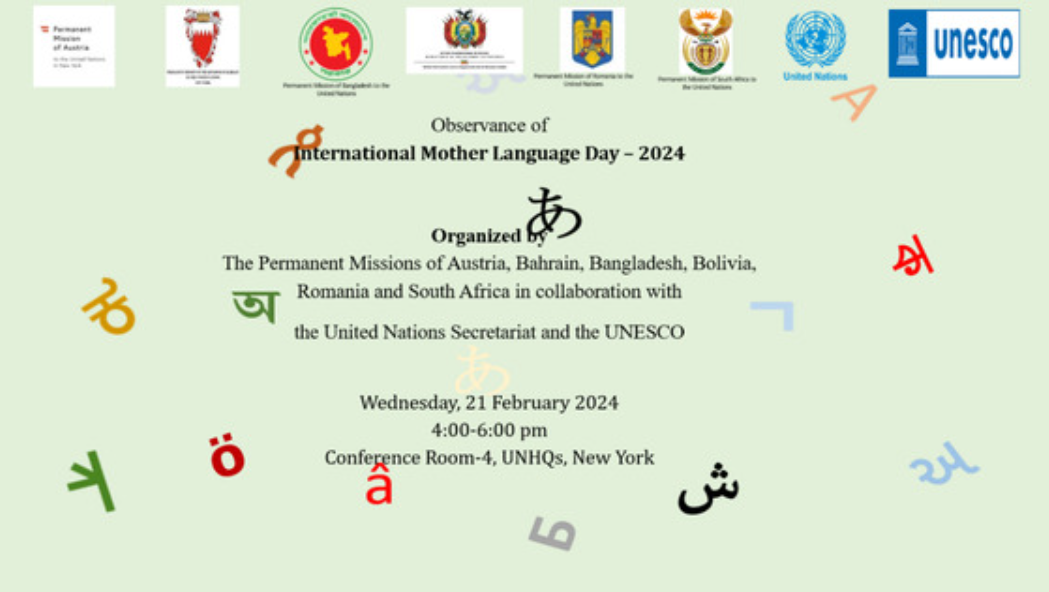


- IMLD Theme Song by Sri Chinmoy Group [Amar Bhaiyer Rokte; Rangano Ekushe February]
- Welcome Remarks by H.E. Mr. Muhammad Abdul Muhith, Representative of Bangladesh Permanent Mission to the United Nations, New York
- Special Remarks by H.E. Mr. Dennis Francis,President of the United Nations General Assembly
- #musicalPerformance by the UN Chamber Music Society of the United Nations Staff Recreation Council
Panel Discussion Segment - 16:40-17:30 hrs,
- Remarks by H.E. Mr. Jamal Fares Alrowaiei, Permanent Representative of the United Nations Bahrainmission.
- Remarks by H.E. Mr. Cornel Feruță, Representative of the Permanent Mission of Romania to the United Nations
- Remarks by H.E. Mr. Diego Pary Rodríguez, Representativo de la Misión Permanente de Bolivia ante las Naciones Unidas - Oficial
- Remarks by H.E. Ms. Mathu Joyini, Permanent Representative of Permanent Mission of South Africa to United Nations
- Remarks by Mr. Stefan Pretterhofer, Deputy Permanent Representative of Permanent Mission of Austria to the UN - Vienna
- Remarks by H.E. Mr. Movses Abelian, Under-Secretary-General for
United Nations Department for General Assembly & Conference Management and UN Coordinator for Multilingualism
- Remarks by the Representative of the Secretary-General of the United Nations (TBC)
- Remarks by Eliot Minchenberg, Director, UNESCO, New York
- Remarks by the Representative of the Group of Friends of Spanish Language
- Remarks by the representatives of interested member states (based on requests made before the event)
- Remarks by CSO representative (NGO Committee on Language and Languages)
- Message from the NYC Mayor's Office

Multilingual Cultural Performance Segment, 17:30-18:00 hrs
- Performance by Sneh Art
- Poetry recitation by Sri Chinmoy Group
- Folk songs by Bangladeshi singers

Closing of the event.

WEBCAST:


Sunday, 19 March 2023

World Poetry Day 2023; March 21st.

FORUMPoetry for Life.World Poetry Day 2023.

World Poetry Day, which takes place each year on March 21, was first declared by UNESCO during its 30th General Conference in Paris in 1999, with the aim of supporting linguistic diversity through poetic expression and increasing the opportunity for endangered languages to be heard. 


EVENTS AND POETRY READINGS

Granada City of Literature in Spain leads the Cities of Literature World Poetry Day activity each year, and in 2023 their chosen theme is “Poetry for Life.” Granada’s celebrations commence with an opening ceremony at the City Hall central court, with the attendance of the City Mayor and other authorities from the cultural sphere where three poets will perform a poetry reading. This will be followed by 90 poets reading f in the gardens of the University of Granada Law School, 18 city bookstores and the long-running Poetry Slam Granada, in which 10 poets will compete to be judged the winner by public vote.

In all, a dozen of the 42 Cities of Literature are marking World Poetry Day with programs;

Dunedin, New Zealand: Dunedin has filmed performance poet David Eggleton, New Zealand Poet Laureate 2019-22, reading his iconic poem “What the future holds,” for sharing with our friends around the city, across the country and in other UNESCO Cities of Literature.

Durban, South Africa: Durban will celebrate with a short educational cartoon audio book compiled and written by Qap’s Mngadi and Artmatem Projects and Tradings Pty LTD that is based on true life issues that reflect peer pressure and teaches youth about the dangers of drugs.

Heidelberg, Germany: Heidelberg celebrates with a variety of events, embracing readings, poetry exhibitions and lectures organized by stakeholders such as the Heidelberg Forum for Arts, private initiatives and by writers from the city and the region.

Melbourne, Australia: Celebration includes an online video series with five poets from the cities of Heidelberg and Melbourne, to celebrate the culmination of a unique online writers room, Expedition Poetry.

Milan, Italy: Milan will hold several events between March 14-25 that feature poetry performances with poets and citizens, at Fondazione Mudima and at Triennale Milano.

Nanjing, China: Nanjing Literature Hall will receive a group of student visitors from special education institutes, Nanjing School for the Blind and Nanjing School for the Deaf for a shared poetry reading.

Nottingham, England: Nottingham Playhouse, Writing East Midlands and Nottingham UNESCO City of Literature join efforts for the project “Speak Easy for World Poetry Day,” a spoken world open mic night for young writers.

Seattle: Seattle City of Literature will celebrate by hosting bilingual readings in
Spanish and English according to the theme “Poetry for life.”

Tartu, Estonia: Tartu will celebrate with a diverse program that involves different venues, age groups and audiences. The celebrations begin with poetry performances by children and youth at Tartu Literature House, including members of Tartu Poetry Theatre carrying out poetry happenings in cafés and restaurants.

Wonju, South Korea: Wonju will celebrate with written poems and promotion on the Wonju city-run Facebook. The participants will be citizens from Wonju. Each participating citizen will contribute a poem of their own creation which will be illustrated by Wonju City of Literature posted between March 17-21.

¡Dale vida a la poesía con Poetry Out Loud!


Saturday, 17 December 2022

Arabic Language Day 2022; December 18th.


FORUM: The Contribution of the Arabic Language to Human Civilization and Culture. “ Arabic Language Day 2022. Through this year’s theme UNESCO will shed a light on the numerous contributions of Arabic to humanity’s cultural and linguistic diversity, as well as to knowledge production. Follow the conversations with the hashtags: #ArabicLanguageDay, #18December, #Arabiclanguage, #Multilingualism.


EVENTS: To celebrate World Arabic Language Day 2022, UNESCO organizes round table discussions and cultural performances at UNESCO Headquarters in Paris on 16 December 2022. Applicants to the Prize for Arab culture must have contributed significantly towards the development, dissemination and the promotion of Arab culture in the world.The winners of the UNESCO-Sharjah Prize for Arab Culture will be announced.

WEBINARS:

GEOTSIRAR: Towards Strong Alliances in the Arab and African Countries on 17 November 2022 - 3:45 pm - 4:45 pm.


Knowledge for Youth-Led Climate Action in the Arab Region and youth-driven policy recommendations for Community-led Action on 17 November 2022 from 2:30 pm - 3:30 pm in Egypt.


Dialogue for Conservation Finance - A new paradigm to landscape restoration in the Arab Region on 16 November 2022 from 11:45 am - 1:15 pm. in Egypt.


Launch of CRIDA in French and Arabic; 14 November 2022 - 3:45 pm - 14 November 2022 - 4:45 pm in Egypt.


Monday, 6 June 2022

Russian Language Day 2022; June 6th.


A total of about 157.1 million people worldwide speak Russian as their mother tongue. Russian language is considered a world language and is spoken as a second language by about 60 million people in addition to native speakers. Russian belongs to the East Slavic languages of the Indo-European language family. 


Russian Language is used with other Official UN languages at United Nations Headquarters during Conferences and Plenary meetings. UN DGACM 


At U.N. Offices and Information Centres.

Celebrating Russian Language Day on 6 June, United Nations entities held a series of virtual events in New York, Geneva and Vienna, including a poetry reading, a literature recital, theatrical performances and discussions about the Russian language.


At YekaterinBurg, Russia.

Yekaterinburg is the fourth-largest city in Russia, the largest city in the Ural Federal District, and one of Russia's main cultural and industrial centres.


Thursday, 22 April 2021

English Language Day 2021; April 23


English Language Day at the UN is celebrated on 23 April, the date traditionally observed as both th birthday and date of death of William Shakespeare. The Day is the result of a 2010 initiative by the Department of Global Communications, establishing language days for each of the Organization's six official languages.

Virtual Music Performance: The UN Chamber Music Society of the United Nations Staff Recreation Council (UNCMS) presents a virtual concert in celebration of the English and Spanish Language Days at the United Nations, which will celebrate the linguistic and cultural diversity of humanity, particularly through English and Spanish language and music.


Tuesday, 20 April 2021

Chinese Language Day 2021; April 20

 FORUM: Commemorating the contribution of Cangjie, the "ancestor of Chinese characters".   Chinese Language Day 2021

On Tuesday, 20 April 2021, the UN Chamber Music Society of the United Nations Staff Recreation Council (UNCMS) will present a virtual concert in celebration of UN Chinese Language Day, which will celebrate the linguistic and cultural diversity of humanity, particularly through Chinese language and music. Chinese Language Day has been set as the "Gu Yu" of the twenty-four solar terms of the lunar calendar, to commemorate the contribution of Cangjie, the "ancestor of Chinese characters". Over the years, the UN Chinese Language Day has become a window for people to understand Chinese culture.


As music is a universal language, the concert’s all-Chinese music programme symbolizes the spiritual connection between music and the Chinese language, one of the most widely spoken languages in the world – and will provide a window for people to understand the richness of Chinese culture and way life. The ancient text of the “Tao Te Ching” states that the Tao is the eternal, changeless spirit that runs through all life and matter. It further says that the task of life is to bring ourselves into attunement with the Tao, so that we are always moving in harmony with the universe, and not in dissonance against it. The music programme will help provide inspiration to the beauty of Chinese Taoism, which treasures 3 things in human beings: compassion, economy, and humility.


Friday, 21 February 2014

International Mother Language Day 2014, February 21

Recognizing local languages enables more people to make their voices heard and take an active part in their collective fate.

Join the forum : International Mother Language Day, February 21

United Nations Secretary-General's message for International Mother Language Day, February 21

International Mother Language Day celebrates linguistic and cultural diversity alongside multilingualism as a force for peace and sustainable development.

As we work towards achieving the Millennium Development Goals while mapping out a post-2015 sustainable development agenda, this diversity can encourage dialogue, mutual understanding, innovation and creativity. This in turn can help us build more just and inclusive societies. As the late President Nelson Mandela once said, "If you talk to a man in a language he understands, that goes to his head. If you talk to him in his language, that goes to his heart".

The theme of this year’s observance spotlights the vital role of local languages in advancing science.  This will help ensure that the latest scientific knowledge is more widely shared.  At the same time, it will help deepen and enrich our global knowledge base with more traditional but often overlooked scientific wisdom.
Let us all join forces to promote linguistic diversity and multilingualism as a key element in our efforts to build a better world and a life of dignity for all.

Ban Ki mooon

Local languages for global citizenship: spotlight on science


 International Mother Language Day celebrates linguistic and cultural diversity alongside multilingualism as a force for peace and sustainable development, United Nations officials said today, marking the commemoration by calling on countries to promote and protect local languages, “which are keys to global citizenship and authentic mutual understanding.” “Recognizing local languages enables more people to make their voices heard and take an active part in their collective fate,” said Irina Bokova, Director-General of the UN Educational, Cultural and Scientific Organization (UNESCO), which in its work promotes the harmonious coexistence of the 7,000 languages spoken worldwide
.
The International Day was proclaimed by the UNESCO General Conference in 1999. In 2007, the UN General Assembly adopted a resolution calling on Member States “to promote the preservation and protection of all languages used by peoples of the world”. By the same text, the Assembly proclaimed 2008 as the International Year of Languages, to promote unity in diversity and international understanding, through multilingualism and multiculturalism.


The 2014 International Day, on the theme “Local languages for global citizenship: spotlight on science”, shows how languages ensure access to knowledge, its transmission and its plurality. “Contrary to popular wisdom, local languages are perfectly capable of transmitting the most modern scientific knowledge in mathematics, physics, technology, and so on,” said Ms. Bokova in her message.

English - IMLD2014 - Message from the UNESCO Director-General


“Recognizing these languages also means opening the door to a great deal of often overlooked traditional scientific knowledge to enrich our overall knowledge base,” she continued, adding that local languages constitute the majority of languages spoken worldwide in the field of science. They are also the most endangered.
“Excluding languages means excluding those who speak them from their fundamental human right to scientific knowledge,” Ms. Bokova said, stressing that in today’s “global village” the norm is to use at least three languages, including one local language, one language of wider communication and one international language to communicate at both the local and global levels.
“This linguistic and cultural diversity may be our best chance for the future: for creativity, innovation and inclusion. We must not squander it,” she declared.


In his message, Secretary-General Ban ki-moon said the theme of the International Day will help ensure that the latest scientific knowledge is more widely shared. “At the same time, it will help deepen and enrich our global knowledge base with more traditional but often overlooked scientific wisdom,” he added.
“Let us all join forces to promote linguistic diversity and multilingualism as a key element in our efforts to build a better world and a life of dignity for all,” the UN chief said, adding that language diversity can encourage dialogue, mutual understanding, innovation and creativity. This in turn can help us build more just and inclusive societies.
Quoting the late South African leader Nelson Mandela, he said: ‘If you talk to a man in a language he understands, that goes to his head. If you talk to him in his language – that goes to his heart’.

Resources :